





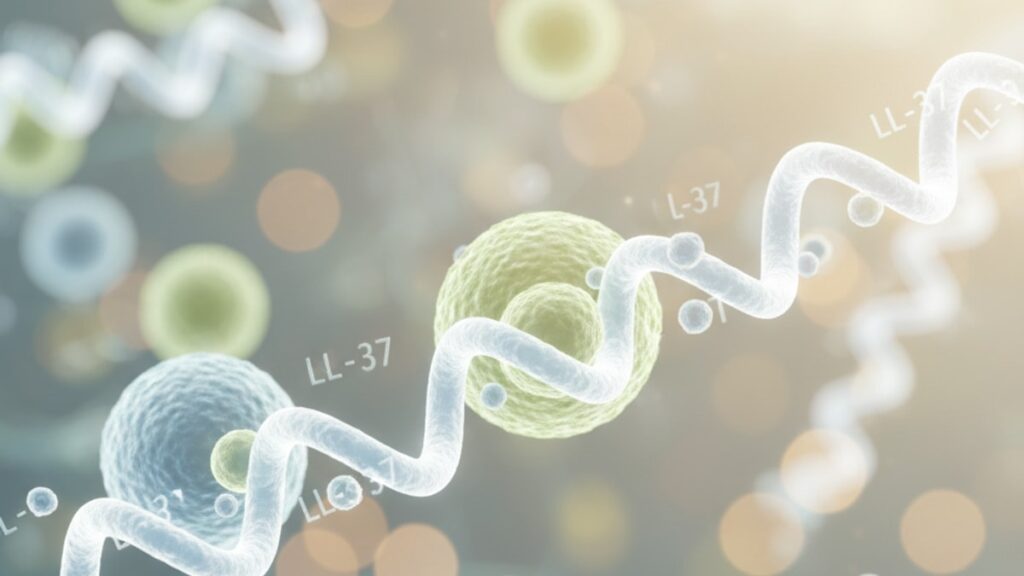
Our bodies are engaged in a relentless, silent war. Every single day, we're exposed to a sprawling universe of bacteria, viruses, and fungi. Most of the time, we don't even notice. That's thanks to an incredibly sophisticated, multi-layered defense system known as our immune system. While many of us are familiar with the adaptive immune system—the part that creates antibodies and remembers specific invaders—there's a more ancient, frontline defense that does much of the heavy lifting. This is the innate immune system.
And within that system, there are powerful molecules acting as the first responders. One of the most fascinating and researched of these is a peptide called LL-37. If you're in the field of biological research, you've likely come across it. But what is LL-37 peptide, really? It's more than just another sequence of amino acids. It’s a cornerstone of our intrinsic defense, a molecule with a complex, multifaceted job description that science is still working to fully understand. Here at Real Peptides, our team has spent years focused on synthesizing high-purity peptides for research, and LL-37 remains one of the most compelling compounds we work with. It represents a beautiful piece of biological engineering, and its potential applications are truly staggering.
So, What Exactly Is LL-37?
Let's break it down. At its core, LL-37 is an antimicrobial peptide (AMP). It’s a specific type of AMP known as a cathelicidin, and what's remarkable is that it's the only cathelicidin found in humans. The name itself is a simple blueprint of its structure: "LL" refers to the first two amino acids in its sequence—two leucine residues—and "37" denotes that the entire peptide chain is composed of 37 amino acids.
Simple, right?
But its simplicity is deceptive. This 37-amino-acid chain is one of our body's most effective natural antibiotics. It's produced by various cells, including neutrophils (a type of white blood cell) and epithelial cells that line our skin, gut, and respiratory tract. Think of these locations. They are the primary barriers between us and the outside world. It makes perfect sense that our bodies would station their best guards right at the gate. When these barriers are breached or threatened, LL-37 is deployed to neutralize the threat quickly and efficiently. It’s a first responder, a sentry, and a cleanup crew all rolled into one.
The Origin Story: How Our Bodies Make LL-37
LL-37 doesn't just float around in its active form waiting for trouble. That would be biologically inefficient and potentially problematic. Instead, it’s produced on an as-needed basis from an inactive precursor protein called hCAP18 (human cationic antimicrobial protein 18). This precursor is stored inside neutrophils and other cells, like a fire extinguisher waiting to be activated.
When your body detects signs of infection or injury—things like bacterial cell wall components or inflammatory signals—it triggers an enzymatic reaction. An enzyme called proteinase 3 cleaves the hCAP18 protein, snipping off the active LL-37 fragment. This process is incredibly elegant. It ensures that this potent, membrane-disrupting peptide is only released precisely where it's needed, minimizing potential damage to the host's own cells. Our team has always been fascinated by these elegant biological processes. The precision is remarkable, and it's a standard we strive to emulate in our own synthesis work.
This targeted deployment is a critical feature. It means that concentrations of LL-37 can become very high at a site of infection or a wound, allowing it to overwhelm pathogens effectively. It's not a systemic flood; it's a targeted strike.
The Primary Mission: A Formidable Antimicrobial Agent
LL-37’s claim to fame is its potent, broad-spectrum antimicrobial activity. We're not just talking about one or two types of bacteria. It's effective against a wide array of pathogens:
- Gram-Positive Bacteria: Including tough ones like Staphylococcus aureus.
- Gram-Negative Bacteria: Such as Escherichia coli and Pseudomonas aeruginosa.
- Fungi: Including species like Candida albicans.
- Viruses: It can disrupt the envelopes of certain viruses, hindering their ability to infect cells.
The mechanism behind this destructive power is primarily biophysical. LL-37 is a cationic peptide, meaning it has a net positive charge. Microbial membranes, on the other hand, are typically rich in negatively charged molecules. This creates an electrostatic attraction. Opposites attract, and in this case, the attraction is fatal for the microbe.
Once LL-37 binds to the microbial surface, it inserts itself into the membrane. As more peptide molecules accumulate, they disrupt the membrane's integrity, forming pores or channels. This causes the cell's contents to leak out, leading to a rapid and irreversible cell death. It’s the biological equivalent of punching holes in a fortress wall until it collapses. This direct, physical mechanism of action is a key reason why it's so difficult for bacteria to develop resistance to LL-37, a stark contrast to the challenges we face with conventional antibiotics.
Beyond Germs: LL-37's Sprawling Immunomodulatory Roles
If LL-37 only killed microbes, it would still be an incredibly important peptide. But its functions are far more nuanced and sprawling. This is where the research gets really interesting. We can't stress this enough: context is everything with peptides like LL-37. It’s not just a killer; it’s a director, a conductor of the immune response.
One of its most critical secondary roles is immunomodulation. It acts as a signaling molecule, effectively calling for backup. It can attract other key immune cells, like neutrophils, monocytes, and T cells, to the site of infection—a process known as chemotaxis. It’s essentially sending out a flare signal that says, "The fight is over here!"
But wait, there's more to understand. LL-37 is also deeply involved in wound healing. Our experience shows this is one of the most promising areas of study. The peptide promotes angiogenesis, which is the formation of new blood vessels, a critical step in tissue repair. It also encourages the proliferation and migration of keratinocytes, the main cells that make up our skin's outer layer, helping to close wounds faster. This dual action—clearing infection and promoting repair—makes it a uniquely powerful agent in tissue regeneration contexts.
Now, this is where it gets interesting. LL-37 can also modulate inflammation. This might sound contradictory, but it showcases the peptide's sophistication. In the initial phase of an infection, it can promote a pro-inflammatory response to help clear the pathogens. However, it can also help resolve inflammation once the threat is neutralized, preventing the kind of chronic, damaging inflammation that underlies so many diseases. Its ability to bind to and neutralize bacterial components like lipopolysaccharide (LPS) is a key part of this anti-inflammatory effect.
This complexity, however, reveals a double-edged sword. When the LL-37 system is dysregulated, it can contribute to autoimmune diseases. In conditions like psoriasis, for example, LL-37 can complex with the body's own DNA, triggering an inappropriate immune response that leads to the characteristic skin lesions. This highlights the delicate balance our bodies must maintain and underscores why rigorous, controlled research is so essential.
Why Researchers Are So Focused on LL-37
The multifaceted nature of LL-37 makes it a hot topic in countless research fields. From dermatology to infectious disease and immunology, scientists are exploring its potential. For any researcher investigating these complex biological pathways, having access to a pure, reliable source of LL-37 is a non-negotiable element. The integrity of your data, and indeed the validity of your conclusions, depends entirely on the integrity of the materials you use.
Let’s be honest, this is crucial. When you're studying cellular signaling or dose-dependent responses, you need to be absolutely certain that the effects you're observing are from the peptide itself, not from impurities or synthesis byproducts. This is where our meticulous small-batch synthesis process makes a tangible difference. By ensuring exact amino-acid sequencing and achieving purity levels consistently above 98%, we provide researchers with the confidence they need to produce reproducible, high-impact results.
This commitment to quality isn't just about one product; it's a philosophy that applies across our full range of peptides for research. We've seen firsthand how a high-purity compound can unlock new discoveries, while a substandard one can send a research project down a dead-end path. It's a responsibility we take very seriously.
| Feature | LL-37 (Cathelicidin) | Beta-Defensins | BPC-157 |
|---|---|---|---|
| Primary Source | Cleaved from hCAP18 in neutrophils, epithelial cells | Epithelial cells, immune cells | Synthetic, derived from a gastric protein |
| Main Function | Antimicrobial, Immunomodulatory, Wound Healing | Primarily Antimicrobial, Chemotactic | Cytoprotective, Angiogenic, Tissue Repair |
| Mechanism | Membrane disruption, Receptor binding | Membrane disruption, Cell signaling | Modulates growth factor pathways, Angiogenesis |
| Immune Role | Direct killing & immune cell recruitment | Direct killing & signaling | Primarily tissue repair; indirect immune effects |
| Research Focus | Infectious disease, dermatology, wound healing | Mucosal immunity, inflammatory conditions | Tissue regeneration, gut health, injury recovery |
The Purity Problem: A Critical Hurdle in Peptide Research
Synthesizing a peptide is a complex chemical process. Synthesizing a 37-amino-acid peptide like LL-37 with impeccable accuracy is a formidable challenge. Each amino acid must be added in the correct sequence, and the bonds between them must be perfect. Any error—a deleted amino acid, a swapped position, or residual chemicals from the synthesis process—can result in a final product that is functionally useless or, worse, produces confounding results.
We've seen it happen. Weeks, even months, of research can be wasted because of a low-purity peptide. A researcher might observe an unexpected cellular response and spend valuable time investigating what they believe is a novel biological effect of LL-37, only to discover later that the response was caused by an unknown contaminant in their vial. It's a catastrophic and entirely avoidable scenario.
This is why we are so unflinching in our commitment to quality control. Every batch of peptide we produce, including our research-grade LL-37, undergoes rigorous analysis to confirm its sequence and purity. We believe that providing researchers with a reliable, consistent, and ultra-pure product is the most fundamental contribution we can make to the advancement of science. It’s the bedrock of good research.
Handling and Reconstitution: Practical Advice for the Lab
Having the best peptide in the world doesn't matter if it's not handled correctly in the lab. For researchers new to working with LL-37, our team has some practical recommendations based on our experience.
LL-37 is typically shipped as a lyophilized (freeze-dried) white powder. This form is highly stable and ideal for long-term storage. We recommend storing the lyophilized peptide at -20°C for maximum shelf life. Keep it sealed and protected from moisture until you're ready to use it.
When you're ready to begin your experiment, you'll need to reconstitute it. This is the process of dissolving the powder into a liquid solution. The choice of solvent is critical. For most applications, using sterile, distilled water is appropriate. However, depending on your specific assay, you might need a particular buffer. It's crucial to dissolve the peptide gently. Don't shake the vial vigorously, as this can cause the peptide to degrade or aggregate. Instead, gently swirl or pipette the solution up and down.
Once reconstituted, the peptide solution is far less stable than its lyophilized form. It's best to aliquot the solution into smaller, single-use volumes and store them frozen. This prevents repeated freeze-thaw cycles, which can significantly reduce the peptide's activity over time. Following these simple handling procedures ensures that the peptide you introduce into your experiment is as active and potent as it was the day it was synthesized.
LL-37 is a testament to the power and elegance of our own biology. It’s a molecule that defends, repairs, and communicates, playing a central role in maintaining the delicate balance of our health. As research continues to unravel its complex mechanisms and vast potential, it promises to open new doors in medicine and biology. For the scientific community, the journey to understanding peptides like LL-37 is just beginning, and we're proud to provide the high-quality tools needed to make that journey a success. If you're ready to see what high-purity peptides can bring to your research, you can Get Started Today.
Frequently Asked Questions
What’s the difference between LL-37 and its precursor hCAP18?
▼
hCAP18 is the inactive storage form of the peptide. The active LL-37 fragment is created only when an enzyme cleaves hCAP18, typically at a site of infection or inflammation. This ensures LL-37 is released only where it’s needed.
Is LL-37 considered an antibiotic?
▼
Yes, it’s often referred to as a natural or endogenous antibiotic. As an antimicrobial peptide (AMP), it has broad-spectrum activity against bacteria, fungi, and some viruses, functioning as a key part of the innate immune system.
Why is the positive charge of LL-37 so important?
▼
The net positive (cationic) charge is crucial for its primary antimicrobial function. It creates an electrostatic attraction to the negatively charged membranes of microbes, allowing the peptide to bind to and disrupt them, leading to cell death.
Can LL-37 be harmful?
▼
While essential for immunity, dysregulation of LL-37 can be problematic. In certain autoimmune conditions like psoriasis and lupus, excessive or misplaced LL-37 activity is believed to contribute to the inflammatory pathology by triggering an inappropriate immune response.
What is the significance of the ‘LL’ in LL-37?
▼
The ‘LL’ simply refers to the first two amino acids in the peptide’s 37-amino-acid sequence. Both are leucine residues, providing a convenient shorthand for identifying the molecule.
How does LL-37 contribute to wound healing?
▼
LL-37 plays a dual role in wound healing. It helps clear the wound of potential pathogens and also actively promotes tissue repair by stimulating the growth of new blood vessels (angiogenesis) and encouraging the migration of skin cells (keratinocytes) to close the wound.
What type of research is LL-37 primarily used for?
▼
Researchers use LL-37 across many fields, including immunology, infectious disease, dermatology, and studies on wound healing. Its complex roles as both an antimicrobial and an immunomodulatory agent make it a valuable tool for understanding these processes.
Why is peptide purity crucial for LL-37 studies?
▼
Purity is paramount because impurities or incorrect sequences can produce misleading or confounding results in sensitive biological assays. For reliable and reproducible data, researchers must use a highly pure compound to ensure observed effects are due to LL-37 itself.
How should lyophilized LL-37 be stored for research?
▼
Lyophilized (freeze-dried) LL-37 should be stored at -20°C in a sealed container to protect it from moisture. This ensures maximum stability and shelf-life before it’s reconstituted for experimental use.
Does LL-37 only work on bacteria?
▼
No, its activity is broad-spectrum. While it is highly effective against both Gram-positive and Gram-negative bacteria, research has also shown it to have activity against various fungi and certain types of enveloped viruses.
Is LL-37 related to other peptides like BPC-157?
▼
While both are peptides studied for healing, they are fundamentally different. LL-37 is an antimicrobial and immunomodulatory peptide from the cathelicidin family, while a compound like [BPC 157](https://www.realpeptides.co/products/bpc-157-peptide/) is a synthetic peptide fragment derived from a gastric protein, primarily studied for its cytoprotective and regenerative properties.
How is synthetic LL-37 produced for research?
▼
Synthetic LL-37 is produced through a process called solid-phase peptide synthesis (SPPS). This method involves sequentially adding amino acids one by one to build the correct 37-amino-acid chain, followed by purification to remove impurities.











