




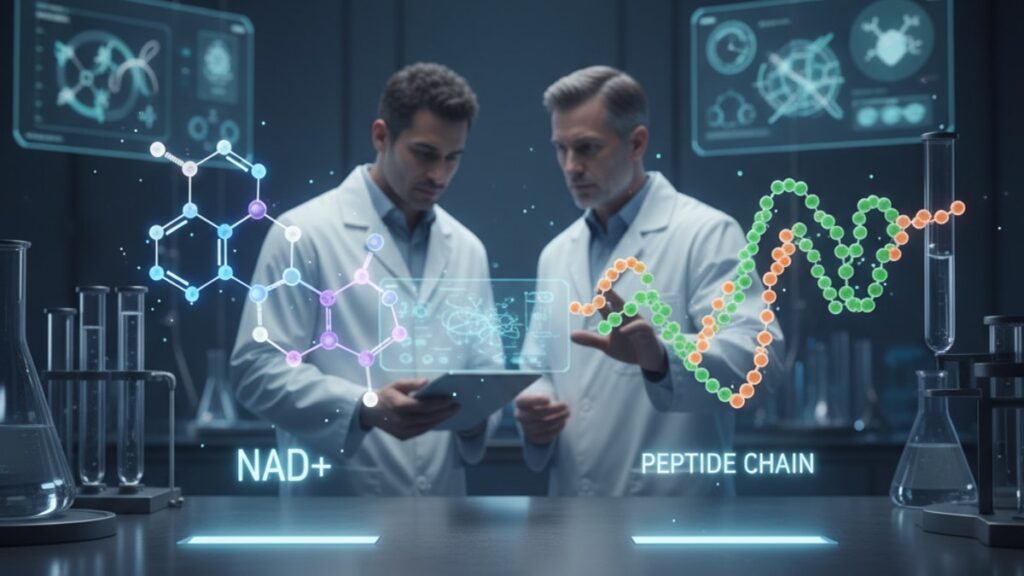
We get this question a lot. In forums, during consultations, and from new researchers navigating the sprawling landscape of cellular biology. The query is simple: is NAD+ a peptide? It seems straightforward, but the confusion is understandable, especially given how both peptides and NAD+ have become central figures in conversations about longevity, cellular health, and performance. Let's be direct: the answer is an unequivocal no. They aren't even in the same biochemical family.
Understanding this distinction isn't just about academic nitpicking. For a research-focused organization like ours, precision is everything. The success of a study—and the validity of its data—hinges on knowing exactly what molecule you're working with, how it functions, and why it's different from others. Conflating a coenzyme like NAD+ with a signaling molecule like a peptide can lead to flawed experimental design and, frankly, wasted resources. Our team at Real Peptides is dedicated to providing impeccably pure, research-grade compounds, and that mission starts with fostering a deep, unambiguous understanding of the science itself.
So, What Exactly is a Peptide?
Before we can truly appreciate why NAD+ is different, we need a rock-solid grasp of what a peptide is. It all starts with amino acids. Think of them as molecular LEGOs. There are 20 common types, and when you link them together, you create a chain. The specific bond that connects one amino acid to the next is called a peptide bond.
That's it. Simple, right?
A molecule is classified as a peptide if it consists of two or more amino acids linked by these specific bonds. The length of the chain determines its more specific name:
- Dipeptide: Two amino acids.
- Tripeptide: Three amino acids.
- Polypeptide: A long, continuous chain of amino acids.
When a polypeptide chain gets really long and folds into a complex, functional 3D structure, we generally start calling it a protein. So, you can think of peptides as short proteins or protein fragments. Their function is dictated entirely by their sequence—the specific order of the amino acids in the chain. This sequence is like a code that tells the peptide what to do, which receptors to bind to, and what biological message to deliver. It's an information molecule. For instance, the renowned research peptide BPC 157 Peptide has a very specific 15-amino-acid sequence that is believed to be the source of its biological activity. Change even one amino acid, and you could dramatically alter or completely nullify its function. This is why, at Real Peptides, we emphasize small-batch synthesis; it allows for meticulous control over the exact amino-acid sequencing, ensuring the final product is precisely what your research demands.
Now, Let's Unpack NAD+
Now, let's switch gears completely. Forget amino acids. Forget peptide bonds. They have absolutely nothing to do with NAD+.
NAD+ stands for Nicotinamide Adenine Dinucleotide. The name itself tells you everything you need to know. It’s a dinucleotide, meaning it's made of two nucleotides joined together. What are those two nucleotides? Nicotinamide and Adenine. These are linked through their phosphate groups. There isn't a single amino acid in its structure.
So, what does it do? NAD+ is a coenzyme. Our team often explains it as the cell's primary rechargeable battery or an electron shuttle. It plays a critical, non-negotiable role in metabolism. In its oxidized form (NAD+), it can accept electrons from other molecules. When it does, it becomes its reduced form, NADH. NADH can then travel to another part of the cell (like the mitochondria) and donate those electrons, turning back into NAD+ and releasing energy in the process. This cycle—the NAD+/NADH redox couple—is fundamental to creating ATP, the energy currency of life.
Its job is not to deliver a specific message to a receptor like a peptide does. Its job is to facilitate countless biochemical reactions by moving electrons around. It's a foundational component of cellular machinery, essential for:
- Energy Production: Driving the Krebs cycle and oxidative phosphorylation.
- DNA Repair: It's a required substrate for enzymes called PARPs that are critical for repairing damaged DNA.
- Gene Expression: It regulates proteins called sirtuins, which play a major role in controlling gene expression related to aging and stress resistance.
Its function is purely chemical and enzymatic. It's a worker molecule, not a messenger molecule in the way a peptide is.
The Direct Answer: Why NAD+ is NOT a Peptide
We've laid the groundwork, so let's make this crystal clear. The two molecules belong to completely different classes of biomolecules. It’s like asking if a brick is a wire. Both are used in building a house, but they are made of different materials and serve entirely different functions. One provides structure, the other conducts electricity. The same logic applies here.
Here's what we've learned is the most effective way to visualize the difference:
| Feature | Peptides | NAD+ (Nicotinamide Adenine Dinucleotide) |
|---|---|---|
| Building Blocks | Amino Acids | Nucleotides (Adenine & Nicotinamide) |
| Connecting Bonds | Peptide Bonds | Phosphodiester Bonds |
| Molecular Class | Polypeptide / Protein Fragment | Dinucleotide / Coenzyme |
| Primary Function | Signaling, Structural, Hormonal | Redox Reactions, Electron Carrier, Enzyme Cofactor |
| Example | GHK-CU Copper Peptide | NAD+ 100mg |
This table cuts through the noise. The building blocks are different. The bonds holding them together are different. Their entire biological purpose is different. This isn't a subtle distinction; it's a fundamental chasm in biochemistry.
Why Does This Confusion Even Exist?
Frankly, we see this question a lot, and it's worth exploring why. If they are so different, why do people group them together? Our experience shows it boils down to a few key factors.
First, there's the convergence of research interests. Both peptides and NAD+ are red-hot topics in the fields of longevity, regenerative medicine, and human performance. When researchers and enthusiasts discuss cellular optimization, names like Epithalon Peptide (a research peptide studied for its connection to telomeres) and NAD+ often appear in the same article or presentation. This topical overlap creates a kind of mental association, even if the mechanisms are worlds apart.
Second is the similarity in administration methods for research. Many peptides and NAD+ are administered parenterally (via injection) in laboratory settings to ensure direct bioavailability and precise dosing. When multiple compounds share a delivery route, they can become mentally categorized together. It's a simple human shortcut that, in this case, creates a scientific inaccuracy.
Third, and we can't stress this enough, is the influence of oversimplified marketing language. In the broader wellness and "biohacking" communities, complex biochemicals are often lumped under umbrella terms like "anti-aging molecules" or "cellular enhancers." This kind of marketing prioritizes accessible concepts over scientific precision, blurring the lines between distinct molecular classes. It's a disservice to the science and to the researchers working diligently to understand these pathways.
Finally, the names themselves can be intimidating. "Nicotinamide Adenine Dinucleotide" and "Body Protection Compound 157" don't exactly roll off the tongue. When faced with complex terminology, it's natural for the brain to seek patterns and group things that sound similarly scientific. It's an understandable shortcut, but one that researchers must consciously avoid.
The Critical Importance of Molecular Precision in Research
Okay, so they're different. Why does it matter so much? It matters because your research hypothesis depends on it.
When you design an experiment with a peptide, you're likely investigating a signaling cascade. You're asking: what happens when this specific amino acid sequence binds to its target receptor? Does it upregulate a specific gene? Does it trigger the release of a certain hormone? Your entire experimental model is built around the concept of a key (the peptide) fitting into a lock (the receptor). If you were to swap in NAD+, the experiment would fail. Not because NAD+ is ineffective, but because you've brought a battery to a job that requires a key. It's the wrong tool entirely. It doesn't have the structure to bind to a peptide receptor.
Conversely, if your research is focused on cellular respiration or the activity of sirtuin enzymes, NAD+ is your tool. You're investigating energy metabolism and epigenetic regulation. Using a peptide like Sermorelin, which signals the pituitary gland, would be nonsensical in this context. It doesn't participate in redox reactions. It can't fuel PARP enzymes.
This is the core of our philosophy at Real Peptides. We believe that groundbreaking research is built on a foundation of absolute purity and precision. Whether you're studying the signaling potential of a complex peptide or the metabolic impact of our high-purity NAD+ 100mg, you must have unwavering confidence in the identity and quality of your compound. A misidentified or contaminated substance doesn't just produce bad data; it undermines the entire scientific process. That's a catastrophic, moving-target objective that no lab can afford.
Exploring Synergies: How Peptides and NAD+ Pathways Interact
Now, this is where it gets interesting. Just because they are different doesn't mean their pathways are isolated. In the incredibly complex ecosystem of the cell, their functions can be complementary and interconnected. This is where the most exciting research is heading.
Think about it. Many peptides, like the components of our Wolverine Peptide Stack, are involved in processes like tissue repair and regeneration. What is tissue repair? It's an incredibly energy-intensive process. Cells need to divide, synthesize new proteins, and clean up damage. All of this activity requires a massive amount of ATP. And where does that ATP come from? It comes from metabolic pathways that are fundamentally dependent on the NAD+/NADH cycle.
So, you could hypothesize that having robust NAD+ levels is essential for a cell to carry out the instructions delivered by a regenerative peptide. A peptide can send the signal to rebuild, but the cell needs the NAD+-driven energy to actually do the construction work. They work in concert. One is the blueprint, the other is the power supply.
Another fascinating area is mitochondrial health. Some research peptides, such as Mots-C Peptide, are known as mitochondrial-derived peptides and are studied for their role in regulating metabolic homeostasis. Since mitochondria are the primary hubs of NAD+-dependent energy production, it's easy to see how these two worlds could intersect. A peptide that improves mitochondrial efficiency could potentially enhance the effectiveness of the existing NAD+ pool. This is a nuanced, symbiotic relationship that underscores the brilliance of cellular biology.
Understanding these potential synergies allows for more sophisticated experimental design. It moves beyond studying molecules in isolation and toward understanding them as part of a dynamic, interconnected system. That's the future.
Choosing the Right Compound for Your Research
So how do you, as a researcher, choose the right path for your study? It all comes back to your central question.
Ask yourself: Am I studying a specific signaling pathway? If your research involves hormone release, cell surface receptors, or the transmission of a specific biological message, you are firmly in the world of peptides. Your work will involve selecting a peptide with a known sequence and target, such as Ipamorelin for growth hormone secretagogue receptor studies or PT-141 Bremelanotide for melanocortin receptor research. The precision of that sequence is paramount.
Or, ask yourself: Am I studying core cellular machinery? If your research involves metabolic rate, mitochondrial function, DNA repair mechanisms, or the global effects of caloric restriction mimetics, then NAD+ and its precursors are your primary tools. You're not targeting a single receptor; you're influencing a foundational process that affects nearly every cell in the organism.
Our commitment at Real Peptides is to support both avenues of inquiry with the highest possible standards of quality. We've built our reputation on the impeccable purity of our vast collection of all peptides, and we apply that same rigorous standard to our other research compounds. We believe that by providing reliable, verifiable tools, we empower the discoveries that will define the next generation of science.
Navigating this complex field requires a partner you can trust. A partner who understands the science as deeply as you do. If you're ready to build your next study on a foundation of unshakeable quality, we invite you to explore our catalog and Get Started Today.
Ultimately, the distinction between NAD+ and peptides is more than a simple definition. It's a guiding principle for effective research. Knowing the difference protects the integrity of your work and unlocks a more profound understanding of the intricate dance of life happening inside every cell.
Frequently Asked Questions
To be clear, is NAD+ a peptide or a protein?
▼
Neither. NAD+ is a dinucleotide, a completely different class of molecule from peptides and proteins, which are made of amino acids. Its function is as a coenzyme in metabolic reactions.
What is the key difference between a peptide bond and the bonds in NAD+?
▼
A peptide bond specifically links amino acids together to form a peptide chain. NAD+ contains no amino acids or peptide bonds; its components (nucleotides) are linked by phosphodiester bonds.
Are NAD+ precursors like NMN or NR considered peptides?
▼
No, they are not. Nicotinamide mononucleotide (NMN) and nicotinamide riboside (NR) are nucleotide precursors to NAD+. Like NAD+ itself, they are not composed of amino acids.
Why is NAD+ sometimes called a ‘helper molecule’?
▼
That term refers to its role as a coenzyme. NAD+ ‘helps’ enzymes carry out their functions by accepting or donating electrons during biochemical reactions, which is essential for processes like energy production.
Can taking peptides increase my NAD+ levels?
▼
There is no direct mechanism by which most peptides would increase NAD+ synthesis. However, peptides that support overall cellular health or mitochondrial function could indirectly support an environment where NAD+ cycles operate more efficiently.
Does Real Peptides test its NAD+ for purity?
▼
Absolutely. Just as we rigorously test our peptides for correct amino-acid sequencing and purity via HPLC-MS analysis, we ensure all our research compounds, including NAD+, meet the highest standards for quality and purity.
What is the main function of a peptide compared to NAD+?
▼
Generally, a peptide’s main function is to act as a signaling molecule, binding to a specific receptor to trigger a downstream biological effect. In contrast, the main function of NAD+ is to act as an electron carrier in metabolic redox reactions.
Could a molecule contain both peptide bonds and a nucleotide structure?
▼
While theoretically possible to synthesize such a hybrid molecule in a lab, they do not typically exist in this simple form in biology. Proteins can be modified with other groups, but the fundamental structures of peptides and nucleotides are distinct.
Why is it important for my research to use pure NAD+?
▼
Purity is paramount because contaminants can introduce confounding variables into your experiment, leading to unreliable or incorrect data. Using high-purity NAD+, like that from Real Peptides, ensures your results are attributable to the compound itself.
If I’m studying anti-aging, should I research peptides or NAD+?
▼
Both are valid and exciting areas of longevity research. Your choice depends on your specific hypothesis. If you’re studying hormonal signaling cascades related to aging, peptides are key. If you’re studying metabolic decline and DNA repair, NAD+ is central.
Are there any peptides that directly bind to NAD+?
▼
Peptides do not bind to NAD+ in the way they bind to a cell-surface receptor. However, many enzymes that use NAD+ as a coenzyme are proteins (long peptides), so in that sense, NAD+ interacts with amino acid chains within an enzyme’s active site.
Can NAD+ be absorbed orally like some small peptides?
▼
The oral bioavailability of NAD+ itself is generally considered to be very low. This is why research often focuses on its precursors, NMN and NR, which are more readily absorbed and converted into NAD+ within the cells.











