





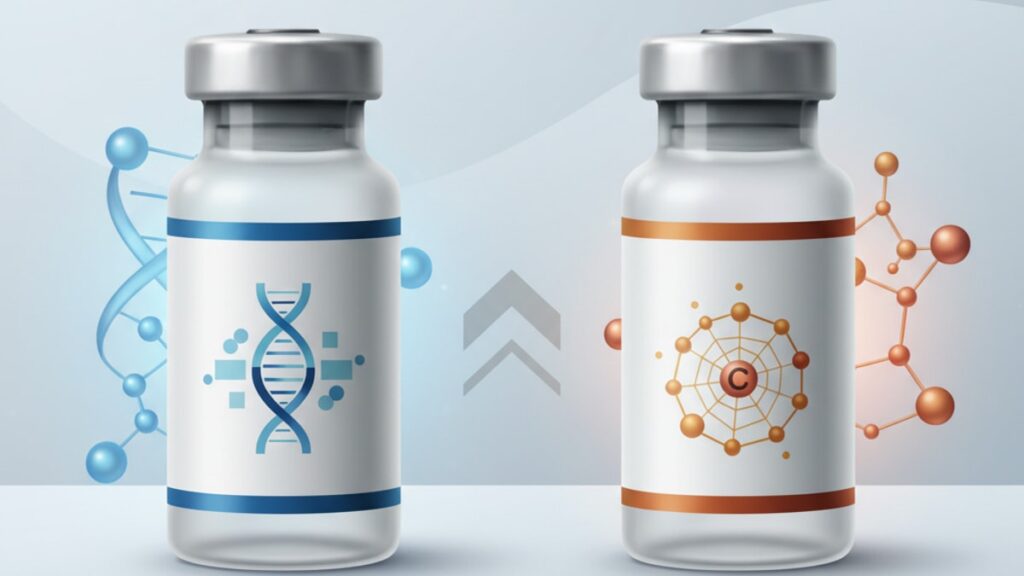
The landscape of peptide research is, without a doubt, a dynamic and profoundly exciting one. As we push deeper into 2026, two compounds consistently emerge at the forefront of discussions concerning regeneration, recovery, and overall physiological optimization: BPC-157 and GHK-Cu. Researchers often find themselves at a crossroads, pondering the nuanced differences and specific applications of each. This isn't just about choosing a peptide; it's about making an informed decision that aligns precisely with your research objectives. We understand the gravitas of this choice, and our team at Real Peptides is here to provide clarity on the enduring debate of BPC-157 vs GHK-Cu.
It’s becoming increasingly challenging to navigate the sheer volume of information available, particularly when seeking high-purity, research-grade compounds. That's precisely why we've dedicated ourselves to synthesizing peptides with exact amino-acid sequencing, ensuring the reliability you need for groundbreaking work. When considering BPC-157 vs GHK-Cu, it's not a question of 'which is better' in a general sense, but rather 'which is better for your specific research question.' Each peptide possesses a unique profile and mechanism of action, making a direct, apples-to-apples comparison difficult without understanding their individual strengths.
Unpacking BPC-157: The Body Protection Compound
Let’s start with BPC-157. This gastric pentadecapeptide, originally isolated from human gastric juice, has garnered significant attention for its remarkable regenerative and protective properties across various physiological systems. Our team has found that its versatility is truly impressive, extending far beyond initial expectations. It's often referred to as a 'body protection compound' for good reason; its influence seems to span wound healing, organ protection, and even neurological support. When we discuss BPC-157 vs GHK-Cu, BPC-157 often stands out for its direct impact on tissue repair.
What makes BPC-157 so compelling for researchers? Its mechanism of action is multifaceted. We've seen compelling evidence suggesting it influences growth factors, particularly vascular endothelial growth factor (VEGF), which is critical for angiogenesis—the formation of new blood vessels. This, in turn, is a fundamental process in wound healing and tissue regeneration. Moreover, BPC-157 appears to modulate nitric oxide (NO) systems, contributing to its protective effects on the gastrointestinal tract and potentially influencing blood pressure regulation. This broad spectrum of activity makes BPC-157 10mg a cornerstone for studies focused on comprehensive recovery.
Our experience shows that researchers often look to BPC-157 for studies involving:
- Tendon and Ligament Repair: Many preclinical models have explored its ability to accelerate the healing of injured tendons and ligaments, a significant, sometimes dramatic shift from traditional recovery timelines.
- Gastrointestinal Health: Given its origin, it's no surprise that BPC-157 exhibits potent gastroprotective effects, aiding in the healing of ulcers, inflammatory bowel conditions, and even potentially mitigating NSAID-induced damage.
- Nervous System Recovery: There's an emerging body of research investigating BPC-157's neuroprotective properties, suggesting potential roles in recovering from brain injuries or mitigating neurotoxicity. This isn't a small thing, it’s a massive area of interest.
- Anti-inflammatory Effects: While not its primary role compared to other compounds, BPC-157 also demonstrates anti-inflammatory capabilities, which can be synergistic with its regenerative actions. We can't stress this enough: inflammation often hinders healing, and BPC-157 seems to address both.
When evaluating BPC-157 vs GHK-Cu, researchers typically consider BPC-157 when their focus is on direct, systemic tissue repair and protection. It's a powerhouse for Regeneration & Recovery studies.
Exploring GHK-Cu: The Copper Peptide for Rejuvenation
Now, let's turn our attention to GHK-Cu, a naturally occurring copper complex that's been a subject of intense scientific scrutiny for decades. This tripeptide, glycyl-L-histidyl-L-lysine, forms a complex with copper ions (Cu2+) and has a profound impact on skin health, wound healing, and anti-aging processes. It's important to remember that when comparing BPC-157 vs GHK-Cu, we're looking at different, though sometimes complementary, spheres of influence. GHK-Cu, particularly in 2026, is often linked to Hair & Skin Research due to its established benefits in these areas.
The mechanism behind GHK-Cu's efficacy is largely attributed to its ability to modulate the expression of numerous genes involved in tissue regeneration and repair. It acts as a signaling peptide, influencing processes like collagen and elastin synthesis, antioxidant activity, and the removal of damaged proteins. The copper component is also critical; copper is an essential trace element involved in various enzymatic reactions crucial for tissue remodeling. Honestly, though, it's the synergistic action of the peptide with copper that gives it its distinct edge.
Our observations indicate that GHK-Cu is predominantly favored for research related to:
- Skin Rejuvenation and Repair: This is GHK-Cu's marquee application. Studies have shown its ability to improve skin elasticity, firmness, and reduce the appearance of wrinkles. It's truly remarkable how it revitalizes the dermal matrix.
- Wound Healing: Similar to BPC-157, GHK-Cu accelerates wound healing by stimulating collagen production and promoting angiogenesis. However, its primary focus is often on dermal wounds.
- Hair Growth: Research suggests GHK-Cu can stimulate hair follicle growth and increase hair thickness, making it a compelling candidate for studies on alopecia and hair regeneration. This is a burgeoning field, we're seeing more and more interest.
- Anti-inflammatory and Antioxidant Effects: GHK-Cu possesses significant anti-inflammatory and antioxidant properties, protecting tissues from oxidative damage and reducing inflammatory responses. These aren't just minor benefits; they're critical for overall cellular health. You can find high-quality Ghk-cu Copper Peptide for your research needs on our website.
When considering BPC-157 vs GHK-Cu, GHK-Cu is usually the peptide of choice when the research is geared towards external tissue integrity, particularly skin and hair, and general cellular revitalization. It's about enhancing the body's innate ability to maintain and restore its structural integrity, especially as it relates to aesthetic and superficial recovery.
BPC-157 vs GHK-Cu: A Comparative Analysis
So, how do we really differentiate between BPC-157 vs GHK-Cu? It often comes down to the primary research objective and the specific tissue or system you're aiming to influence. While both exhibit regenerative and wound-healing properties, their core strengths and systemic reach differ quite a bit. It’s not a zero-sum game, but rather a strategic selection process.
Here’s a breakdown of their key distinctions, which our team has meticulously observed and documented through years of supplying research-grade peptides:
| Feature | BPC-157 (Body Protection Compound) | GHK-Cu (Copper Peptide) |
|---|---|---|
| Primary Focus | Systemic tissue regeneration, organ protection, GI healing, tendon/ligament repair, neuroprotection. | Dermal matrix remodeling, skin rejuvenation, wound healing (skin), hair growth, anti-aging. |
| Mechanism | Modulates growth factors (VEGF), nitric oxide systems, influences cell survival and migration. | Gene modulation, stimulates collagen/elastin synthesis, antioxidant, anti-inflammatory, copper delivery. |
| Key Applications | Tendon/ligament injuries, gut health issues, nerve damage, muscle tears, systemic inflammation. | Fine lines/wrinkles, skin laxity, scars, hyperpigmentation, hair loss, general skin vitality. |
| Systemic Impact | More broad-spectrum systemic effects, particularly on connective tissues and internal organs. | Primarily localized effects on skin and hair; systemic effects are more indirect or less pronounced. |
| Regenerative Style | Direct tissue repair and protection, fostering a healing environment internally. | Cellular remodeling, antioxidant defense, and stimulation of youth-associated gene expression. |
We often find researchers asking if there's an overlap, and the answer is yes, to a certain extent. Both compounds contribute to wound healing and possess anti-inflammatory actions. However, the depth and breadth of these actions, and the specific tissues they excel in, are distinct. When you're thinking about the big picture, the choice for BPC-157 vs GHK-Cu becomes clearer based on your precise goals.
Synergistic Potential: Combining BPC-157 and GHK-Cu
Now, this is where it gets interesting. While the BPC-157 vs GHK-Cu debate often frames them as alternatives, there's a growing body of anecdotal evidence and preclinical interest in their synergistic application. Imagine a scenario where you're aiming for comprehensive recovery and rejuvenation. Could using both compounds offer a more robust outcome? Our team believes it’s a compelling avenue for future research.
For instance, a researcher focusing on extensive soft tissue repair (where BPC-157 would be paramount) might also consider the dermal regenerative benefits of GHK-Cu for overlying skin integrity and appearance. This combination could be particularly relevant in research exploring complex injury recovery protocols or post-surgical healing, where both internal and external tissue health are critical. We've seen researchers pair BPC-157 with compounds like TB-500 (thymosin Beta-4) for enhanced soft tissue repair, and adding GHK-Cu could potentially extend those benefits to skin resilience.
However, it's crucial to approach such combinations with careful experimental design. Understanding the distinct pharmacokinetic and pharmacodynamic profiles of each peptide remains paramount. We always recommend meticulous record-keeping and controlled studies when exploring poly-peptide protocols. The goal isn't just to combine; it's to combine intelligently, maximizing potential benefits while mitigating any unforeseen interactions. This is a nuanced area, and responsible research is key.
The Real Peptides Commitment: Purity and Precision
Regardless of whether your research leads you towards BPC-157 or GHK-Cu, or perhaps even a comprehensive approach, the bedrock of successful scientific inquiry is the purity and reliability of your compounds. This is where Real Peptides truly differentiates itself. In a world where quality can sometimes be compromised, we've remained unflinching in our commitment to excellence. We understand that your research hinges on consistent, lab-reliable materials.
Our specialized process of small-batch synthesis with exact amino-acid sequencing ensures that every peptide, from BPC-157 Tablets to Ghk-cu Cosmetic, meets rigorous standards. We're not just suppliers; we're partners in discovery, providing the foundational elements for your breakthroughs. We believe that researchers deserve nothing less than impeccable quality, and that's precisely what we deliver. This commitment extends across our full range of compounds, including those designed for Anti-inflammatory Research and Mitochondrial Research.
When you're making critical decisions about BPC-157 vs GHK-Cu, or any other peptide, you need to trust your source implicitly. Our dedication to purity means you can focus on your experiments, confident in the integrity of your materials. It's a demanding field, and the last thing you need is doubt about your peptide's composition. That's why we invite you to explore our full range and see the difference precision makes. We're here to help you Find the Right Peptide Tools for Your Lab.
Future Directions in Peptide Research (2026 and Beyond)
Looking ahead, the field of peptide science is only going to expand, and the discussions around compounds like BPC-157 vs GHK-Cu will become even more sophisticated. We anticipate continued exploration into targeted delivery systems, personalized peptide protocols, and deeper understanding of their genomic and proteomic impacts. The advancements we're seeing in 2026 are just the beginning, honestly. Researchers are pushing boundaries, and we're excited to support them.
Our team is constantly monitoring the latest scientific literature and engaging with the research community to ensure we're offering the most relevant and highest-quality compounds. Whether it's the systemic regenerative power of BPC-157 or the dermal rejuvenation capabilities of GHK-Cu, these peptides represent powerful tools in the researcher's arsenal. The quest for better understanding and more effective interventions is relentless, and we're proud to play a role in facilitating that journey. It's truly inspiring to witness the incredible work being done.
We encourage researchers to continue delving into the specific literature for both BPC-157 and GHK-Cu, using this comparison as a starting point. Every study is unique, and the ideal peptide choice will always be dictated by the intricate details of your experimental design. We're confident that with high-purity peptides and sound scientific methodology, the potential for discovery is virtually limitless. That’s the reality, and it's exhilarating. Our commitment is to ensure you always have the best available resources to Explore High-Purity Research Peptides.
Addressing Common Research Scenarios with BPC-157 vs GHK-Cu
Let's consider a few practical scenarios that often arise when researchers are weighing BPC-157 vs GHK-Cu. What if you're studying a specific type of injury, say, a muscle tear? Our internal observations and the broader scientific literature strongly suggest that BPC-157, with its potent effects on muscle, tendon, and ligament repair, would likely be the primary candidate for initial investigation. It directly supports tissue integrity and accelerates healing processes crucial for such injuries. We’ve seen researchers achieve significant results by focusing on compounds like Healing & Total Recovery Bundle which often includes peptides geared toward this kind of robust support.
Conversely, if your research is centered on improving the outcome of surgical scars or enhancing the overall appearance and elasticity of aging skin, then GHK-Cu would undoubtedly take precedence. Its established role in collagen and elastin synthesis, coupled with its anti-inflammatory and antioxidant properties, makes it exceptionally suited for dermal applications. The distinction here is quite stark: one focuses more on structural, deep tissue repair, while the other excels at surface-level, aesthetic, and cellular rejuvenation. This isn't to say there's no cross-over, but their specialized strengths are clear when it comes to BPC-157 vs GHK-Cu.
And another consideration: what about systemic inflammation that affects multiple organ systems? While both peptides have anti-inflammatory aspects, BPC-157's broad protective effects across various tissues and its modulation of nitric oxide pathways often position it as a more potent candidate for systemic inflammatory conditions. GHK-Cu's anti-inflammatory action is more localized, primarily within the skin. This distinction in reach and primary mechanism is a critical factor when designing experiments focused on wide-ranging physiological responses. It’s a complex tapestry, and understanding each thread is vital.
Ultimately, the choice for BPC-157 vs GHK-Cu is a strategic one, based on the precise nature of the biological questions you're attempting to answer. We're here to ensure you have access to the highest quality tools, allowing you to focus on the science itself. Our commitment to exact amino-acid sequencing for every peptide we synthesize means you can trust your results. It's a cornerstone of what we do at Real Peptides, and it makes all the difference in the world for rigorous scientific exploration. We're constantly refining our processes to support your important work in 2026 and beyond.
Frequently Asked Questions
What are the primary differences between BPC-157 and GHK-Cu?
▼
BPC-157 primarily targets systemic tissue repair, gut health, and organ protection, acting broadly on various tissues. GHK-Cu, conversely, focuses more on skin rejuvenation, wound healing (dermal), and hair growth, with more localized effects. When considering BPC-157 vs GHK-Cu, think systemic vs. localized, broadly speaking.
Can BPC-157 and GHK-Cu be used together in research protocols?
▼
Yes, some researchers explore synergistic applications, particularly for comprehensive recovery scenarios where both internal tissue repair (BPC-157) and external skin health (GHK-Cu) are desired. However, such combinations require careful experimental design and observation. Our team advises thorough individual testing before combining.
Which peptide is better for tendon and ligament repair studies?
▼
For studies specifically targeting tendon and ligament repair, BPC-157 is generally considered the more potent option. Its demonstrated influence on growth factors and direct tissue regeneration mechanisms make it highly relevant for these types of injuries. This is a key differentiator when comparing BPC-157 vs GHK-Cu.
Is GHK-Cu effective for anti-aging research?
▼
Absolutely. GHK-Cu is widely researched for its anti-aging properties, particularly concerning skin elasticity, firmness, and wrinkle reduction. It stimulates collagen and elastin production, which are crucial for youthful skin appearance. Many studies focus on GHK-Cu’s role in revitalizing the dermal matrix.
What role does purity play when researching BPC-157 vs GHK-Cu?
▼
Purity is paramount for accurate and reliable research. High-purity peptides, synthesized with exact amino-acid sequencing, ensure that your experimental results are attributable to the compound itself, not contaminants. At Real Peptides, we prioritize this unwavering quality for all our products.
Are there any specific safety considerations when working with these peptides?
▼
As with any research compound, adherence to strict laboratory protocols and safety guidelines is essential. Researchers should always consult relevant safety data sheets and ensure proper handling, storage, and disposal. Our commitment is to provide research-grade materials for responsible scientific inquiry.
How do BPC-157 and GHK-Cu contribute to wound healing?
▼
Both peptides contribute to wound healing, but through slightly different emphases. BPC-157 promotes angiogenesis and tissue regeneration more broadly, including internal organs and connective tissues. GHK-Cu primarily aids dermal wound healing by stimulating collagen, elastin, and antioxidant activity. This is a crucial distinction in the BPC-157 vs GHK-Cu discussion.
Which peptide is more suited for gastrointestinal health studies?
▼
BPC-157 is exceptionally well-suited for gastrointestinal health studies due to its origin and potent gastroprotective effects. It has been investigated for healing ulcers, inflammatory bowel conditions, and mitigating damage from certain medications. GHK-Cu does not have the same direct GI focus.
What is the significance of copper in GHK-Cu?
▼
Copper is an essential trace element vital for numerous enzymatic reactions involved in tissue remodeling, antioxidant defense, and energy production. In GHK-Cu, the copper ion forms a complex with the tripeptide, enhancing its biological activity and delivery. It’s a critical component for its efficacy.
How does Real Peptides ensure the quality of its peptides?
▼
We ensure quality through small-batch synthesis and exact amino-acid sequencing for every peptide. This meticulous process guarantees high purity, consistency, and lab reliability for researchers. Our dedication to precision is a cornerstone of our brand, setting us apart in the industry.
Are there specific research bundles that include these peptides?
▼
Yes, for comprehensive research needs, we offer various bundles. For instance, the [Healing & Total Recovery Bundle](https://www.realpeptides.co/products/healing-total-recovery-bundle/) often features peptides aimed at broad regenerative support. Researchers can explore our full range to find combinations tailored to their specific studies, enhancing the BPC-157 vs GHK-Cu comparison with other compounds.
What are the latest trends in peptide research for 2026?
▼
In 2026, we’re seeing increasing trends in personalized peptide protocols, targeted delivery systems, and deeper genomic/proteomic impact studies. Research into novel combinations of peptides, like BPC-157 vs GHK-Cu, for synergistic effects is also a significant area of focus. The field is rapidly evolving with exciting new discoveries.
Which peptide offers more benefits for hair growth research?
▼
GHK-Cu has shown more direct and significant promise in research concerning hair growth and thickness. Studies suggest its ability to stimulate hair follicle growth, making it a primary candidate for investigations into alopecia and hair regeneration. This is a clear strength for GHK-Cu when comparing BPC-157 vs GHK-Cu.
