


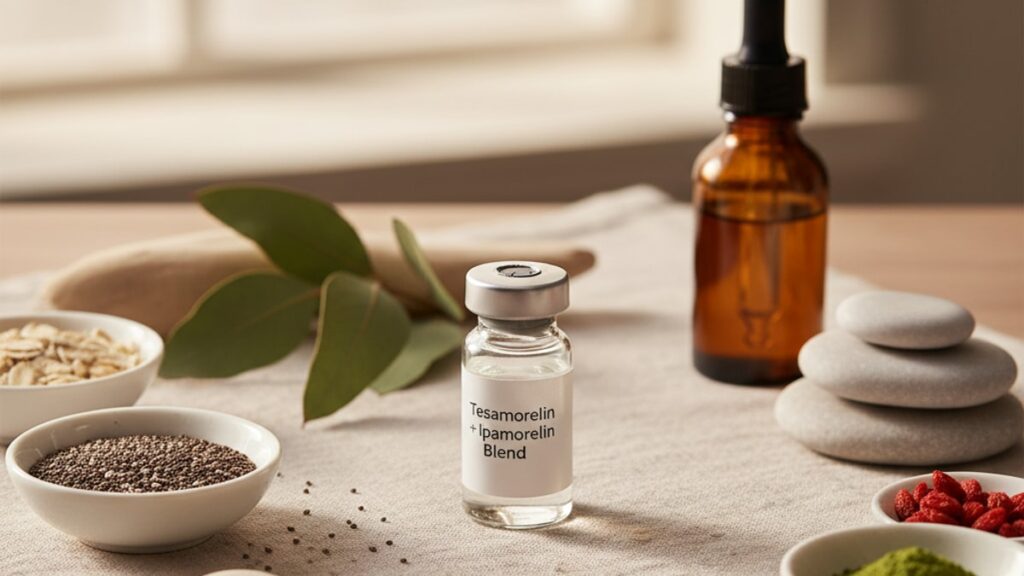
Tesamorelin + Ipamorelin Blend Vial Size & Dosing Options
Most peptide research fails at the reconstitution stage, not the injection stage. A vial that contains 5mg total peptide requires different bacteriostatic water volumes than a 10mg vial to achieve the same per-unit concentration—and getting that ratio wrong means every dose in your protocol is off by 30% or more before you even draw the syringe. We've guided hundreds of research teams through peptide sourcing decisions, and the single most overlooked variable isn't purity or supplier reliability—it's vial size selection and how it cascades through every downstream measurement.
What is the standard tesamorelin + ipamorelin blend vial size for research applications?
Tesamorelin + ipamorelin blend vial size typically ranges from 6mg to 15mg total peptide content per vial, with common configurations including 5mg/5mg (10mg total), 6mg/6mg (12mg total), and 7.5mg/7.5mg (15mg total) splits. The blend ratio is usually 1:1, meaning equal milligram amounts of each peptide, though some formulations offer 2:1 or custom ratios depending on research objectives. Vial size directly determines reconstitution volume, dose precision, and protocol duration—a 10mg vial reconstituted with 2mL bacteriostatic water yields 5mg/mL concentration, while the same 2mL added to a 15mg vial produces 7.5mg/mL.
The tesamorelin + ipamorelin blend isn't a single standardized product—it's a category of compounded peptide combinations prepared by 503B outsourcing facilities and research suppliers under varying total peptide loads. Unlike FDA-approved single-agent peptides with fixed vial sizes (like semaglutide pens at 2mg or 4mg), research-grade blends are manufactured in batches tailored to protocol demands, which means vial size varies by supplier and intended use case. This article covers exactly how vial size affects dosing accuracy, what reconstitution ratios preserve peptide stability, and which configurations work best for different research timelines.
Understanding Tesamorelin + Ipamorelin Blend Composition and Peptide Load
Tesamorelin is a growth hormone-releasing hormone (GHRH) analog consisting of 44 amino acids, while ipamorelin is a growth hormone secretagogue receptor (GHSR) agonist—a pentapeptide with selective ghrelin receptor activity. The two peptides work through complementary mechanisms: tesamorelin stimulates anterior pituitary somatotrophs to release endogenous growth hormone (GH) through GHRH receptor activation, while ipamorelin amplifies GH pulse amplitude without stimulating prolactin or cortisol release, a selectivity advantage over earlier secretagogues like GHRP-6. When combined in a single vial, the blend allows researchers to administer both peptides in one subcutaneous injection, simplifying protocols that would otherwise require two separate reconstitutions and injections.
The tesamorelin + ipamorelin blend vial size you select determines the total peptide mass available per vial, which directly impacts how many doses a single vial yields and what concentration you achieve after reconstitution. A 10mg total vial (5mg tesamorelin + 5mg ipamorelin) reconstituted with 2mL bacteriostatic water produces a 5mg/mL solution—if your protocol calls for 250mcg of each peptide per dose (500mcg total), you would draw 0.1mL per injection, yielding 20 doses per vial. The same protocol using a 15mg vial (7.5mg each) reconstituted with 2mL yields 7.5mg/mL concentration, requiring just 0.067mL per 500mcg dose—but that smaller draw volume introduces measurement error with standard 1mL insulin syringes, which are calibrated in 0.01mL increments.
Vial size also determines refrigerated shelf life after reconstitution. Lyophilized (freeze-dried) peptides stored at −20°C remain stable for 12–24 months, but once reconstituted with bacteriostatic water, the solution must be refrigerated at 2–8°C and used within 28 days to minimize bacterial growth and peptide degradation. A researcher conducting a 12-week protocol at 500mcg total dose five days per week needs 60 doses total—meaning a 10mg vial yields insufficient doses (only 20), requiring three vials over the study period, while two 15mg vials would suffice with a dose buffer. Real Peptides offers Tesamorelin Ipamorelin Growth Hormone Stack in multiple vial configurations to match protocol length and dosing frequency without forcing researchers to open additional vials mid-study.
Reconstitution Ratios, Concentration Calculations, and Dosing Precision
The relationship between tesamorelin + ipamorelin blend vial size and bacteriostatic water volume determines final peptide concentration, which directly affects dosing precision and injection volume. Peptide concentration is calculated as total peptide mass (mg) divided by reconstitution volume (mL)—a 12mg vial reconstituted with 2.4mL bacteriostatic water yields 5mg/mL, while the same vial with 1.2mL yields 10mg/mL. Higher concentrations allow smaller injection volumes, which can reduce injection site reactions and improve subject comfort, but they also amplify measurement error—a 10mcg error in draw volume represents 100mcg peptide error at 10mg/mL concentration versus 50mcg error at 5mg/mL.
Standard insulin syringes are calibrated in 0.01mL (1 unit) increments up to 1mL total volume, meaning the smallest measurable draw is 0.01mL. At 5mg/mL concentration, each 0.01mL increment represents 50mcg peptide—acceptable precision for protocols dosing 250–500mcg per injection. At 10mg/mL concentration, each 0.01mL increment represents 100mcg, which introduces 20–40% relative error for protocols requiring 250mcg doses. Researchers aiming for sub-100mcg precision should target concentrations between 2.5–5mg/mL, which requires larger reconstitution volumes: a 10mg vial needs 2–4mL bacteriostatic water, while a 15mg vial needs 3–6mL to hit that range.
Reconstitution technique matters as much as volume. Bacteriostatic water should be injected slowly down the inside wall of the vial—never directly onto the lyophilized peptide cake—to prevent mechanical shearing of peptide bonds. After adding water, gently swirl the vial in a circular motion rather than shaking it; vigorous agitation denatures peptides by introducing air bubbles and mechanical stress. The reconstituted solution should be clear to slightly opalescent—any cloudiness, particulates, or color change indicates peptide aggregation or contamination, and the vial should be discarded. Once mixed, the solution is stable at 2–8°C for 28 days, but every needle puncture introduces contamination risk, so using a vial within 21 days and minimizing punctures (one draw per dose, never re-injecting air) extends usable life.
We've observed measurement errors compound across multi-vial protocols—if a researcher under-doses by 50mcg per injection due to poor concentration planning, that's 3,000mcg (3mg) error across a 60-dose protocol, equivalent to six full missed doses. Choosing the correct tesamorelin + ipamorelin blend vial size upfront and matching it to an appropriate reconstitution volume eliminates this variable before the first injection.
Tesamorelin + Ipamorelin Blend Vial Size: Configuration Comparison
Selecting the appropriate tesamorelin + ipamorelin blend vial size depends on protocol duration, dosing frequency, and precision requirements. The table below compares common vial configurations based on total peptide load, typical reconstitution volume, resulting concentration, doses per vial at standard research doses, and practical use case. All calculations assume 1:1 peptide ratio and 500mcg total dose per injection (250mcg tesamorelin + 250mcg ipamorelin).
| Vial Configuration | Total Peptide Load | Reconstitution Volume | Final Concentration | Doses Per Vial (500mcg) | Best Use Case | Bottom Line |
|---|---|---|---|---|---|---|
| 5mg/5mg | 10mg total | 2mL | 5mg/mL | 20 doses | Short-term pilots (4 weeks or less) | Adequate for preliminary studies but requires multiple vials for extended protocols |
| 6mg/6mg | 12mg total | 2.4mL | 5mg/mL | 24 doses | Mid-length protocols (5–6 weeks) | Balanced option with acceptable draw volume precision |
| 7.5mg/7.5mg | 15mg total | 3mL | 5mg/mL | 30 doses | Standard research cycles (6–8 weeks) | Industry standard for most in vivo research—maximizes doses per vial without concentration trade-offs |
| 10mg/10mg | 20mg total | 4mL | 5mg/mL | 40 doses | Extended protocols (8+ weeks) | Reduces vial turnover but requires larger reconstitution volume and refrigerator space |
The 7.5mg/7.5mg tesamorelin + ipamorelin blend vial size represents the most common configuration in research settings because it balances dose yield, measurement precision, and reconstitution convenience. At 3mL reconstitution volume and 5mg/mL concentration, each 0.1mL draw (easily measured on standard insulin syringes) delivers exactly 500mcg total peptide—no rounding, no guesswork. A single vial supports 30 doses, sufficient for a six-week protocol at five doses per week with a small buffer for measurement loss during reconstitution and handling.
For researchers running dose-escalation studies or comparing multiple dosing regimens simultaneously, smaller vial sizes (5mg/5mg or 6mg/6mg) offer flexibility—each subject cohort can be assigned a dedicated vial, minimizing cross-contamination risk and simplifying dose tracking. Larger vials (10mg/10mg or higher) suit long-duration studies where subjects receive consistent dosing over 12+ weeks, but they require meticulous sterile technique to prevent bacterial contamination across 40+ needle punctures. Every additional puncture slightly increases contamination risk, even with alcohol swab prep and sterile needle handling.
Key Takeaways
- Tesamorelin + ipamorelin blend vial size typically ranges from 10mg to 20mg total peptide content, with 15mg (7.5mg/7.5mg) being the most common research configuration.
- Final peptide concentration is determined by dividing total peptide mass by reconstitution volume—targeting 5mg/mL allows precise 0.1mL draws for 500mcg doses using standard insulin syringes.
- A 15mg vial reconstituted with 3mL bacteriostatic water yields 30 doses at 500mcg per injection, sufficient for a six-week protocol at five doses per week.
- Reconstituted peptide solutions remain stable for 28 days when refrigerated at 2–8°C, but practical usable life is 21 days to minimize bacterial contamination from repeated needle punctures.
- Higher concentrations (10mg/mL or greater) reduce injection volume but amplify measurement error—each 0.01mL syringe increment represents 100mcg peptide, introducing 20–40% relative error for sub-250mcg doses.
- Tesamorelin + ipamorelin work through complementary GH-release mechanisms: tesamorelin activates GHRH receptors on pituitary somatotrophs, while ipamorelin selectively stimulates ghrelin receptors without cortisol or prolactin elevation.
What If: Tesamorelin + Ipamorelin Blend Vial Size Scenarios
What If I Accidentally Reconstitute a 15mg Vial With the Wrong Volume of Bacteriostatic Water?
Recalculate your dose immediately using the actual concentration. If you added 2mL instead of 3mL to a 15mg vial, your concentration is 7.5mg/mL instead of 5mg/mL—meaning each 0.1mL draw now contains 750mcg instead of 500mcg. To correct for 500mcg dosing, draw 0.067mL per injection, but recognize this introduces measurement error with standard insulin syringes. If the error makes dosing impractical, discard the vial and reconstitute a fresh one—peptide waste is cheaper than protocol invalidation from inconsistent dosing. The mistake is most common when researchers prep multiple vials simultaneously or switch between vial sizes mid-protocol without adjusting their water volume.
What If My Protocol Requires Doses Smaller Than 250mcg Per Peptide?
Use a smaller tesamorelin + ipamorelin blend vial size or increase reconstitution volume to lower concentration. For 100mcg per peptide (200mcg total dose), a 10mg vial reconstituted with 5mL yields 2mg/mL—each 0.1mL contains exactly 200mcg. Alternatively, use a 5mg/5mg vial with 2.5mL reconstitution for the same 2mg/mL concentration with less total peptide waste. Lower concentrations require larger injection volumes, but for subcutaneous administration, volumes up to 0.5mL per site are well-tolerated in most research models. Never attempt to measure doses below 0.05mL with standard syringes—measurement error exceeds 50% at that volume.
What If I'm Running a 12-Week Protocol and Don't Want to Open Multiple Vials?
Order two 20mg vials (10mg/10mg each) and reconstitute each with 4mL bacteriostatic water for 5mg/mL concentration. Each vial yields 40 doses at 500mcg per injection—two vials cover 80 doses, sufficient for 12 weeks at five doses per week with a 20-dose buffer. Use one vial completely before opening the second to minimize the number of vials in active refrigeration simultaneously. Track puncture dates and discard any vial that has been reconstituted for more than 28 days, even if peptide remains. Extending beyond 28 days risks bacterial contamination that no visual inspection can detect.
What If the Reconstituted Solution Develops Cloudiness or Particulates After One Week?
Discard the vial immediately. Cloudiness or particulate formation indicates peptide aggregation, bacterial contamination, or chemical degradation—none of which are reversible. Aggregated peptides lose biological activity and can trigger immune responses if administered. This failure mode is most common when vials are stored above 8°C, subjected to freeze-thaw cycles, or punctured with non-sterile needles. Review your storage conditions: ensure the refrigerator maintains 2–8°C consistently (verify with a thermometer, not the appliance display) and that you're using fresh alcohol swabs for every needle puncture. If the problem recurs across multiple vials, the issue is environmental—not the peptide itself.
The Practical Truth About Tesamorelin + Ipamorelin Blend Vial Size
Here's the honest answer: most researchers over-order vial size because they want to minimize reordering frequency, then end up discarding half the peptide when they hit the 28-day post-reconstitution deadline with doses remaining. A 20mg vial looks cost-efficient until you're disposing of 8mg of unused peptide three weeks into a protocol that only required 12mg total. The math is simple—match vial size to your actual dose count, add a 10% buffer for handling loss and measurement error, and order exactly that. A researcher conducting a six-week protocol at 500mcg five times per week needs 30 doses—that's a 15mg vial, not a 20mg vial.
The tesamorelin + ipamorelin blend vial size that works best isn't the largest one available—it's the smallest one that covers your full protocol duration without forcing a mid-study vial changeover. Real Peptides manufactures research-grade peptide blends with precise amino acid sequencing and third-party purity verification, and every vial is labeled with exact peptide content to eliminate guesswork during reconstitution. When your protocol depends on consistent GH secretagogue delivery across weeks or months, the vial size you choose in week one determines whether your final data reflects true biological response or accumulated measurement error.
If you're designing a growth hormone-focused research protocol and need peptide tools that match your dosing requirements without forcing compromise, explore the full peptide collection at Real Peptides—where every vial is produced through small-batch synthesis with exact peptide loads, so your reconstitution calculations work the first time.
Frequently Asked Questions
What is the most common tesamorelin + ipamorelin blend vial size for research use?
▼
The 15mg total vial (7.5mg tesamorelin + 7.5mg ipamorelin) is the most common configuration in research settings. When reconstituted with 3mL bacteriostatic water, it yields 5mg/mL concentration and provides 30 doses at 500mcg per injection—sufficient for a six-week protocol at five doses per week. This size balances dose yield, measurement precision, and practical handling without excessive peptide waste.
How do I calculate the correct reconstitution volume for my tesamorelin + ipamorelin vial?
▼
Divide your desired final concentration (typically 5mg/mL) into the total peptide mass to determine bacteriostatic water volume. For a 15mg vial targeting 5mg/mL, divide 15mg by 5mg/mL to get 3mL reconstitution volume. For a 10mg vial at the same concentration, you need 2mL. Higher concentrations reduce injection volume but increase measurement error—targeting 5mg/mL allows precise dosing with standard insulin syringes calibrated in 0.01mL increments.
Can I store a reconstituted tesamorelin + ipamorelin vial for longer than 28 days?
▼
No. Once reconstituted with bacteriostatic water, the solution must be refrigerated at 2–8°C and used within 28 days to prevent bacterial growth and peptide degradation. Even if the solution appears clear, bacterial contamination that is invisible to the eye can develop after 28 days. Practical usable life is 21 days when the vial is punctured multiple times. Extending storage beyond this window risks administering degraded or contaminated peptide.
What happens if I choose a tesamorelin + ipamorelin vial size that is too large for my protocol?
▼
You will discard unused peptide when the 28-day post-reconstitution deadline expires. A 20mg vial yields 40 doses at 500mcg per injection—if your protocol only requires 30 doses over six weeks, you’ll waste 10 doses worth of peptide (5mg total). Match vial size to your actual dose count plus a 10% buffer for handling loss. Ordering excess vial capacity does not extend shelf life or improve cost-efficiency.
How does tesamorelin + ipamorelin blend vial size affect dosing precision?
▼
Vial size determines the concentration you achieve after reconstitution, which directly affects measurement precision. A 10mg vial reconstituted with 1mL yields 10mg/mL—at this concentration, each 0.01mL syringe increment represents 100mcg peptide, introducing significant error for doses below 250mcg. A 15mg vial reconstituted with 3mL yields 5mg/mL, where each 0.01mL increment represents 50mcg—acceptable precision for most research protocols. Lower concentrations improve precision but require larger injection volumes.
Is the peptide ratio always 1:1 in tesamorelin + ipamorelin blend vials?
▼
Most research-grade blends use a 1:1 ratio (equal milligram amounts of each peptide), but custom ratios like 2:1 or 3:2 are available from some compounding facilities depending on research objectives. Always verify the exact peptide content listed on the vial label before reconstitution—assuming a 1:1 ratio when the actual blend is 2:1 will cause dosing errors. Real Peptides labels every vial with precise peptide content to eliminate guesswork.
What is the difference between lyophilized and pre-mixed tesamorelin + ipamorelin vials?
▼
Lyophilized (freeze-dried) vials contain peptide powder that must be reconstituted with bacteriostatic water before use—these are stable at −20°C for 12–24 months before reconstitution. Pre-mixed vials contain peptide already dissolved in solution and must be refrigerated immediately—they have shorter shelf life (typically 60–90 days) and are less common in research settings. Lyophilized peptides offer longer storage flexibility and allow researchers to control final concentration through reconstitution volume.
Can I combine tesamorelin and ipamorelin from separate vials instead of using a pre-blended vial?
▼
Yes, but it requires reconstituting both peptides separately and drawing precise volumes from each vial per dose, doubling injection preparation time and increasing measurement error. Pre-blended vials eliminate this complexity by providing both peptides in a single solution at a fixed ratio. For protocols requiring consistent 1:1 dosing, pre-blended vials are more reliable. Separate vials are only advantageous for dose-titration studies where researchers need independent control of each peptide’s dose.
How many needle punctures can a reconstituted tesamorelin + ipamorelin vial safely tolerate?
▼
Each needle puncture introduces contamination risk, even with alcohol swab prep and sterile technique. A vial punctured 40+ times over 28 days (for a 20mg vial yielding 40 doses) has higher bacterial contamination risk than a vial punctured 20 times. Practical limits depend on sterile technique—most research protocols target fewer than 30 punctures per vial. Using smaller vial sizes that match protocol length reduces total punctures and extends usable life.
Why do some tesamorelin + ipamorelin blend vials cost significantly less than others?
▼
Price differences reflect peptide purity, synthesis method, and supplier verification standards. Research-grade peptides synthesized through solid-phase peptide synthesis (SPPS) with HPLC purity verification cost more than bulk peptides with minimal quality control. Compounded peptides from FDA-registered 503B facilities meet USP monograph standards, while unregulated suppliers may offer lower-purity peptides with undisclosed impurities. Lower cost per vial often means lower peptide purity, which introduces biological variability that compromises research reproducibility.
