Is Reconstitution solution good to Reconstitute Retatrutide?
Table of Contents
Is Reconstitution solution good to Reconstitute Retatrutide?
Is Reconstitution solution good to Reconstitute Retatrutide?
When reconstituting retatrutide, choosing the right solution is critical to maintain its stability, solubility, and effectiveness in research. Here’s a quick breakdown of the options:
Sterile Water: Pure but lacks preservatives, making it suitable only for immediate use. It offers poor storage stability and increases the risk of contamination.
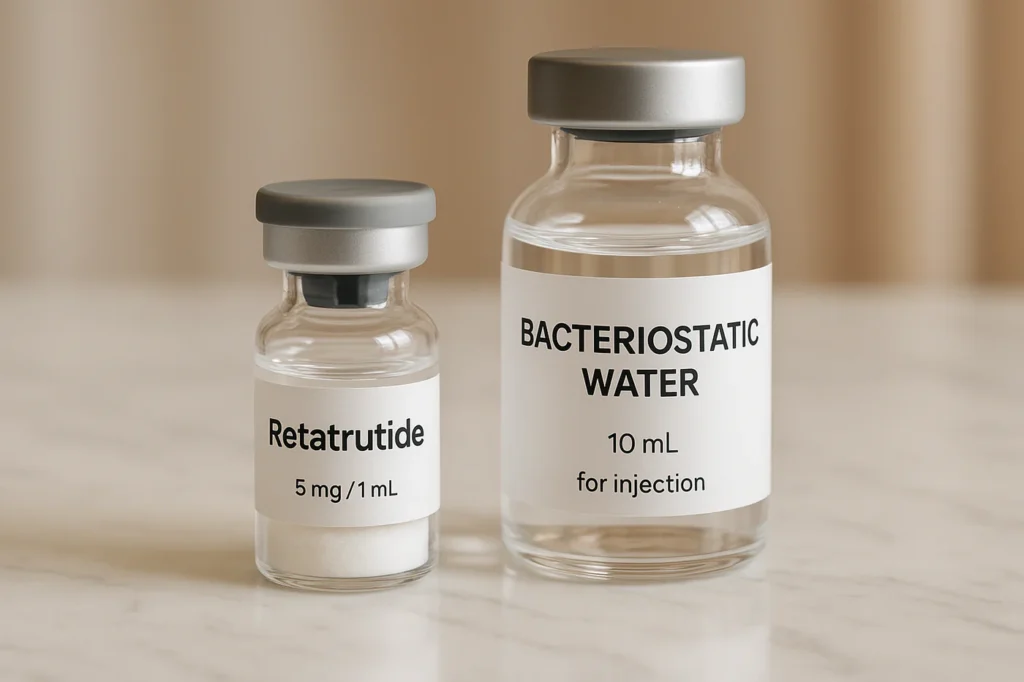
Bacteriostatic Water: Contains benzyl alcohol as a preservative, allowing for longer refrigerated storage (up to 30 days) and multi-dose use. This is the most reliable choice for maintaining retatrutide’s activity.
Acetic Acid Solutions: Useful for peptides requiring improved solubility in acidic environments. Best for long-term storage when aliquoted and frozen, but requires careful handling to avoid degradation.
Conclusion: Bacteriostatic water is the preferred option for reconstituting retatrutide, balancing stability, ease of use, and storage flexibility. Proper preparation ensures consistent research outcomes and preserves peptide integrity.
1. Sterile Water
Chemical Compatibility
Sterile Water for Injection is generally not suitable for reconstituting retatrutide. While the peptide may dissolve in sterile water, the absence of preservatives like benzyl alcohol makes it prone to bacterial contamination. This lack of protection also raises concerns about the solution’s stability over time.
Stability and Storage
Solutions prepared with sterile water must be used immediately due to the absence of preservatives. In comparison, bacteriostatic water allows for refrigerated storage for up to 30 days. This instability can impact the peptide’s biological activity, making it less effective for future applications.
Impact on Retatrutide Activity
The solvent used for reconstitution plays a critical role in maintaining retatrutide’s activity and reliability in research. Using sterile water can lead to reduced efficacy and altered pharmacokinetics, which may increase safety concerns. Regulatory agencies caution against using diluents without preservatives, as this can result in peptide degradation and precipitation. These issues can directly affect the reproducibility of experiments. Adhering to recommended reconstitution practices is crucial to ensure peptide integrity and reliable experimental results.
2. Bacteriostatic Water
Chemical Compatibility
Bacteriostatic Water for Injection is a common choice for preparing retatrutide in research settings. It contains 0.9% benzyl alcohol, which acts as a preservative to guard against microbial contamination during storage. With a pH range of 4.5 to 7.0, this solution provides an environment that can support the stability of peptide formulations like retatrutide. The specific compatibility, however, depends on the unique properties of the peptide, making it essential for researchers to consider these factors for optimal results.
Stability and Storage
To ensure retatrutide solutions remain stable, they should be stored under refrigerated conditions at 2–8°C, following established protocols. Proper storage helps preserve the pharmacological properties of retatrutide, ensuring it remains effective for research purposes.
Impact on Retatrutide Activity
Using bacteriostatic water not only stabilizes retatrutide but also helps maintain its pharmacological activity, ensuring consistent and reliable experimental outcomes. This approach supports reproducible results and accurate dosing.
Real Peptides offers research-grade retatrutide designed for easy reconstitution with bacteriostatic water. This allows researchers to prepare larger volumes for multiple doses, streamlining workflows and reducing waste by enabling precise, multi-dose usage from a single preparation.
3. Acetic Acid Solutions
Chemical Compatibility
Acetic acid solutions provide an acidic alternative to water-based reconstitution, particularly for peptides that require improved solubility. These solutions come in various concentrations, such as 0.1%, 10%, and 25%, offering an environment that can enhance the dissolution of peptides that struggle to dissolve at neutral pH.
When preparing retatrutide with acetic acid, ensure the peptide is fully dissolved in the solution before any dilution. To aid dissolution, gently sonicate the mixture in a water bath for a few minutes. Be cautious to avoid excessive heat, as it may compromise the peptide’s stability. Once the peptide is completely dissolved, follow appropriate storage protocols.
Stability and Storage
Reconstituted solutions should be stored at -20°F or colder. To maintain stability, aliquot the solution to avoid repeated freeze-thaw cycles.
Impact on Retatrutide Activity
Keeping an acidic environment is essential to preserve retatrutide’s activity. When diluting the solution, add the peptide dropwise while gently agitating to prevent localized concentration spikes.
Real Peptides offers high-quality retatrutide designed for research purposes. Their products are compatible with acetic acid-based reconstitution methods, giving researchers the flexibility to maintain peptide integrity while meeting their experimental needs.
sbb-itb-9529e2d
How to Reconstitute Retatrutide Peptide
Comparison of Reconstitution Solutions
This section highlights the main differences among the available reconstitution methods for retatrutide. Each option comes with its own set of advantages and limitations, making it essential for researchers to weigh factors like chemical compatibility, antimicrobial properties, ease of handling, and storage requirements when deciding which method is most suitable for their experiments.
Here’s a quick breakdown of the three reconstitution options:
Sterile Water
Sterile water is a simple, additive-free option, ideal for immediate use. Since it lacks preservatives, it’s best suited for applications requiring immediate preparation or short-term storage.
Bacteriostatic Water
With the addition of benzyl alcohol as a preservative, bacteriostatic water allows for multi-dose usage. Its antimicrobial properties make it a practical choice for experiments involving multiple aliquots or repeated dosing over time.
Acetic Acid Solutions
Acetic acid solutions are particularly effective for dissolving peptides and maintaining an acidic environment, which helps preserve peptide integrity. This method is especially beneficial when working with peptides prone to aggregation or precipitation.
Selecting the right reconstitution method for retatrutide largely depends on the experimental timeline, storage needs, and the laboratory’s handling capabilities. For more tailored advice, Real Peptides offers detailed guidance and technical support to help researchers optimize their reconstitution practices.
This comparison underscores the importance of choosing the appropriate method to ensure the best performance and reliability of retatrutide in research applications.
Conclusion
Based on the analysis, bacteriostatic water stands out as the ideal solution for reconstituting retatrutide. The choice of reconstitution solution plays a critical role in preserving retatrutide’s stability and effectiveness. Bacteriostatic water not only ensures chemical compatibility but also provides antimicrobial properties, helping maintain the peptide’s integrity during storage, as highlighted in the comparisons above.
On the other hand, using non-recommended diluents like 0.9% sodium chloride injection can negatively impact the peptide’s stability and overall efficacy.
Here are some key guidelines for reconstituting retatrutide effectively:
Use bacteriostatic water and follow established reconstitution protocols.
Avoid diluents that could compromise the peptide’s stability or performance.
Take into account dosing schedules and experimental timelines when selecting reconstitution methods.
For researchers seeking high-quality retatrutide and expert support, Real Peptides offers both the product and detailed technical guidance. Visit www.realpeptides.co for more information on reconstitution protocols and storage recommendations. These insights align with the findings discussed earlier, ensuring optimal handling and performance of retatrutide.