



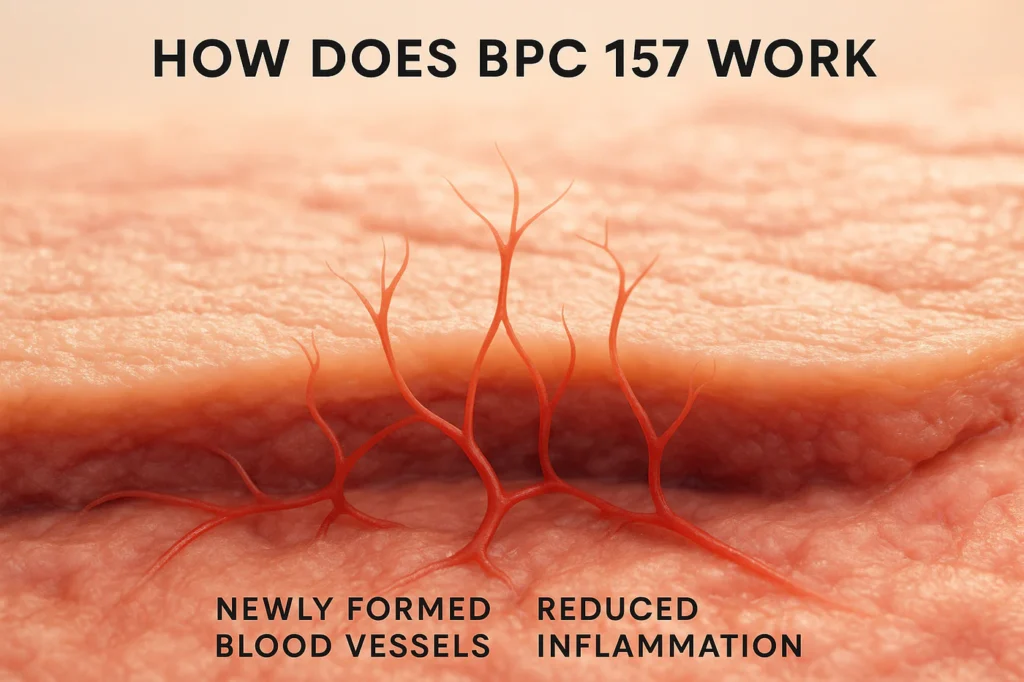
BPC-157 is a synthetic peptide derived from human gastric juice, primarily researched for its potential in tissue repair, reducing inflammation, and promoting blood vessel growth. It works by increasing the sensitivity of tendon fibroblasts to growth hormone, enhancing collagen production, and activating key cellular pathways like JAK2. Animal studies suggest it speeds up healing of tendons, muscles, and bones while also supporting blood vessel formation for better oxygen and nutrient delivery. Additionally, it may reduce inflammation markers, ease pain perception, and protect tissues at a cellular level. While promising, BPC-157 is strictly for research purposes and not approved for human use.
BPC-157 plays a crucial role in cellular repair by increasing the sensitivity of tendon fibroblasts to growth hormone. It achieves this by regulating growth hormone receptors in a way that depends on both dosage and timing.
Research published in Molecules in 2014 revealed that BPC-157 can amplify growth hormone receptor levels in tendon fibroblasts by as much as sevenfold. This was confirmed through RT-PCR and Western blot analysis. By doing so, the cells are better prepared for growth hormone exposure, leading to increased cell proliferation and higher PCNA expression, which are essential for tissue regeneration.
When growth hormone receptors are upregulated, critical signaling pathways are activated. For example, BPC-157 pretreatment enhances the activation of JAK2 once growth hormone is introduced. This heightened activation stimulates fibroblast activity, which, in turn, speeds up tissue repair by promoting collagen production and other regenerative processes.
Early research suggests that BPC-157 may play a key role in speeding up tissue repair and supporting the growth of blood vessels. It appears to achieve this by influencing important cellular processes.
Animal studies provide compelling evidence that BPC-157 can speed up the healing of tendons, stimulate the regeneration of muscle fibers through satellite cell activation, and enhance bone repair by boosting osteoblast activity. Additionally, it has been shown to improve the closure of skin wounds. These effects collectively contribute to better blood vessel development during the healing process.
BPC-157 doesn’t just help tissues heal faster – it also promotes the formation of new blood vessels. Research shows that it activates endothelial signaling pathways, which are crucial for angiogenesis, the process of creating new blood vessels. This leads to improved oxygen and nutrient supply to the affected areas. Experimental models reveal that tissues treated with BPC-157 develop more organized vascular networks compared to untreated ones.
BPC-157 also appears to influence the production of collagen and bone-related proteins, adding another layer to its regenerative effects. Studies indicate that it enhances fibroblast-driven collagen synthesis and modulates BMP (bone morphogenetic protein) signaling. This helps maintain a balance between osteoblasts (cells that build bone) and osteoclasts (cells that break down bone), supporting healthy bone formation.
For researchers exploring these regenerative properties, BPC-157 from Real Peptides offers reliable quality for consistent experimental outcomes.
BPC-157 plays a dual role in managing inflammation and safeguarding cells. These actions not only reduce inflammation but also complement the peptide’s repair and regeneration capabilities discussed earlier.
Research shows that BPC-157 helps minimize inflammation markers, creating an environment that supports faster and more efficient healing. This reduction in inflammation lays the groundwork for the tissue repair processes mentioned earlier.
Studies suggest that BPC-157 may influence how pain is perceived, reducing discomfort during the recovery process. This ability to ease pain adds another layer to its potential therapeutic benefits observed in experimental settings.
BPC-157 has also been shown to protect tissues, promote gastrointestinal health, and maintain overall tissue integrity. These effects go beyond localized repair, offering broader protection and preservation at the cellular level.
For researchers seeking reliable sources, high-quality BPC-157 is available at Real Peptides.
To ensure reliable research outcomes, proper storage and handling of BPC-157 are essential. Following the recommended guidelines provided by the manufacturer helps maintain the peptide’s stability and ensures compliance with research standards.
Preserving the integrity of BPC-157 starts with adhering to its specific storage requirements. Lyophilized (freeze-dried) BPC-157 should remain frozen until use. Once reconstituted with a sterile solvent, it should be stored in a refrigerator and used within the suggested timeframe. During preparation, it’s crucial to use sterile techniques and handle the peptide carefully to prevent degradation. Maintaining a consistent cold chain from storage to usage is key to achieving accurate and reproducible research results.
Research-grade BPC-157 is held to high purity standards to ensure consistent and reliable outcomes. A purity level of ≥99%, verified through HPLC testing, is a benchmark for quality peptides. Additionally, thorough endotoxin screening minimizes assay interference, while ISO-certified manufacturing processes guarantee batch-to-batch consistency. Independent laboratory tests confirm that our BPC-157 meets HPLC-verified purity levels and passes rigorous endotoxin checks.
Proper handling practices go hand in hand with efficient research workflows. Ready-to-use formats eliminate the need for precise handling of small powder quantities, reducing errors and saving time. Pre-measured vials help minimize variability, while research stacks that combine BPC-157 with complementary peptides simplify the process by removing the need to source and mix individual components. Temperature-controlled shipping ensures that peptides like BPC-157, which are sensitive to temperature changes, arrive in perfect condition, maintaining their integrity from production to the lab.
For researchers in need of dependable, high-quality BPC-157 paired with robust handling and storage protocols, Real Peptides provides tailored solutions to support advanced scientific research.
The research discussed highlights how BPC-157 interacts with various cellular pathways, making it a promising focus in regenerative medicine studies. This peptide supports collagen production, speeds up tissue repair, and reduces inflammation – creating conditions that aid tissue recovery. Its effects on the nitric oxide pathway enhance blood flow and encourage the development of new blood vessels. Additionally, studies have observed changes in pain response, further emphasizing its diverse role in tissue protection.
BPC-157’s mechanisms – ranging from cellular signaling and angiogenesis to inflammation control – make it a valuable resource in tissue repair research. Whether it’s wound healing, vascular development, or cellular defense, these mechanisms provide researchers with a foundation to deepen their understanding of regenerative biology.
For researchers seeking high-purity BPC-157 for advanced studies, Real Peptides offers products designed to meet rigorous research standards.
