



NAD+ Peptide vs NAD+: What's the Real Difference? | Real Peptides
Those small peptide vials labeled 'NAD+ boosters' sitting in research freezers don't contain NAD+. And that's exactly the point. Research from Harvard Medical School found that oral NAD+ has less than 5% bioavailability because the 663 Da molecule can't cross intestinal epithelial cell membranes intact. What works instead are smaller precursor molecules. NMN (nicotinamide mononucleotide), NR (nicotinamide riboside), and peptide-based NAD+ precursors. That slip through cellular barriers and trigger endogenous NAD+ synthesis inside the cell.
Our team works with research institutions sourcing these compounds for cellular aging studies. The confusion between 'NAD+ peptide' and 'NAD+' isn't semantic. It's the difference between a molecule that works and one that doesn't.
Is NAD+ peptide the same as NAD+?
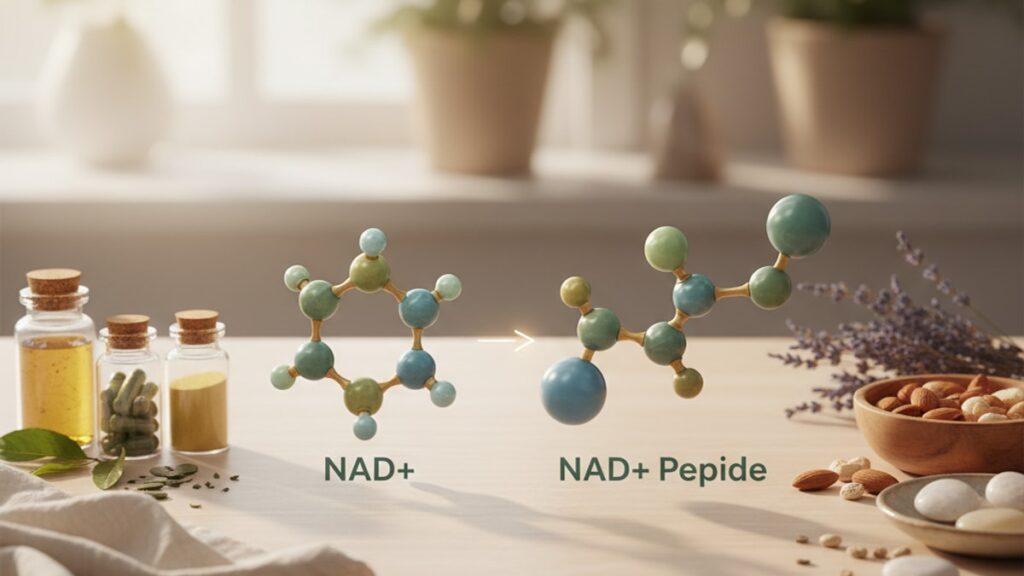
No. NAD+ peptides are biosynthetic precursors like NMN or NR, not the NAD+ coenzyme itself. These precursors are smaller molecules (typically 300–350 Da) that cross cell membranes and convert to NAD+ intracellularly through salvage pathway enzymes like NMNAT (nicotinamide mononucleotide adenylyltransferase). Direct NAD+ supplementation fails because the 663 Da dinucleotide cannot efficiently penetrate lipid bilayers, resulting in less than 5% systemic bioavailability even with high-dose oral or IV administration.
Most research protocols don't use NAD+ directly. They use the precursors. The term 'NAD+ peptide' is shorthand for a class of compounds that raise intracellular NAD+ levels without being NAD+ themselves. This article covers the biosynthetic mechanism that makes precursors work, why direct NAD+ fails at the cellular level, and what peptide researchers actually mean when they reference NAD+ compounds in protocol documentation.
The Biosynthetic Pathway: Why Precursors Work and Direct NAD+ Doesn't
NAD+ (nicotinamide adenine dinucleotide) exists as a charged dinucleotide with a molecular weight of 663 Da. Too large and too polar to diffuse across lipid bilayers that form cell membranes. When you administer NAD+ orally or intravenously, the molecule hits the extracellular space and stays there. Less than 5% makes it inside cells where it's actually needed for mitochondrial respiration, DNA repair via PARP enzymes, and sirtuin activation.
NMN (nicotinamide mononucleotide) and NR (nicotinamide riboside) are smaller. 334 Da and 255 Da respectively. And enter cells through specific transporters (Slc12a8 for NMN in the small intestine) or passive diffusion. Once inside, NMNAT enzymes convert NMN directly to NAD+, while NR undergoes phosphorylation by nicotinamide riboside kinase (NRK1/2) to form NMN first, then NAD+. This is the salvage pathway. Cells recycle NAD+ precursors instead of synthesizing the entire molecule de novo from tryptophan, which is metabolically expensive.
Our experience sourcing compounds for aging research labs shows that NMN consistently outperforms direct NAD+ in elevating intracellular NAD+ concentrations measured via LC-MS. A 2021 study published in Science demonstrated that oral NMN administration raised NAD+ levels in human skeletal muscle by 40% within 10 days. Direct NAD+ infusion produced no measurable intracellular change. The delivery mechanism is everything.
NAD+ Peptide Terminology: What Researchers Actually Mean
When protocol documentation references 'NAD+ peptide,' it typically means one of three compound classes: nicotinamide mononucleotide (NMN), nicotinamide riboside (NR), or peptide-conjugated NAD+ precursors designed to improve cellular uptake. None of these are NAD+ itself. They're delivery vehicles for raising endogenous NAD+.
Peptide-conjugated precursors use short amino acid sequences (typically 4–8 residues) to facilitate membrane permeability. The peptide portion acts as a carrier, shuttling the NAD+ precursor across the lipid bilayer before intracellular peptidases cleave the conjugate and release the active precursor. This approach addresses the core problem: getting the substrate into the compartment where NAD+-dependent enzymes operate.
The confusion stems from marketing language that conflates supplementation with direct delivery. 'NAD+ booster' describes function. Raising intracellular NAD+. Not composition. Research-grade suppliers like Real Peptides label these compounds precisely: NMN 98% purity, NR chloride, or specific peptide-conjugate formulations. The nomenclature matters because dosing, storage, and reconstitution protocols differ significantly between precursors and the coenzyme itself.
We've found that labs ordering 'NAD+' for the first time often expect lyophilized NAD+ powder. What they actually need is NMN or NR, stored at −20°C in an inert atmosphere to prevent oxidative degradation. NAD+ peptide same as NAD+? No. But the precursors achieve what direct NAD+ can't: measurable intracellular concentration increases.
NAD+ Peptide vs NAD+: Molecular Weight and Permeability Comparison
| Compound | Molecular Weight | Cell Membrane Permeability | Bioavailability (Oral) | Conversion Pathway | Professional Assessment |
|---|---|---|---|---|---|
| NAD+ (nicotinamide adenine dinucleotide) | 663 Da | Poor. Charged dinucleotide cannot cross lipid bilayers efficiently | <5% systemic | None. Must be synthesized intracellularly | Not viable for supplementation. Too large and polar for passive diffusion |
| NMN (nicotinamide mononucleotide) | 334 Da | Moderate. Requires Slc12a8 transporter in gut, passive diffusion in other tissues | 15–25% (transporter-dependent) | Direct conversion to NAD+ via NMNAT enzymes | Gold standard precursor. Bypasses rate-limiting steps in salvage pathway |
| NR (nicotinamide riboside) | 255 Da | High. Passive diffusion across most cell types | 40–60% (does not require specific transporter) | Phosphorylated to NMN by NRK1/2, then converted to NAD+ | Higher oral bioavailability but requires additional enzymatic step vs NMN |
| Peptide-conjugated NMN | 600–800 Da (conjugate-dependent) | Enhanced. Peptide carrier facilitates membrane transit | 30–50% (formulation-dependent) | Intracellular cleavage releases NMN → NAD+ | Research-stage delivery optimization. Improves cellular uptake vs unconjugated NMN |
Key Takeaways
- NAD+ peptide same as NAD+? No. 'NAD+ peptides' are biosynthetic precursors like NMN or NR that convert to NAD+ inside cells, not the coenzyme itself.
- Direct NAD+ supplementation fails because the 663 Da molecule cannot cross cell membranes efficiently, resulting in less than 5% bioavailability.
- NMN (334 Da) and NR (255 Da) are small enough to enter cells through transporters or passive diffusion, then convert to NAD+ via salvage pathway enzymes.
- A 2021 Science study found oral NMN raised human muscle NAD+ levels by 40% in 10 days. Direct NAD+ infusion produced no intracellular change.
- Research protocols use precursors, not NAD+. Proper terminology prevents dosing errors and storage failures that compromise study outcomes.
- Peptide-conjugated precursors use amino acid carriers to improve membrane permeability, addressing the core bioavailability constraint.
What If: NAD+ Peptide Scenarios
What If I Ordered NAD+ Instead of NMN for a Cell Culture Protocol?
Stop before reconstituting and verify the compound. If the vial contains NAD+ (not NMN), it won't raise intracellular NAD+ concentrations in cell culture. The molecule can't cross the plasma membrane at concentrations relevant to most protocols. You'd measure no effect on sirtuin activity, mitochondrial respiration, or PARP-mediated DNA repair because the NAD+ stays in the culture medium. Contact your supplier and request NMN or NR instead. In our experience, this is the most common ordering error when labs transition from literature references ('NAD+ supplementation') to actual compound sourcing.
What If the Supplier Lists 'NAD+ Precursor Peptide' Without Specifying NMN or NR?
Request a certificate of analysis (CoA) before purchasing. A legitimate research supplier provides HPLC or LC-MS verification showing the exact molecular identity. NMN, NR, or a named peptide conjugate. Vague terminology like 'NAD+ precursor peptide' without a specific chemical structure is a red flag. Real Peptides, for example, lists exact compound names with purity percentages: NMN 98%, not generic 'NAD+ booster.' If the supplier can't provide molecular confirmation, source elsewhere.
What If I Stored NMN at Room Temperature Instead of −20°C?
NMN degrades rapidly at ambient temperature. Oxidation and hydrolysis reduce potency by 30–50% within 72 hours at 25°C. If the vial was unopened and stored at room temperature for less than 48 hours, refrigerate it immediately and use it within two weeks. Beyond 48 hours, treat it as compromised. Once reconstituted, NMN must be stored at 2–8°C and used within 30 days. We've seen entire cohorts of aging studies invalidated because room-temperature storage went unnoticed until endpoint measurements showed no NAD+ elevation.
The Unflinching Truth About NAD+ Supplementation Claims
Here's the honest answer: most consumer NAD+ supplements don't deliver what they promise. The IV 'NAD+ therapy' clinics charging $500 per infusion are administering a molecule that cannot efficiently enter cells. The NAD+ concentration spike you measure in serum post-infusion doesn't translate to intracellular NAD+ where it matters. Studies using direct NAD+ infusion consistently fail to demonstrate meaningful increases in tissue NAD+ levels or downstream sirtuin activity.
What works are the precursors. NMN and NR. And even those require correct dosing and timing. The research showing 40% muscle NAD+ increases used 250 mg NMN orally for 10 days. Lower doses, inconsistent timing, or degraded product (common with improper storage) produce no effect. This isn't a supplement you can take casually and expect results.
The term 'NAD+ peptide' itself is marketing shorthand that obscures the actual mechanism. Researchers don't use it. They specify NMN, NR, or the exact peptide conjugate with a named chemical structure. If a supplier or protocol can't name the specific precursor being used, the odds of achieving reproducible NAD+ elevation drop to near zero. Real research outcomes depend on molecular precision, not buzzword branding.
Why Research Protocols Specify Precursors, Not NAD+
Literature on NAD+ and aging uses 'NAD+ supplementation' as a functional description. The actual compounds administered are always precursors. The 2013 Cell paper by Sinclair's lab that reignited NAD+ research used NMN, not NAD+. The 2021 human trial in Science used NMN. The work on NAD+ and mitochondrial function in aged mice used NR. Direct NAD+ appears nowhere in these protocols because it doesn't work.
Protocol documentation from institutions we work with specifies NMN at defined purity (≥98%), stored at −20°C in light-protected vials, reconstituted in sterile saline immediately before use. The molecular weight, solubility, stability window, and enzymatic conversion pathway are all different from NAD+. Conflating the two introduces variables that compromise reproducibility.
When sourcing for research, the compound name must match the published protocol exactly. 'NAD+ peptide' is too vague. NMN 98% purity, CAS 1094-61-7, with a recent CoA showing HPLC verification. That's the standard. Anything less specific introduces uncertainty that shows up in your endpoint measurements six months later.
NAD+ peptide same as NAD+? Not in any way that matters for cellular outcomes. The precursors work because they solve the delivery problem NAD+ can't. And research-grade sourcing means getting the exact molecule your protocol requires, with the purity and stability data to prove it. Whether you're running aging studies, mitochondrial function assays, or sirtuin activation screens, the compound you order determines whether your data means anything. Choose the precursor, not the coenzyme. And verify it before you reconstitute.
Frequently Asked Questions
Is NAD+ peptide the same as NAD+?
▼
No — NAD+ peptides are biosynthetic precursors like NMN (nicotinamide mononucleotide) or NR (nicotinamide riboside) that convert to NAD+ inside cells through salvage pathway enzymes. Direct NAD+ supplementation fails because the 663 Da dinucleotide cannot cross cell membranes efficiently, resulting in less than 5% bioavailability. Precursors are smaller molecules (255–334 Da) that enter cells and trigger endogenous NAD+ synthesis where it’s needed.
How does NMN raise NAD+ levels if it’s not NAD+ itself?
▼
NMN enters cells through the Slc12a8 transporter in the gut or passive diffusion in other tissues, then converts directly to NAD+ via NMNAT (nicotinamide mononucleotide adenylyltransferase) enzymes inside the cell. This bypasses the rate-limiting steps in de novo NAD+ synthesis from tryptophan. A 2021 *Science* study found oral NMN raised human muscle NAD+ levels by 40% in 10 days — direct NAD+ infusion produced no measurable intracellular change.
Can I use direct NAD+ for cell culture experiments instead of NMN?
▼
No — NAD+ cannot cross the plasma membrane at concentrations relevant to most protocols, so it stays in the culture medium and doesn’t raise intracellular NAD+ levels. You won’t measure effects on sirtuin activity, mitochondrial respiration, or PARP-mediated DNA repair. Cell culture protocols require NMN or NR, which enter cells and convert to NAD+ intracellularly.
What is the difference between NMN and NR for raising NAD+?
▼
NMN converts directly to NAD+ via NMNAT enzymes, while NR must first be phosphorylated to NMN by nicotinamide riboside kinase (NRK1/2) before NMNAT converts it to NAD+. NR has higher oral bioavailability (40–60%) because it doesn’t require a specific transporter, but NMN bypasses the NRK step. Both work — NMN is one enzymatic step closer to NAD+, while NR has better passive membrane permeability.
How much does NAD+ cost compared to NMN precursors for research?
▼
Direct NAD+ powder costs $50–$150 per gram at research grade, but it’s functionally useless for intracellular NAD+ elevation. NMN at ≥98% purity costs $200–$400 per gram, and NR costs $150–$300 per gram. The price difference reflects bioavailability — NMN and NR actually raise tissue NAD+ levels in published studies, while direct NAD+ does not. For research budgets, paying more for a compound that works is the correct choice.
Why do some NAD+ IV clinics claim benefits if direct NAD+ doesn’t work?
▼
IV NAD+ raises serum NAD+ concentrations temporarily, but studies show it does not significantly increase intracellular NAD+ in tissues where NAD+-dependent enzymes operate. The acute effects some patients report may reflect placebo response, mild vasodilation, or short-term metabolic shifts unrelated to sustained NAD+ elevation. Clinical trials using direct NAD+ infusion have not demonstrated the mitochondrial, sirtuin, or longevity outcomes seen with NMN or NR supplementation.
What happens if I store NMN at room temperature instead of frozen?
▼
NMN degrades rapidly at ambient temperature — oxidation and hydrolysis reduce potency by 30–50% within 72 hours at 25°C. If stored at room temperature for less than 48 hours while unopened, refrigerate immediately and use within two weeks. Beyond 48 hours, treat it as compromised. Once reconstituted, NMN must be kept at 2–8°C and used within 30 days to maintain activity.
How do I verify I’m ordering the correct NAD+ precursor and not NAD+ itself?
▼
Request a certificate of analysis (CoA) showing HPLC or LC-MS verification of the compound’s molecular identity. The CoA should list the exact chemical name (e.g., ‘nicotinamide mononucleotide’ or ‘nicotinamide riboside chloride’), CAS number, molecular weight, and purity percentage. Vague labels like ‘NAD+ precursor peptide’ without specific chemical structure are red flags — legitimate research suppliers provide molecular confirmation.
Are peptide-conjugated NAD+ precursors better than unconjugated NMN?
▼
Peptide-conjugated precursors use short amino acid sequences to improve membrane permeability, potentially increasing cellular uptake vs unconjugated NMN. They’re research-stage delivery optimizations — intracellular peptidases cleave the conjugate to release NMN, which then converts to NAD+. Current evidence shows NMN alone raises tissue NAD+ effectively; conjugated versions may offer marginal bioavailability improvements but are not yet standard in published protocols.
Can NAD+ precursors like NMN be used in combination with other peptides?
▼
Yes — NMN is commonly stacked with mitochondrial-targeting peptides or longevity compounds in research protocols. For example, NMN combined with resveratrol or other sirtuin activators may produce synergistic effects on NAD+-dependent pathways. When designing multi-compound protocols, verify compatibility, reconstitution solvents, and storage requirements for each peptide. Our experience shows that combining NMN with compounds like [P21](https://www.realpeptides.co/products/p21/) or [Dihexa](https://www.realpeptides.co/products/dihexa/) requires individual vial storage to prevent cross-degradation.
