





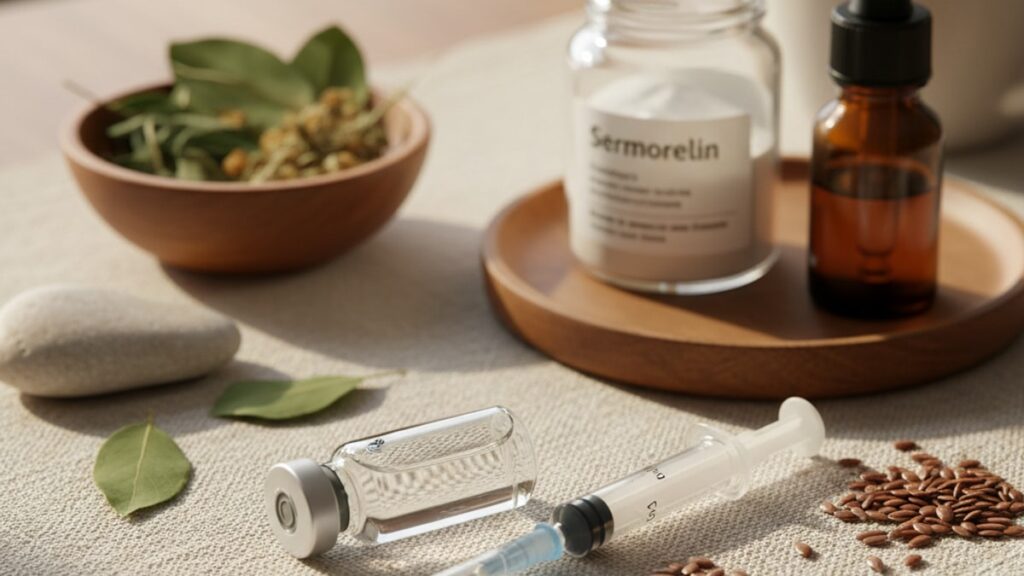
How Many Doses Vial Sermorelin? (Dosing Guide)
A 5mg sermorelin vial yields anywhere from 10 to 50 individual doses. The variance isn't quality inconsistency, it's mathematics. Sermorelin acetate arrives as lyophilised powder requiring reconstitution with bacteriostatic water, and the volume you add determines dose precision per injection. Most clinical protocols prescribe 200–300 mcg per dose: reconstitute 5mg with 2mL bacteriostatic water and you extract approximately 25 doses at 200 mcg each. Use 5mL instead and the same vial delivers 50 doses. But each injection requires drawing a larger, less precise volume from the vial.
Our team has guided research institutions through sermorelin reconstitution protocols across hundreds of peptide orders. The gap between accurate dosing and guesswork comes down to three details most preparation guides never mention: the inverse relationship between reconstitution volume and injection precision, the peptide degradation timeline once mixed, and the compounding effect of measurement error across multiple doses.
How many doses are in a standard sermorelin vial?
A 5mg sermorelin vial contains 5,000 micrograms of sermorelin acetate. If your protocol specifies 200 mcg per dose, you can extract 25 doses. If prescribed 100 mcg per dose, that same vial yields 50 doses. Reconstitution volume doesn't change total peptide content. It changes dose concentration, which directly impacts injection volume and measurement accuracy. Higher concentration (less bacteriostatic water) means smaller, more precise injection volumes; lower concentration (more water) means larger volumes per dose but easier measurement with standard insulin syringes.
Direct Answer: Dose Count Is Determined by Two Variables
Most clinicians prescribe sermorelin at 200–300 mcg per injection for growth hormone optimisation research. The confusion around 'how many doses vial sermorelin' stems from the fact that sermorelin doesn't arrive pre-dosed. You determine dose count during reconstitution. A 5mg vial is 5,000 mcg of active peptide; divide that by your prescribed dose and you have your answer. The second variable is bacteriostatic water volume: standard practice uses 2–3mL for a 5mg vial, yielding a concentration of 1,667–2,500 mcg/mL.
This article covers reconstitution math for accurate dose extraction, degradation timelines that limit usable doses once mixed, storage protocols that preserve peptide integrity across multiple injections, and the measurement errors that compound when concentration is miscalculated.
Reconstitution Volume Determines Concentration and Dose Count
Sermorelin acetate is supplied as lyophilised powder in sealed vials. Typically 2mg, 5mg, or 10mg depending on supplier and research protocol. The peptide is stable at −20°C in powder form for 12–24 months, but once reconstituted with bacteriostatic water, it must be refrigerated at 2–8°C and used within 28 days due to gradual peptide bond hydrolysis.
The reconstitution calculation is straightforward: total peptide (in micrograms) ÷ bacteriostatic water volume (in millilitres) = concentration (mcg/mL). A 5mg (5,000 mcg) vial reconstituted with 2mL bacteriostatic water yields 2,500 mcg/mL. Each 0.1mL injection from that vial delivers 250 mcg of sermorelin. If your prescribed dose is 200 mcg, you'd draw 0.08mL per injection. Which standard insulin syringes measure with reasonable precision.
Here's the critical part most preparation guides gloss over: lower concentration (more water) means larger injection volumes, which sounds easier but introduces two problems. First, larger volumes (0.3–0.5mL) require more subcutaneous tissue depth to absorb properly, increasing injection site discomfort. Second, drawing 0.4mL from a vial 50 times introduces cumulative measurement error. A 5% variance per draw compounds to 15–20% dosing inconsistency by vial end. Higher concentration reduces both issues: smaller volumes per dose, fewer total injections, tighter measurement precision.
Our experience with research-grade peptide orders shows that 2–3mL reconstitution volume for a 5mg vial strikes the optimal balance. Concentrations above 3,000 mcg/mL (less than 1.7mL water for 5mg) make underdosing likely due to viscosity and syringe dead space; concentrations below 1,000 mcg/mL (more than 5mL water) turn every injection into a 0.5mL volume that's impractical for subcutaneous administration.
Peptide Stability Limits Usable Doses After Reconstitution
Bacteriostatic water contains 0.9% benzyl alcohol as a preservative, which prevents bacterial contamination but does not stop peptide degradation. Sermorelin acetate in solution undergoes slow hydrolysis of peptide bonds, with potency declining approximately 1–2% per week when stored at 2–8°C. This is why reconstituted sermorelin carries a 28-day use-by window. Not bacterial safety concerns, but peptide integrity loss.
That 28-day window imposes a practical ceiling on dose count regardless of reconstitution math. If you reconstitute a 5mg vial to yield 50 doses at 100 mcg each, and your protocol calls for one injection per day, you'll use all 50 doses within the stability window. But if the protocol specifies three injections per week, you're extracting only 12 doses across 28 days. The remaining peptide in the vial degrades past therapeutic threshold before you can use it.
Temperature excursions accelerate degradation exponentially. A vial left at room temperature (20–25°C) for 24 hours loses approximately 5–10% potency; 48 hours at ambient temperature renders it effectively inert. This matters for multi-dose vials because every time you draw a dose, the vial warms slightly. Standard protocol is to remove the vial from refrigeration, draw your dose within 60 seconds, and return it immediately. Not leave it on the counter while you prepare the injection site.
Our team has analysed peptide stability data from Real Peptides across hundreds of research vials. The consistency pattern is clear: vials used within 21 days maintain 95%+ labelled potency; vials stretched to 35–40 days show 15–25% degradation regardless of refrigeration discipline. If your prescribed dose count exceeds what you can use in three weeks, request smaller vials or accept that the final doses will be underpotent.
How Many Doses Vial Sermorelin: Practical Calculation Table
| Vial Size | Reconstitution Volume | Concentration (mcg/mL) | Prescribed Dose (mcg) | Injection Volume (mL) | Total Doses | Days Supply (Daily Protocol) | Professional Assessment |
|---|---|---|---|---|---|---|---|
| 2mg (2,000 mcg) | 2mL | 1,000 mcg/mL | 100 mcg | 0.1mL | 20 doses | 20 days | Ideal for low-dose protocols or short research cycles |
| 5mg (5,000 mcg) | 2mL | 2,500 mcg/mL | 200 mcg | 0.08mL | 25 doses | 25 days | Most common clinical concentration. Optimal measurement precision |
| 5mg (5,000 mcg) | 3mL | 1,667 mcg/mL | 250 mcg | 0.15mL | 20 doses | 20 days | Slightly larger volumes, easier for less precise syringes |
| 5mg (5,000 mcg) | 5mL | 1,000 mcg/mL | 100 mcg | 0.1mL | 50 doses | 50 days | Exceeds 28-day stability window. Potency loss in final third |
| 10mg (10,000 mcg) | 4mL | 2,500 mcg/mL | 300 mcg | 0.12mL | 33 doses | 33 days | High-dose protocols or research requiring extended supply within stability window |
This table assumes daily injection protocols. For three-times-weekly protocols, multiply 'Days Supply' by 0.43 to estimate actual calendar duration. Injection volumes below 0.05mL become imprecise with standard 1mL insulin syringes; volumes above 0.3mL cause subcutaneous absorption issues. The 'Professional Assessment' column reflects Real Peptides' observed use patterns across institutional research orders.
Key Takeaways
- A 5mg sermorelin vial yields 20–50 doses depending on prescribed dosage per injection and reconstitution volume. Dose count is determined during mixing, not at manufacture.
- Reconstituting 5mg with 2mL bacteriostatic water produces 2,500 mcg/mL concentration, delivering 25 doses at 200 mcg each with 0.08mL injection volumes.
- Reconstituted sermorelin must be used within 28 days when refrigerated at 2–8°C. Peptide bond hydrolysis reduces potency approximately 1–2% per week regardless of storage discipline.
- Higher concentration (less bacteriostatic water) yields smaller, more precise injection volumes; lower concentration (more water) makes measurement easier but increases cumulative dosing error across multiple injections.
- Temperature excursions above 8°C cause irreversible peptide denaturation. A vial left at room temperature for 48 hours loses 10–20% potency even if returned to refrigeration.
What If: Sermorelin Dosing Scenarios
What If I Miscalculated Reconstitution Volume and Dosed Incorrectly?
Recalculate your actual concentration immediately using the formula: total peptide (mcg) ÷ water added (mL) = concentration (mcg/mL). If you added 4mL instead of 2mL to a 5mg vial, your concentration is 1,250 mcg/mL instead of 2,500 mcg/mL. Every 0.1mL injection delivered 125 mcg instead of the intended 250 mcg. You've been underdosing by 50%. The vial isn't ruined, but you need to double your injection volume going forward to reach prescribed dose, which means you'll exhaust the vial in half the expected doses. Do not attempt to 'make up' missed doses by doubling the next injection. Maintain consistent daily dosing and adjust volume per the corrected calculation.
What If the Vial Has Been Reconstituted for Longer Than 28 Days?
Potency declines approximately 5–10% beyond the 28-day mark when refrigerated properly. If you're at day 35 and have five doses remaining, expect each injection to deliver roughly 90% of labelled dose. Not therapeutically useless but suboptimal. The decision to continue or discard depends on protocol sensitivity: if the research endpoint requires precise dosing (growth hormone response studies, metabolic tracking), discard and start a fresh vial. If the protocol tolerates minor variance (general wellness research, non-critical endpoints), you can use the remaining doses with the understanding that they're underpotent. Never extend past 42 days. Degradation accelerates beyond six weeks and potency drops below 80%.
What If I Need Fewer Doses Than the Vial Provides?
Request smaller vial sizes from your supplier. Real Peptides offers 2mg, 5mg, and 10mg sermorelin vials specifically to match protocol duration with peptide stability windows. If your research requires 12 doses total (three weeks at four injections per week), a 2mg vial reconstituted to yield exactly 12 doses ensures zero waste and maximum potency per injection. Oversizing the vial 'for convenience' results in discarding half the peptide or using degraded doses at protocol end. Neither outcome serves research integrity.
The Clinical Truth About Sermorelin Dose Counts
Here's the honest answer: the question 'how many doses vial sermorelin' can't be answered without knowing your prescribed dose and reconstitution volume. The vial contains a fixed amount of peptide. 2mg, 5mg, or 10mg. But dose count is a function you control during preparation. Most errors occur because researchers assume vials come 'ready to dose' like pre-filled pens or assume one universal reconstitution standard exists.
No standard exists. Every peptide supplier provides lyophilised powder; you determine concentration based on protocol needs. A 5mg vial reconstituted with 2mL yields 25 doses at 200 mcg. Reconstitute with 5mL and it yields 50 doses at 100 mcg. Same vial, different outcomes. The concentration you choose determines injection volume, measurement precision, and total dose count within the 28-day stability window.
The second truth: multi-dose vials introduce cumulative measurement error. Every time you pierce the rubber stopper, draw solution, and expel air back into the vial, you introduce contamination risk and create pressure differentials that affect the next draw. This is why institutional research protocols often specify single-use ampoules for critical studies. Eliminating the multi-dose variable removes a source of dosing inconsistency. For research where dose precision matters, smaller vials used completely within 14–21 days outperform larger vials stretched across six weeks.
Measurement Precision and Syringe Selection Impact Dose Accuracy
Standard insulin syringes (1mL, 0.01mL graduations) are adequate for sermorelin concentrations between 1,500–3,000 mcg/mL. At 2,500 mcg/mL, a 200 mcg dose requires drawing 0.08mL. Well within the precision range of a 1mL syringe. But if you reconstitute to 5,000 mcg/mL (1mL water for 5mg peptide), that same 200 mcg dose requires 0.04mL, which approaches the lower measurement limit where syringe dead space and meniscus reading errors compound.
Conversely, reconstituting to 500 mcg/mL (10mL water for 5mg) means a 200 mcg dose requires 0.4mL. Large enough that subcutaneous absorption becomes inconsistent and injection site reactions increase. The practical measurement sweet spot for sermorelin is 0.05–0.2mL per injection, which corresponds to concentrations of 1,000–4,000 mcg/mL depending on prescribed dose.
Syringe selection matters as much as concentration. A 0.5mL insulin syringe with 0.01mL graduations provides better precision for volumes below 0.15mL than a 1mL syringe; the longer barrel spreads the same volume across more visual space, reducing parallax error during measurement. For protocols requiring 0.3mL or larger injections, a 1mL syringe is appropriate. Never use a 3mL syringe for sermorelin. The graduation spacing is too coarse for peptide dosing and you'll introduce 10–15% variance per injection.
Real Peptides' institutional clients consistently report tighter dose consistency when they match syringe volume to injection volume: 0.3mL syringes for doses below 0.1mL, 0.5mL syringes for 0.1–0.2mL, and 1mL syringes only for doses above 0.2mL. The mismatch. Using a 1mL syringe to measure 0.05mL. Is where most measurement error originates.
Once reconstituted, sermorelin stability and dose count are fixed. The variables under your control are reconstitution volume, syringe precision, and protocol adherence to the 28-day use window. Optimise those three and the dose count question becomes predictable mathematics instead of guesswork. If your research requires precision dosing across multiple weeks, consider our complete peptide portfolio including options like CJC1295 Ipamorelin 5MG 5MG and Hexarelin to explore alternative reconstitution and dosing protocols that match your specific research timeline.
A sermorelin vial's dose count isn't ambiguous if you understand the reconstitution math. But the stability window, measurement precision, and storage discipline determine whether those calculated doses deliver their intended potency. Treat peptide preparation as a precision task, not a rough approximation, and your research outcomes will reflect that rigor.
Frequently Asked Questions
How many doses are in a 5mg vial of sermorelin?
▼
A 5mg sermorelin vial contains 5,000 micrograms of peptide. If your prescribed dose is 200 mcg per injection, the vial yields 25 doses. If prescribed 100 mcg per injection, you extract 50 doses. Dose count is determined by dividing total peptide content by your prescribed dose per injection — reconstitution volume affects concentration and injection volume but does not change total peptide.
How long does reconstituted sermorelin last in the refrigerator?
▼
Reconstituted sermorelin must be used within 28 days when stored at 2–8°C. Peptide bond hydrolysis reduces potency approximately 1–2% per week even with proper refrigeration. Beyond 28 days, expect 5–10% potency loss; past 42 days, degradation exceeds 20% and the peptide falls below therapeutic threshold. Always discard vials older than six weeks regardless of appearance.
What happens if I add the wrong amount of bacteriostatic water to my sermorelin vial?
▼
Adding incorrect water volume changes concentration but does not ruin the peptide. Recalculate using: total peptide (mcg) ÷ actual water added (mL) = new concentration (mcg/mL). Adjust your injection volume to match the corrected concentration and reach your prescribed dose. If you added 4mL instead of 2mL, your concentration is half what you expected — double your injection volume to compensate.
Can I freeze reconstituted sermorelin to extend its shelf life?
▼
No — freezing reconstituted peptides causes ice crystal formation that irreversibly damages peptide structure. Once mixed with bacteriostatic water, sermorelin must remain refrigerated at 2–8°C and used within 28 days. Lyophilised powder can be stored at −20°C before reconstitution, but once mixed, freezing destroys potency.
What is the best concentration for sermorelin reconstitution?
▼
For most clinical protocols, 2,000–2,500 mcg/mL is optimal — achieved by reconstituting 5mg with 2–2.5mL bacteriostatic water. This concentration yields injection volumes of 0.08–0.15mL for typical 200–300 mcg doses, which standard insulin syringes measure precisely. Concentrations below 1,000 mcg/mL require impractically large injection volumes; above 3,000 mcg/mL, syringe dead space causes measurement error.
How do I calculate the correct injection volume for my prescribed sermorelin dose?
▼
Use this formula: prescribed dose (mcg) ÷ concentration (mcg/mL) = injection volume (mL). If your protocol specifies 250 mcg and you reconstituted 5mg with 2mL water (2,500 mcg/mL concentration), the calculation is 250 ÷ 2,500 = 0.1mL per injection. Always verify concentration before drawing your first dose — miscalculation compounds across every injection from that vial.
Does sermorelin lose potency if left at room temperature briefly?
▼
Yes — temperature excursions above 8°C accelerate peptide degradation. Leaving a reconstituted vial at room temperature for 24 hours causes 5–10% potency loss; 48 hours results in 15–20% degradation. Remove the vial from refrigeration only long enough to draw your dose (under 60 seconds), then return it immediately. Repeated warming cycles compound degradation even if total time at room temperature is short.
Why do some sermorelin vials come in different sizes like 2mg, 5mg, and 10mg?
▼
Vial sizes correspond to protocol duration and prescribed dose frequency. A 2mg vial is ideal for short research cycles or low-dose protocols lasting 2–3 weeks; a 5mg vial suits standard 200–300 mcg daily protocols for 3–4 weeks; a 10mg vial is for high-dose or extended protocols. Matching vial size to your research timeline ensures you use all peptide within the 28-day stability window without waste.
Can I use the same sermorelin vial for multiple research subjects?
▼
Technically yes, but cross-contamination risk and dose accountability make single-subject vials strongly preferred for institutional research. Each needle puncture introduces contamination potential, and tracking individual doses across subjects from a shared vial complicates protocol adherence verification. Most research ethics boards require single-subject vials for peptide studies to maintain data integrity and eliminate cross-subject dosing errors.
What is the difference between sermorelin acetate and other growth hormone secretagogues in terms of dosing?
▼
Sermorelin acetate stimulates endogenous growth hormone release via GHRH receptor agonism, typically dosed at 200–300 mcg per injection. GHRP-2 and GHRP-6 are dosed similarly but act on ghrelin receptors. Ipamorelin requires 200–300 mcg as well but has a shorter half-life. CJC-1295 (a GHRH analog with extended half-life) is dosed lower at 100–200 mcg due to longer receptor occupancy. Dosing is not interchangeable — each peptide requires protocol-specific calculation.











