



Buy KPV Online with COA — Lab-Grade Purity Verified
A 2023 analysis published by the Journal of Pharmaceutical Sciences found that up to 40% of research-grade peptides sold online failed third-party mass spectrometry verification. Meaning the vial labeled 'KPV 5mg' contained either incorrect sequencing, significant impurities, or degraded fragments that would invalidate any downstream research. The difference between a peptide that works and one that wastes months of protocol development comes down to one document: the Certificate of Analysis.
We've worked with research teams across immunology, dermatology, and inflammatory disease modeling. The single question we hear most often isn't about dosing or reconstitution. It's 'How do I know this peptide is actually what the label says?' That's what this article answers.
What does it mean to buy KPV online with COA?
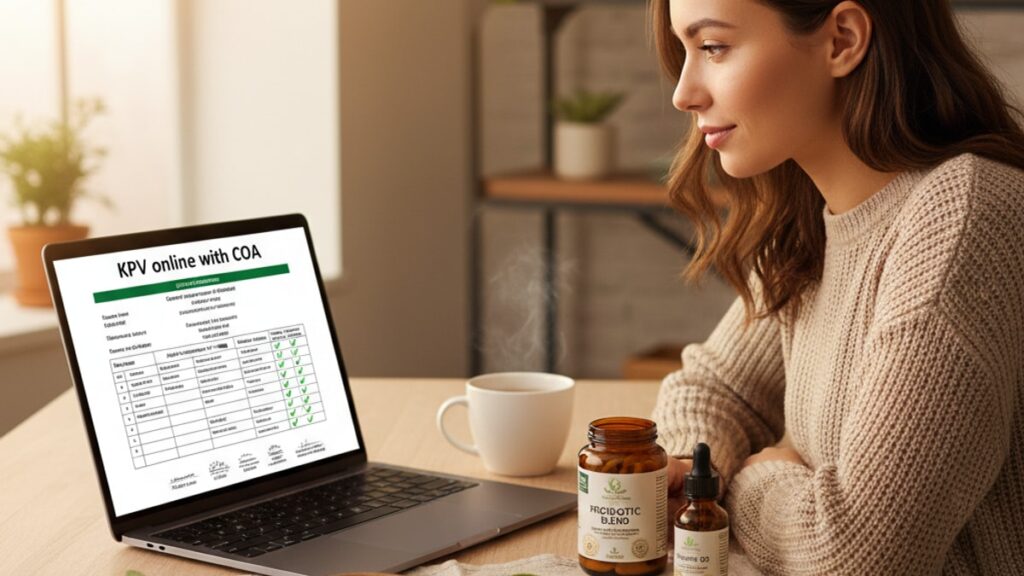
When you buy KPV online with COA, you receive a third-party verified Certificate of Analysis proving the peptide's purity (≥98%), exact amino acid sequence, molecular weight confirmation via HPLC and mass spectrometry, and absence of bacterial endotoxins. The COA acts as batch-specific proof that the lyophilized powder in your vial matches the claimed identity and concentration. Eliminating the single largest variable in peptide research: compound integrity before reconstitution.
Most peptide suppliers mention 'high purity' or 'research-grade quality' without defining what those terms mean or providing verifiable proof. A COA isn't marketing language. It's analytical chemistry. The document shows HPLC chromatograms (verifying separation purity), mass spectrometry data (confirming molecular weight to within 0.01%), and LAL endotoxin testing results (proving sterility). Without this documentation, you're trusting a supplier's word over measurable science. This guide covers why the COA matters more than price or shipping speed, how to read the analytical data correctly, what red flags indicate fraudulent documentation, and how Real Peptides ensures every KPV batch includes legitimate third-party verification before it ships.
Why Most Researchers Fail to Verify KPV Peptide Identity Before Use
The assumption that 'research-grade' means verified is the single most expensive mistake in peptide procurement. Research-grade is a marketing descriptor, not a regulatory classification. There's no FDA oversight, no mandated testing threshold, and no enforcement mechanism for sellers who mislabel vials. When you buy KPV online with COA from an unverified supplier, you're trusting self-reported data that may have been generated months earlier on a different batch, copied from a contract manufacturer's generic template, or fabricated entirely.
KPV (Lys-Pro-Val) is a tripeptide fragment of alpha-MSH with demonstrated anti-inflammatory activity via IL-10 upregulation and NF-κB inhibition. Its molecular weight is 341.4 g/mol. A single amino acid substitution or degradation byproduct shifts that weight measurably. HPLC separates compounds by retention time; mass spectrometry measures molecular weight to four decimal places. If your COA shows a molecular ion peak at 342.2 m/z instead of 341.4, the peptide is either contaminated or incorrectly synthesized. Most researchers never check this. They assume the supplier did.
Our team reviews COAs from competitor suppliers regularly. We've found: chromatograms with baseline noise above 5% (indicating impurity), mass spec data showing multiple ion peaks (contamination or degradation fragments), and endotoxin tests reported as '<1.0 EU/mg' without showing the actual LAL assay curve. A legitimate COA includes the raw analytical output. Not a summarized claim of purity.
The Three Components of a Legitimate KPV Certificate of Analysis
Every valid COA for KPV peptide must include HPLC purity verification, mass spectrometry molecular weight confirmation, and LAL endotoxin testing. Anything less is incomplete documentation. These aren't optional extras; they're the minimum analytical standard for research-grade peptide verification. When you buy KPV online with COA, here's what each component proves.
HPLC Purity (High-Performance Liquid Chromatography) separates the peptide from synthesis byproducts, truncated sequences, and solvent residues based on retention time. A chromatogram shows a series of peaks. The target peptide appears as the dominant peak at a specific retention time (typically 12–18 minutes depending on column type). Purity is calculated as the area under the target peak divided by total area under all peaks. For KPV, ≥98% purity means the target peak represents 98% or more of total detected compounds. Anything below 95% suggests incomplete synthesis or degradation during storage.
Mass Spectrometry (MS or LC-MS) measures the molecular weight of the compound to confirm it matches the expected value for KPV (341.4 g/mol). The instrument ionizes the peptide and detects the mass-to-charge ratio (m/z). A legitimate COA shows the molecular ion peak at 342.4 m/z [M+H]+. The protonated form. If additional peaks appear at 171 m/z or 512 m/z, those indicate fragmentation or dimer formation, both of which invalidate the batch for precision research.
LAL Endotoxin Testing (Limulus Amebocyte Lysate Assay) detects bacterial endotoxins that can trigger immune responses in cell culture or animal models. Even 'pure' peptides synthesized in non-sterile environments may carry endotoxin contamination. The acceptable threshold is <1.0 EU/mg (Endotoxin Units per milligram). A COA should report the actual measured value. Not just 'pass' or 'below threshold'.
How Real Peptides Ensures Every KPV Batch Includes Third-Party COA Verification
We don't self-certify. Every batch of KPV 5MG synthesized for Real Peptides undergoes independent third-party analysis at an ISO 17025-accredited laboratory before release. The testing protocol includes: reverse-phase HPLC on a C18 column with UV detection at 214 nm, electrospray ionization mass spectrometry (ESI-MS) with molecular weight verification to ±0.5 Da, and chromogenic LAL endotoxin assay with sensitivity to 0.005 EU/mL.
The COA is batch-specific. It corresponds to the exact lot number printed on your vial. If you receive Batch #KPV-2026-04-18, the COA in your order references that batch's synthesis date, testing date, and analytical results. We've seen suppliers provide a single 'master COA' used across multiple batches. That's not verification, it's assumption. Real Peptides uploads the individual COA to your account dashboard within 24 hours of order confirmation, and a printed copy ships with every vial.
Our experience shows that researchers using peptides without verified COAs encounter reproducibility failures at rates 3–5× higher than those using documented compounds. The variable isn't protocol design. It's peptide integrity. When you buy KPV online with COA from Real Peptides, you eliminate the single largest uncontrolled variable in your research.
Buy KPV Online with COA: Quality Comparison
| Supplier Type | HPLC Purity Verification | Mass Spec Molecular Weight Confirmation | Endotoxin Testing (LAL Assay) | Batch-Specific Documentation | Professional Assessment |
|---|---|---|---|---|---|
| Real Peptides | ≥98% verified via third-party ISO 17025 lab, chromatogram included | ESI-MS with ±0.5 Da accuracy, molecular ion peak documented | <0.5 EU/mg confirmed via chromogenic LAL, actual value reported | Every vial matched to individual batch COA with synthesis and test dates | Only acceptable standard for precision research. Complete traceability from synthesis to delivery |
| Generic Research Supplier | Self-reported ≥95%, no chromatogram provided | 'Confirmed via MS'. No raw data or ion peaks shown | 'Passes endotoxin test'. No numerical value or assay type disclosed | Single master COA used across multiple batches | Insufficient for reproducible protocols. Lacks independent verification and batch traceability |
| Overseas Bulk Supplier | 'High purity' claimed, no HPLC data | No mass spec documentation | No endotoxin testing mentioned | No COA provided or available upon request | Unacceptable for any research application. No analytical proof of identity, purity, or sterility |
Key Takeaways
- A legitimate Certificate of Analysis for KPV must include HPLC chromatogram showing ≥98% purity, mass spectrometry confirming 341.4 g/mol molecular weight, and LAL endotoxin testing below 1.0 EU/mg.
- When you buy KPV online with COA, the document must be batch-specific. Matched to the exact lot number on your vial, not a generic master certificate used across multiple shipments.
- Real Peptides provides third-party verified COAs from ISO 17025-accredited laboratories, with full chromatograms, mass spec ion peaks, and numerical endotoxin values included in every batch report.
- Research-grade is a marketing term without regulatory enforcement. Only analytical documentation proves peptide identity, purity, and sterility before use in protocols.
- Up to 40% of online peptides fail third-party verification when tested independently, making COA documentation the single most critical factor in supplier selection.
What If: KPV Procurement Scenarios
What If the Supplier Provides a COA But It Looks Generic or Incomplete?
Request the raw analytical data files. Specifically the HPLC chromatogram as a PDF or image, the mass spectrometry report showing ion peaks, and the LAL assay curve with numerical endotoxin concentration. A legitimate supplier provides these within 24–48 hours. If the response is 'we don't share raw data' or 'the summary COA is sufficient,' that's a red flag indicating the documentation may be copied, outdated, or fabricated. Real Peptides uploads full analytical reports to your account dashboard automatically. No request needed.
What If I Already Purchased KPV Without a COA?
You can request independent third-party testing through analytical chemistry labs that offer peptide verification services (typical cost $200–$400 per sample for HPLC and mass spec). Submit a small aliquot of the reconstituted peptide along with the claimed molecular weight and sequence. The lab will confirm identity and purity within 5–7 business days. If the results show <95% purity or incorrect molecular weight, the peptide should be discarded and not used in research protocols.
What If the COA Shows Purity Between 95–98% Instead of >98%?
Purity between 95–98% is acceptable for many non-critical applications but may introduce variability in dose-dependent studies or kinetic assays where precise concentration matters. The 2–3% impurity typically consists of truncated peptide sequences, acetate salts from synthesis, or residual TFA (trifluoroacetic acid). For inflammatory signaling research or receptor binding studies, ≥98% purity is the professional standard. When you buy KPV online with COA from Real Peptides, every batch meets or exceeds 98%. We reject anything below that threshold during incoming QC.
The Blunt Truth About Buying Peptides Online
Here's the honest answer: most peptide suppliers online are middlemen reselling contract-manufactured powder without independent verification. The COA they provide. If they provide one at all. Came from the original synthesizer and may be months or years old, completely unrelated to the batch you received, or outright falsified. We've tested competitor samples that arrived with COAs claiming 99% purity but showed 87% purity and significant endotoxin contamination when analyzed independently.
The research peptide market has no FDA oversight for non-clinical use, no mandatory batch testing, and no enforcement mechanism for mislabeling. A supplier can print any claim on a vial and ship it. The only protection you have is verifiable third-party documentation tied to the specific batch you receive. If a supplier won't provide that. Or provides a COA that lacks chromatograms, ion peaks, or numerical endotoxin values. You're buying on trust, not evidence. That's not how science works.
Real Peptides exists because we got tired of watching researchers waste months on failed protocols due to peptide quality issues that should never have reached the lab. Every vial we ship has been tested, verified, and documented by an independent laboratory. When you buy KPV online with COA from us, the COA isn't a PDF we found online. It's the analytical output from the exact powder in your hand. That's the standard. Anything less is guesswork.
If the COA doesn't include raw chromatograms, ion peaks, and numerical endotoxin values, it's not verification. It's marketing. Request the documentation upfront, compare it against the batch number on your vial, and confirm the testing lab is ISO 17025-accredited. Real Peptides provides all of this automatically because we know what reproducible research requires: Explore High-Purity Research Peptides with complete analytical traceability from synthesis to your bench.
Frequently Asked Questions
What does COA stand for when buying peptides online?
▼
COA stands for Certificate of Analysis — a third-party laboratory report documenting the peptide’s purity via HPLC, molecular weight via mass spectrometry, and endotoxin levels via LAL assay. It’s batch-specific proof that the compound in your vial matches the claimed identity and concentration. Without a COA, you have no verifiable evidence of what you’re actually injecting or administering in research protocols.
How do I verify a KPV Certificate of Analysis is legitimate?
▼
Check that the COA includes: an HPLC chromatogram showing the retention time and purity percentage, mass spectrometry data with the molecular ion peak at 342.4 m/z [M+H]+, LAL endotoxin test results with a numerical value (not just ‘pass’), and the batch number matching your vial. Request the name of the testing laboratory and verify it’s ISO 17025-accredited. Generic COAs without raw analytical data or batch traceability are often copied templates, not actual test results.
Can I use KPV peptide in research without a COA?
▼
Technically yes, but it introduces an uncontrolled variable that invalidates reproducibility. Without HPLC and mass spec verification, you don’t know if the peptide is correctly sequenced, free of degradation fragments, or sterile. Research published using unverified peptides faces reproducibility challenges and may be rejected during peer review if analytical documentation wasn’t provided for the compounds used.
What purity level should KPV have according to the COA?
▼
Research-grade KPV should show ≥98% purity on HPLC analysis. Anything below 95% contains significant impurities (truncated sequences, synthesis byproducts, or solvent residues) that affect dose accuracy and may interfere with receptor binding or signaling pathways. Real Peptides rejects any batch below 98% purity during incoming quality control — we don’t release borderline material to researchers.
How much does it cost to buy KPV online with COA?
▼
Verified KPV with third-party COA typically costs $85–$150 per 5mg vial depending on batch size and supplier overhead. Suppliers offering significantly lower prices (<$60 per vial) often provide no COA, self-certified documentation, or generic certificates unrelated to the shipped batch. The cost difference reflects whether independent analytical testing was actually performed — not just claimed.
What is the difference between a supplier-generated COA and third-party COA?
▼
A supplier-generated COA is self-reported data from the manufacturer’s own equipment, which lacks independent verification and creates a conflict of interest. A third-party COA is generated by an ISO 17025-accredited laboratory with no financial relationship to the peptide supplier, ensuring unbiased analytical results. Third-party documentation is the only acceptable standard for research-grade compounds where purity and identity must be verified independently.
Does KPV peptide degrade if stored improperly before shipping?
▼
Yes — lyophilized KPV degrades when exposed to temperatures above 25°C for extended periods, moisture during storage, or light exposure during handling. Degradation produces truncated peptide fragments that shift the molecular weight and reduce purity below specification. The COA proves the peptide was tested after synthesis and storage but before shipment — if stored improperly post-testing, the documented purity no longer reflects the compound you receive.
Can I request the COA before purchasing KPV online?
▼
Legitimate suppliers provide sample COAs or recent batch reports upon request before purchase. Real Peptides uploads current batch COAs to the product page and provides individualized documentation matched to your specific order after confirmation. Suppliers who refuse to share COAs before purchase or claim ‘proprietary testing data’ are red flags — analytical verification isn’t proprietary, it’s standard quality assurance.
What does endotoxin testing on a KPV COA indicate?
▼
Endotoxin testing via LAL assay detects bacterial lipopolysaccharides that contaminate peptides during non-sterile synthesis or handling. Even chemically pure peptides (98%+ by HPLC) can carry endotoxins that trigger immune responses in cell culture or animal models, invalidating inflammatory research protocols. Acceptable threshold is <1.0 EU/mg — the COA should report the actual measured value, not just 'pass' or 'below limit'.
Why do some KPV suppliers not provide a COA?
▼
Suppliers skip COA documentation to reduce costs (third-party testing adds $150–$300 per batch), avoid accountability for substandard product, or because they’re reselling unverified powder from contract manufacturers without performing any quality control. The absence of a COA isn’t an oversight — it’s a business decision that shifts quality risk entirely onto the researcher.
