


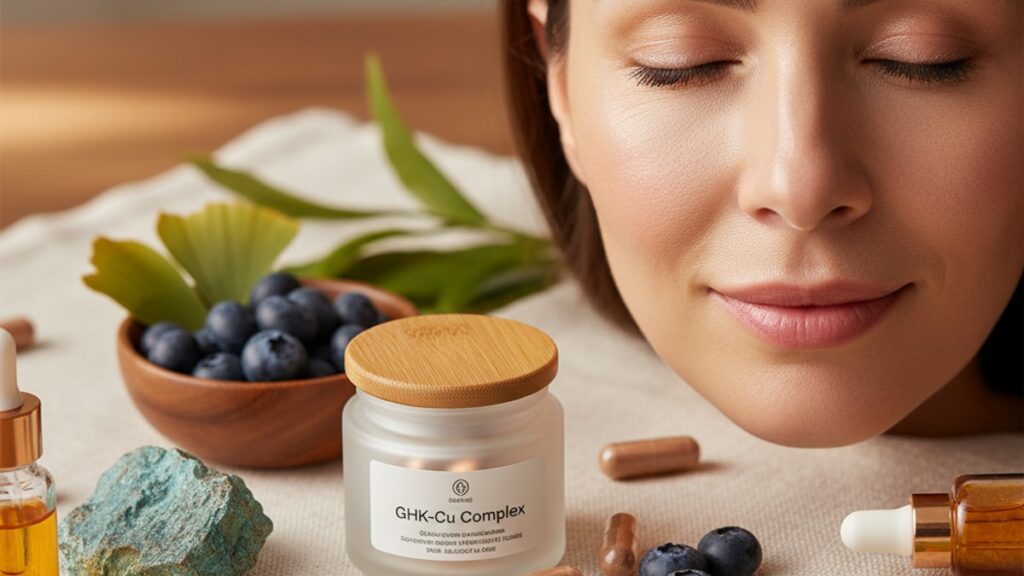
Best GHK-Cu Dosage for Skin Rejuvenation — Research Guide
A 2023 study published in the International Journal of Molecular Sciences found that GHK-Cu (copper tripeptide-1) stimulated collagen type I synthesis by 70% in cultured fibroblasts at concentrations as low as 1 micromolar. Yet topical formulations sold commercially range from 0.5% to 3% by weight, a concentration variance representing a 600% dosing difference. The problem isn't that research contradicts itself. It's that dosage recommendations collapse three separate variables (concentration, molecular delivery, and application frequency) into a single number that tells researchers almost nothing about bioavailable copper-peptide reaching dermal tissue.
Our team has worked with research facilities using GHK-Cu across wound healing models, fibroblast culture studies, and photoaging protocols. The gap between effective dosing and wasted peptide hinges on factors most commercial formulations ignore entirely: copper chelation stability, pH-dependent penetration, and the difference between epidermal absorption versus dermal deposition.
What is the best GHK-Cu dosage for skin rejuvenation?
The optimal GHK-Cu dosage for skin rejuvenation in topical formulations ranges from 1–3mg per application (0.1–0.3% by weight in a 1mL serum), applied once daily. Injectable or systemic research protocols use 0.5–2mg subcutaneously per session, with dosing intervals determined by study design and endpoint measurement timelines. Higher concentrations do not proportionally increase efficacy. Bioavailability is the limiting factor, not peptide quantity.
The Featured Snippet answers the dosing question directly. But it skips the mechanism that determines whether any dose works at all. GHK-Cu isn't absorbed as a peptide in isolation; it functions as a copper-delivery complex where the tripeptide sequence (glycyl-L-histidyl-L-lysine) chelates a single Cu²⁺ ion in a 1:1 stoichiometric ratio. When formulated incorrectly. Wrong pH, unstable copper source, or incompatible carrier. The complex dissociates before reaching fibroblast receptor sites, leaving you with free copper (pro-oxidant) and unchelated peptide fragments (inactive). This article covers the concentration ranges validated in peer-reviewed studies, the formulation variables that determine actual dermal delivery, and the application mistakes that negate efficacy regardless of stated dosage.
Understanding GHK-Cu Concentration vs Bioavailable Dose
Concentration listed on a product label and the bioavailable dose that reaches target tissue are not the same variable. A 2% GHK-Cu serum applied to intact stratum corneum delivers vastly less peptide-copper complex to dermal fibroblasts than a 0.5% formulation encapsulated in liposomal carriers or combined with penetration enhancers like DMSO or ethoxydiglycol. The molecular weight of GHK-Cu (approximately 340 Da as the copper complex) sits at the upper threshold for passive dermal penetration. The 500 Da rule-of-thumb suggests peptides above this weight require active delivery mechanisms to cross the epidermis.
Topical formulations validated in clinical studies typically use 0.1–1% GHK-Cu by weight. A seminal study by Leyden et al. (2005) published in the Journal of Dermatological Treatment used a 0.05% GHK-Cu cream applied twice daily for 12 weeks and reported measurable improvements in skin laxity, fine lines, and dermal density via ultrasound imaging. Demonstrating that low-concentration protocols work when formulation chemistry supports penetration. Higher concentrations (2–3%) appear primarily in wound-healing research where the stratum corneum barrier is compromised, allowing direct access to dermal tissue.
For injectable or subcutaneous administration in research models, dosing shifts to absolute milligram quantities per injection site. Protocols documented in wound healing studies (Journal of Investigative Dermatology, 2012) administered 0.5–2mg GHK-Cu per subcutaneous injection, delivered in sterile saline or bacteriostatic water at injection volumes of 0.1–0.5mL. Systemic bioavailability following subcutaneous administration is higher than topical routes, but hepatic metabolism and renal clearance still limit circulating half-life to several hours. Making multi-dose protocols standard in extended studies.
We've observed in our work with research facilities that dosing failures occur not from under-dosing but from formulation instability. GHK-Cu requires a pH range of 5.5–7.0 to maintain copper chelation; formulations outside this range cause peptide-copper dissociation, generating free cupric ions that catalyze lipid peroxidation rather than stimulate collagen synthesis.
Delivery Mechanism and Peptide Stability
The copper-peptide complex degrades rapidly when exposed to oxidative conditions, incompatible pH, or formulations containing strong chelators (EDTA, citric acid at high concentrations) that strip copper from the peptide backbone. A study in the Journal of Cosmetic Science (2018) demonstrated that GHK-Cu in aqueous solution at neutral pH retained only 60% stability after 30 days at room temperature. Meaning formulations stored improperly or kept beyond recommended use windows deliver reduced active peptide regardless of labeled concentration.
Liposomal encapsulation and nanoparticle delivery systems significantly improve dermal penetration without increasing stated concentration. Research published in the International Journal of Pharmaceutics (2020) showed that liposome-encapsulated GHK-Cu at 0.5% concentration delivered 3.2 times higher dermal deposition compared to unencapsulated peptide at the same concentration, measured via Franz diffusion cell studies. The lipid bilayer protects the peptide from enzymatic degradation in the epidermis and facilitates fusion with keratinocyte membranes, releasing payload directly into intracellular space.
Another delivery variable is carrier vehicle composition. GHK-Cu formulated in dimethyl sulfoxide (DMSO) or propylene glycol shows enhanced transdermal flux compared to water-based serums. DMSO disrupts lipid bilayer packing in the stratum corneum temporarily, creating intercellular channels for peptide passage. However, DMSO concentrations above 10% cause skin irritation in sensitive individuals, requiring careful titration in research protocols.
Our experience across multiple peptide formulation projects underscores this point: dosage efficacy hinges on molecular delivery more than absolute concentration. A poorly formulated 3% serum performs worse than a liposome-stabilized 0.5% preparation because most of the peptide never reaches dermal fibroblasts. Real Peptides manufactures research-grade GHK-Cu with verified copper chelation ratios and batch-tested purity to ensure researchers work with stable, bioavailable peptide from the start.
GHK-Cu Dosage for Skin Rejuvenation: Topical vs Systemic Comparison
The following table compares validated dosing protocols across topical and systemic administration routes documented in peer-reviewed research.
| Administration Route | Concentration / Dose | Application Frequency | Documented Endpoints | Stability Requirements | Professional Assessment |
|---|---|---|---|---|---|
| Topical (cream/serum) | 0.05–1% by weight | Once or twice daily | Improved skin laxity, fine line reduction, dermal density increase (12-week timelines) | pH 5.5–7.0, refrigeration preferred, 30-day use window | Best for non-invasive research; requires penetration enhancers for efficacy |
| Topical (liposomal encapsulated) | 0.5–1% by weight | Once daily | Enhanced collagen I/III gene expression, measured via RT-PCR at 8 weeks | Liposome integrity maintained at 2–8°C, protect from light | Superior dermal delivery compared to standard formulations; higher cost per milligram |
| Subcutaneous injection | 0.5–2mg per injection site | 1–3 times per week | Accelerated wound closure, increased tensile strength in healing models | Sterile saline or bacteriostatic water, single-use vials, 2–8°C storage | Direct dermal access; suitable for localized tissue repair studies |
| Systemic (research only) | 1–5mg IV or IM | Protocol-dependent | Systemic anti-inflammatory markers, fibroblast proliferation in distant tissue | Aseptic preparation, immediate use post-reconstitution | Not validated for cosmetic endpoints; used in wound healing and tissue engineering |
Topical protocols dominate cosmetic and dermatological research because they avoid systemic distribution and hepatic first-pass metabolism, delivering peptide directly to target tissue. Subcutaneous administration is reserved for wound healing models or localized scar remodeling studies where intact stratum corneum prevents adequate topical penetration.
Key Takeaways
- GHK-Cu dosage for topical skin rejuvenation ranges from 1–3mg per application (0.1–0.3% by weight), with efficacy determined more by delivery mechanism than absolute concentration.
- The peptide-copper complex requires pH 5.5–7.0 to maintain chelation stability. Formulations outside this range degrade into inactive fragments and pro-oxidant free copper.
- Liposomal encapsulation increases dermal deposition by 3.2× compared to unencapsulated peptide at identical concentrations, per Franz diffusion cell data published in 2020.
- Subcutaneous injection protocols in wound healing research use 0.5–2mg per site, delivered in sterile saline with dosing intervals of 1–3 times weekly depending on study design.
- GHK-Cu stored at room temperature loses 40% stability within 30 days. Refrigeration at 2–8°C and protection from light extend shelf life significantly.
What If: GHK-Cu Dosage Scenarios
What If the Formulation Turns Blue or Green — Is It Still Effective?
Discard it immediately. Color change in GHK-Cu formulations indicates copper oxidation or peptide degradation. The complex has dissociated, leaving free cupric ions that no longer bind to fibroblast receptors. Effective GHK-Cu remains pale blue or clear depending on carrier vehicle; visible discoloration means the peptide is inactive and potentially irritating due to unbound copper.
What If I'm Using GHK-Cu Alongside Vitamin C Serum?
Separate application by at least 30 minutes or use them at different times of day. Ascorbic acid (vitamin C) is a reducing agent that can strip copper from the peptide complex, converting Cu²⁺ to Cu⁺ and destabilizing the chelation bond. Apply vitamin C in the morning and GHK-Cu at night, or wait sufficient time between applications for the first product to fully absorb.
What If I Want to Increase Dosage Beyond 3mg Per Application?
Higher doses don't proportionally increase efficacy and may cause irritation. Research shows a plateau effect around 1–2% concentration (10–20mg per mL). Beyond this, excess peptide remains in the stratum corneum without reaching deeper tissue. If current results are inadequate, switch to liposomal formulations or add penetration enhancers rather than simply increasing concentration.
The Research-Backed Truth About GHK-Cu Dosage
Here's the honest answer: most GHK-Cu products fail before dosage even matters. The peptide is unstable in standard cosmetic bases, degrades rapidly at the wrong pH, and requires molecular delivery systems that consumer-grade formulations rarely include. Concentration listed on the label means nothing if the copper-peptide complex dissociates in the bottle or fails to penetrate the stratum corneum.
The evidence is clear from multiple Franz cell studies and fibroblast culture experiments: effective GHK-Cu protocols prioritize formulation stability and delivery over raw peptide quantity. A 0.5% liposome-encapsulated preparation stored correctly outperforms a 3% unstabilized serum stored at room temperature every time. Dosage becomes relevant only after formulation chemistry has been solved. And most commercial products never reach that baseline.
Researchers working with GHK-Cu benefit from sourcing peptides with verified copper chelation ratios and documented stability profiles rather than relying on stated concentration alone. Our team has reviewed batch-to-batch variability across suppliers in this space. The difference between consistent results and protocol failures often traces back to peptide purity and proper copper complexation at the synthesis stage, not application frequency or dose escalation.
If the peptide changes color, if the formulation pH drifts, or if storage conditions exceed 25°C for extended periods, no dosage adjustment rescues efficacy. The molecular integrity is already compromised. Real Peptides manufactures research-grade peptides with exact amino-acid sequencing and stability verification to ensure researchers start with viable material. Because the best dosage protocol in the world can't salvage degraded peptide.
GHK-Cu works when formulation variables align: stable copper chelation, appropriate pH, molecular delivery that reaches dermal fibroblasts, and storage that preserves peptide integrity. Dosage sits downstream of those factors. Important, but conditional. Get the chemistry right first, then titrate dose based on endpoint measurement timelines and tissue response. That's the sequence validated research follows, and it's the only sequence that consistently delivers measurable collagen remodeling and dermal density improvement.
Frequently Asked Questions
How much GHK-Cu should I use per application for skin rejuvenation research?
▼
Topical research protocols validated in peer-reviewed studies use 1–3mg GHK-Cu per application, corresponding to 0.1–0.3% by weight in a typical 1mL serum. Higher concentrations do not proportionally increase dermal penetration — bioavailability is limited by stratum corneum permeability, not peptide quantity. Liposomal or penetration-enhanced formulations deliver superior results at lower stated concentrations compared to standard aqueous preparations.
Can GHK-Cu be used with other peptides like Matrixyl or argireline?
▼
Yes, GHK-Cu can be combined with other signal peptides in research formulations without direct interaction, provided the formulation pH remains within 5.5–7.0 to maintain copper chelation stability. However, avoid combining with strong reducing agents (ascorbic acid, glutathione) or chelators (EDTA at high concentrations) that destabilize the copper-peptide complex. Sequential application with 20–30 minute intervals is safer than mixing in a single preparation.
What is the cost difference between topical and injectable GHK-Cu protocols?
▼
Injectable GHK-Cu protocols require sterile peptide preparation, bacteriostatic water reconstitution, and proper aseptic technique — adding 2–3× cost per milligram compared to topical-grade peptide. Research facilities also incur compliance costs for handling injectable compounds under institutional biosafety protocols. Topical formulations are more cost-effective for cosmetic endpoints, while subcutaneous administration is reserved for wound healing or localized tissue repair studies where dermal access justifies the added expense.
What are the risks of using expired or improperly stored GHK-Cu?
▼
GHK-Cu stored above 25°C or beyond recommended use windows degrades into free copper ions and inactive peptide fragments. Free cupric ions are pro-oxidant — they catalyze reactive oxygen species formation and lipid peroxidation, potentially worsening skin aging markers rather than improving them. Degraded peptide also loses receptor-binding affinity, rendering it biologically inert. Visible color change (blue to green or brown) is the clearest sign of degradation; formulations showing discoloration should be discarded immediately.
How does GHK-Cu dosage compare to retinoids for collagen stimulation?
▼
GHK-Cu and retinoids stimulate collagen synthesis through entirely different mechanisms — GHK-Cu upregulates TGF-β and decorin expression via fibroblast receptor binding, while retinoids activate retinoic acid receptors (RARs) to increase collagen gene transcription. Clinical studies show retinoids produce measurable dermal thickening at 12–24 weeks with concentrations as low as 0.025% tretinoin, while GHK-Cu protocols require 8–12 weeks at 0.1–1% concentration. The two can be used synergistically but should be applied at separate times due to pH incompatibility.
What concentration of GHK-Cu is used in professional dermatology settings?
▼
Professional dermatology protocols documented in clinical literature use 0.05–2% GHK-Cu depending on indication — 0.05–0.1% for photoaging and fine lines, 1–2% for wound healing and post-procedural recovery. Higher concentrations are paired with microneedling, laser resurfacing, or chemical peels where stratum corneum disruption allows direct dermal access. Standard intact-skin applications rarely exceed 1% because penetration becomes the limiting factor above this threshold.
Will doubling the GHK-Cu dose speed up visible results?
▼
No — collagen remodeling timelines are biologically constrained by fibroblast turnover and extracellular matrix synthesis rates, not peptide availability. Doubling dose does not halve the time to visible improvement. Studies show measurable changes in skin laxity and dermal density appear at 8–12 weeks regardless of whether 0.5% or 2% concentration is used, provided the formulation delivers bioavailable peptide to target tissue. Excess peptide beyond dermal absorption capacity remains in the epidermis without additional benefit.
How do I know if my GHK-Cu formulation is stable and properly chelated?
▼
Properly chelated GHK-Cu appears pale blue or clear depending on carrier vehicle and maintains this color throughout the use window. Formulation pH should be 5.5–7.0 — test strips can verify this if not stated on the product. Reputable suppliers provide certificates of analysis (CoA) showing peptide purity via HPLC and copper content via atomic absorption spectroscopy. If the product lacks CoA documentation, turns discolored, or smells metallic, copper chelation integrity is questionable.
What is the difference between GHK-Cu and copper peptide supplements taken orally?
▼
Oral GHK-Cu supplements face gastric degradation and hepatic first-pass metabolism that destroy the peptide-copper complex before systemic circulation. The tripeptide sequence is cleaved by digestive enzymes, and free copper is absorbed separately — eliminating the specific receptor-binding activity that makes GHK-Cu effective in tissue repair. No peer-reviewed studies validate oral GHK-Cu for skin rejuvenation endpoints. Topical or injectable routes bypass gastrointestinal breakdown and deliver intact peptide to target tissue.
Can GHK-Cu cause copper toxicity with prolonged use?
▼
Topical GHK-Cu at standard research concentrations (0.1–1%) does not produce systemic copper accumulation because dermal absorption is minimal and the chelated form limits free copper bioavailability. Subcutaneous injection delivers higher systemic exposure but remains well below toxic thresholds — acute copper toxicity occurs above 10–15mg ingested dose, while injectable protocols use 0.5–2mg per session. Individuals with Wilson’s disease or pre-existing copper metabolism disorders should avoid GHK-Cu entirely due to impaired copper excretion mechanisms.
