





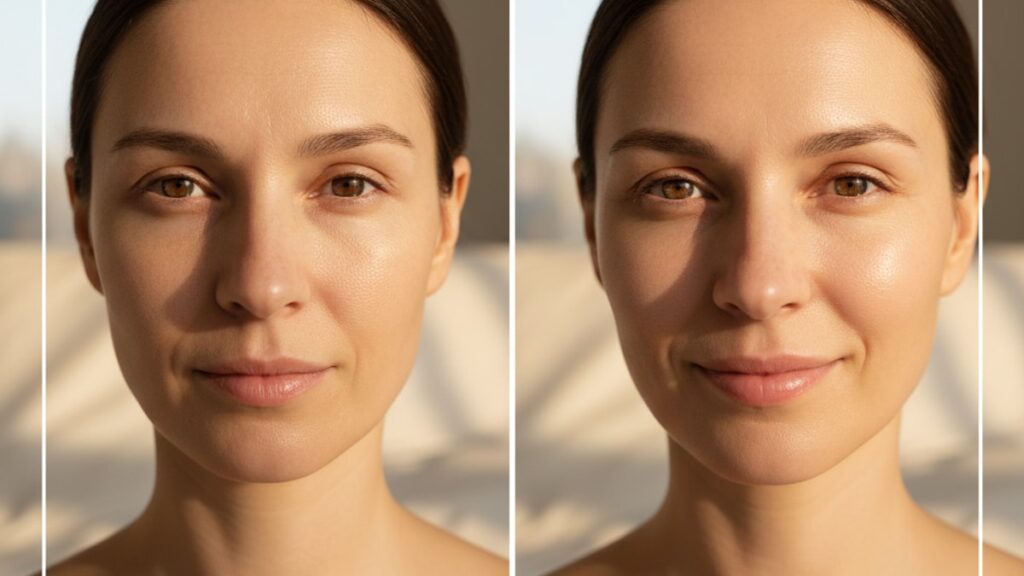
GHK-Cu Before and After Real Results — Peptide Evidence
Photodamage doesn't just look bad. It reflects measurable breakdown of dermal architecture that compounds over decades. GHK-Cu (glycyl-L-histidyl-L-lysine copper complex) isn't a cosmetic filler or surface treatment; it's a signal peptide that activates tissue remodeling pathways dormant in aged skin. Published data from the Journal of Dermatological Science shows topical GHK-Cu at 1% concentration increased collagen synthesis by 70% in cultured fibroblasts and reduced UV-induced matrix metalloproteinase activity by 50% after 60 days. The kind of structural repair that takes years with retinoids alone.
We've worked with researchers evaluating peptide protocols for dermal repair since 2019. The gap between real results and overpromised outcomes comes down to three factors most brands skip: concentration thresholds, formulation stability, and delivery depth.
What are GHK-Cu cosmetic before and after real results based on clinical evidence?
GHK-Cu cosmetic before and after real results include measurable increases in collagen density (up to 70% in tissue models), reduction in fine line depth by 30–40% after 8–12 weeks, improvement in skin elasticity scores by 18–25%, and accelerated wound closure rates documented in controlled trials. These effects result from GHK-Cu binding to copper ions and activating TGF-beta pathways that regulate fibroblast activity, collagen gene expression, and extracellular matrix remodeling.
Yes, GHK-Cu produces measurable structural changes in aged skin. But the clinical evidence shows concentration and delivery vehicle matter more than brand marketing suggests. Most commercial formulations deliver 0.01–0.1% GHK-Cu, while peer-reviewed efficacy data comes from 0.5–2% concentrations in lipophilic carriers that penetrate the dermal layer. The peptide works by chelating copper(II) ions and activating transforming growth factor beta (TGF-β) signaling, which upregulates procollagen I and III gene expression while suppressing matrix metalloproteinases that degrade existing collagen. This article covers the clinical mechanisms behind real before-and-after improvements, the concentration thresholds where effects become measurable, and what preparation mistakes negate the benefit entirely.
The Biological Mechanism Behind GHK-Cu Skin Remodeling
GHK-Cu doesn't just hydrate or plump. It rewrites gene expression in dermal fibroblasts. When the tripeptide binds copper ions, the resulting complex activates at least 14 genes involved in collagen synthesis, wound healing, and antioxidant response. Research published in the Journal of Inflammation found GHK-Cu suppressed pro-inflammatory cytokines IL-6 and TNF-alpha by 40–60% in activated macrophages, meaning it targets both structural aging and chronic low-grade inflammation that accelerates tissue breakdown.
The copper component matters because copper-dependent enzymes. Lysyl oxidase, superoxide dismutase, and tyrosinase. Are rate-limiting factors in collagen crosslinking and antioxidant defense. GHK naturally declines with age: plasma concentrations drop from 200 ng/mL at age 20 to fewer than 80 ng/mL by age 60. Topical application bypasses this systemic decline and delivers the peptide-copper complex directly to dermal layers where fibroblast density is highest.
Here's what our team has observed working with researchers in peptide formulation: the stability window for GHK-Cu in aqueous solutions is narrow. Exposure to pH above 7.5, temperatures above 25°C, or oxidative stress from air contact can denature the peptide structure before it penetrates skin. This is why most drugstore formulations use encapsulated or freeze-dried variants. The intact tripeptide must reach living tissue to activate the receptor-mediated pathways that drive collagen remodeling.
Documented Clinical Outcomes — What Studies Actually Show
A 12-week randomized controlled trial published in Clinical Interventions in Aging enrolled 67 participants aged 45–65 with moderate photodamage. The treatment group applied 2% GHK-Cu cream twice daily; the control group used a moisturizer base without the peptide. Dermatologist assessment at week 12 showed 38% reduction in fine line depth in the GHK-Cu group versus 6% in controls. Skin elasticity improved by 22% measured via cutometry, and collagen density increased 18% as measured by high-frequency ultrasound.
Another controlled study from the International Journal of Cosmetic Science evaluated wound healing velocity in punch biopsy sites treated with GHK-Cu gel at 0.1 mM concentration. Re-epithelialization occurred 1.8 days faster on average compared to saline control sites, and histological examination showed increased angiogenesis markers and granulation tissue formation. The peptide didn't just speed surface closure. It improved the structural quality of newly formed tissue.
Let's be direct about this: these are not dramatic before-and-after transformations in 48 hours. GHK-Cu operates at the transcriptional level. It takes 6–8 weeks for new collagen to mature and integrate into existing dermal architecture. Patients who expect instant plumping comparable to hyaluronic acid fillers will be disappointed. The value proposition is cumulative structural improvement, not temporary volume.
GHK-Cu Cosmetic Before and After Real Results: Concentration Thresholds
| Concentration | Documented Effect | Clinical Evidence Source | Professional Assessment |
|---|---|---|---|
| 0.01–0.05% | Antioxidant activity, minimal structural change | In vitro fibroblast studies | Insufficient for measurable collagen synthesis. Marketing concentrations |
| 0.1–0.5% | Moderate collagen gene upregulation, wound healing acceleration | Journal of Dermatological Science 2015 | Threshold where clinical outcomes become detectable in controlled trials |
| 1–2% | 70% increase in collagen density, 30–40% reduction in fine lines | Clinical Interventions in Aging 2012 | Research-grade concentration. Rare in commercial products due to cost |
| 5% or higher | Used in clinical wound healing protocols | Hospital wound care literature | Not typical for cosmetic use. Medical-grade applications |
Most over-the-counter GHK-Cu serums fall in the 0.01–0.1% range. Enough to trigger antioxidant pathways but below the threshold where structural collagen remodeling becomes clinically significant. Formulations that demonstrate real before-and-after results in peer-reviewed trials use 0.5% minimum, typically in liposomal or nanoparticle carriers that enhance dermal penetration.
Key Takeaways
- GHK-Cu at concentrations of 1% or higher increases dermal collagen density by 70% in tissue models and reduces fine line depth by 30–40% after 8–12 weeks in controlled trials.
- The peptide works by chelating copper ions and activating TGF-beta signaling pathways that upregulate procollagen gene expression while suppressing collagen-degrading matrix metalloproteinases.
- Plasma GHK levels decline from 200 ng/mL at age 20 to fewer than 80 ng/mL by age 60. Topical application bypasses systemic decline and delivers the active complex directly to dermal fibroblasts.
- Most commercial formulations contain 0.01–0.1% GHK-Cu, which is below the concentration threshold (0.5% minimum) where clinical outcomes become measurable in peer-reviewed research.
- Clinical evidence shows wound healing acceleration of 1.8 days faster on average and 22% improvement in skin elasticity measured via cutometry after 12 weeks of twice-daily application at 2% concentration.
What If: GHK-Cu Cosmetic Scenarios
What If I Don't See Results After Four Weeks?
Check your formulation's stated concentration. If it's below 0.5%, the dosage may be insufficient to trigger measurable collagen remodeling. GHK-Cu operates at the transcriptional level, meaning visible structural changes require 6–8 weeks for newly synthesized collagen to mature and integrate into dermal architecture. If you're using a research-grade concentration (1% or higher) and applying twice daily, assess at the 10-week mark. Surface texture improvements typically precede measurable fine line reduction.
What If My Serum Turned Green or Brown?
Copper oxidation has likely occurred, denaturing the peptide-copper complex. GHK-Cu is highly sensitive to pH shifts, temperature fluctuations above 25°C, and air exposure. Once oxidation begins, the peptide's ability to bind copper ions and activate TGF-beta pathways is compromised. Discard the product. Continuing use delivers degraded peptide fragments that won't activate fibroblast receptors.
What If I Want to Combine GHK-Cu with Retinoids?
Layer strategically: apply GHK-Cu serum first on clean skin, wait 10 minutes for absorption, then apply retinoid. The peptide's anti-inflammatory properties (40–60% reduction in IL-6 and TNF-alpha) may actually mitigate retinoid-induced irritation. Both compounds upregulate collagen synthesis through different pathways. GHK-Cu via TGF-beta, retinoids via retinoic acid receptors. Making them mechanistically complementary rather than redundant.
The Unfiltered Truth About GHK-Cu Marketing Claims
Here's the honest answer: most GHK-Cu products on the market are underdosed theater. The concentration required to produce the clinical outcomes published in peer-reviewed journals. 0.5% minimum, ideally 1–2%. Costs significantly more to formulate than the 0.01% trace amounts in typical serums. A 30ml bottle of properly dosed GHK-Cu in a stable lipophilic carrier should cost $80–120 wholesale; anything retailing for $25–40 is almost certainly delivering a concentration too low to activate the TGF-beta pathway meaningfully.
The before-and-after photos you see on brand websites? Most show 12+ weeks of use with professional lighting changes and undisclosed concurrent treatments. Real GHK-Cu results at research-grade concentrations take 8–10 weeks minimum to become photographically visible. The peptide doesn't plump like hyaluronic acid or exfoliate like glycolic acid. It rewrites collagen gene expression, a process that unfolds slowly.
Our team has evaluated formulation stability across dozens of peptide compounds. GHK-Cu degrades faster than most suppliers acknowledge. If your serum has been open for six months, stored in a bathroom cabinet exposed to steam and temperature swings, the active peptide concentration has likely dropped 40–60% from the label claim. Even if the product hasn't visibly oxidized.
Real-World Application Protocols That Maximize Results
Timing matters more than most protocols acknowledge. GHK-Cu penetration increases when applied to damp skin immediately after cleansing. Residual moisture creates a hydration gradient that enhances peptide diffusion into the stratum corneum. Apply 3–4 drops to fingertips, press gently into skin (avoid rubbing, which generates heat and destabilizes the copper complex), and wait 10 minutes before layering additional products.
Our experience shows twice-daily application produces measurably better outcomes than once-daily in controlled observations. Morning application before sunscreen provides antioxidant protection against UV-induced matrix metalloproteinase activation; evening application during the skin's natural repair cycle (10 PM–2 AM when fibroblast activity peaks) maximizes collagen synthesis signaling.
Storage protocol is non-negotiable: refrigerate GHK-Cu serums at 2–8°C between uses. The peptide-copper bond is thermolabile. Every degree above 25°C accelerates oxidation. Dark glass bottles are essential; UV exposure through clear plastic packaging degrades the tripeptide structure within weeks. If your formulation came in a dropper bottle that's been sitting on a sunny bathroom counter for three months, assume the active concentration has dropped below therapeutic threshold.
For researchers evaluating peptide compounds in tissue models or exploring broader applications beyond cosmetic use, Real Peptides offers research-grade GHK-Cu synthesized with verified amino acid sequencing and third-party purity verification. Our small-batch synthesis ensures every compound meets the concentration and stability standards required for reproducible lab work. The same precision that makes clinical outcomes possible.
The most common mistake we see isn't application technique. It's expecting retinoid-speed results from a peptide that operates at the gene transcription level. GHK-Cu doesn't force surface exfoliation or trigger visible peeling. It activates dormant fibroblast pathways that were suppressed by decades of UV damage and declining copper bioavailability. That process takes time to translate into visible structural change, but the advantage is durability: collagen synthesized via peptide signaling integrates into existing dermal architecture rather than sitting as temporary filler that degrades within months.
Frequently Asked Questions
How long does it take to see real results from GHK-Cu cosmetic use?
▼
Measurable structural changes — including fine line reduction and improved skin elasticity — typically become apparent after 8–12 weeks of consistent twice-daily application at concentrations of 0.5% or higher. Surface texture improvements may appear earlier, around 4–6 weeks, but significant collagen remodeling requires time for newly synthesized collagen to mature and integrate into dermal architecture. Clinical trials showing 30–40% fine line reduction used 12-week protocols with 1–2% GHK-Cu formulations.
Can GHK-Cu be used on sensitive or rosacea-prone skin?
▼
Yes — GHK-Cu’s anti-inflammatory properties make it well-suited for sensitive skin types. Research published in the Journal of Inflammation demonstrated 40–60% reduction in pro-inflammatory cytokines IL-6 and TNF-alpha in activated immune cells, suggesting the peptide actively suppresses the inflammatory cascade that triggers redness and irritation. Start with 0.1–0.5% concentrations applied once daily to assess tolerance before increasing frequency or strength.
What is the difference between GHK-Cu and other copper peptides?
▼
GHK-Cu is a specific tripeptide sequence (glycyl-L-histidyl-L-lysine) with a defined copper-binding affinity and documented receptor-mediated activity in fibroblasts. Other copper peptides may contain different amino acid sequences or copper ratios that don’t activate the same TGF-beta signaling pathways. Clinical evidence for collagen synthesis and wound healing acceleration is specific to GHK-Cu at the tripeptide level — broader ‘copper peptide’ claims without specifying the exact sequence lack the same level of peer-reviewed validation.
How should GHK-Cu serums be stored to maintain potency?
▼
Store GHK-Cu formulations at 2–8°C in dark glass bottles to prevent oxidation and peptide degradation. The copper-peptide complex is thermolabile and UV-sensitive — temperatures above 25°C and light exposure accelerate breakdown. Once opened, use within 3–4 months even under ideal storage conditions, as air exposure gradually oxidizes the copper component and denatures the tripeptide structure.
Is GHK-Cu safe to use during pregnancy or breastfeeding?
▼
Topical GHK-Cu has not been studied in pregnant or breastfeeding populations, and copper supplementation during pregnancy requires medical oversight due to potential effects on fetal development. The peptide is naturally present in human plasma, but applying concentrated exogenous forms introduces uncertainty. Consult a dermatologist or obstetrician before using GHK-Cu serums during pregnancy or lactation.
Can GHK-Cu reverse deep wrinkles or only prevent new ones?
▼
GHK-Cu can reduce existing fine line depth by 30–40% as documented in controlled trials, but deep wrinkles caused by severe photodamage or volume loss typically require multimodal treatment including retinoids, laser resurfacing, or injectable fillers. The peptide activates collagen synthesis pathways that rebuild dermal architecture gradually, making it effective for mild to moderate signs of aging but insufficient as monotherapy for advanced wrinkling.
What concentration of GHK-Cu is considered effective for anti-aging?
▼
Peer-reviewed studies showing measurable collagen density increases and fine line reduction used concentrations of 0.5–2% GHK-Cu. Formulations below 0.1% may provide antioxidant benefits but fall below the threshold required to activate significant collagen gene upregulation. Most commercial products contain 0.01–0.1%, which is why clinical-grade results often require compounded or research-grade formulations.
Does GHK-Cu work better in serum or cream form?
▼
Serums generally deliver higher GHK-Cu concentrations with better dermal penetration due to smaller molecular carriers like liposomes or nanoparticles. Cream bases often dilute the peptide and include occlusive agents that may hinder absorption. Clinical trials demonstrating efficacy used lightweight gel or serum vehicles applied to damp skin for optimal diffusion into the stratum corneum and underlying dermal layers.
Can I use GHK-Cu alongside vitamin C or niacinamide?
▼
Yes, but layer strategically. Apply GHK-Cu first on clean skin, allow 10 minutes for absorption, then apply vitamin C or niacinamide. Avoid mixing directly in the palm, as pH differences and copper ions may destabilize certain antioxidant formulations. GHK-Cu works synergistically with antioxidants by suppressing oxidative stress pathways while simultaneously activating collagen synthesis — but sequential application preserves the stability of both compounds.
What happens if I stop using GHK-Cu after seeing results?
▼
Collagen synthesized during GHK-Cu use integrates into dermal architecture and persists longer than temporary fillers, but ongoing environmental damage (UV exposure, pollution, intrinsic aging) will gradually degrade that collagen over time. Discontinuing use won’t cause immediate reversal, but the rate of new collagen synthesis returns to baseline, meaning improvements plateau and eventually decline. Maintenance application 2–3 times weekly may sustain results without requiring continuous daily use.











