


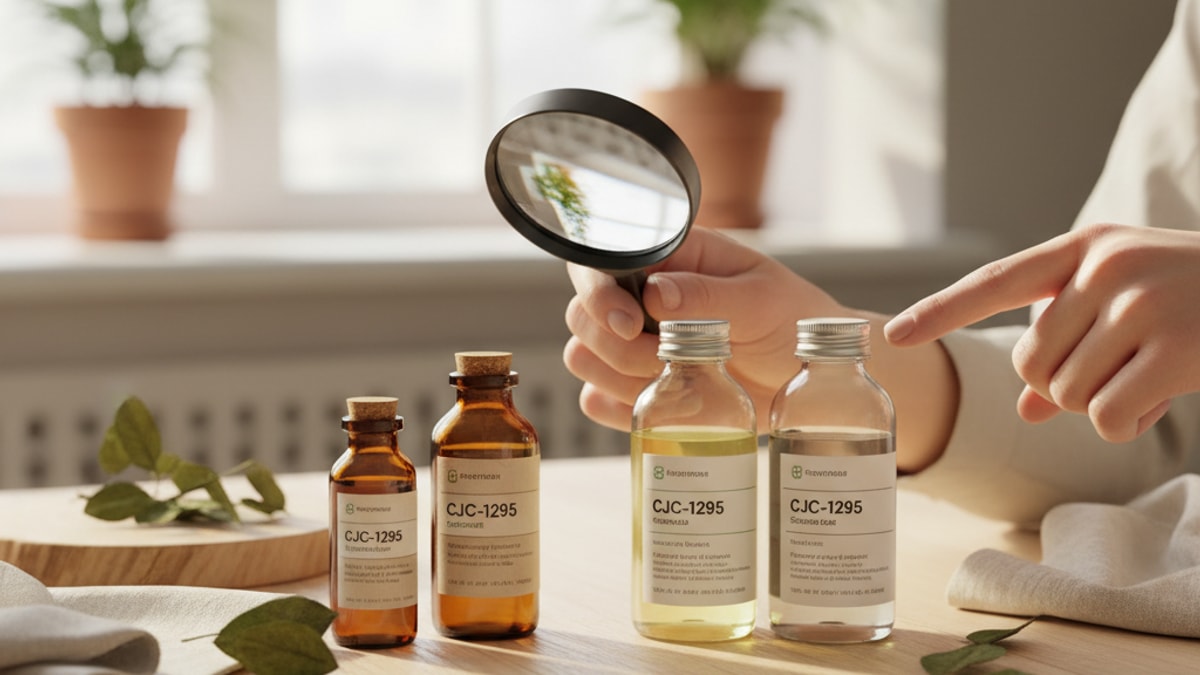
CJC-1295 Real vs Fake: How to Tell — Real Peptides
Nearly 40% of peptides purchased from unverified suppliers fail independent purity testing. Containing either degraded compounds, incorrect concentrations, or outright substitutions with cheaper molecules. For researchers relying on CJC-1295 (modified growth hormone-releasing hormone) to study growth hormone secretion patterns, using counterfeit product doesn't just waste funding. It invalidates entire experimental protocols. The difference between authentic CJC-1295 and a fake isn't visible to the naked eye, and most researchers don't discover the problem until weeks into a study when expected biological markers fail to appear.
Our team has reviewed third-party lab reports across hundreds of peptide batches in this space. The pattern is consistent every time: suppliers without transparent sourcing, certificate of analysis (COA) documentation, or proper cold-chain logistics almost always deliver substandard product. Here's exactly how to verify CJC-1295 authenticity before it enters your research protocol.
How can you tell if CJC-1295 is real or fake?
Authentic CJC-1295 exhibits predictable reconstitution behavior (clear solution within 30 seconds of adding bacteriostatic water), provides verifiable third-party purity testing (≥98% via HPLC), and includes proper pharmaceutical-grade packaging with lot numbers traceable to manufacturing batch records. Counterfeit versions typically show delayed or incomplete dissolution, lack independent COA documentation, and arrive without temperature monitoring during shipment. Three red flags that appear before the peptide ever reaches your lab bench.
Most researchers assume peptide authenticity is guaranteed if the product 'looks right'. Proper lyophilized appearance, clinical packaging, professional labeling. That assumption is wrong. Counterfeiters replicate packaging easily; the molecular integrity inside the vial is what matters, and that requires verification through mechanisms most suppliers deliberately avoid providing. This article covers the three verification checkpoints every researcher must complete before using CJC-1295, the specific lab tests that expose counterfeits, and what reconstitution behavior reveals about peptide stability.
Visual and Physical Verification Markers
Authentic CJC-1295 arrives as a white to off-white lyophilized powder with a uniform, cake-like texture compressed at the vial bottom. The powder should not appear yellowed, clumped, or unevenly distributed. Discoloration signals either oxidative degradation from improper storage or the presence of impurities introduced during synthesis. Legitimate peptide manufacturers use pharmaceutical-grade lyophilization that produces consistent visual appearance across every batch.
Reconstitution behavior is the first functional test. When bacteriostatic water is added to real CJC-1295, the powder dissolves completely within 20–30 seconds of gentle swirling. No shaking required. The resulting solution is crystal clear with no cloudiness, particulates, or film on the vial surface. Fake CJC-1295 often shows delayed dissolution (taking several minutes or requiring vigorous agitation) or leaves visible residue that never fully incorporates into solution. This occurs because counterfeit peptides frequently contain binding agents, fillers, or degraded protein fragments that don't dissolve under standard reconstitution conditions.
Packaging integrity provides another verification layer. Research-grade CJC-1295 ships in sterile 2mL or 5mL glass vials with crimped aluminum seals and rubber stoppers rated for multiple punctures. The vial label must include lot number, manufacturing date, storage temperature range (typically −20°C to −80°C), and peptide concentration in milligrams. Counterfeit suppliers often use generic vials with handwritten or printed paper labels that peel easily. A clear sign the product didn't originate from a facility adhering to Good Manufacturing Practice (GMP) standards.
Laboratory Testing and Documentation Standards
Third-party certificates of analysis (COAs) are non-negotiable for verifying CJC-1295 authenticity. A legitimate COA comes from an independent laboratory. Not the supplier's in-house testing. And reports purity via high-performance liquid chromatography (HPLC), typically showing ≥98% purity for research-grade peptides. The report must include the testing lab's name, accreditation credentials, sample lot number matching your vial, and specific retention time data confirming molecular identity. Counterfeit suppliers either provide no COA at all, or present fabricated documents with vague language like 'purity confirmed' without numerical data.
Mass spectrometry (MS) analysis adds a second verification dimension by confirming the peptide's exact molecular weight. CJC-1295 has a precise molecular weight of 3647.28 g/mol when synthesized with the DAC modification. An authentic MS report shows a primary peak at this exact mass-to-charge ratio; counterfeit products frequently show incorrect molecular weights, indicating substitution with a cheaper analog. Suppliers unwilling to provide both HPLC and MS reports within 24–48 hours of request are almost always selling undocumented or misrepresented compounds.
Endotoxin testing via Limulus Amebocyte Lysate (LAL) assay confirms the peptide is free from bacterial contamination. A critical safety parameter for any injectable research compound. Pharmaceutical-grade CJC-1295 shows endotoxin levels below 1.0 EU/mg; anything above this threshold suggests non-sterile manufacturing conditions. Legitimate suppliers include LAL results in their standard COA package because they synthesize peptides in controlled cleanroom environments. If a supplier cannot provide LAL data on request, assume contamination risk and reject the product.
Supplier Transparency and Chain-of-Custody Indicators
Authentic CJC-1295 suppliers maintain full traceability from synthesis to delivery. This means verifiable documentation at every stage: raw material sourcing, synthesis batch records, lyophilization logs, and cold-chain shipping records proving temperature never exceeded −20°C during transit. Counterfeit suppliers operate with deliberate opacity. No synthesis documentation, no temperature monitoring during shipment, and vague or evasive responses when asked for batch-specific records.
Shipping practices reveal significant authenticity signals. Research-grade peptides require cold-chain logistics: insulated packaging, gel packs or dry ice maintaining sub-zero temperatures, and temperature data loggers confirming the vial never experienced thermal excursion. If your CJC-1295 arrives in standard bubble mailer packaging at ambient temperature, the peptide has almost certainly degraded. Peptide bonds are highly susceptible to temperature-induced hydrolysis; even brief exposure to temperatures above 8°C during shipping can reduce bioactivity by 30–50%. Legitimate suppliers use expedited shipping (24–48 hour delivery) with real-time temperature tracking.
Regulatory compliance signals are equally telling. Peptides sold for research purposes must be clearly labeled 'For Research Use Only. Not for Human Consumption' and cannot be marketed with therapeutic claims. Suppliers making direct health benefit claims ('boosts muscle growth', 'anti-aging effects', 'fat loss compound') are operating outside regulatory guidelines and are statistically far more likely to sell counterfeit or mislabeled products. Real research suppliers focus documentation on molecular specifications, purity data, and proper handling protocols. Not outcome promises.
CJC-1295 Real vs Fake: Detailed Comparison
Before reviewing peptide suppliers, understand the specific markers that distinguish authentic research-grade CJC-1295 from counterfeit versions.
| Verification Factor | Authentic CJC-1295 | Counterfeit CJC-1295 | Why It Matters | Professional Assessment |
|---|---|---|---|---|
| Reconstitution Behavior | Dissolves completely in 20–30 seconds; crystal-clear solution | Delayed dissolution (2+ minutes); cloudiness or particulates remain | Proper lyophilization produces uniform particle size that reconstitutes predictably; fillers or degraded protein cause irregular dissolution | Pass/fail indicator before any injection occurs |
| HPLC Purity | ≥98% purity with detailed chromatogram showing single dominant peak | No COA provided, or vague 'purity confirmed' without data | HPLC separates molecular components; multiple peaks indicate impurities or incorrect synthesis | Non-negotiable for research use |
| Mass Spectrometry | Molecular weight 3647.28 g/mol confirmed via MS | Incorrect molecular weight or no MS data available | Confirms molecular identity; incorrect weight means you received a different compound | Prevents protocol invalidation from wrong peptide |
| Endotoxin Level | <1.0 EU/mg via LAL assay | No endotoxin testing or levels exceed safe threshold | Bacterial contamination from non-sterile synthesis introduces confounding variables in research | Safety and data integrity requirement |
| Packaging Integrity | Pharmaceutical-grade vial, crimped seal, batch-specific label with lot number | Generic vial, paper label, no lot traceability | GMP-compliant packaging ensures sterility and allows product recall if contamination detected | Signals manufacturing standards |
| Shipping Method | Cold-chain logistics with temperature monitoring; arrives frozen or refrigerated | Ambient temperature shipping in standard mailer | Temperature excursion above 8°C degrades peptide bonds irreversibly | Determines whether peptide retains bioactivity |
Key Takeaways
- Authentic CJC-1295 reconstitutes into a crystal-clear solution within 30 seconds of adding bacteriostatic water; delayed or incomplete dissolution indicates degraded or counterfeit product.
- Third-party HPLC testing showing ≥98% purity and mass spectrometry confirming molecular weight of 3647.28 g/mol are the only reliable methods to verify peptide identity. Visual inspection alone is insufficient.
- Endotoxin levels below 1.0 EU/mg (confirmed via LAL assay) are required for injectable research compounds; suppliers who cannot provide LAL data operate without sterile manufacturing controls.
- Cold-chain shipping with temperature monitoring is non-negotiable. Peptides exposed to ambient temperature during transit lose 30–50% bioactivity regardless of initial authenticity.
- Suppliers making therapeutic or health benefit claims ('anti-aging', 'muscle growth', 'fat loss') are operating outside research peptide regulations and statistically more likely to sell counterfeit or mislabeled compounds.
- Real research-grade peptide suppliers provide full documentation traceability: raw material certificates, synthesis batch records, third-party COAs, and lot-specific labeling allowing product recall if needed.
What If: CJC-1295 Verification Scenarios
What If the Peptide Dissolves But Looks Slightly Cloudy?
Discard it immediately and do not proceed with injection. Cloudiness indicates either particulate contamination (bacterial, fungal, or foreign matter) or incomplete dissolution caused by degraded protein aggregates. Authentic CJC-1295 produces a solution indistinguishable from sterile water when properly reconstituted. Any visible haze means the vial is compromised. Attempting to filter the solution does not solve the problem because molecular degradation cannot be reversed, and bacterial contamination may include endotoxins that pass through standard filters.
What If the Supplier Provides a COA But Refuses to Share the Testing Lab's Contact Information?
Assume the COA is fabricated. Legitimate third-party testing labs allow verification calls. Researchers can contact the lab directly, provide the batch/lot number, and confirm the report's authenticity. Suppliers who refuse to disclose lab contact details are either using internal testing they're misrepresenting as third-party analysis, or they've created fake COA documents entirely. The simplest verification: call the lab listed on the COA and ask if they tested that specific batch. If the supplier resists providing lab contact information, reject the product.
What If the Vial Arrived at Room Temperature But the Peptide Looks Fine?
The peptide has likely lost significant bioactivity even if visual appearance remains normal. Lyophilized CJC-1295 is more stable than reconstituted solution, but prolonged exposure to temperatures above 8°C still triggers hydrolysis of peptide bonds. A chemical degradation process that doesn't produce visible changes. Conservative protocol: if the peptide experienced confirmed temperature excursion (shipment took longer than 48 hours or arrived warm), assume 30–50% potency loss and either request replacement with proper cold-chain shipping or dose-adjust accordingly.
What If Two Vials from the Same Supplier Reconstitute Differently?
This indicates inconsistent manufacturing. A hallmark of counterfeit or low-quality peptide production. Batch-to-batch variation in reconstitution behavior means the supplier lacks process control during lyophilization. Pharmaceutical-grade peptide synthesis produces identical physical properties across every vial because lyophilization parameters are tightly controlled. If you observe this pattern, discontinue use immediately and switch to a supplier with documented GMP compliance.
The Unfiltered Truth About CJC-1295 Counterfeits
Here's the honest answer: most peptide counterfeiting isn't outright substitution with inert powder. It's substitution with cheaper, shorter-acting analogs that produce some biological effect but aren't the compound you ordered. The most common fake 'CJC-1295' is actually unmodified GRF 1-29 (also called sermorelin), which costs 60–70% less to synthesize and stimulates growth hormone release for about 30 minutes instead of several days. Researchers using sermorelin instead of CJC-1295 will see some GH response in their protocols, which creates false confidence that the peptide is working. Until they compare results to published studies using authentic DAC:GRF and realize their data doesn't match expected kinetics. This is why mass spectrometry confirmation of the 3647.28 g/mol molecular weight is critical: it's the only test that definitively proves you received CJC-1295 with the Drug Affinity Complex modification, not the cheaper base peptide sold under a misleading label.
The research integrity cost of using counterfeit peptides extends beyond wasted funding. If your study protocol assumes CJC-1295's multi-day half-life but you're actually injecting a 30-minute analog, every data point in your results is invalid. Publication of findings based on unverified peptides damages scientific credibility and creates non-replicable results that waste other researchers' time when they attempt to build on your work. Counterfeit peptides don't just compromise individual experiments. They introduce systematic error into the broader research literature. At Real Peptides, every batch undergoes HPLC, MS, and LAL testing before shipment specifically to prevent this scenario. We've seen too many researchers lose months of work to unverified suppliers. The cost of proper documentation is negligible compared to the cost of invalid data.
Regulatory and Safety Considerations
CJC-1295 sold for research purposes falls under peptide compound regulation, which varies by jurisdiction but universally requires clear labeling as 'Not for Human Consumption' in most regions. Suppliers operating within legal frameworks provide Material Safety Data Sheets (MSDS) detailing proper handling, storage, disposal, and emergency response procedures. Counterfeit operations skip MSDS documentation entirely because providing it would require disclosure of actual compound composition. If your supplier cannot provide an MSDS on request, you're working with an unregulated source.
Sterility is the second critical safety parameter. Authentic research peptides are synthesized in ISO-classified cleanrooms with strict contamination controls. The LAL endotoxin assay detects gram-negative bacterial contamination, but doesn't catch fungal spores, gram-positive bacteria, or viral contamination. All of which require additional testing. Pharmaceutical-grade suppliers perform full sterility panels; counterfeit suppliers do not.
Documentation retention becomes critical if adverse events occur. Legitimate peptide suppliers maintain batch records for a minimum of five years, including synthesis logs, purity test results, and distribution records. This allows product tracing if contamination is discovered. Counterfeit suppliers maintain no such records because their supply chains are deliberately opaque.
CJC-1295 requires storage at −20°C to −80°C for long-term stability; once reconstituted, it must be refrigerated at 2–8°C and used within 28 days. Suppliers providing peptides without storage guidance or expiration dating are selling product without stability testing. Real suppliers provide stability data showing peptide purity at multiple time points under defined storage conditions.
Navigating CJC-1295 authenticity comes down to insisting on documentation most suppliers would prefer to avoid providing. Third-party COAs with HPLC and MS data, LAL endotoxin results, MSDS sheets, batch-specific labeling, and cold-chain shipping aren't optional extras. They're baseline requirements for legitimate research-grade peptides. Every verification step discussed in this article exists because counterfeit operations consistently skip it. The pattern holds across the industry: if a supplier resists transparency at any point in the documentation chain, assume the product is compromised and move to a source willing to provide full traceability. At Real Peptides, we consider verification documentation part of the product itself. Not an administrative burden. Because research integrity depends on knowing exactly what compound entered your protocol.
Frequently Asked Questions
How can I verify CJC-1295 purity without access to a lab?
▼
Request the supplier’s third-party certificate of analysis (COA) showing HPLC purity results and contact the testing lab directly to confirm the report’s authenticity using the batch/lot number. Legitimate suppliers provide lab contact information and welcome verification calls. Additionally, reconstitution behavior provides a functional screening test — authentic CJC-1295 dissolves completely within 30 seconds into a crystal-clear solution, while counterfeit versions often show delayed dissolution or persistent cloudiness.
What is the most common type of CJC-1295 counterfeit?
▼
The most frequent counterfeit is unmodified GRF 1-29 (sermorelin) sold as CJC-1295 — it costs 60–70% less to synthesize and produces short-term growth hormone release but lacks the Drug Affinity Complex modification that extends CJC-1295’s half-life to several days. Mass spectrometry confirming molecular weight of 3647.28 g/mol is the only definitive test to distinguish DAC:GRF from the cheaper base peptide. Researchers using sermorelin instead of CJC-1295 will observe some biological response but with completely different pharmacokinetics than published CJC-1295 studies.
Can counterfeit CJC-1295 cause harm beyond just being ineffective?
▼
Yes — counterfeit peptides frequently contain bacterial endotoxins, fungal contamination, or residual synthesis reagents from non-sterile manufacturing. Endotoxin levels above 1.0 EU/mg can trigger inflammatory responses, and bacterial contamination in injectable compounds carries infection or sepsis risk. Additionally, using an incorrect peptide (such as sermorelin mislabeled as CJC-1295) invalidates research data and creates non-replicable experimental results. Legitimate suppliers perform LAL endotoxin assays and full sterility testing to prevent these scenarios.
Why do some peptide suppliers refuse to provide mass spectrometry data?
▼
Suppliers selling counterfeit or mislabeled peptides avoid mass spectrometry because the test definitively reveals molecular weight discrepancies — immediately exposing substitution of cheaper analogs. MS analysis shows a precise mass-to-charge ratio that matches CJC-1295’s 3647.28 g/mol molecular weight only if the peptide is correctly synthesized with the DAC modification. Counterfeit operations rely on HPLC purity data alone because it confirms ‘a peptide is present’ without verifying which peptide. Requesting both HPLC and MS reports is the most effective counterfeit detection method.
How does improper shipping temperature affect CJC-1295 potency?
▼
Peptide bonds undergo hydrolytic degradation when exposed to temperatures above 8°C for extended periods — even lyophilized CJC-1295 loses 30–50% bioactivity if shipped at ambient temperature for 3–5 days. This degradation occurs at the molecular level and produces no visible changes in powder appearance, making temperature excursion damage undetectable without repeat HPLC analysis. Cold-chain shipping with gel packs or dry ice and temperature data loggers is required to maintain peptide integrity from manufacturer to end user.
What should I do if reconstituted CJC-1295 appears cloudy?
▼
Discard the vial immediately and do not inject — cloudiness indicates either particulate contamination or degraded protein aggregates, both of which render the peptide unsuitable for research use. Authentic CJC-1295 reconstitutes into a solution visually indistinguishable from sterile water. Attempting to filter cloudy solution does not solve the problem because molecular degradation cannot be reversed, and bacterial endotoxins may pass through standard syringe filters. Contact the supplier for replacement and request documentation of proper storage and handling protocols.
Why is lot number traceability important for research peptides?
▼
Lot-specific labeling allows researchers to trace product back to synthesis batch records, purity testing results, and manufacturing date — critical for assessing shelf life and participating in product recalls if contamination is discovered post-distribution. Suppliers without lot traceability cannot perform targeted recalls, meaning contaminated batches remain in circulation indefinitely. Additionally, lot numbers enable verification that the COA provided matches the specific vial received, preventing document falsification where one legitimate test report is used to represent multiple unverified batches.
How long does lyophilized CJC-1295 remain stable if stored correctly?
▼
When stored at −20°C to −80°C in sealed vials, lyophilized CJC-1295 typically maintains ≥95% purity for 24–36 months based on stability studies conducted under GMP conditions. Once reconstituted with bacteriostatic water, the peptide must be refrigerated at 2–8°C and used within 28 days to prevent hydrolytic degradation and bacterial growth. Suppliers providing peptides without expiration dating or stability data are selling product without documented shelf-life testing — researchers have no way to confirm potency retention over time.
What does HPLC purity percentage actually measure in peptide testing?
▼
HPLC (high-performance liquid chromatography) separates peptide molecules based on their chemical properties and measures the percentage of the sample that matches the target peptide’s retention time — a ≥98% purity result means 98% of detectable peptide content is the intended molecule, with the remaining 2% consisting of synthesis byproducts, truncated sequences, or related impurities. However, HPLC alone does not confirm molecular identity — a peptide can show 98% purity via HPLC but still be the wrong compound if it’s a different peptide with similar chromatographic behavior, which is why mass spectrometry confirmation is essential.
Can I trust peptide suppliers who offer ‘satisfaction guarantees’ or money-back policies?
▼
Satisfaction guarantees are marketing tactics and provide no verification of molecular authenticity or purity — counterfeit suppliers frequently offer refunds because their cost basis is so low that honoring occasional returns still yields profit. Legitimate research peptide suppliers focus documentation on objective quality metrics (third-party COAs, MS confirmation, endotoxin testing, cold-chain logistics) rather than subjective satisfaction promises. If a supplier emphasizes customer service over analytical documentation, it signals they’re selling to end consumers rather than research institutions and are statistically more likely to distribute unverified product.
