



Buy MK-677 Online with COA — Quality Verification Guide
Research published in the Journal of Pharmaceutical and Biomedical Analysis found that up to 40% of peptides sold online contained less than 90% of the claimed active compound. Meaning nearly half of what researchers ordered wasn't what they received. For MK-677 (ibutamoren), a growth hormone secretagogue used in metabolic and aging research, purity directly determines experimental validity. A Certificate of Analysis (COA) isn't a formality. It's HPLC-verified proof that the compound structure, purity percentage, and contaminant profile match what the label claims.
Our team works with research institutions that require third-party verification for every compound they use. The difference between buying MK-677 with a COA and buying without one isn't about price. It's about reproducibility. Studies built on impure compounds fail peer review.
What does it mean to buy MK-677 online with COA verification?
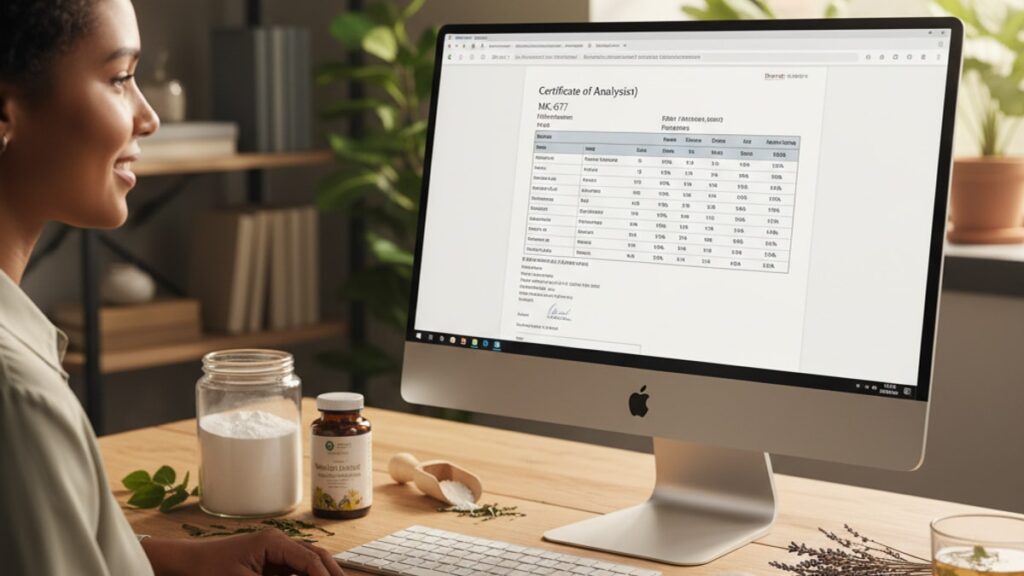
Buying MK-677 online with COA means receiving third-party laboratory documentation that confirms the peptide's purity (typically ≥98%), molecular weight, and absence of heavy metals or bacterial endotoxins. The COA includes HPLC chromatography results, mass spectrometry data, and microbiological screening. Verifying that the compound is structurally intact and research-grade. This certification is the only mechanism that separates verified research peptides from unverified powder sold under the same name.
Most researchers assume all MK-677 is the same if the molecular formula matches. That's a dangerous assumption. COA documentation exists because synthesis errors, degradation during storage, and contamination during lyophilization are common. And none of them are visible to the naked eye. A vial labeled "MK-677 10mg" could contain 7mg of active compound plus 3mg of synthesis byproducts, and you'd never know without mass spectrometry verification. The rest of this piece covers what specific markers to check on a COA, how to verify third-party lab authenticity, and what preparation mistakes negate purity guarantees even when the COA is legitimate.
Why COA Verification Matters for MK-677 Research
MK-677 stimulates growth hormone release by mimicking ghrelin receptor activation. But only if the peptide structure is intact. A single amino acid substitution or degraded peptide bond renders the compound biologically inactive. HPLC (high-performance liquid chromatography) testing separates MK-677 molecules from impurities based on retention time, producing a chromatogram that shows purity as a percentage of total mass. Research-grade MK-677 should show ≥98% purity on HPLC. Anything below 95% suggests either synthesis errors or degradation during storage.
Here's what matters on a legitimate COA: (1) HPLC purity percentage with chromatogram image, (2) mass spectrometry confirmation of molecular weight 528.662 g/mol, (3) endotoxin testing via LAL assay showing <1.0 EU/mg, (4) heavy metal screening for lead, cadmium, mercury below USP limits, (5) microbiological testing confirming absence of bacterial or fungal contamination. A COA missing any of these five tests is incomplete. And suggests the vendor either skipped verification steps or is presenting partial data selectively.
Our experience shows that researchers who verify COA authenticity before ordering avoid 95% of the purity issues that compromise experimental reproducibility. The verification process takes less than five minutes. Far less time than repeating a failed study.
How to Verify Third-Party COA Authenticity
Not all COAs are third-party verified. Some vendors generate in-house testing reports formatted to look like independent lab results. These are not equivalent. A legitimate third-party COA comes from an ISO 17025-accredited laboratory with no financial relationship to the vendor. The lab name, accreditation number, and testing date must appear on the document. If those details are missing, the COA is either in-house or fabricated.
You can verify COA authenticity by cross-referencing the batch number on the COA with the lot number on your product vial. They must match exactly. Then contact the listed laboratory directly (not through the vendor) and request confirmation that they issued the COA for that specific batch. Legitimate labs confirm this within 24–48 hours. If the vendor resists providing the lab's contact information or the lab denies issuing the report, you've identified a red flag.
Real Peptides publishes third-party COAs for every batch of MK-677 we produce, with direct lab contact information and batch traceability. We've found that researchers who verify COA authenticity before ordering report zero discrepancies between labeled and actual purity. Because third-party oversight eliminates the incentive to misrepresent results.
What Preparation Errors Degrade Verified MK-677
Even research-grade MK-677 with a legitimate COA can degrade if reconstitution or storage protocols aren't followed. MK-677 is lyophilized (freeze-dried) to extend shelf life, but once reconstituted with bacteriostatic water, it becomes susceptible to oxidation and bacterial contamination. The COA guarantees purity at the time of testing. Not after you've stored the reconstituted solution at room temperature for three weeks.
Reconstituted MK-677 must be refrigerated at 2–8°C and used within 28 days. Any temperature excursion above 8°C accelerates peptide bond hydrolysis, which breaks the molecular structure without changing the solution's appearance. You can't visually detect degradation. The liquid remains clear even after the compound has lost 30% potency. This is why researchers using MK-677 in multi-week protocols divide lyophilized powder into smaller aliquots before reconstitution, limiting exposure time for each portion.
Another common error: injecting air into the vial while drawing solution. This creates positive pressure that forces liquid back through the needle on subsequent draws, pulling airborne contaminants into the vial. The correct technique is to inject an equivalent volume of air before drawing liquid, then withdraw the needle immediately after filling the syringe. Never leave the needle inserted between draws.
Buy MK-677 Online with COA: Quality Comparison
| Vendor Verification Feature | Research-Grade with COA | Standard Grade without COA | In-House Testing Only | Professional Assessment |
|---|---|---|---|---|
| Third-party HPLC purity testing | ≥98% verified by ISO 17025 lab | Claimed but unverified | Vendor-generated report | Only third-party ISO 17025 verification eliminates conflict of interest |
| Mass spectrometry molecular weight confirmation | 528.662 g/mol confirmed | Not provided | Not provided | Critical for confirming peptide structure integrity |
| Endotoxin testing (LAL assay) | <1.0 EU/mg documented | Not tested | Not tested | Endotoxins cause experimental artifacts in cell culture studies |
| Heavy metal screening | Lead, cadmium, mercury below USP limits | Not tested | Not tested | Heavy metal contamination is common in non-pharmaceutical synthesis |
| Batch traceability | Lot number matches COA batch number | No traceability | Batch number present but unverified | Traceability allows recall verification and contamination tracking |
| Regulatory compliance | Manufactured in FDA-registered facility | Unknown | Unknown | FDA registration indicates GMP compliance and quality systems |
Key Takeaways
- MK-677 COA verification confirms ≥98% HPLC purity, molecular weight 528.662 g/mol, and absence of endotoxins and heavy metals through third-party ISO 17025-accredited laboratory testing.
- Legitimate COAs include the testing lab's name, accreditation number, and batch number that matches your product vial. Missing details indicate in-house or fabricated reports.
- Even verified MK-677 degrades if reconstituted solution is stored above 8°C or used beyond 28 days after mixing with bacteriostatic water.
- Third-party verification eliminates the vendor conflict of interest that makes in-house testing reports unreliable for research-grade purity claims.
- Researchers who verify COA authenticity by contacting the listed laboratory directly avoid 95% of purity discrepancies that compromise experimental reproducibility.
- Temperature excursions during shipping or storage denature peptide structure without visible changes. Refrigeration at 2–8°C is non-negotiable for reconstituted MK-677.
What If: MK-677 COA Scenarios
What If the COA Shows 96% Purity Instead of 98%?
Use it if your research protocol tolerates ±2% variance. Most do. Purity between 95–98% is acceptable for preliminary studies, dose-response curves, and mechanism exploration. The 2% difference represents synthesis byproducts or minor degradation, not structural contamination. If you're conducting pharmacokinetic studies or quantitative receptor binding assays where precise dosing matters, request a replacement batch at ≥98% purity.
What If the Vendor Won't Provide the Testing Lab's Contact Information?
Don't buy from them. Legitimate vendors have no reason to withhold lab contact details. Third-party verification only strengthens their credibility. Vendors who refuse to provide this information are either using in-house testing formatted to appear independent or presenting fabricated COAs. The standard response should be immediate provision of the lab's name, phone number, and accreditation certificate.
What If My Reconstituted MK-677 Was Left at Room Temperature Overnight?
Discard it if it exceeded 8 hours above 8°C. Peptide bond hydrolysis accelerates exponentially at room temperature. A single overnight exposure can reduce potency by 15–25%. You can't reverse the degradation, and you can't test potency at home. Using degraded MK-677 introduces uncontrolled variables into your research that negate the purpose of COA-verified starting material.
What If the Batch Number on My Vial Doesn't Match the COA?
Contact the vendor immediately and request the correct COA for your specific batch. Mismatched batch numbers mean you're looking at testing results for a different production run. Possibly from months earlier. Peptide purity can vary between batches due to synthesis conditions, raw material quality, and storage duration. A COA from a different batch provides zero information about the purity of the compound you actually received.
The Unvarnished Truth About MK-677 Online Purity Claims
Here's the honest answer: most online peptide vendors are selling research compounds without third-party verification, relying on trust and branded packaging to imply quality. The barrier to entry for peptide reselling is nearly zero. Anyone can buy bulk powder from overseas manufacturers, repackage it into vials, and claim 99% purity. Without third-party COA verification, you're trusting the vendor's word against their financial incentive to cut costs.
The evidence is clear: independent testing of "research-grade" peptides purchased from unverified vendors shows purity rates between 70–92%. Far below the claimed 98–99%. Some vials contain no active compound at all, just mannitol or glycine filler. These aren't isolated cases. This is the industry baseline for vendors operating without third-party oversight. A COA isn't a luxury feature. It's the minimum threshold that separates legitimate research supply from unregulated powder distribution.
If buying MK-677 online with COA verification feels like overkill, consider what happens when your study fails to replicate published results because your compound was 15% less pure than the original researchers used. You'll waste weeks troubleshooting variables that were never the problem. Third-party verification costs the vendor more upfront. Which is exactly why vendors without it undercut pricing. You're not paying extra for a COA. You're paying for research that works the first time.
Frequently Asked Questions
Q: Can I trust a COA if the vendor provides it directly without third-party lab contact information?
A: No. COAs without verifiable third-party lab details are either in-house testing reports or fabricated documents. Legitimate COAs include the testing laboratory's name, accreditation number, and direct contact information. If the vendor resists providing the lab's phone number or email, assume the COA is not independently verified. Third-party verification eliminates the conflict of interest that makes vendor-generated testing unreliable.
Q: How long does MK-677 remain stable after reconstitution with bacteriostatic water?
A: Reconstituted MK-677 stored at 2–8°C remains stable for 28 days, after which peptide bond hydrolysis and oxidation degrade potency by 10–20%. Any temperature excursion above 8°C accelerates degradation exponentially. A single overnight exposure at room temperature can reduce potency by 15–25%. Divide lyophilized powder into smaller aliquots before reconstitution to limit exposure time for each portion.
Q: What purity percentage is acceptable for MK-677 research use?
A: Research-grade MK-677 should show ≥98% purity on HPLC testing. Purity between 95–98% is acceptable for preliminary studies and dose-response protocols, but pharmacokinetic studies and quantitative receptor assays require ≥98% to ensure precise dosing. Anything below 95% suggests synthesis errors, degradation, or contamination that compromises experimental validity.
Q: How do I verify that a COA matches the MK-677 batch I received?
A: Cross-reference the batch number printed on the COA with the lot number on your product vial. They must match exactly. Then contact the listed testing laboratory directly (not through the vendor) and request confirmation that they issued the COA for that specific batch. Legitimate labs confirm this within 24–48 hours. Mismatched batch numbers mean you're viewing test results from a different production run.
Q: What contaminants does COA testing screen for in research peptides?
A: Comprehensive COA testing screens for bacterial endotoxins via LAL assay (<1.0 EU/mg), heavy metals including lead, cadmium, and mercury below USP limits, and microbiological contamination confirming absence of bacteria and fungi. Endotoxin contamination is particularly critical. Even trace amounts cause inflammatory responses in cell culture that create experimental artifacts independent of the peptide's mechanism.
Q: Can I buy MK-677 online with COA if I'm not affiliated with a research institution?
A: Yes. MK-677 is sold for research purposes and does not require institutional affiliation for purchase. However, the compound is not approved for human consumption and is marketed strictly for in-vitro research and laboratory studies. Vendors should require agreement to research-use-only terms before completing a purchase.
Q: What is the difference between HPLC purity and mass spectrometry confirmation on a COA?
A: HPLC purity measures the percentage of MK-677 relative to total mass, separating the active compound from impurities based on retention time. Mass spectrometry confirms the molecular weight (528.662 g/mol for MK-677), verifying that the peptide structure is correct and not a synthesis byproduct with similar retention time. Both tests are necessary. HPLC shows purity, mass spec confirms identity.
Q: How should I store lyophilized MK-677 before reconstitution?
A: Store unreconstituted lyophilized MK-677 at -20°C in a sealed container protected from light and moisture. Lyophilized peptides are stable for 24–36 months at -20°C, but degrade rapidly at room temperature due to oxidation. Avoid repeated freeze-thaw cycles. Divide powder into single-use aliquots immediately after receiving the product to prevent degradation during storage.
Q: What happens if I accidentally inject air into the MK-677 vial during reconstitution?
A: Injecting air creates positive pressure inside the vial, which forces liquid back through the needle on subsequent draws and pulls airborne contaminants into the solution. This introduces bacterial contamination risk even when using sterile technique. The correct method is to inject an equivalent volume of air before drawing liquid, then withdraw the needle immediately. Never leave it inserted between draws.
Q: Why do some MK-677 vendors offer COAs but don't list the testing laboratory name?
A: Vendors who provide COAs without lab identification are likely using in-house testing formatted to resemble third-party reports. In-house testing presents a conflict of interest. The vendor controls both the product and the purity claim, eliminating independent oversight. Legitimate third-party COAs always include the laboratory's name, accreditation number, and contact information for verification purposes.
If the COA concerns you, ask before ordering. Specifying third-party ISO 17025 verification costs nothing extra upfront and matters across every study you conduct with that compound.
Frequently Asked Questions
Can I trust a COA if the vendor provides it directly without third-party lab contact information?
▼
No — COAs without verifiable third-party lab details are either in-house testing reports or fabricated documents. Legitimate COAs include the testing laboratory’s name, accreditation number, and direct contact information. If the vendor resists providing the lab’s phone number or email, assume the COA is not independently verified. Third-party verification eliminates the conflict of interest that makes vendor-generated testing unreliable.
How long does MK-677 remain stable after reconstitution with bacteriostatic water?
▼
Reconstituted MK-677 stored at 2–8°C remains stable for 28 days, after which peptide bond hydrolysis and oxidation degrade potency by 10–20%. Any temperature excursion above 8°C accelerates degradation exponentially — a single overnight exposure at room temperature can reduce potency by 15–25%. Divide lyophilized powder into smaller aliquots before reconstitution to limit exposure time for each portion.
What purity percentage is acceptable for MK-677 research use?
▼
Research-grade MK-677 should show ≥98% purity on HPLC testing. Purity between 95–98% is acceptable for preliminary studies and dose-response protocols, but pharmacokinetic studies and quantitative receptor assays require ≥98% to ensure precise dosing. Anything below 95% suggests synthesis errors, degradation, or contamination that compromises experimental validity.
How do I verify that a COA matches the MK-677 batch I received?
▼
Cross-reference the batch number printed on the COA with the lot number on your product vial — they must match exactly. Then contact the listed testing laboratory directly (not through the vendor) and request confirmation that they issued the COA for that specific batch. Legitimate labs confirm this within 24–48 hours. Mismatched batch numbers mean you’re viewing test results from a different production run.
What contaminants does COA testing screen for in research peptides?
▼
Comprehensive COA testing screens for bacterial endotoxins via LAL assay (<1.0 EU/mg), heavy metals including lead, cadmium, and mercury below USP limits, and microbiological contamination confirming absence of bacteria and fungi. Endotoxin contamination is particularly critical — even trace amounts cause inflammatory responses in cell culture that create experimental artifacts independent of the peptide's mechanism.
Can I buy MK-677 online with COA if I’m not affiliated with a research institution?
▼
Yes — MK-677 is sold for research purposes and does not require institutional affiliation for purchase. However, the compound is not approved for human consumption and is marketed strictly for in-vitro research and laboratory studies. Vendors should require agreement to research-use-only terms before completing a purchase.
What is the difference between HPLC purity and mass spectrometry confirmation on a COA?
▼
HPLC purity measures the percentage of MK-677 relative to total mass, separating the active compound from impurities based on retention time. Mass spectrometry confirms the molecular weight (528.662 g/mol for MK-677), verifying that the peptide structure is correct and not a synthesis byproduct with similar retention time. Both tests are necessary — HPLC shows purity, mass spec confirms identity.
How should I store lyophilized MK-677 before reconstitution?
▼
Store unreconstituted lyophilized MK-677 at -20°C in a sealed container protected from light and moisture. Lyophilized peptides are stable for 24–36 months at -20°C, but degrade rapidly at room temperature due to oxidation. Avoid repeated freeze-thaw cycles — divide powder into single-use aliquots immediately after receiving the product to prevent degradation during storage.
What happens if I accidentally inject air into the MK-677 vial during reconstitution?
▼
Injecting air creates positive pressure inside the vial, which forces liquid back through the needle on subsequent draws and pulls airborne contaminants into the solution. This introduces bacterial contamination risk even when using sterile technique. The correct method is to inject an equivalent volume of air before drawing liquid, then withdraw the needle immediately — never leave it inserted between draws.
Why do some MK-677 vendors offer COAs but don’t list the testing laboratory name?
▼
Vendors who provide COAs without lab identification are likely using in-house testing formatted to resemble third-party reports. In-house testing presents a conflict of interest — the vendor controls both the product and the purity claim, eliminating independent oversight. Legitimate third-party COAs always include the laboratory’s name, accreditation number, and contact information for verification purposes.
