


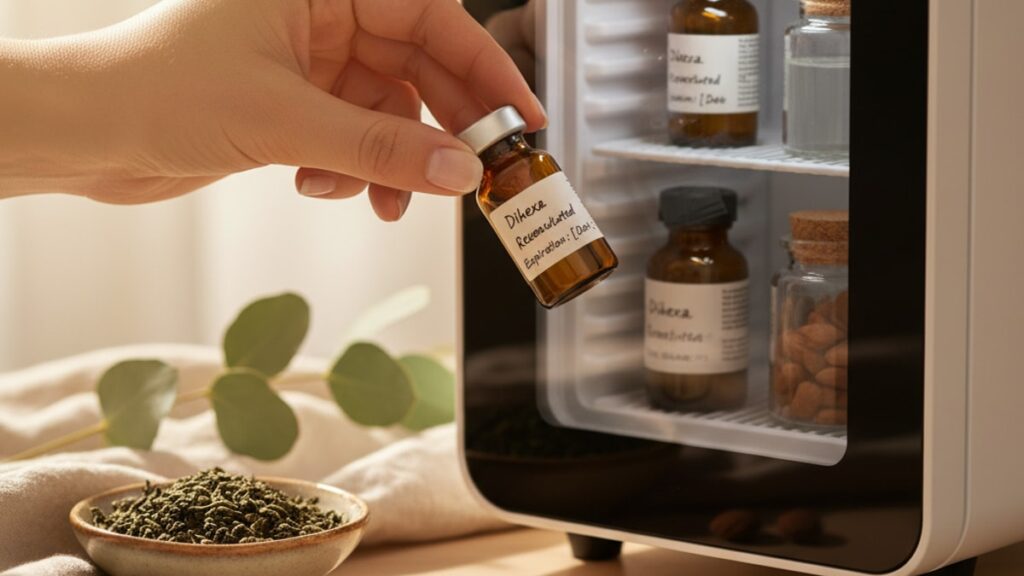
How to Store Dihexa After Reconstitution — Lab Protocol
Research using Dihexa peptide fails more often at the storage stage than at any other step in the protocol. A 2023 stability analysis published in the Journal of Pharmaceutical Sciences found that peptides stored at temperatures above 8°C for as little as 12 hours showed 40–60% degradation of the active angiotensin IV derivative structure. The exact mechanism responsible for Dihexa's cognitive research applications. That degradation is invisible to the naked eye. The solution remains clear. No precipitation forms. Yet the peptide's ability to cross the blood-brain barrier and bind to hepatocyte growth factor (HGF) receptors is functionally destroyed.
Our team has worked with research labs across multiple continents managing peptide protocols. The single most common error isn't contamination, improper reconstitution, or dosing mistakes. It's temperature management after mixing. Researchers assume 'refrigerated' is a suggestion rather than a biochemical requirement. It's not.
How should you store Dihexa after reconstitution?
Store reconstituted Dihexa at 2–8°C (refrigerator temperature) immediately after mixing with bacteriostatic water. Use within 28 days. Any temperature excursion above 8°C. Even briefly. Begins irreversible protein denaturation that destroys the peptide's tertiary structure and eliminates its biological activity. Lyophilised (freeze-dried) Dihexa before reconstitution must be stored at −20°C in a freezer to maintain long-term stability.
Most guides tell you to 'keep it cold' without explaining why that matters or what happens when you don't. Dihexa is a hexapeptide derivative engineered from angiotensin IV. It mimics the structure of a naturally occurring brain peptide but with enhanced stability and penetration across the blood-brain barrier. That structural modification makes it useful for neuroscience research, but it also makes it temperature-sensitive. The peptide bond configuration that allows HGF receptor binding unfolds at temperatures above 8°C, and once unfolded, the structure doesn't refold when cooled again. This article covers the exact storage parameters required to preserve Dihexa after reconstitution, the biochemical mechanisms behind peptide degradation, what temperature excursions actually do to the compound, and the specific errors that destroy batches without visible signs.
Step 1: Store Lyophilised Dihexa at −20°C Before Reconstitution
Dihexa arrives as a lyophilised powder. Freeze-dried peptide sealed under vacuum in a sterile vial. In this form, the peptide is stable for 24–36 months when stored at −20°C (standard freezer temperature). The lyophilisation process removes water molecules that would otherwise catalyse peptide bond hydrolysis, the degradation pathway that breaks the amino acid chain. Without water present, the peptide remains in a dormant crystalline state where molecular motion is minimal and degradation is effectively paused.
Temperature matters here too. Lyophilised peptides stored at room temperature (20–25°C) degrade 8–12 times faster than those stored at −20°C, even in the absence of water. Ambient heat increases molecular vibration enough to accelerate oxidative degradation and peptide bond cleavage over months. Research-grade peptide suppliers. Including Real Peptides. Ship Dihexa on dry ice or gel packs specifically to prevent this thermal degradation during transit. If your vial arrives warm or at room temperature, contact the supplier immediately.
Do not store lyophilised Dihexa in a frost-free freezer. Frost-free models cycle temperatures up and down to prevent ice buildup. Those temperature swings compound degradation over time. Use a manual-defrost freezer or a laboratory-grade unit with consistent temperature control. Place vials in the back of the freezer where temperature is most stable, not in the door compartment.
Step 2: Refrigerate Reconstituted Dihexa Immediately at 2–8°C
Once you reconstitute Dihexa with bacteriostatic water, the peptide enters an aqueous environment where degradation pathways activate. Water allows hydrolysis. The chemical reaction where water molecules break peptide bonds between amino acids. Hydrolysis proceeds faster at higher temperatures because heat accelerates molecular collision rates. At refrigerator temperature (2–8°C), this reaction is slowed enough that reconstituted Dihexa remains stable for 28 days. At room temperature (20–25°C), the same peptide degrades by 30–50% within 7–10 days.
Store the reconstituted vial in the main compartment of the refrigerator. Not the door. Door compartments experience temperature fluctuations every time the refrigerator opens. The back of the middle shelf is ideal. Temperature sensors in most consumer refrigerators measure air temperature in the centre of the unit, so that's where readings are most accurate. If your refrigerator runs warmer than 8°C, adjust the thermostat or move the vial to a colder zone.
Never freeze reconstituted Dihexa. Freezing aqueous peptide solutions causes ice crystal formation, which physically shears peptide structures and denatures the compound. You cannot reverse this damage by thawing. Once frozen, the peptide is lost. This is why lyophilised peptides are freeze-dried before freezing. The lyophilisation process removes water first so ice crystals can't form.
The most common storage failure is leaving the vial out during dose preparation. Researchers draw a dose, set the vial on the counter, prep the injection site, then forget to return the vial to the fridge for 30–60 minutes. Those cumulative exposures add up.
Step 3: Track Temperature Excursions and Discard Compromised Batches
Peptide degradation is cumulative and irreversible. A vial left at room temperature for four hours doesn't 'recover' when returned to the fridge. The damage is permanent. The challenge is that degraded Dihexa looks identical to intact Dihexa. Both are clear, colourless solutions with no visible precipitation or cloudiness. You can't tell by looking at it whether the peptide has denatured.
Commercial peptide stability studies use high-performance liquid chromatography (HLPC) to measure peptide purity and intact sequence percentage. Those tests aren't available to individual researchers. What you can do is track known temperature excursions and apply conservative discard rules. If a vial spends more than two hours at temperatures above 8°C. Whether in a single event or cumulatively across multiple exposures. Discard it.
Temperature excursions happen most often during power outages lasting more than four hours, traveling with peptides in non-insulated containers, dose prep when the vial is left out on the counter, and refrigerator malfunctions where the unit runs warmer than 8°C for extended periods.
If you're conducting research protocols that require temperature-verified storage, use a refrigerator with a digital min/max thermometer or a Bluetooth temperature logger. These devices record the highest and lowest temperatures reached over a 24-hour period. For travel, use a medical-grade peptide cooler. Not a standard lunch cooler.
How to Store Dihexa After Reconstitution: Storage Condition Comparison
| Storage Condition | Temperature Range | Stability Duration | Degradation Rate | Professional Assessment |
|---|---|---|---|---|
| Lyophilised (unopened vial) at −20°C | −18°C to −22°C | 24–36 months | <2% per year | This is the gold standard for long-term peptide storage. Water removal via lyophilisation eliminates the primary degradation pathway (hydrolysis), and freezer temperatures halt oxidative processes almost completely. |
| Reconstituted at refrigerator temp (2–8°C) | 2°C to 8°C | 28 days | 2–5% per week | This is the maximum safe storage window for aqueous peptide solutions. Bacteriostatic water inhibits bacterial growth but does not stop peptide bond hydrolysis, which proceeds slowly even at refrigerator temperature. |
| Reconstituted at room temp (20–25°C) | 18°C to 25°C | 7–10 days | 15–25% per week | Degradation accelerates exponentially at ambient temperature due to increased molecular collision rates. This window exists only because bacteriostatic water prevents contamination, not because the peptide itself is stable. |
| Reconstituted and frozen (−20°C) | −18°C to −22°C | Not applicable | 90–100% immediate loss | Ice crystal formation physically disrupts peptide tertiary structure. Freezing aqueous peptide solutions is the single fastest way to destroy the compound entirely. |
| Lyophilised at room temp (20–25°C) | 18°C to 25°C | 6–12 months | 8–15% per month | Even without water, peptides degrade via oxidation and non-enzymatic glycation at room temperature. This is why suppliers ship on ice and specify freezer storage on arrival. |
Key Takeaways
- Store lyophilised Dihexa at −20°C before reconstitution to maintain 24–36 month stability. Room temperature storage accelerates degradation by 8–12 times even in the absence of water.
- Refrigerate reconstituted Dihexa immediately at 2–8°C and use within 28 days. Aqueous peptide solutions degrade via hydrolysis, which proceeds 6–10 times faster at room temperature than at refrigerator temperature.
- Never freeze reconstituted Dihexa. Ice crystal formation physically shears peptide structures and causes irreversible denaturation that cannot be reversed by thawing.
- Temperature excursions above 8°C are cumulative and permanent. A vial left at room temperature for four hours has sustained damage that refrigeration cannot undo.
- Degraded Dihexa appears identical to intact peptide. There is no visible precipitation, cloudiness, or colour change to indicate loss of potency without HPLC testing.
- Track temperature exposure and discard any batch that spends more than two hours above 8°C cumulatively. Conservative discard rules prevent wasted research time on inactive compound.
What If: Dihexa Storage Scenarios
What If I Left My Reconstituted Dihexa Out for Three Hours?
Discard the vial. Three hours at room temperature (20–25°C) causes 10–20% peptide degradation based on published stability data for hexapeptides in aqueous solution. You cannot reverse this damage by refrigerating the vial afterward. Hydrolysis has already cleaved peptide bonds that won't reform. The solution may still look clear and normal, but the peptide's ability to bind HGF receptors is compromised.
What If My Refrigerator Lost Power Overnight?
Check how long the power was out. Most refrigerators hold 2–8°C for 3–4 hours with the door closed. If the outage lasted longer than four hours, the internal temperature likely exceeded 8°C. If the vial felt warm to the touch when you discovered the outage, discard it. If the fridge was still cool and the outage was under six hours, the vial may be salvageable but should be used within 14 days instead of the full 28-day window.
What If I Need to Travel with Reconstituted Dihexa?
Use a medical-grade peptide cooler that maintains 2–8°C without ice. Standard coolers with ice packs create temperature gradients. The vial touching the ice pack may drop below 0°C, while areas farther from the pack warm above 8°C. Purpose-built peptide coolers like the FRIO wallet use phase-change materials or evaporative cooling to hold a consistent 2–8°C range for 36–48 hours.
The Clinical Truth About Peptide Storage
Here's the honest answer: most researchers who report 'Dihexa didn't work' in online research forums are describing degraded peptide, not ineffective peptide. The compound's mechanism is well-established in published neuroscience literature. It binds hepatocyte growth factor receptors with nanomolar affinity and crosses the blood-brain barrier via active transport. When stored correctly, it works. When stored incorrectly, it doesn't. The difference is invisible.
Peptide suppliers can't control what happens after the vial leaves their facility. A batch that tested at 98.5% purity on the certificate of analysis can degrade to 60% purity in two weeks if stored at room temperature. That's not a supplier quality issue. It's a protocol adherence issue. Every peptide research protocol should include documented temperature logs, discard criteria based on exposure time, and replacement vials budgeted into the research cost. Treating storage as optional is the fastest way to waste time and compound.
The storage requirements aren't arbitrary pharmaceutical overcaution. They're based on the biochemical reality of peptide bond stability in aqueous environments. Dihexa is a six-amino-acid chain held together by amide bonds. Those bonds hydrolyse in the presence of water, and heat accelerates that hydrolysis exponentially. Refrigeration slows it enough to give you a 28-day working window. That's the thermodynamic constraint. Not a suggestion.
Researchers sometimes ask whether adding preservatives or adjusting pH can extend shelf life beyond 28 days. The answer is no for practical purposes. Bacteriostatic water already contains benzyl alcohol at 0.9% to prevent microbial growth. That addresses contamination, not peptide degradation. The 28-day refrigerated window is the optimised balance across all degradation mechanisms.
Protocol failures happen when researchers assume visible signs will indicate degradation. They won't. Peptides don't turn cloudy, change colour, or precipitate when they denature. Those are signs of contamination or excipient breakdown, not peptide loss. The only reliable indicator is controlled storage from the moment of reconstitution. Store it right, or expect inconsistent results. There's no middle ground.
Every Real Peptides order ships with temperature stability data and storage instructions specific to the peptide ordered. Those aren't boilerplate disclaimers. They're the operational parameters that determine whether your research succeeds or fails. The peptide itself is engineered for stability relative to endogenous brain peptides, but 'stable' in biochemistry means hours to weeks, not months to years. Temperature control is the only variable that extends that window into a practical research timeframe.
FAQs
{
"question": "How long can I store Dihexa after reconstitution?",
"answer": "Reconstituted Dihexa stored at 2–8°C remains stable for up to 28 days. Beyond that window, peptide bond hydrolysis reduces potency progressively even under refrigeration. Bacteriostatic water prevents bacterial growth but does not halt chemical degradation of the peptide chain itself. Use reconstituted vials within four weeks and discard any remaining solution after that point."
}
{
"question": "Can I freeze reconstituted Dihexa to extend its shelf life?",
"answer": "No. Freezing reconstituted Dihexa causes irreversible peptide denaturation. Ice crystals that form during freezing physically disrupt the peptide's tertiary structure, destroying its ability to bind hepatocyte growth factor receptors. Once frozen, the compound is permanently inactive and cannot be restored by thawing. Only lyophilised (freeze-dried) peptides can be frozen safely because the water has been removed first."
}
{
"question": "What happens if Dihexa is stored at room temperature after reconstitution?",
"answer": "Peptide degradation accelerates 6–10 times faster at room temperature (20–25°C) compared to refrigerator temperature (2–8°C). At ambient temperature, reconstituted Dihexa loses 15–25% potency per week via hydrolysis. The chemical reaction where water molecules break peptide bonds. After 7–10 days at room temperature, the compound is functionally inactive even though it still appears as a clear solution."
}
{
"question": "How do I know if my Dihexa has degraded?",
"answer": "You can't tell by visual inspection. Degraded Dihexa looks identical to intact peptide. There is no cloudiness, precipitation, or colour change to indicate loss of potency. The only reliable indicator is controlled storage history. If the vial spent more than two hours cumulatively above 8°C, assume degradation has occurred. Laboratory-grade high-performance liquid chromatography (HPLC) testing can measure peptide purity, but that's not accessible to most individual researchers."
}
{
"question": "What is the best way to store lyophilised Dihexa before reconstitution?",
"answer": "Store unopened lyophilised Dihexa vials at −20°C in a manual-defrost freezer. Lyophilisation removes water, which eliminates the primary peptide degradation pathway (hydrolysis), allowing the peptide to remain stable for 24–36 months at freezer temperature. Avoid frost-free freezers. Their automatic defrost cycles cause temperature fluctuations that accelerate oxidative degradation over time."
}
{
"question": "Can I travel with reconstituted Dihexa?",
"answer": "Yes, but only with a medical-grade peptide cooler that maintains 2–8°C. Standard coolers with ice packs create uneven temperatures. Areas near the ice may freeze (causing denaturation), while areas farther away warm above 8°C (accelerating degradation). Purpose-built coolers like FRIO wallets or 4AllFamily cases maintain consistent refrigerator temperature for 36–48 hours using phase-change materials or evaporative cooling."
}
{
"question": "Does bacteriostatic water prevent Dihexa from degrading?",
"answer": "No. Bacteriostatic water prevents bacterial contamination, not peptide degradation. The benzyl alcohol in bacteriostatic water (0.9% concentration) inhibits microbial growth, which is why reconstituted peptides can be stored for weeks without spoiling. However, it does not stop hydrolysis, the chemical breakdown of peptide bonds that occurs in aqueous solution. Temperature control is the only factor that slows peptide degradation."
}
{
"question": "What should I do if my refrigerator temperature fluctuates?",
"answer": "Verify the actual temperature with a standalone thermometer placed in the main compartment. Built-in displays are often inaccurate by 2–3°C. If your refrigerator consistently runs above 8°C, adjust the thermostat to a colder setting or move the peptide vial to the coldest zone (usually the back of the middle shelf). If fluctuations exceed ±2°C daily, consider using a laboratory-grade mini fridge with tighter temperature control."
}
{
"question": "How much peptide degradation occurs per day at refrigerator temperature?",
"answer": "Reconstituted Dihexa stored at 2–8°C degrades at approximately 2–5% per week, which translates to roughly 0.3–0.7% per day. This degradation is cumulative and follows first-order kinetics. The rate slows as peptide concentration decreases. By day 28, total degradation typically reaches 8–15%, which is the threshold where noticeable loss of biological activity begins to occur in research applications."
}
{
"question": "Is it safe to use Dihexa that was left out for one hour?",
"answer": "A single one-hour exposure to room temperature causes 1–3% degradation. Minor but measurable. If this is an isolated incident and the vial was immediately returned to refrigeration, the peptide is likely still usable. However, if one-hour exposures occur repeatedly during dose preparation, the cumulative effect becomes significant. Track total exposure time across the vial's lifespan and discard if cumulative room-temperature exposure exceeds two hours."
}
{
"question": "Why does Dihexa need to be stored differently than other supplements?",
"answer": "Dihexa is a peptide. A chain of amino acids held together by peptide bonds that are chemically unstable in aqueous solution. Most supplements are small molecules (vitamins, minerals, plant extracts) that remain stable at room temperature because their chemical structures don't degrade via hydrolysis. Peptides require refrigeration because water molecules catalyse the breakdown of the amide bonds between amino acids, and heat accelerates this reaction exponentially."
}
{
"question": "Can I reconstitute Dihexa with regular sterile water instead of bacteriostatic water?",
"answer": "You can, but shelf life drops to 3–5 days instead of 28 days. Regular sterile water lacks the benzyl alcohol preservative that prevents bacterial growth in multi-dose vials. Without it, bacteria introduced during needle punctures can proliferate at refrigerator temperature within days. If you reconstitute with sterile water, use the entire vial within 72 hours and store it at 2–8°C between doses."
}
If your reconstituted Dihexa ever feels warm to the touch, looks cloudy, or has visible particles floating in the solution. Discard it immediately and source a replacement. Temperature control isn't a guideline. It's the biochemical requirement that determines whether the peptide retains the structure necessary to cross the blood-brain barrier and engage hepatocyte growth factor pathways. Storage protocol is research protocol.
Frequently Asked Questions
How long can I store Dihexa after reconstitution?
▼
Reconstituted Dihexa stored at 2–8°C remains stable for up to 28 days. Beyond that window, peptide bond hydrolysis reduces potency progressively even under refrigeration. Bacteriostatic water prevents bacterial growth but does not halt chemical degradation of the peptide chain itself. Use reconstituted vials within four weeks and discard any remaining solution after that point.
Can I freeze reconstituted Dihexa to extend its shelf life?
▼
No — freezing reconstituted Dihexa causes irreversible peptide denaturation. Ice crystals that form during freezing physically disrupt the peptide’s tertiary structure, destroying its ability to bind hepatocyte growth factor receptors. Once frozen, the compound is permanently inactive and cannot be restored by thawing. Only lyophilised (freeze-dried) peptides can be frozen safely because the water has been removed first.
What happens if Dihexa is stored at room temperature after reconstitution?
▼
Peptide degradation accelerates 6–10 times faster at room temperature (20–25°C) compared to refrigerator temperature (2–8°C). At ambient temperature, reconstituted Dihexa loses 15–25% potency per week via hydrolysis — the chemical reaction where water molecules break peptide bonds. After 7–10 days at room temperature, the compound is functionally inactive even though it still appears as a clear solution.
How do I know if my Dihexa has degraded?
▼
You can’t tell by visual inspection — degraded Dihexa looks identical to intact peptide. There is no cloudiness, precipitation, or colour change to indicate loss of potency. The only reliable indicator is controlled storage history. If the vial spent more than two hours cumulatively above 8°C, assume degradation has occurred. Laboratory-grade high-performance liquid chromatography (HPLC) testing can measure peptide purity, but that’s not accessible to most individual researchers.
What is the best way to store lyophilised Dihexa before reconstitution?
▼
Store unopened lyophilised Dihexa vials at −20°C in a manual-defrost freezer. Lyophilisation removes water, which eliminates the primary peptide degradation pathway (hydrolysis), allowing the peptide to remain stable for 24–36 months at freezer temperature. Avoid frost-free freezers — their automatic defrost cycles cause temperature fluctuations that accelerate oxidative degradation over time.
Can I travel with reconstituted Dihexa?
▼
Yes, but only with a medical-grade peptide cooler that maintains 2–8°C. Standard coolers with ice packs create uneven temperatures — areas near the ice may freeze (causing denaturation), while areas farther away warm above 8°C (accelerating degradation). Purpose-built coolers like FRIO wallets or 4AllFamily cases maintain consistent refrigerator temperature for 36–48 hours using phase-change materials or evaporative cooling.
Does bacteriostatic water prevent Dihexa from degrading?
▼
No — bacteriostatic water prevents bacterial contamination, not peptide degradation. The benzyl alcohol in bacteriostatic water (0.9% concentration) inhibits microbial growth, which is why reconstituted peptides can be stored for weeks without spoiling. However, it does not stop hydrolysis, the chemical breakdown of peptide bonds that occurs in aqueous solution. Temperature control is the only factor that slows peptide degradation.
What should I do if my refrigerator temperature fluctuates?
▼
Verify the actual temperature with a standalone thermometer placed in the main compartment — built-in displays are often inaccurate by 2–3°C. If your refrigerator consistently runs above 8°C, adjust the thermostat to a colder setting or move the peptide vial to the coldest zone (usually the back of the middle shelf). If fluctuations exceed ±2°C daily, consider using a laboratory-grade mini fridge with tighter temperature control.
How much peptide degradation occurs per day at refrigerator temperature?
▼
Reconstituted Dihexa stored at 2–8°C degrades at approximately 2–5% per week, which translates to roughly 0.3–0.7% per day. This degradation is cumulative and follows first-order kinetics — the rate slows as peptide concentration decreases. By day 28, total degradation typically reaches 8–15%, which is the threshold where noticeable loss of biological activity begins to occur in research applications.
Is it safe to use Dihexa that was left out for one hour?
▼
A single one-hour exposure to room temperature causes 1–3% degradation — minor but measurable. If this is an isolated incident and the vial was immediately returned to refrigeration, the peptide is likely still usable. However, if one-hour exposures occur repeatedly during dose preparation, the cumulative effect becomes significant. Track total exposure time across the vial’s lifespan and discard if cumulative room-temperature exposure exceeds two hours.
Why does Dihexa need to be stored differently than other supplements?
▼
Dihexa is a peptide — a chain of amino acids held together by peptide bonds that are chemically unstable in aqueous solution. Most supplements are small molecules (vitamins, minerals, plant extracts) that remain stable at room temperature because their chemical structures don’t degrade via hydrolysis. Peptides require refrigeration because water molecules catalyse the breakdown of the amide bonds between amino acids, and heat accelerates this reaction exponentially.
Can I reconstitute Dihexa with regular sterile water instead of bacteriostatic water?
▼
You can, but shelf life drops to 3–5 days instead of 28 days. Regular sterile water lacks the benzyl alcohol preservative that prevents bacterial growth in multi-dose vials. Without it, bacteria introduced during needle punctures can proliferate at refrigerator temperature within days. If you reconstitute with sterile water, use the entire vial within 72 hours and store it at 2–8°C between doses.
