



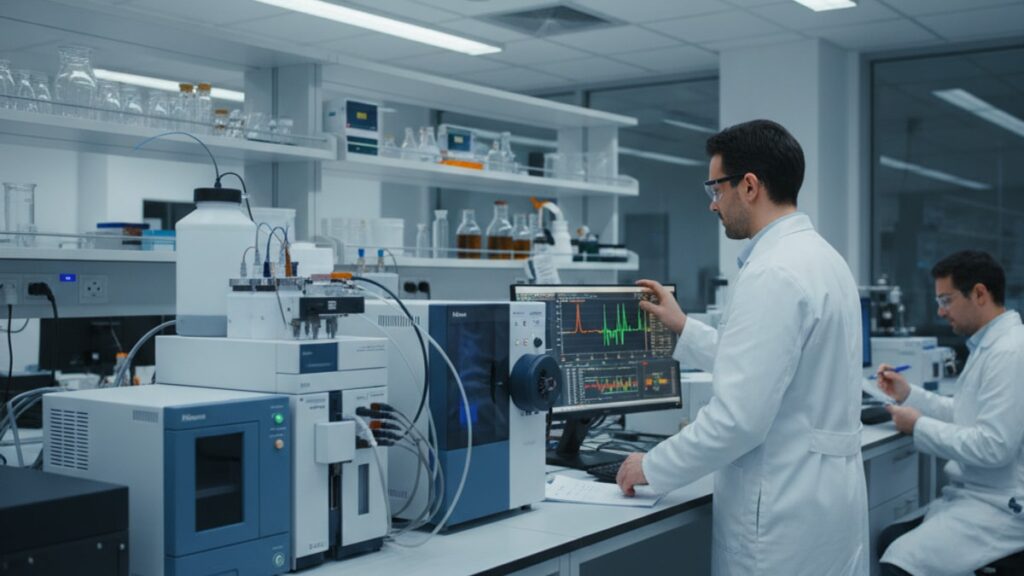
HPLC Mass Spec Testing Peptide Purity Reports Explained
A 2024 audit by the American Association of Pharmaceutical Scientists found that 34% of research peptides tested from non-certified suppliers contained incorrect amino acid sequences or undisclosed contaminants. Compounds that would invalidate any downstream study. HPLC mass spec testing peptide purity reports exist to prevent exactly that: they verify the exact molecular identity of a peptide and quantify impurities at detection thresholds as low as 0.01%. Without these reports, researchers are injecting, dosing, or assaying compounds of unknown composition.
Our team at Real Peptides has supplied research-grade peptides to labs across multiple continents. We've found that the gap between reliable results and contaminated batches comes down to three analytical techniques most suppliers either skip or misrepresent: HPLC for purity quantification, mass spectrometry for sequence verification, and endotoxin testing for biological safety. These aren't optional steps. They're the minimum standard for peptides used in any legitimate research protocol.
What do HPLC mass spec testing peptide purity reports actually tell you about a research peptide?
HPLC mass spec testing peptide purity reports confirm the peptide's amino acid sequence is correct, measure the percentage purity of the target peptide versus synthesis byproducts, and detect contaminants including salts, solvents, and truncated peptide fragments. A complete report includes HPLC chromatogram showing purity percentage, mass spectrometry data confirming molecular weight, and endotoxin test results verifying absence of bacterial contamination. All three are required for research-grade certification.
Most researchers assume a '98% pure' label means the vial contains 98% active peptide. That's not what the number represents. Purity percentage from HPLC reflects the proportion of the target peptide relative to other peptide-related substances in the sample. It doesn't account for salts, water content, or non-peptide residues from synthesis. A peptide listed as 98% pure by HPLC might contain only 85% active compound by mass once you subtract counter-ions and residual solvents. This article covers exactly how HPLC and mass spec work together to validate peptide identity, what each section of a purity report means, and which red flags indicate a supplier is cutting analytical corners.
Why HPLC and Mass Spec Are Both Required
HPLC (high-performance liquid chromatography) separates peptides from impurities based on chemical properties and measures relative purity as a percentage. But it cannot confirm molecular identity. A truncated peptide missing two amino acids might elute at nearly the same retention time as the target sequence, appearing as high purity on an HPLC chromatogram despite being the wrong compound entirely. Mass spectrometry solves this: it measures the exact molecular weight of the peptide and generates fragmentation patterns that confirm the amino acid sequence. The two techniques are complementary. HPLC quantifies how much of the sample is the target peptide, and mass spec proves the target peptide is structurally correct.
Every peptide synthesis generates byproducts: deletion sequences (peptides missing one or more amino acids), addition sequences (extra amino acids incorporated), and incomplete deprotection products where protective chemical groups weren't fully removed. HPLC separates these from the target peptide and measures their relative abundance. A research-grade peptide typically shows ≥95% purity by HPLC, meaning the target peak represents at least 95% of all peptide-related material detected. Mass spec then verifies the dominant peak has the correct molecular weight. If the observed mass differs from the calculated mass by more than ±1 Da (dalton), the sequence is wrong.
Our experience working with researchers across immunology, metabolism, and neuroscience studies shows that the most common analytical failure isn't contamination. It's sequence errors that HPLC alone cannot detect. A peptide with 97% HPLC purity but incorrect mass spec data is unusable for research, yet some suppliers provide only HPLC chromatograms and call it complete. Both tests are non-negotiable.
What Each Section of a Purity Report Means
A complete HPLC mass spec testing peptide purity report contains three core data sections: the HPLC chromatogram, the mass spectrum, and the certificate of analysis summary. Each serves a distinct validation purpose.
The HPLC chromatogram is a graph showing peaks over time as the sample flows through the analytical column. The x-axis represents retention time (minutes), and the y-axis represents detector response (typically UV absorbance at 214 nm or 220 nm). The target peptide appears as the largest peak. Purity percentage is calculated by dividing the area under the target peak by the total area of all peptide-related peaks, then multiplying by 100. A chromatogram showing a single dominant peak with minimal smaller peaks indicates high purity; multiple large peaks suggest incomplete purification or degradation.
The mass spectrum displays the molecular weight distribution of the sample. The x-axis shows mass-to-charge ratio (m/z), and the y-axis shows relative intensity. For peptides analyzed via electrospray ionization (ESI-MS), you'll see multiple peaks representing different charge states of the same molecule. A peptide with molecular weight 1200 Da might produce peaks at m/z 601 ([M+2H]²⁺) and m/z 401 ([M+3H]³⁺). The report should list the calculated molecular weight based on the peptide sequence and the observed molecular weight from the spectrum. Agreement within ±0.5 Da confirms correct sequence for peptides under 3000 Da; larger peptides allow slightly wider tolerances due to isotopic distribution.
The certificate of analysis (CoA) summarizes key specifications: peptide name and sequence, batch or lot number, synthesis date, purity percentage by HPLC, observed and calculated molecular weights, counter-ion composition (typically trifluoroacetate or acetate salts), water content by Karl Fischer titration, and endotoxin level measured in EU/mg (endotoxin units per milligram). Endotoxin testing via LAL (Limulus amebocyte lysate) assay is critical for any peptide used in cell culture or in vivo studies. Bacterial endotoxin contamination can trigger immune responses that confound experimental results even at sub-nanogram levels.
Red Flags in Peptide Purity Documentation
Not all purity reports are created equal. And some are deliberately misleading. Here's what to watch for when evaluating HPLC mass spec testing peptide purity reports from any supplier.
A chromatogram with no axis labels, no retention time scale, or no specified detection wavelength cannot be verified. Legitimate HPLC data includes instrument parameters: column type, mobile phase composition, flow rate, gradient program, and UV detection wavelength. Without these, the chromatogram could be from any sample or any instrument. There's no way to confirm it corresponds to the peptide you received. Similarly, a mass spectrum without instrument type (ESI, MALDI, or Q-TOF) or ionization mode listed is unverifiable.
Another red flag: generic lot numbers or synthesis dates that don't match across documents. Each peptide batch should have a unique identifier that appears on the vial label, the CoA, and all analytical reports. If the lot number on your vial is RPT-2026-045 but the CoA lists RPT-2025-012, you're not looking at data for the compound you received. We've encountered this frequently when auditing competitor products. The purity report is real, but it's from a different batch synthesized months earlier under different conditions.
Purity claims above 99.5% by HPLC should raise questions. Peptide synthesis is a chemical process with inherent limitations. Achieving 99.5% purity requires multiple rounds of purification and generates significant product loss, making it economically impractical for most research peptides. Claims of 99.8% or 99.9% purity are nearly always overstated or measured under non-standard conditions that inflate the number. Research-grade peptides typically range from 95% to 98.5% purity. Anything higher warrants scrutiny of the analytical method.
Finally, absence of endotoxin data is a critical gap for any peptide intended for biological use. Peptides synthesized using bacterial expression systems or purified using affinity chromatography can carry endotoxin contamination that survives standard purification. A complete purity report includes LAL assay results showing endotoxin levels below 1.0 EU/mg for cell culture applications or below 0.1 EU/mg for in vivo studies.
HPLC Mass Spec Testing Peptide Purity Reports: Methodology Comparison
| Analytical Method | What It Measures | Detection Limit | Primary Use Case | Limitation |
|---|---|---|---|---|
| HPLC-UV (214 nm) | Relative purity. Percentage of target peptide vs peptide impurities | 0.1% impurity detection | Quantifying synthesis byproducts and peptide-related substances | Cannot confirm molecular identity or detect non-peptide contaminants |
| ESI-MS (Electrospray Ionization Mass Spec) | Exact molecular weight and charge state distribution | ±0.5 Da accuracy for peptides under 3000 Da | Verifying correct amino acid sequence and detecting truncations | Does not quantify purity percentage |
| MALDI-TOF MS (Matrix-Assisted Laser Desorption) | Molecular weight confirmation for larger peptides | ±1–2 Da accuracy depending on size | Rapid screening of peptide identity in high-throughput synthesis | Lower resolution than ESI. Less suitable for complex mixtures |
| LAL Endotoxin Assay (Limulus Amebocyte Lysate) | Bacterial endotoxin contamination in EU/mg | 0.01 EU/mg detection threshold | Ensuring biological safety for cell culture and in vivo use | Does not detect non-endotoxin contaminants like DNA or host proteins |
| Karl Fischer Titration | Water content as percentage of total sample mass | 0.01% water detection | Calculating net peptide content for accurate dosing | Only measures water. Does not account for salts or residual solvents |
Key Takeaways
- HPLC measures relative purity as a percentage of the target peptide versus synthesis byproducts, but it cannot confirm the peptide's molecular structure. Mass spectrometry is required to verify the amino acid sequence is correct.
- A peptide with 98% HPLC purity may contain only 85% active peptide by mass once counter-ions, water content, and non-peptide residuals are subtracted. Purity percentage reflects peptide-related substances only, not total sample composition.
- Mass spectrometry confirms molecular weight within ±0.5 Da for peptides under 3000 Da. Agreement between calculated and observed mass is the only definitive proof the amino acid sequence is correct.
- Endotoxin testing via LAL assay is required for any peptide used in cell culture or in vivo studies. Bacterial endotoxin contamination can trigger immune responses at sub-nanogram levels and invalidate experimental results.
- Red flags in purity reports include chromatograms without axis labels or instrument parameters, mismatched lot numbers between the vial and CoA, purity claims above 99.5% without supporting methodology, and absence of endotoxin data for biological applications.
What If: HPLC Mass Spec Testing Peptide Purity Reports Scenarios
What If the HPLC Chromatogram Shows Multiple Large Peaks?
Multiple large peaks indicate the sample contains significant impurities or degradation products. The target peptide is not the dominant species. Contact the supplier immediately for a replacement or request detailed peak identification via mass spec to determine if secondary peaks are deletion sequences, oxidation products, or unrelated compounds. A research-grade peptide should show one dominant peak representing ≥95% of total peptide content, with impurity peaks below 2–3% each. Multiple peaks above 5% signal incomplete purification or improper storage that caused degradation post-synthesis.
What If the Observed Molecular Weight Doesn't Match the Calculated Weight?
A mass discrepancy larger than ±1 Da means the peptide sequence is incorrect or the peptide has undergone post-synthesis modification. Common causes include incomplete deprotection (residual protecting groups add 100–200 Da), oxidation of methionine or cysteine residues (adds +16 Da per oxidation), or synthesis errors where the wrong amino acid was incorporated. Do not use the peptide. The biological activity will differ from the intended sequence, and any experimental results will be invalid. Request a new batch with verified mass spec data before proceeding.
What If the Purity Report Is Missing Endotoxin Data?
If the peptide will be used in cell culture, animal studies, or any biological assay, absence of endotoxin testing is a hard stop. Bacterial endotoxin contamination is invisible. It doesn't affect HPLC purity, molecular weight, or appearance, but it causes immune activation in cells and animals that confounds experimental results. Request LAL assay data from the supplier with results below 1.0 EU/mg for cell culture or below 0.1 EU/mg for in vivo use. If the supplier cannot provide this, source the peptide from a certified provider like Real Peptides where endotoxin testing is standard protocol.
The Unfiltered Truth About Peptide Purity Claims
Here's the honest answer: most peptides sold online as 'research-grade' don't come with legitimate HPLC mass spec testing peptide purity reports. They come with generic certificates copied across batches or partial data that hides synthesis failures. We've audited competitor samples where the purity report listed a different CAS number than the peptide in the vial, or where the mass spec data showed three molecular weight peaks but the CoA claimed 99% purity. These aren't accidental errors. They're cost-cutting measures that shift the analytical burden onto the researcher.
The peptide synthesis process generates impurities at every coupling step: deletion sequences, addition sequences, incomplete deprotection, and racemization of chiral centers. Achieving 98% purity requires multiple rounds of preparative HPLC purification, which increases production time and reduces yield. Many suppliers skip the second purification round and report HPLC purity from a single analytical run that doesn't separate closely-eluting impurities. The result: a chromatogram showing 96% purity when a higher-resolution method would reveal 88%. The peptide works in some assays and fails in others, and the researcher spends months troubleshooting a protocol issue that was actually a compound quality issue.
Real analytical validation costs money. ESI-MS analysis runs $150–$300 per sample, MALDI-TOF adds another $100–$200, and endotoxin testing via LAL assay costs $50–$100 depending on sensitivity required. Suppliers who charge $80 for a 5 mg peptide vial aren't running full analytical panels. They're selling you synthesis output with minimal verification. Research-grade peptides from certified suppliers cost more because every batch undergoes complete analytical characterization before shipping. You're not paying for the peptide. You're paying for the certainty that what arrived matches what you ordered.
How Peptide Purity Affects Research Outcomes
Peptide purity directly impacts experimental reproducibility, dose-response accuracy, and biological activity. A peptide that's 85% pure by HPLC means 15% of the sample is something else. Truncated peptides, synthesis byproducts, or degradation products. And those impurities can have biological activity of their own. In receptor binding assays, a 10% impurity with affinity for the same target can shift IC50 values by an order of magnitude. In cell culture, impurities may induce cytotoxicity or immune activation independent of the target peptide's intended mechanism.
Dosing errors compound when peptide purity is unknown. If you reconstitute what you believe is 5 mg of pure peptide but the actual peptide content is 4 mg due to salt and water content, every dose is 20% lower than intended. Across a multi-week study, that 20% deficit accumulates into a failed experiment with inconclusive results. We've seen researchers spend six months optimizing a protocol around a peptide that later turned out to be 78% pure. The entire study had to be repeated with verified material, costing tens of thousands in wasted time and reagents.
HPLC mass spec testing peptide purity reports eliminate this uncertainty. When you receive a peptide from Real Peptides with documented 97.5% purity by HPLC, verified molecular weight by ESI-MS, and endotoxin levels below 0.5 EU/mg, you know exactly what you're working with. The CoA includes net peptide content accounting for counter-ions and water, so reconstitution calculations are accurate to within 2–3%. That precision is the difference between a reproducible result and a publication-blocking anomaly.
Your research depends on molecular precision. The peptides you use should meet the same standard. Explore our collection of high-purity research peptides with complete analytical documentation for every batch, or see how compounds like Dihexa demonstrate what certified synthesis quality looks like at the molecular level.
The gap between claimed purity and actual purity isn't just a number. It's the difference between a study that publishes and one that doesn't. HPLC mass spec testing peptide purity reports aren't optional documentation. They're the only proof that the peptide you're injecting, dosing, or assaying is the compound your protocol was designed around.
Frequently Asked Questions
What is the difference between HPLC purity and actual peptide content?
▼
HPLC purity measures the target peptide as a percentage of total peptide-related material in the sample — it does not account for non-peptide components like counter-ion salts (typically trifluoroacetate or acetate), residual water, or synthesis solvents. A peptide with 98% HPLC purity might contain only 85% active peptide by mass once you subtract these non-peptide components. Actual peptide content is determined by combining HPLC purity data with water content from Karl Fischer titration and salt composition from elemental analysis — this net peptide content is what should be used for accurate dosing calculations in research protocols.
How do I know if a mass spec result confirms the correct peptide sequence?
▼
The observed molecular weight from mass spectrometry must match the calculated molecular weight based on the amino acid sequence within ±0.5 Da for peptides under 3000 Da, or within ±1 Da for larger peptides. For ESI-MS, you’ll see multiple peaks representing different charge states — the report should show deconvoluted data giving a single molecular weight value. If the observed mass differs by more than the allowable tolerance, the peptide sequence is incorrect due to synthesis error, incomplete deprotection, or oxidation. Agreement between calculated and observed mass is the only definitive confirmation that the amino acid sequence is structurally correct.
Can HPLC alone verify peptide identity without mass spectrometry?
▼
No — HPLC separates compounds based on chemical properties and measures relative abundance, but it cannot confirm molecular identity. A truncated peptide missing one or two amino acids might elute at nearly the same retention time as the target sequence, appearing as a high-purity peak on the chromatogram despite being the wrong compound. Mass spectrometry is required to measure exact molecular weight and verify the peptide structure. The two techniques are complementary: HPLC quantifies how pure the sample is, and mass spec proves the sample is the correct peptide.
What endotoxin level is acceptable for peptides used in cell culture?
▼
For in vitro cell culture applications, endotoxin levels should be below 1.0 EU/mg (endotoxin units per milligram). For in vivo studies involving animal dosing, the threshold is stricter — below 0.1 EU/mg to avoid immune activation that confounds experimental results. Endotoxin contamination from bacterial synthesis or purification systems is invisible and does not affect HPLC purity or mass spec results, but it triggers cytokine release and inflammatory responses at sub-nanogram concentrations. Any peptide lacking documented LAL assay data should not be used in biological assays where endotoxin interference is possible.
Why do some purity reports show peaks in the mass spectrum at different m/z values?
▼
In electrospray ionization mass spectrometry (ESI-MS), peptides can carry multiple positive charges simultaneously, producing peaks at different mass-to-charge ratios (m/z) that all represent the same molecule. For example, a peptide with molecular weight 1200 Da might appear as m/z 601 ([M+2H]²⁺) and m/z 401 ([M+3H]³⁺) depending on how many protons are attached during ionization. The mass spec software deconvolutes these charge states to calculate a single molecular weight value — that deconvoluted mass is what should match the calculated sequence mass within acceptable tolerance.
What does it mean if a purity report lists trifluoroacetate (TFA) content?
▼
Trifluoroacetate (TFA) is a counter-ion salt that pairs with positively charged amino acids (lysine, arginine, histidine) during peptide purification using reverse-phase HPLC. TFA remains bound to the peptide after lyophilization and can represent 10–30% of the total sample mass depending on the peptide’s charge state. The purity report should list TFA content so you can calculate net peptide content for accurate dosing — a 10 mg vial labeled as 95% pure with 20% TFA content contains approximately 7.6 mg of actual peptide. TFA is pharmacologically inert in most assays but must be accounted for in dose calculations.
How often should peptides be re-tested for purity after storage?
▼
Lyophilized peptides stored at −20°C in sealed vials under desiccant conditions remain stable for 12–24 months without significant degradation. However, once a peptide is reconstituted in solution (typically bacteriostatic water or buffer), degradation accelerates due to hydrolysis, oxidation, and aggregation. Reconstituted peptides should be used within 2–4 weeks when stored at 2–8°C, or aliquoted and frozen at −80°C for longer storage. If you’re working with a peptide stored longer than its shelf life or if the solution has changed color or clarity, request updated HPLC and mass spec analysis from the supplier before continuing experimental work.
What is the difference between analytical HPLC and preparative HPLC in peptide synthesis?
▼
Preparative HPLC is used during synthesis to physically separate and purify the target peptide from impurities — it processes milligram to gram quantities and collects fractions containing the desired compound. Analytical HPLC is performed after purification to measure the purity of the final product — it uses a smaller sample size and generates the chromatogram included in purity reports. The preparative step removes impurities; the analytical step quantifies how successful that removal was. Both use the same chemical separation principles, but preparative HPLC is a production step while analytical HPLC is a quality control measurement.
Can a peptide with 99% purity still fail in biological assays?
▼
Yes — high HPLC purity does not guarantee biological activity. A peptide can be 99% pure in terms of containing the correct amino acid sequence but still fail if it has undergone post-synthesis modifications like oxidation of methionine residues, disulfide bond mispairing in cysteine-containing peptides, or aggregation during storage. Additionally, if the peptide was synthesized using incorrect stereochemistry (D-amino acids instead of L-amino acids), HPLC and mass spec will appear normal but the peptide will have no biological activity. Functional validation assays — receptor binding, enzyme activity, or cell-based assays — are required to confirm biological efficacy beyond structural purity.
Why is ESI-MS preferred over MALDI-TOF for peptide verification?
▼
ESI-MS (electrospray ionization mass spectrometry) produces multiple charge states that allow higher mass accuracy (±0.5 Da or better) and better resolution for complex peptide mixtures, making it ideal for verifying exact molecular weight and detecting minor impurities. MALDI-TOF (matrix-assisted laser desorption time-of-flight) is faster and better suited for high-throughput screening or very large peptides, but it has lower resolution (±1–2 Da) and can produce matrix-related background peaks that complicate interpretation. For research-grade peptide verification where precise molecular weight confirmation is critical, ESI-MS is the standard analytical method.
What should I do if the HPLC chromatogram shows a second peak at 3–5% intensity?
▼
A secondary peak representing 3–5% of total peptide content is common in research-grade peptides and typically represents a deletion sequence (missing one amino acid), an oxidation product, or incomplete deprotection. If the target peptide peak is still ≥95%, the material is acceptable for most research applications. However, if you’re conducting assays where even minor impurities could interfere — such as receptor binding studies or structural biology — request the supplier to identify the secondary peak via mass spectrometry and confirm it won’t affect your specific experimental outcome. Secondary peaks above 5% intensity indicate incomplete purification and should prompt a batch replacement request.
How does water content affect peptide dosing accuracy?
▼
Lyophilized peptides are hygroscopic and absorb atmospheric moisture during handling and storage, typically containing 5–15% water by mass. If you assume a 10 mg vial contains 10 mg of peptide but 10% of that mass is water, your actual peptide content is 9 mg — a 10% dosing error that compounds across an entire study. Purity reports should include water content measured by Karl Fischer titration so you can calculate net peptide content: multiply the vial mass by HPLC purity percentage, then subtract water and counter-ion mass. This net peptide content is what should be used in reconstitution calculations for accurate molar concentrations.
