


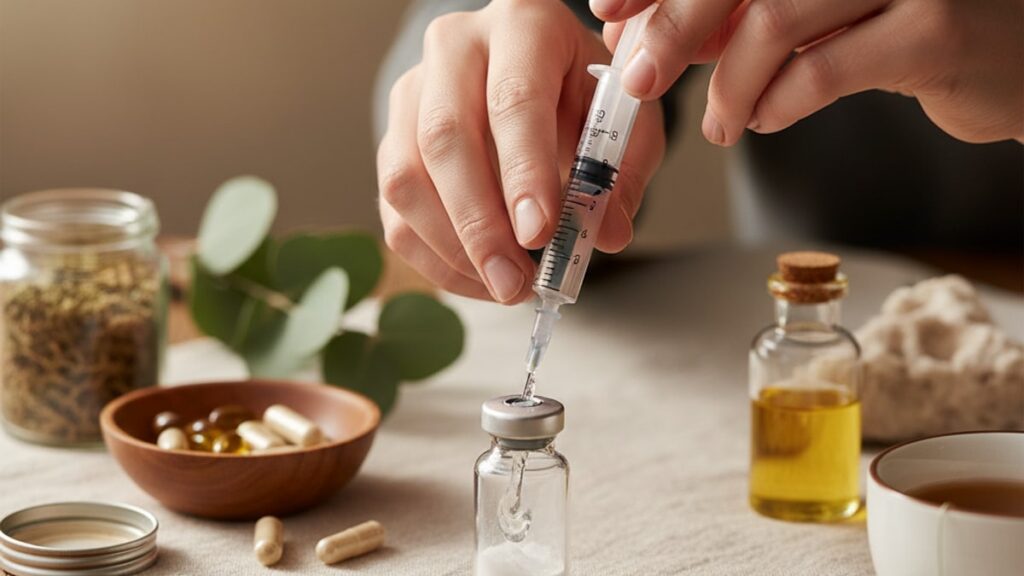
Best BAC Water Dosage Mixing Peptides — 2026 Standards
The most common peptide reconstitution failure isn't contamination. It's dosing the bacteriostatic water wrong. Use too little BAC water and your solution becomes hyperosmolar and painful to inject; use too much and you're forced into impractically large injection volumes that waste peptide through dead space loss in the syringe hub. A 10mg vial reconstituted with 1mL yields 10mg/mL. Meaning a 500mcg dose requires only 0.05mL (5 units on an insulin syringe). That same vial reconstituted with 5mL yields 2mg/mL, forcing you to inject 0.25mL (25 units) for the same 500mcg dose. And every extra 0.01mL left in the syringe after injection represents wasted peptide that never reaches your system.
Our team has guided researchers through hundreds of peptide reconstitutions across compounds ranging from Thymalin to Dihexa. The gap between doing it right and doing it wrong comes down to three things most guides never mention: target concentration math, injection volume practicality, and peptide-specific solubility limits.
What is the best BAC water dosage for mixing peptides in 2026?
The optimal bacteriostatic water volume for peptide reconstitution ranges from 1mL to 3mL per vial, calculated by dividing total peptide mass by desired concentration. Standard practice targets 1–5mg/mL for subcutaneous injection depending on peptide solubility and dose frequency. For example, a 5mg vial reconstituted with 2mL bacteriostatic water yields 2.5mg/mL, allowing precise microdosing with standard insulin syringes while maintaining injection volumes below 0.3mL per administration.
This isn't about following a one-size-fits-all recipe. Peptide reconstitution requires reverse-engineering your target dose into a concentration that makes sense for your injection equipment and frequency. A researcher administering 250mcg daily needs a different concentration than someone dosing 2mg twice weekly. And bacteriostatic water volume is the variable that determines whether your protocol is practical or wasteful.
The rest of this piece covers exactly how to calculate optimal BAC water volume for any peptide and vial size, which concentration ranges work for different administration schedules, and what preparation mistakes cause irreversible potency loss that neither appearance nor reconstitution technique can fix.
Concentration Math: How BAC Water Volume Determines Usable Dose Precision
Bacteriostatic water dosage for peptide mixing follows one core formula: total peptide mass (mg) ÷ BAC water volume (mL) = final concentration (mg/mL). A 10mg vial reconstituted with 2mL yields 5mg/mL. Meaning every 0.1mL (10 units on an insulin syringe) contains 500mcg of active peptide. Double the water to 4mL and that same 0.1mL injection now contains only 250mcg. The concentration you create determines whether you can dose accurately with standard syringes or whether you're forced into fractional measurements that increase error.
Most lyophilised research peptides arrive as 2mg, 5mg, or 10mg vials. Standard insulin syringes measure in 0.01mL increments (1 unit = 0.01mL), which means your smallest reliable dose is whatever peptide mass fits into 0.01mL of your reconstituted solution. For a 5mg vial mixed with 1mL BAC water (yielding 5mg/mL), one unit on the syringe delivers 50mcg. Allowing precise microdosing for compounds like P21 or KPV where typical doses range 100–500mcg. That same 5mg vial reconstituted with 5mL (yielding 1mg/mL) means one unit delivers only 10mcg. Requiring 5-unit minimum draws for the same 50mcg dose, which increases dead space waste.
Solubility limits constrain how little BAC water you can use. Most peptides remain stable in solution at concentrations up to 5–10mg/mL, but hydrophobic sequences like those in Hexarelin or GHRP-2 may precipitate above 3mg/mL even with proper reconstitution technique. Visible cloudiness or particulates after mixing indicate you've exceeded the peptide's solubility ceiling. The solution is no longer homogeneous, and dosing accuracy is compromised. This is why starting with 2mL per vial is the safest default for unfamiliar compounds: it balances practical injection volumes (most doses fall between 0.05–0.3mL) with solubility headroom.
Injection Volume Practicality: Why 'More Dilute' Isn't Always Better
Diluting peptides with excess bacteriostatic water reduces concentration, forcing larger injection volumes that waste peptide through syringe dead space and increase subcutaneous depot size. Every insulin syringe retains approximately 0.02–0.05mL in the hub after plunger depression. Peptide that never reaches your tissue. At 10mg/mL concentration, that dead space represents 200–500mcg of lost compound per injection. At 2mg/mL, the same dead space wastes only 40–100mcg. But if your dose requires 0.5mL at that lower concentration, you're injecting 2.5× the volume into subcutaneous tissue compared to a 0.2mL injection at higher concentration. And larger depots slow absorption while increasing injection site discomfort.
Practical injection volumes for subcutaneous administration fall between 0.1mL and 0.5mL. Anything below 0.1mL becomes difficult to measure accurately with standard syringes; anything above 0.5mL creates a visible subcutaneous bulge that takes 30–60 minutes to fully absorb. Target concentrations should place your typical dose within this range. For peptides like CJC-1295/Ipamorelin blends dosed at 200–300mcg per administration, a 2mg/mL concentration yields 0.1–0.15mL injection volumes. Ideal for daily or twice-daily protocols without excessive tissue trauma.
Our experience shows researchers frequently over-dilute vials to 'make them last longer' without accounting for the practical cost. A 10mg vial reconstituted with 10mL bacteriostatic water (1mg/mL) seems economical. It allows 0.1mL injections for 100mcg doses, stretching the vial across 100 administrations. But syringe dead space alone wastes 2–5mg across that many draws, and the larger total volume occupies more refrigerator space while increasing contamination risk every time the stopper is punctured. Reconstituting that same 10mg vial with 2mL (5mg/mL) yields 0.02mL per 100mcg dose. Tighter measurement tolerance but dramatically lower cumulative waste.
Peptide-Specific Solubility and Stability Considerations
Not all peptides tolerate the same bacteriostatic water ratios. Hydrophilic sequences like those in Cerebrolysin or Cartalax remain stable at concentrations exceeding 10mg/mL, while longer or more complex chains precipitate above 2–3mg/mL regardless of reconstitution technique. Precipitation isn't reversible. Once a peptide crashes out of solution, gentle agitation won't redissolve it. The aggregated protein is permanently denatured, and dosing accuracy is destroyed because the visible powder settling at the vial bottom contains an unknown fraction of your total peptide mass.
Temperature during reconstitution matters as much as volume. Bacteriostatic water should be at refrigerator temperature (2–8°C) when added to lyophilised powder. Room-temperature or warm BAC water accelerates peptide degradation during the critical first 60 seconds of contact. The benzyl alcohol preservative in bacteriostatic water (0.9% w/v) maintains sterility for 28 days post-reconstitution when refrigerated, but this timeline assumes the peptide itself remains chemically stable. Compounds containing methionine or cysteine residues oxidise faster in aqueous solution; those with asparagine or glutamine are prone to deamidation. For such peptides, reconstituting smaller vials with proportionally less BAC water. Rather than one large vial with excess diluent. Extends usable lifespan by minimising time in solution.
Growth hormone secretagogues like MK-677 and metabolic modulators like Tesofensine are supplied in different salt forms (acetate, hydrochloride) that alter solubility behaviour. Acetate salts generally tolerate higher concentrations than free-base peptides; hydrochloride forms may require pH adjustment if reconstituted above 5mg/mL. The product literature accompanying research-grade peptides from verified suppliers specifies maximum recommended concentration. Adhering to this ceiling prevents solubility failures that waste the entire vial.
Best BAC Water Dosage Mixing Peptides 2026: Standard Protocols by Vial Size
| Vial Size | Recommended BAC Water Volume | Final Concentration | Typical Dose Range | Injection Volume per Dose | Notes |
|---|---|---|---|---|---|
| 2mg | 1mL | 2mg/mL | 100–500mcg | 0.05–0.25mL | Ideal for daily microdosing protocols; minimises dead space waste |
| 5mg | 2mL | 2.5mg/mL | 250–1000mcg | 0.1–0.4mL | Balanced concentration for most subcutaneous peptides; practical injection volumes |
| 10mg | 2mL | 5mg/mL | 500–2000mcg | 0.1–0.4mL | Standard for higher-dose compounds; verify solubility limit before use |
| 10mg | 4mL | 2.5mg/mL | 250–1000mcg | 0.1–0.4mL | Alternative for hydrophobic peptides prone to precipitation above 3mg/mL |
| 5mg | 1mL | 5mg/mL | 500–1000mcg | 0.1–0.2mL | Maximum practical concentration for most research peptides; not suitable for all sequences |
| Professional Assessment | Use 2mL as the default starting volume for any unfamiliar peptide regardless of vial size. This provides solubility headroom while keeping injection volumes practical. Adjust only after confirming the compound remains fully dissolved with no visible cloudiness or particulates. |
Key Takeaways
- The optimal bacteriostatic water volume for peptide reconstitution is determined by dividing total peptide mass by target concentration, typically yielding 1–5mg/mL for subcutaneous injection with standard insulin syringes.
- Syringe dead space (0.02–0.05mL per injection) wastes 200–500mcg of peptide at 10mg/mL concentration but only 40–100mcg at 2mg/mL. Higher concentrations reduce per-dose waste but require smaller, more precise injection volumes.
- Practical subcutaneous injection volumes range 0.1–0.5mL; doses requiring more than 0.5mL indicate excessive dilution that increases tissue trauma and slows absorption kinetics.
- Hydrophobic peptide sequences precipitate above 3mg/mL even with proper technique. Visible cloudiness after reconstitution means the solution is no longer homogeneous and dosing accuracy is permanently compromised.
- Bacteriostatic water should be refrigerator-temperature (2–8°C) when added to lyophilised powder; room-temperature diluent accelerates degradation during the first 60 seconds of contact with the peptide.
- Reconstituting 2mL per vial is the safest default for unfamiliar compounds, balancing solubility headroom with practical injection volumes. Adjust only after confirming full dissolution with no particulates.
What If: BAC Water Dosage Scenarios
What If My Peptide Looks Cloudy After Reconstitution?
Discard the vial immediately. Cloudiness indicates precipitation, meaning the peptide concentration exceeded its solubility limit and the solution is no longer homogeneous. Gentle swirling won't redissolve precipitated protein; the aggregated peptide is permanently denatured and dosing accuracy is destroyed because an unknown fraction of total peptide mass has crashed out of solution. Reconstitute a fresh vial with double the bacteriostatic water volume (e.g., 4mL instead of 2mL) to bring concentration below the solubility ceiling, and verify complete clarity before drawing any dose.
What If I Need to Dose 50mcg But My Concentration Is Too High?
Reconstitute a second vial at lower concentration rather than attempting fractional syringe measurements below 0.05mL. A 5mg vial mixed with 5mL bacteriostatic water yields 1mg/mL, where 0.05mL delivers exactly 50mcg. Measurable with standard insulin syringes at the 5-unit mark. Attempting to draw 0.01mL (1 unit) from a 5mg/mL solution introduces measurement error exceeding 20% and wastes peptide through repeated syringe loading. Low-dose protocols require proportionally higher dilution; this is a feature, not a flaw.
What If I Accidentally Used Sterile Water Instead of Bacteriostatic Water?
Use the reconstituted peptide within 24–48 hours and discard any remainder. Sterile water lacks the benzyl alcohol preservative that prevents bacterial growth in multi-dose vials. Each needle puncture introduces contamination risk, and without preservative the solution becomes a bacterial culture medium within 72 hours even when refrigerated. Bacteriostatic water extends multi-dose vial stability to 28 days; sterile water does not. If your protocol requires doses spanning more than two days, reconstitute a fresh vial with proper bacteriostatic water rather than risking infection from a contaminated solution.
What If My Dose Requires 0.6mL Injection Volume?
Your peptide is over-diluted. Reduce bacteriostatic water volume by half and reconstitute a fresh vial. Subcutaneous injections above 0.5mL create visible tissue bulges that take 45–60 minutes to absorb, increase injection site discomfort, and slow absorption kinetics compared to tighter 0.1–0.3mL depots. A dose requiring 0.6mL at current concentration would require only 0.3mL if concentration were doubled, achieved by halving the BAC water volume used during reconstitution. Practical administration always trumps 'making the vial last longer.'
The Unvarnished Truth About Peptide Reconstitution
Here's the honest answer: most peptide protocols fail at the mixing stage, not the injection stage. Researchers treat bacteriostatic water volume like a suggestion rather than a calculation, then wonder why their doses feel inconsistent or their vials crash out of solution halfway through a cycle. The concentration you create during reconstitution determines every downstream variable. Dose precision, injection comfort, peptide waste, and solution stability. Guessing at 'approximately 2mL' isn't close enough when the difference between 1.8mL and 2.2mL changes your effective dose by 10% per injection.
The correct BAC water volume isn't the one that makes your vial last longest. It's the one that places your typical dose between 0.1mL and 0.3mL on an insulin syringe while keeping concentration below the peptide's solubility ceiling. That requires knowing your target dose in micrograms, your vial's total peptide mass, and basic division. If that sounds like overkill, consider that clinical peptide trials use pharmaceutical-grade pre-filled syringes dosed to within 2% accuracy. Research-grade lyophilised peptides require you to create that precision yourself. And the variable you control is bacteriostatic water volume. Get it wrong and you're injecting an unknown dose of a compound that might be partially precipitated. Get it right and you replicate pharmaceutical dosing standards in a home or lab setting.
Explore our full peptide collection to see how precision matters across every compound we supply.
Reconstitution isn't the place to improvise. Follow the math, verify full dissolution, and dose with the same syringe type every time. Your results depend on it.
Frequently Asked Questions
How much bacteriostatic water should I use to reconstitute a 5mg peptide vial?
▼
For a 5mg vial, 2mL bacteriostatic water is the standard starting volume, yielding a 2.5mg/mL concentration that allows precise dosing with insulin syringes while maintaining practical injection volumes between 0.1–0.4mL. This concentration works for most peptides and keeps doses in the range where syringe measurement error remains under 5%. If your target dose requires more than 0.5mL at this concentration, reduce BAC water to 1mL for a 5mg/mL solution — but verify the peptide remains fully dissolved with no cloudiness before use.
Can I use regular sterile water instead of bacteriostatic water for peptide reconstitution?
▼
Sterile water can reconstitute peptides but lacks the 0.9% benzyl alcohol preservative that prevents bacterial contamination in multi-dose vials — you must use the entire vial within 24–48 hours and discard any remainder. Bacteriostatic water extends shelf life to 28 days post-reconstitution when refrigerated because the preservative inhibits microbial growth across multiple needle punctures. For single-dose vials used immediately, sterile water works; for any protocol requiring doses over multiple days, bacteriostatic water is mandatory to prevent infection risk.
What concentration should I aim for when mixing peptides with BAC water?
▼
Target concentrations between 1–5mg/mL depending on your dose size and injection frequency — this range keeps most doses between 0.1–0.5mL, which is the practical subcutaneous injection volume window. Daily microdosing protocols (100–500mcg per dose) work best at 2–5mg/mL, allowing 0.02–0.25mL injections; higher doses (1–2mg) require lower concentrations (1–2mg/mL) to avoid injection volumes exceeding 0.5mL. Always verify the peptide dissolves completely without cloudiness at your target concentration before proceeding.
Why does my reconstituted peptide solution look cloudy?
▼
Cloudiness indicates the peptide has precipitated out of solution because concentration exceeded its solubility limit — the solution is no longer homogeneous and accurate dosing is impossible. This happens when too little bacteriostatic water is used for the peptide’s molecular structure; hydrophobic sequences often precipitate above 3mg/mL even with proper technique. Discard cloudy solutions immediately and reconstitute a fresh vial with double the BAC water volume to bring concentration below the solubility ceiling. Gentle agitation will not redissolve precipitated protein.
How do I calculate the right bacteriostatic water volume for my peptide dose?
▼
Divide your vial’s total peptide mass (in mg) by your desired final concentration (in mg/mL) to get the BAC water volume in mL. For example, a 10mg vial targeting 5mg/mL requires 2mL bacteriostatic water (10mg ÷ 5mg/mL = 2mL). Then verify your typical dose falls between 0.1–0.5mL: at 5mg/mL, a 500mcg dose requires 0.1mL (10 units), and a 2mg dose requires 0.4mL (40 units) — both practical ranges. Adjust concentration up or down if your dose falls outside this injection volume window.
What happens if I use too much bacteriostatic water when reconstituting peptides?
▼
Excessive dilution forces impractically large injection volumes that waste peptide through syringe dead space and increase subcutaneous depot size. Every insulin syringe retains 0.02–0.05mL in the hub after injection — at 1mg/mL concentration this wastes only 20–50mcg per dose, but if your dose requires 0.8mL injection volume you’re creating a painful subcutaneous bulge that takes over an hour to absorb. Over-diluted solutions also occupy unnecessary refrigerator space and increase contamination risk across more needle punctures to deliver the same total peptide mass.
How long does reconstituted peptide last in bacteriostatic water?
▼
Bacteriostatic water’s 0.9% benzyl alcohol preservative maintains sterility for 28 days when refrigerated at 2–8°C, but peptide chemical stability varies by sequence — compounds with methionine or cysteine oxidise faster, while those with asparagine deamidate over time. Most research peptides remain potent for 14–21 days post-reconstitution if stored properly; discard any solution showing discolouration, particulates, or cloudiness regardless of age. For maximum stability, reconstitute smaller vials more frequently rather than diluting large vials that sit in solution for weeks.
Should I refrigerate bacteriostatic water before adding it to peptide powder?
▼
Yes — bacteriostatic water should be refrigerator-temperature (2–8°C) when added to lyophilised peptide powder. Room-temperature or warm diluent accelerates degradation during the critical first 60 seconds of reconstitution when the peptide transitions from dry powder to aqueous solution. Pre-chill your BAC water in the refrigerator for at least 30 minutes before use, and never use water warmed to room temperature or heated to ‘dissolve faster’ — heat denatures protein structure irreversibly. The reconstitution process itself should occur at controlled temperature to preserve peptide integrity.
What is the difference between reconstituting peptides at 2mg/mL versus 5mg/mL?
▼
At 2mg/mL, a 500mcg dose requires 0.25mL injection volume (25 units on insulin syringe), while the same dose at 5mg/mL requires only 0.1mL (10 units) — the higher concentration reduces injection volume and syringe dead space waste but requires more precise measurement. Lower concentrations provide easier dose adjustments and reduce precipitation risk for hydrophobic peptides; higher concentrations minimise wasted peptide per injection and reduce total injection frequency for equivalent dosing. Choose based on your target dose size and peptide solubility: microdosing favours higher concentration, multi-milligram doses require lower concentration to stay under 0.5mL injection volume.
Can I reconstitute multiple peptide vials with different BAC water volumes?
▼
Yes, but track each vial’s concentration separately to avoid dosing errors — label every vial immediately after reconstitution with peptide name, total mass, BAC water volume added, final concentration, and reconstitution date. Using 2mL for one vial and 4mL for another of the same peptide creates different concentrations that require different syringe measurements for identical doses. Standardising BAC water volume across all vials of the same peptide simplifies dosing and reduces error, but varying volume is necessary when peptide solubility or dose requirements differ between compounds in your protocol.
Why do some peptides require less bacteriostatic water than others?
▼
Peptide solubility varies by amino acid sequence length, hydrophobicity, and salt form — hydrophilic sequences like those in growth factors dissolve easily at 10mg/mL, while hydrophobic chains precipitate above 2–3mg/mL regardless of reconstitution technique. Longer peptides (over 30 amino acids) generally require more dilute solutions than shorter sequences; acetate salts tolerate higher concentrations than free-base forms. Always start with manufacturer-recommended concentration if provided, or use 2mL per vial as the conservative default and verify complete dissolution before adjusting to higher concentrations for subsequent vials.
What syringe dead space waste should I expect when injecting reconstituted peptides?
▼
Standard insulin syringes retain 0.02–0.05mL in the hub and needle after full plunger depression — this represents 100–250mcg wasted per injection at 5mg/mL concentration, or 20–50mcg at 1mg/mL. Over a 30-dose protocol, dead space waste at high concentration can total 3–7.5mg of peptide never reaching tissue. Using low-dead-space syringes reduces this to under 0.01mL per injection, and choosing appropriate concentration for your dose size minimises total waste: lower concentrations mean less peptide lost per syringe but require larger injection volumes that increase total handling and contamination risk.
