


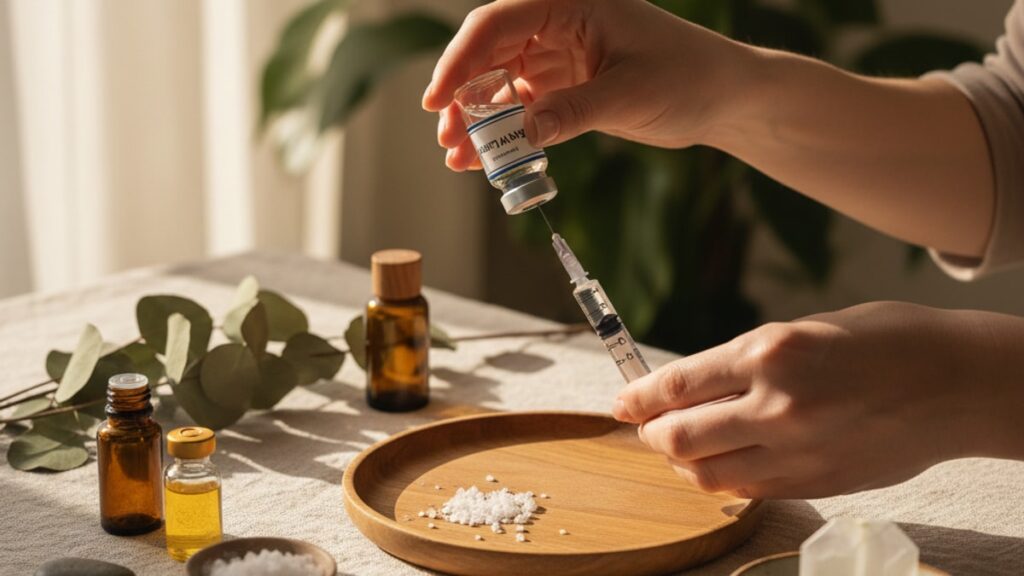
BAC Water Injection Prep — Peptide Reconstitution Guide
Most peptide reconstitution failures happen during the BAC water injection preparation step. Not from contamination, but from pressure differentials that pull airborne bacteria back through the needle after each draw. The mechanism is simple: injecting air into a vial to equalize pressure before drawing liquid creates a pathway for environmental microbes to enter the sealed sterile field. One exposure won't ruin the vial. But repeated draws over 28 days will.
Our team has guided hundreds of researchers through BAC water injection preparation protocols across every major peptide class. The gap between doing it right and doing it wrong comes down to three procedural details most lab SOPs never mention.
What is BAC water injection preparation and why does sterile technique matter?
BAC water injection preparation is the process of reconstituting lyophilized peptides using bacteriostatic water (0.9% benzyl alcohol in sterile water for injection) under aseptic conditions to produce a stable, sterile solution for subcutaneous or intramuscular administration. Benzyl alcohol inhibits bacterial growth for up to 28 days post-reconstitution, but only if the initial preparation avoids microbial introduction. Once contaminated, no preservative can reverse it. The reconstituted peptide must be refrigerated at 2–8°C and used within the benzyl alcohol efficacy window.
Here's what separates functional BAC water injection preparation from contamination risk: the 0.9% benzyl alcohol concentration is bacteriostatic, not bactericidal. It prevents bacterial replication but does not kill existing microbes. If you introduce Staphylococcus epidermidis from your skin during needle insertion, benzyl alcohol won't eliminate it. It will just slow the colony expansion. This is why sterile technique during BAC water injection preparation is non-negotiable, and why multi-dose vials require alcohol swab prep before every single draw.
This guide covers the exact reconstitution ratios for common peptide dosages, the procedural mistakes that compromise sterility without visible contamination, and what preparation errors negate benzyl alcohol's protective effect entirely.
Reconstitution Ratios and Dilution Math
The most common BAC water injection preparation error is incorrect dilution calculation. Researchers eyeball the volume instead of using the peptide mass and target concentration to determine exact bacteriostatic water volume. Here's the formula: to achieve a desired concentration (mg/mL), divide the peptide mass (mg) by the target concentration. For a 5mg lyophilized peptide vial targeting 0.5mg/mL, you need exactly 10mL of BAC water (5mg ÷ 0.5mg/mL = 10mL).
Standard reconstitution volumes for research peptides range from 1mL to 3mL depending on peptide mass and injection convenience. A 2mg peptide reconstituted in 2mL BAC water yields 1mg/mL. Meaning a 0.2mg dose requires a 0.2mL (20-unit) insulin syringe draw. Researchers working with peptides requiring daily 0.1mg doses often reconstitute to 0.5mg/mL to allow more precise 0.2mL draws rather than struggling with 0.1mL volumes on standard syringes.
Concentration accuracy matters because peptide stability decreases in overly dilute solutions. Reconstituting a 10mg vial in 20mL BAC water (0.5mg/mL) extends the physical volume but reduces peptide stability compared to reconstituting the same vial in 10mL (1mg/mL). The benzyl alcohol preservative concentration remains constant, but peptide aggregation and oxidation accelerate in dilute aqueous environments. This is why commercial peptide formulations rarely exceed 2–3mL total volume regardless of peptide mass.
Sterile Technique During BAC Water Injection
The procedural error that ruins more reconstituted peptides than any other is injecting air into the BAC water vial before drawing liquid. The pressure equalization step. Taught in most pharmacy protocols. Creates a contamination pathway when performed incorrectly. Here's the mechanism: drawing liquid from a sealed vial creates negative pressure inside. If you don't equalize that pressure, the syringe plunger resists and you get incomplete draws. The standard fix is to inject an equal volume of air before drawing liquid.
The problem: injecting air through a needle that just passed through a rubber stopper introduces environmental microbes directly into the sterile vial. Even after alcohol swab prep, the rubber stopper surface isn't sterile. It's disinfected. Staphylococcus species, Bacillus spores, and airborne fungi survive alcohol contact and transfer to the needle during insertion. When you push that air into the vial, you're inoculating the bacteriostatic water with whatever microbes clung to the needle during stopper penetration.
Our team's BAC water injection preparation protocol avoids this: after swabbing the stopper with 70% isopropyl alcohol and allowing 30 seconds of contact time, insert the needle and draw the required volume without injecting air first. Accept the plunger resistance. Once the syringe contains the desired BAC water volume, withdraw the needle and inject into the peptide vial using a fresh alcohol-prepped insertion site. This eliminates one contamination vector entirely. You never push non-sterile air into either vial.
Second critical point: needle gauge affects peptide stability during reconstitution. Using anything smaller than 22-gauge (i.e., 25-gauge or 27-gauge) creates high shear forces as the liquid passes through the narrow bore, which can denature peptides with complex tertiary structures like growth hormone secretagogues or brain-derived neurotrophic factor analogs. The standard for BAC water injection preparation is an 18-gauge or 20-gauge needle for drawing and a 22-gauge for peptide vial injection. Larger bore for fluid transfer, smaller bore to avoid coring the stopper.
Storage and Stability Post-Reconstitution
Once you complete BAC water injection preparation, the reconstituted peptide must be stored at 2–8°C and used within 28 days. The benzyl alcohol efficacy window. Temperature excursions above 8°C accelerate peptide degradation through two mechanisms: oxidation of methionine and cysteine residues, and aggregation of hydrophobic amino acid chains. A single 24-hour period at room temperature (20–25°C) reduces potency by an estimated 10–15% for most peptides, and repeated excursions compound the loss.
Freeze-thaw cycles are even more destructive. Freezing a reconstituted peptide causes ice crystal formation, which physically disrupts the tertiary structure by expanding within the protein matrix. Thawing doesn't reverse this. The peptide remains denatured. If you accidentally freeze a reconstituted vial, assume total potency loss and discard it. This is mechanistically different from lyophilized peptides, which tolerate freezing because the dry powder state prevents ice crystal formation inside the molecule.
Visual inspection cannot detect reduced potency. A clear, colorless solution can have 50% degraded peptide and still appear identical to a fresh preparation. The only reliable potency verification is HPLC analysis, which most researchers don't have access to. This is why adhering to the 28-day use window and 2–8°C storage is non-negotiable. You're relying on time and temperature controls because you can't visually confirm whether the peptide is still active.
Benzyl alcohol's preservative effect is time-limited because it evaporates slowly through the rubber stopper and degrades under UV light exposure. Vials stored in direct light lose bacteriostatic activity faster than those kept in darkness. Standard practice: store reconstituted peptides in the original box inside a dedicated refrigerator compartment, not on the door where temperature fluctuates with every opening.
BAC Water Injection Preparation: Peptide Comparison
The table below compares reconstitution protocols for three common research peptide classes. Each requires slightly different BAC water injection preparation handling due to molecular stability differences.
| Peptide Class | Standard Reconstitution Volume | Target Concentration | Needle Gauge | Stability Window (2–8°C) | Professional Assessment |
|---|---|---|---|---|---|
| Growth Hormone Secretagogues (MK-677, Hexarelin) | 2–3mL per 5mg vial | 1.5–2.5mg/mL | 22-gauge for injection | 28 days | High shear sensitivity. Avoid needles smaller than 22-gauge to prevent denaturation during transfer |
| Thymic Peptides (Thymalin) | 1–2mL per 10mg vial | 5–10mg/mL | 20-gauge for drawing, 22-gauge for injection | 21 days | Lower benzyl alcohol tolerance. Some formulations degrade faster than 28-day standard |
| Metabolic Modulators (Tesofensine, Survodutide) | 2mL per 5mg vial | 2.5mg/mL | 22-gauge for injection | 28 days | Stable under standard BAC water injection preparation. Minimal aggregation risk at recommended concentrations |
Key Takeaways
- BAC water injection preparation requires sterile technique because benzyl alcohol is bacteriostatic, not bactericidal. It prevents replication of introduced microbes but doesn't kill existing contamination.
- The correct reconstitution volume is calculated by dividing peptide mass (mg) by target concentration (mg/mL). Eyeballing the volume leads to incorrect dosing and reduced stability in overly dilute solutions.
- Injecting air into a vial before drawing liquid creates a contamination pathway by pushing environmental microbes (transferred to the needle during stopper penetration) directly into the sterile solution.
- Reconstituted peptides must be stored at 2–8°C and used within 28 days. Benzyl alcohol efficacy degrades over time and temperature excursions above 8°C accelerate peptide oxidation and aggregation.
- Freeze-thaw cycles cause irreversible denaturation by forming ice crystals inside the reconstituted peptide structure. If a vial accidentally freezes, discard it entirely.
- Visual inspection cannot detect reduced potency. A clear solution can have 50% degraded peptide and appear identical to a fresh preparation.
What If: BAC Water Injection Preparation Scenarios
What if I accidentally inject air into the peptide vial during reconstitution?
With the peptide vial specifically, the risk is mechanical (not microbial). Injecting air creates turbulence that causes foaming, which denatures peptides at the air-liquid interface. Draw BAC water from its vial without air injection, then inject slowly down the inside wall of the peptide vial to minimize foam formation. If foam appears, let the vial rest undisturbed for 10–15 minutes before drawing your first dose. Agitating or swirling a foamy solution compounds the denaturation.
What if my reconstituted peptide turns cloudy after a few days in the fridge?
Cloudiness indicates either microbial contamination or peptide aggregation. Both render the solution unusable. Aggregation occurs when peptide molecules clump together due to hydrophobic interactions, typically accelerated by temperature fluctuations or prolonged storage beyond the stability window. Contamination produces cloudiness from bacterial colony suspension. You can't distinguish between the two visually, and neither is reversible. Discard the vial and prepare a fresh reconstitution using stricter sterile technique and tighter temperature control.
What if I need to transport a reconstituted peptide and can't maintain 2–8°C for several hours?
Use a medical-grade cold pack designed for insulin transport. Products like FRIO wallets use evaporative cooling to maintain 2–8°C for 36–48 hours without electricity or ice. Standard ice packs risk freezing the peptide if placed in direct contact. The peptide can tolerate short-term ambient temperature (up to 6 hours at 20–25°C) with minimal degradation, but repeated temperature cycling accelerates aggregation. If transporting for longer than 8 hours, consider whether the stability loss outweighs the convenience. In some cases, starting a fresh vial at the destination is more reliable than risking degraded product.
The Unfiltered Truth About BAC Water Injection Preparation
Here's the honest answer: most researchers and patients overcomplicate BAC water injection preparation with excessive sterile theatre while ignoring the one procedural step that actually matters. Not injecting air into vials. You don't need a laminar flow hood. You don't need surgical gloves. You need 70% isopropyl alcohol, 30 seconds of contact time on the stopper, and the discipline to draw liquid without pushing air first.
The benzyl alcohol preservative in bacteriostatic water is robust enough to handle minor technique imperfections. Touching the outside of the vial with bare hands, setting the syringe down on a clean counter for a few seconds, re-inserting a used needle once if you didn't get the full draw. What it cannot handle is direct inoculation with environmental bacteria via the air-injection pathway. That single step is where most contamination happens, and it's completely avoidable.
If your reconstituted peptide develops visible contamination before the 28-day mark, the failure happened during initial preparation. Not from storage conditions or syringe re-entry. Benzyl alcohol at 0.9% concentration prevents bacterial growth from trace contamination introduced during subsequent draws. It doesn't prevent growth from a large microbial load introduced on day one.
Practical Considerations for Multi-Dose Vials
Multi-dose vials require BAC water injection preparation discipline that single-dose ampules don't. Every needle insertion is a new contamination opportunity. Standard protocol: swab the stopper with 70% isopropyl alcohol before every single draw, even if you just drew a dose five minutes ago. Alcohol evaporates within 30 seconds, leaving the surface susceptible to airborne microbes.
Needle reuse is a separate risk category. Using the same needle for multiple draws from the same vial increases contamination probability because the needle tip accumulates environmental microbes between uses. If you draw Monday's dose, cap the needle, and reuse it Wednesday, you're introducing three days' worth of airborne bacteria directly into the vial. Single-use needles aren't a luxury. They're the baseline for maintaining sterility across 28 days of repeated access.
Stopper coring is the mechanical failure mode for multi-dose vials. Repeated needle insertions at the same puncture site eventually dislodge rubber fragments into the solution. Using needles larger than 18-gauge accelerates coring. Standard prevention: rotate insertion sites across the stopper surface and use 20-gauge or 22-gauge needles for all draws. If you see black rubber particles floating in the solution, the vial is compromised. Filtering through a 0.22-micron syringe filter removes the particles but doesn't address the sterility breach from repeated insertions at a degraded site.
For researchers working with expensive peptides like Cerebrolysin or Dihexa, the cost of discarding a contaminated vial mid-cycle often exceeds the upfront investment in sterile technique supplies. Alcohol swabs cost $0.03 each. A replacement 10mg peptide vial costs $200–400. The math is unambiguous.
Reconstituting peptides isn't rocket science, but it's also not forgiving of procedural shortcuts. The difference between a stable 28-day supply and a contaminated waste vial comes down to whether you inject air before drawing liquid. That's the entire margin. Every other variable. Storage temperature, needle gauge, reconstitution volume. Matters, but none of them alone will ruin a vial the way the air-injection pathway can. Get that one step right and the rest is just attention to detail.
Frequently Asked Questions
What is the correct BAC water volume for reconstituting a 5mg peptide vial?
▼
The reconstitution volume depends on your target concentration, not a fixed ratio. For a 5mg peptide vial, reconstituting with 2mL BAC water yields 2.5mg/mL, meaning a 0.5mg dose requires a 0.2mL draw. Reconstituting the same vial with 5mL yields 1mg/mL, requiring a 0.5mL draw for the same dose. Choose the concentration that makes your injection volumes practical for the syringe type you’re using — insulin syringes handle 0.1–0.3mL draws most accurately.
How long does reconstituted peptide remain stable in bacteriostatic water?
▼
Reconstituted peptides stored at 2–8°C remain stable for up to 28 days when prepared with bacteriostatic water containing 0.9% benzyl alcohol. Beyond 28 days, benzyl alcohol’s preservative effect diminishes and peptide degradation accelerates through oxidation and aggregation. Some peptides with complex tertiary structures (like thymic peptides) degrade faster and should be used within 21 days. Temperature excursions above 8°C or freeze-thaw cycles reduce this window significantly.
Can I use sterile water instead of bacteriostatic water for peptide reconstitution?
▼
Sterile water (water for injection without preservative) is suitable only for single-dose immediate use — it lacks the benzyl alcohol preservative that prevents bacterial growth in multi-dose vials. If you reconstitute a peptide with sterile water and store it for later use, any microbial contamination introduced during the initial preparation or subsequent draws will replicate freely. Use bacteriostatic water for any vial you plan to access more than once or store longer than 24 hours.
What needle size should I use for BAC water injection preparation?
▼
Use an 18-gauge or 20-gauge needle for drawing BAC water from the stock vial (larger bore reduces draw time and minimizes stopper coring), then switch to a 22-gauge needle for injecting into the peptide vial. Needles smaller than 22-gauge (like 25-gauge or 27-gauge) create high shear forces during liquid transfer, which can denature peptides with complex structures. Never use the same needle for both drawing and injecting — contamination transfers between vials.
Why does my reconstituted peptide solution turn cloudy after a few days?
▼
Cloudiness indicates either peptide aggregation or microbial contamination — both render the solution unusable. Aggregation occurs when peptide molecules clump due to temperature fluctuations, prolonged storage, or incorrect pH from improper reconstitution. Contamination produces cloudiness from bacterial colonies suspended in the liquid. You cannot visually distinguish between the two, and neither is reversible. Discard the vial immediately and prepare a fresh reconstitution using stricter sterile technique.
Is it safe to reuse the same needle for multiple draws from a peptide vial?
▼
No — needle reuse introduces environmental microbes accumulated on the needle tip between draws directly into the vial during re-insertion. Even if the vial contains bacteriostatic water, reusing needles creates a contamination load that overwhelms the preservative. Single-use needles cost approximately $0.10 each; the cost of a contaminated peptide vial ranges from $200–$400. Use a fresh sterile needle for every draw.
What happens if I accidentally freeze a reconstituted peptide?
▼
Freezing causes irreversible denaturation through ice crystal formation inside the peptide structure — the crystals physically disrupt hydrogen bonds and tertiary folding. Thawing doesn’t reverse this damage. If a reconstituted vial accidentally freezes, assume total potency loss and discard it. This is mechanically different from lyophilized (freeze-dried) peptides, which tolerate freezing because they exist in a dry powder state where ice crystals cannot form within the molecule.
How do I know if my BAC water injection preparation technique introduced contamination?
▼
Visible contamination (cloudiness, discoloration, floating particles) typically appears within 7–14 days if microbial load is high. However, low-level contamination may not produce visible changes until the bacterial colony reaches critical mass, which can take 21+ days. The most reliable prevention is strict adherence to sterile technique during initial reconstitution — swab stoppers with 70% alcohol, allow 30 seconds contact time, avoid injecting air into vials, and use single-use needles for every draw.
Can I store reconstituted peptides at room temperature if I use them within a few days?
▼
No — even short-term room temperature storage (20–25°C) accelerates peptide degradation through oxidation and aggregation. A single 24-hour period at ambient temperature reduces potency by an estimated 10–15% for most peptides. Benzyl alcohol’s preservative effect prevents bacterial growth but does not protect against chemical degradation. All reconstituted peptides must be stored at 2–8°C immediately after preparation, even if you plan to use the entire vial within 48 hours.
What is the difference between bacteriostatic water and sterile saline for peptide reconstitution?
▼
Bacteriostatic water contains 0.9% benzyl alcohol, which prevents bacterial replication for up to 28 days — making it suitable for multi-dose vials accessed repeatedly. Sterile saline (0.9% sodium chloride in sterile water) lacks preservative and must be used immediately after opening or discarded. Some peptides tolerate saline better than bacteriostatic water due to pH or osmolarity considerations, but saline is only appropriate for single-dose immediate use unless you add benzyl alcohol separately at 0.9% concentration.
