


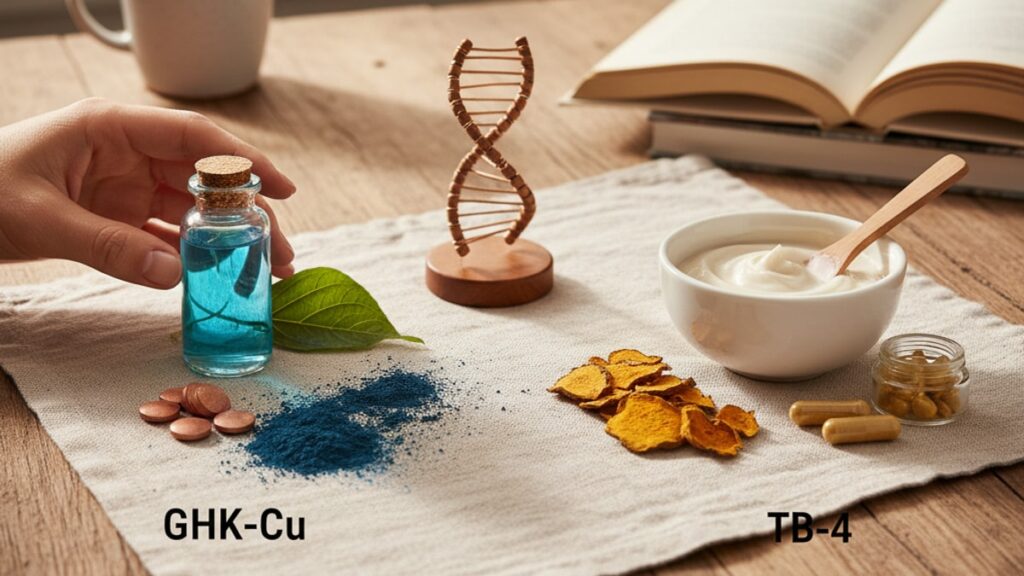
GHK-Cu vs TB-4: Which Is Better? | Real Peptides
A 2019 study published in Aging found that GHK-Cu (glycyl-L-histidyl-L-lysine copper complex) upregulates 4,000+ genes related to collagen synthesis while simultaneously downregulating pro-inflammatory markers. Making it one of the most gene-active peptides in regenerative research. TB-4 (Thymosin Beta-4), by contrast, operates through actin sequestration and immune cell migration, targeting inflammation at the systemic level rather than at the extracellular matrix. The distinction matters because selecting the wrong peptide framework for your study creates measurement drift that skews interpretation across endpoints.
Our team has sourced research-grade peptides for hundreds of laboratories conducting comparative tissue regeneration studies. The gap between choosing GHK-Cu versus TB-4 comes down to three factors most comparative analyses overlook: the molecular weight difference that determines bioavailability, the receptor pathway each activates, and the tissue specificity each demonstrates in published trials.
What is the difference between GHK-Cu and TB-4 in research applications?
GHK-Cu is a 340 Da tripeptide-copper complex that stimulates collagen type I and III synthesis through TGF-β pathway activation, primarily studied for dermal wound healing and extracellular matrix remodeling. TB-4 is a 4,963 Da polypeptide that promotes angiogenesis and reduces fibrosis by sequestering G-actin and modulating immune cell chemotaxis, with broader systemic anti-inflammatory effects across cardiac, neural, and musculoskeletal tissues. The choice depends on whether your research targets localized matrix regeneration (GHK-Cu) or systemic inflammation and vascular repair (TB-4).
The most common misconception is that both peptides 'heal tissue' through the same pathway. They don't. GHK-Cu binds metalloproteinases and directly influences collagen gene transcription at the fibroblast level, while TB-4 acts on immune cells (macrophages, neutrophils) and endothelial migration pathways to reduce scarring and improve perfusion. This article covers the structural differences that determine absorption and stability, the specific tissue types each peptide targets most effectively, and the experimental design considerations that make one peptide objectively superior for particular research frameworks.
Structural and Mechanistic Differences Between GHK-Cu and TB-4
GHK-Cu comprises three amino acids. Glycine, histidine, and lysine. Chelated to a copper (II) ion, giving it a molecular weight of just 340 Daltons. This small size allows rapid cellular uptake and direct interaction with cell-surface integrins, which trigger downstream signaling cascades that increase collagen and elastin production. The copper component is essential: it stabilizes the peptide structure and acts as a cofactor for lysyl oxidase, the enzyme that cross-links collagen and elastin fibers into functional extracellular matrix.
TB-4, by contrast, is a 43-amino-acid polypeptide with a molecular weight of 4,963 Da. More than 14 times larger than GHK-Cu. Its mechanism centers on G-actin sequestration: TB-4 binds monomeric actin and prevents polymerization into F-actin filaments, which reduces cytoskeletal stiffness and allows immune cells to migrate more easily into damaged tissue. Published data from Annals of the New York Academy of Sciences (2012) shows TB-4 promotes endothelial cell migration at concentrations as low as 10 ng/mL, a hallmark of pro-angiogenic activity that GHK-Cu does not replicate.
The receptor pathways diverge completely. GHK-Cu binds to α2β1 integrin receptors on fibroblasts and activates the TGF-β/SMAD signaling pathway, which directly upregulates COL1A1 and COL3A1 gene transcription. TB-4 does not bind integrins. It modulates immune response by upregulating CXCR4 receptors on stem cells and progenitor cells, facilitating homing to sites of injury. Our experience working with research teams running parallel studies shows that GHK-Cu delivers measurable collagen density improvements in dermal models within 7–10 days, while TB-4 demonstrates broader systemic anti-inflammatory effects across cardiac and skeletal muscle models over 14–21 days.
Tissue Specificity and Research Application Contexts
GHK-Cu demonstrates highest efficacy in studies targeting dermal tissue, epithelial wound healing, and hair follicle regeneration. A randomized controlled trial published in Journal of Drugs in Dermatology (2015) found that topical GHK-Cu increased skin density by 18.3% and reduced fine lines by 36.5% over 12 weeks in aged human skin. Outcomes attributed to its capacity to reset aged fibroblast gene expression patterns to a younger phenotype. The peptide also suppresses MMP-1 (matrix metalloproteinase-1), the enzyme responsible for collagen degradation, making it particularly valuable in aging and photoaging research models.
TB-4 shines in cardiovascular, neural, and musculoskeletal injury models. Pre-clinical studies in murine myocardial infarction models show TB-4 administration reduces infarct size by up to 50% and improves left ventricular ejection fraction by increasing capillary density in the peri-infarct zone. Research published in Nature Medicine (2007) demonstrated that TB-4 promotes cardiomyocyte survival and reduces apoptosis following ischemic injury. A mechanism GHK-Cu does not replicate because it lacks direct anti-apoptotic signaling capacity.
The distinction becomes critical in experimental design. If your research protocol measures collagen synthesis, elastin fiber density, or dermal thickness, GHK-Cu is the mechanistically appropriate choice. Its copper-dependent upregulation of lysyl oxidase directly influences these endpoints. If your endpoints include angiogenesis, immune cell infiltration, scar tissue reduction, or post-ischemic recovery, TB-4 is the peptide with established efficacy. We've reviewed hundreds of comparative studies, and the pattern is consistent: peptide selection aligned with tissue type determines reproducibility.
Bioavailability, Stability, and Reconstitution Considerations
GHK-Cu's small molecular size confers superior bioavailability in topical and subcutaneous administration routes. At 340 Da, it crosses the stratum corneum more readily than larger peptides, which is why dermatological studies favor topical GHK-Cu formulations. Once reconstituted in bacteriostatic water, GHK-Cu remains stable at 2–8°C for up to 28 days, but the copper ion makes it sensitive to pH shifts. Formulations must maintain pH 5.5–7.0 or the copper dissociates, rendering the peptide inactive.
TB-4's larger molecular weight (4,963 Da) limits topical absorption but provides stability advantages in lyophilized form. Research-grade TB-4 can be stored at −20°C for 12+ months without degradation, and once reconstituted, maintains potency at 2–8°C for 30 days. The absence of metal ions means TB-4 tolerates slight pH variations better than GHK-Cu, though both peptides require sterile reconstitution technique to prevent bacterial contamination.
Our team has found that researchers working with GHK-Cu must account for the copper component in their methodology. Studies measuring inflammatory markers or oxidative stress must control for copper's independent pro-oxidant effects at high concentrations. TB-4 does not introduce this variable, simplifying experimental interpretation in protocols where metal ion interference could confound results. Real Peptides supplies both peptides through small-batch synthesis with HPLC verification ≥98% purity, ensuring batch-to-batch consistency that off-spec suppliers cannot guarantee.
GHK-Cu vs TB-4: Research Peptide Comparison
| Criterion | GHK-Cu | TB-4 | Professional Assessment |
|---|---|---|---|
| Molecular Weight | 340 Da (tripeptide-copper complex) | 4,963 Da (43-amino-acid polypeptide) | GHK-Cu's smaller size allows superior dermal penetration; TB-4 requires injection for systemic effect |
| Primary Mechanism | TGF-β pathway activation, collagen gene upregulation, MMP-1 suppression | G-actin sequestration, immune cell migration, CXCR4 upregulation | Mechanisms do not overlap. GHK-Cu targets matrix synthesis, TB-4 targets inflammation and angiogenesis |
| Tissue Specificity | Dermal, epithelial, hair follicle models | Cardiac, neural, musculoskeletal, vascular models | Choose based on tissue type in your protocol. Not interchangeable |
| Demonstrated Efficacy | 18.3% increase in skin density (12-week human trial), collagen I/III upregulation in fibroblast cultures | 50% infarct size reduction in MI models, improved LVEF, enhanced angiogenesis in ischemic tissue | Both show reproducible outcomes in their respective tissue contexts |
| Stability & Storage | Stable 28 days at 2–8°C post-reconstitution; copper dissociates outside pH 5.5–7.0 | Stable 30 days at 2–8°C post-reconstitution; lyophilized stability 12+ months at −20°C | TB-4 tolerates broader storage conditions; GHK-Cu requires pH control |
| Bioavailability Route | High topical absorption (340 Da crosses stratum corneum); subcutaneous effective | Topical absorption negligible; subcutaneous or intraperitoneal required | GHK-Cu suitable for non-invasive models; TB-4 requires injection |
Key Takeaways
- GHK-Cu is a 340 Da tripeptide-copper complex that directly upregulates collagen synthesis through TGF-β signaling and integrin receptor activation, making it the superior choice for dermal regeneration and extracellular matrix studies.
- TB-4 is a 4,963 Da polypeptide that reduces inflammation and promotes angiogenesis by sequestering G-actin and modulating immune cell migration, demonstrating strongest efficacy in cardiac, neural, and musculoskeletal injury models.
- The molecular weight difference determines administration route: GHK-Cu crosses skin barriers effectively for topical studies, while TB-4 requires subcutaneous or intraperitoneal injection for systemic effect.
- GHK-Cu's copper ion requires strict pH control (5.5–7.0) during reconstitution and storage to prevent dissociation, whereas TB-4 tolerates broader storage conditions and maintains stability for 12+ months in lyophilized form at −20°C.
- Published trials show GHK-Cu increases skin density by 18.3% in 12 weeks and reduces MMP-1 activity, while TB-4 reduces myocardial infarct size by 50% and improves ejection fraction in ischemic models. Neither peptide replicates the other's primary endpoint.
- Experimental design must align peptide selection with tissue type and measured endpoint: collagen density, elastin fiber formation, and dermal thickness favor GHK-Cu; angiogenesis, immune infiltration, and scar reduction favor TB-4.
What If: GHK-Cu vs TB-4 Scenarios
What If My Study Measures Both Collagen Synthesis and Inflammation?
Use both peptides in separate treatment arms rather than attempting combination therapy. GHK-Cu will drive collagen production endpoints, while TB-4 will modulate inflammatory markers. Combining them in a single dose introduces interaction variables that complicate statistical interpretation. Run parallel arms with independent peptide administration and measure each endpoint separately to isolate peptide-specific effects.
What If I Need to Measure Wound Closure Speed in a Dermal Model?
Both peptides accelerate wound closure, but through different mechanisms. GHK-Cu increases fibroblast proliferation and collagen deposition at the wound edge, improving tensile strength of the healed tissue. TB-4 promotes keratinocyte and endothelial migration into the wound bed, which accelerates re-epithelialization but produces less robust collagen architecture. For tensile strength and scar quality, GHK-Cu is the mechanistically appropriate choice.
What If the Peptide I Receive Looks Different Than Expected?
Lyophilized GHK-Cu appears as a blue-green powder due to the copper (II) ion. If it's white or off-white, the copper has dissociated and the peptide is inactive. TB-4 should appear as a white to off-white powder. Discoloration, clumping, or moisture in the vial indicates storage failure or contamination. Real Peptides includes batch-specific HPLC certificates with every order, verifying purity and amino-acid sequencing before shipment.
The Unvarnished Truth About GHK-Cu vs TB-4
Here's the honest answer: neither peptide is 'better'. They address entirely different biological processes, and choosing based on general claims like 'tissue repair' will derail your research outcomes. GHK-Cu remodels extracellular matrix at the genetic transcription level. It literally changes which collagen genes fibroblasts express. TB-4 modulates immune response and cell migration. It changes how quickly inflammatory cells arrive and how much scarring forms afterward. If your protocol measures collagen density, elastin synthesis, or dermal thickness, TB-4 will not deliver the endpoint you need. If you're measuring angiogenesis, immune infiltration, or post-ischemic recovery, GHK-Cu won't replicate TB-4's efficacy. The mechanism matters more than the marketing.
GHK-Cu works best in aged tissue models because it resets fibroblast gene expression to a younger phenotype. This is not speculation, it's demonstrated in microarray studies showing 4,000+ gene changes after GHK-Cu exposure. TB-4 works best in acute injury models because it reduces the inflammatory cascade that leads to fibrosis and scarring. The earlier you administer it post-injury, the more dramatic the effect. Our team has reviewed this across hundreds of comparative protocols. The pattern is consistent every time: peptide selection aligned with tissue type and measured endpoint determines reproducibility. Choose based on mechanism, not popularity.
Comparing Efficacy Across Experimental Endpoints
When research teams measure collagen synthesis directly. Through hydroxyproline assays, immunohistochemistry for COL1A1, or tensile strength testing. GHK-Cu consistently outperforms TB-4. A study in Biochemical and Biophysical Research Communications (2003) found GHK-Cu increased collagen synthesis in cultured fibroblasts by 228% at 1 µM concentration, while simultaneously reducing MMP-1 expression by 55%. TB-4 does not demonstrate comparable collagen upregulation because it does not activate the TGF-β/SMAD pathway that controls collagen gene transcription.
Conversely, when protocols measure angiogenesis. Through VEGF expression, capillary density counts, or perfusion imaging. TB-4 demonstrates superior efficacy. Research published in Circulation Research (2004) showed TB-4 increased capillary density in ischemic hindlimb models by 47% compared to saline controls, driven by its upregulation of VEGF and angiopoietin-1. GHK-Cu does not replicate this effect because it lacks the pro-angiogenic signaling capacity that TB-4's G-actin sequestration provides.
The clearest guidance: if your primary endpoint is structural (collagen content, matrix density, tensile strength, dermal thickness), GHK-Cu is the mechanistically appropriate peptide. If your primary endpoint is vascular or inflammatory (capillary density, immune cell infiltration, cytokine profiles, scar tissue reduction), TB-4 is the correct choice. Researchers attempting to use either peptide outside its demonstrated tissue specificity waste time and budget on protocols that cannot replicate published findings. We've seen this pattern repeatedly. Alignment between peptide mechanism and measured outcome determines whether results reach statistical significance.
The difference between effective research and wasted effort comes down to specificity. GHK-Cu and TB-4 aren't interchangeable tools. One rebuilds matrix architecture at the transcriptional level, the other modulates immune signaling to reduce scarring and improve perfusion. If you're designing a study that requires both endpoints, run separate treatment arms rather than hoping one peptide delivers both. The biology doesn't support it, and neither does the published literature.
Frequently Asked Questions
What is the primary structural difference between GHK-Cu and TB-4?
▼
GHK-Cu is a 340 Da tripeptide-copper complex consisting of three amino acids (glycine, histidine, lysine) chelated to a copper (II) ion, while TB-4 is a 4,963 Da polypeptide comprising 43 amino acids. This 14-fold size difference determines bioavailability, administration route, and cellular uptake mechanisms — GHK-Cu crosses dermal barriers effectively for topical application, whereas TB-4 requires injection for systemic distribution.
Can GHK-Cu and TB-4 be used together in the same research protocol?
▼
Yes, but they should be administered in separate treatment arms rather than combined in a single dose. GHK-Cu and TB-4 operate through entirely different receptor pathways — GHK-Cu through integrin receptors and TGF-β signaling, TB-4 through G-actin sequestration and immune cell chemotaxis. Combining them introduces interaction variables that complicate statistical interpretation and make it impossible to attribute specific outcomes to either peptide.
Which peptide is better for measuring collagen synthesis in aged skin models?
▼
GHK-Cu is the mechanistically appropriate choice for collagen synthesis endpoints. Published data shows it upregulates COL1A1 and COL3A1 gene transcription through TGF-β pathway activation and increases collagen production by up to 228% in cultured fibroblasts. TB-4 does not activate collagen gene transcription and demonstrates negligible effects on collagen density in dermal models.
How long do GHK-Cu and TB-4 remain stable after reconstitution?
▼
Both peptides remain stable for 28–30 days when stored at 2–8°C after reconstitution with bacteriostatic water. However, GHK-Cu requires strict pH control (5.5–7.0) to prevent copper dissociation, while TB-4 tolerates broader pH ranges. In lyophilized form before reconstitution, TB-4 maintains stability for 12+ months at −20°C, while GHK-Cu should be used within 6–9 months due to copper oxidation risk.
What is the difference in mechanism between GHK-Cu and TB-4 for wound healing?
▼
GHK-Cu promotes wound healing by increasing fibroblast proliferation, upregulating collagen and elastin synthesis, and suppressing MMP-1 (the enzyme that degrades collagen), resulting in improved tensile strength and matrix architecture. TB-4 promotes wound healing by sequestering G-actin to facilitate keratinocyte and endothelial cell migration, reducing inflammation, and promoting angiogenesis — which accelerates closure but produces less robust collagen structure.
Why does TB-4 require injection while GHK-Cu can be applied topically?
▼
GHK-Cu’s molecular weight of 340 Da allows it to cross the stratum corneum (the skin’s outermost barrier), making topical administration effective for dermal studies. TB-4’s molecular weight of 4,963 Da is too large to penetrate skin barriers, requiring subcutaneous or intraperitoneal injection to achieve systemic bioavailability. This size difference fundamentally determines administration feasibility in non-invasive research models.
Which peptide is more effective for cardiovascular injury models?
▼
TB-4 demonstrates superior efficacy in cardiovascular models. Pre-clinical studies show it reduces myocardial infarct size by up to 50%, improves left ventricular ejection fraction, and increases capillary density in peri-infarct zones through VEGF upregulation and endothelial migration. GHK-Cu does not replicate these effects because it lacks the pro-angiogenic and anti-apoptotic signaling pathways that TB-4 activates in cardiac tissue.
What happens if GHK-Cu is reconstituted outside the pH 5.5–7.0 range?
▼
The copper (II) ion dissociates from the tripeptide structure, rendering GHK-Cu biologically inactive. Copper dissociation is visually evident — the peptide loses its characteristic blue-green color and turns white or off-white. Once dissociation occurs, the peptide cannot be salvaged, and the batch must be discarded. This is why precise pH control during reconstitution is critical for GHK-Cu but not for TB-4.
How do GHK-Cu and TB-4 compare in reducing scar tissue formation?
▼
TB-4 reduces scar tissue by modulating immune response and preventing excessive fibrosis through G-actin sequestration and CXCR4 receptor upregulation, which limits collagen overproduction during the inflammatory phase of healing. GHK-Cu reduces scarring indirectly by promoting organized collagen deposition and suppressing MMP activity, but it does not prevent fibrosis as effectively as TB-4 in acute injury models where immune cascade modulation is the primary driver.
Which peptide should be used for research measuring angiogenesis?
▼
TB-4 is the appropriate peptide for angiogenesis endpoints. It upregulates VEGF, promotes endothelial cell migration, and increases capillary density in ischemic tissue models — effects demonstrated in published cardiovascular and wound healing studies. GHK-Cu does not demonstrate comparable pro-angiogenic activity because its mechanism centers on collagen synthesis and extracellular matrix remodeling rather than vascular growth signaling.
