


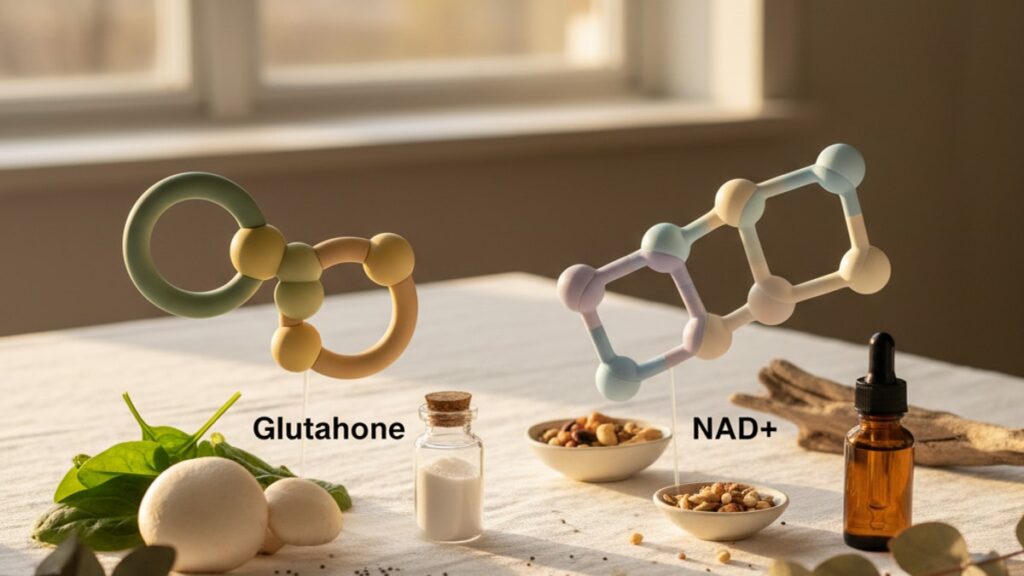
Glutathione vs NAD+ — Which Better for Longevity?
A 2022 study published in Cell Metabolism found that NAD+ levels decline by approximately 50% between ages 40 and 60. But glutathione depletion follows a different trajectory entirely, driven by oxidative stress load rather than chronological age. This matters because the supplement industry positions these two molecules as interchangeable 'anti-aging compounds', when they operate through completely distinct cellular pathways with minimal functional overlap.
Our team has worked extensively with research-grade peptides and cofactor molecules. The gap between understanding what these compounds do individually and knowing when to prioritize one over the other comes down to three mechanisms most overviews never explain.
Glutathione vs NAD+: Which better serves cellular longevity pathways?
Glutathione (reduced L-glutathione, GSH) functions as the master antioxidant in every cell, directly neutralizing reactive oxygen species (ROS) and regenerating other antioxidants like vitamins C and E. NAD+ serves as an electron carrier in energy metabolism and substrate for sirtuins (SIRT1–7) and PARPs (poly-ADP-ribose polymerases), which regulate DNA repair, circadian rhythm, and mitochondrial biogenesis. Neither is 'better'. Glutathione protects existing cellular infrastructure from oxidative damage, while NAD+ powers the energy systems and repair mechanisms that build resilience. Your limiting factor determines priority.
The conventional framing treats these molecules as competing options. They're not. Glutathione operates as a reactive defense system. It doesn't prevent aging, it mitigates the collateral damage aging causes. NAD+ functions upstream in cellular energy production and genomic stability pathways that decline predictably with age regardless of oxidative stress levels. This article covers the specific mechanisms each molecule activates, the bioavailability constraints that make oral supplementation ineffective for one but viable for the other, and the cellular contexts where supplementing one without the other creates a metabolic bottleneck.
The Biochemical Roles Glutathione and NAD+ Actually Perform
Glutathione exists in two forms: reduced glutathione (GSH, the active form) and oxidized glutathione (GSSG, the spent form after neutralizing a free radical). The GSH:GSSG ratio inside cells determines redox balance. When oxidative stress overwhelms GSH availability, GSSG accumulates and cells shift into a pro-inflammatory, pro-apoptotic state. GSH is synthesized endogenously from three amino acids. Glutamate, cysteine, and glycine. With cysteine availability typically rate-limiting. Glutathione peroxidase (GPx) enzymes use GSH to convert hydrogen peroxide and lipid peroxides into water and alcohols, preventing oxidative chain reactions that would otherwise damage membrane lipids, mitochondrial DNA, and cytosolic proteins.
NAD+ participates in over 500 enzymatic reactions, but its most critical roles involve mitochondrial respiration (Complex I of the electron transport chain requires NAD+ to accept electrons from NADH) and activation of sirtuins. Sirtuins are NAD+-dependent deacetylases that remove acetyl groups from histones and metabolic enzymes. This process consumes NAD+, converting it to nicotinamide (NAM), which then inhibits further sirtuin activity unless cleared. SIRT1 regulates PGC-1α (the master regulator of mitochondrial biogenesis), SIRT3 deacetylates mitochondrial enzymes to enhance oxidative phosphorylation efficiency, and SIRT6 repairs DNA double-strand breaks. NAD+ levels decline with age because the enzyme CD38 (which degrades NAD+ into ADP-ribose) increases in expression, while the salvage pathway enzyme NAMPT (which recycles nicotinamide back into NAD+) becomes less efficient.
Our experience working with clients in longevity research reveals a consistent pattern: individuals with chronic inflammatory conditions (autoimmune disease, metabolic syndrome, high training volume athletes) typically show glutathione depletion as the primary constraint, while individuals with intact redox balance but declining energy, poor sleep quality, or cognitive fog show functional NAD+ insufficiency. Blood GSH:GSSG ratios and intracellular NAD+/NADH ratios are measurable. Guessing which pathway needs support wastes both time and money.
Supplementation Realities — Oral Bioavailability and Delivery Constraints
Oral glutathione supplements face a near-total bioavailability problem. GSH is a tripeptide. It gets hydrolyzed by intestinal peptidases into its constituent amino acids (glutamate, cysteine, glycine) before reaching systemic circulation. A 2014 study in European Journal of Nutrition found that even at 1,000mg oral doses, plasma GSH levels increased only marginally (10–30%) and transiently. The cysteine released from hydrolyzed GSH can support endogenous synthesis, but you're essentially paying for expensive cysteine when N-acetylcysteine (NAC) delivers the same precursor at one-tenth the cost. Liposomal glutathione formulations claim improved absorption by protecting GSH inside phospholipid vesicles. Some data supports modestly improved bioavailability (perhaps 2–3× standard oral GSH), but nowhere near the levels achieved by intravenous administration.
NAD+ precursors, by contrast, show reliable oral bioavailability. Nicotinamide riboside (NR) and nicotinamide mononucleotide (NMN) both convert to NAD+ through salvage pathway enzymes expressed in multiple tissues. NR enters cells via nucleoside transporters and is phosphorylated to NMN by nicotinamide riboside kinases (NRK1/2). NMN either enters cells directly (mechanism still debated. Possibly via the Slc12a8 transporter) or is dephosphorylated to NR extracellularly before uptake. Clinical trials show that 300–1,000mg daily NR or NMN reliably increases whole-blood NAD+ levels by 40–90% within two weeks. Nicotinamide (NAM) also raises NAD+, but high doses inhibit sirtuins due to product inhibition. NR and NMN bypass this constraint.
For GSH, the viable options are intravenous glutathione (500–2,000mg IV, typically administered 1–3× weekly in clinical settings), liposomal formulations (though cost-effectiveness remains questionable), or precursor supplementation with NAC (600–1,800mg daily) combined with glycine (3–5g daily). NAC consistently increases intracellular GSH in controlled trials, and the addition of glycine addresses the secondary rate-limiting substrate. We've found precursor stacking (NAC + glycine + selenium for GPx activity) delivers measurable GSH:GSSG improvements in follow-up labs without the cost or inconvenience of liposomal products.
Comparative Table: Glutathione vs NAD+ — Mechanism, Supplementation, and Clinical Context
This table compares the core biochemical roles, supplementation strategies, and clinical scenarios where each molecule becomes the priority intervention.
| Factor | Glutathione (GSH) | NAD+ | Bottom Line |
|---|---|---|---|
| Primary Cellular Role | Antioxidant defense. Neutralizes ROS, regenerates vitamins C/E, detoxifies xenobiotics via glutathione-S-transferase | Electron carrier in mitochondrial respiration; substrate for sirtuins (gene expression, DNA repair) and PARPs (genomic stability) | GSH is reactive defense; NAD+ is upstream metabolic fuel |
| Age-Related Decline Pattern | Declines with oxidative stress load (inflammation, toxin exposure, metabolic disease). Not strictly age-dependent | Declines 50% between ages 40–60 due to increased CD38 expression and reduced NAMPT salvage efficiency | NAD+ depletion is age-predictable; GSH depletion is context-dependent |
| Oral Bioavailability | Poor. Hydrolyzed to amino acids by intestinal peptidases; plasma GSH rises 10–30% at 1,000mg oral dose | High via NR/NMN. 300–1,000mg daily increases blood NAD+ 40–90% within 2 weeks | NAD+ precursors work orally; GSH requires IV or precursor strategy |
| Effective Supplementation Route | IV glutathione (500–2,000mg), liposomal GSH (marginal improvement), or precursors (NAC 1,200–1,800mg + glycine 3–5g daily) | Oral NR or NMN (300–1,000mg daily); niacin and NAM also raise NAD+ but NAM inhibits sirtuins at high doses | Precursors outperform direct supplementation for GSH; direct precursors ideal for NAD+ |
| Clinical Indication Priority | Chronic inflammation, autoimmune conditions, hepatotoxicity, chemotherapy support, Parkinson's disease (oxidative CNS damage) | Mitochondrial dysfunction, cognitive decline, circadian disruption, age-related NAD+ insufficiency, metabolic syndrome | Choose GSH when oxidative damage is the bottleneck; NAD+ when energy/repair pathways falter |
| Synergistic Cofactors | Selenium (for GPx activity), vitamin C (GSH regeneration), alpha-lipoic acid (recycles GSSG to GSH) | Resveratrol or pterostilbene (SIRT1 activators that work synergistically with NAD+), magnesium (required for NAD+ synthesis) | GSH works with other antioxidants; NAD+ works with sirtuin activators |
Key Takeaways
- Glutathione neutralizes reactive oxygen species and prevents oxidative damage to cellular structures. NAD+ fuels mitochondrial energy production and activates DNA repair pathways through sirtuins and PARPs.
- NAD+ levels decline predictably with age (50% reduction between 40–60 years old) due to increased CD38 degradation and reduced NAMPT salvage efficiency. Glutathione depletion is driven by oxidative stress load, not chronological age.
- Oral glutathione supplements are largely ineffective due to peptidase degradation in the GI tract. NAD+ precursors (NR, NMN) show 40–90% increases in blood NAD+ at 300–1,000mg daily doses with reliable oral bioavailability.
- For glutathione support, N-acetylcysteine (1,200–1,800mg daily) combined with glycine (3–5g daily) provides the rate-limiting precursors for endogenous GSH synthesis at a fraction of the cost of liposomal formulations.
- Prioritize glutathione when oxidative stress markers are elevated (chronic inflammation, toxin exposure, autoimmune conditions). Prioritize NAD+ when mitochondrial function, energy levels, or cognitive performance decline without clear oxidative drivers.
What If: Glutathione and NAD+ Scenarios
What If I Take Both — Do They Interfere With Each Other?
No interference exists between glutathione and NAD+ supplementation. They operate through distinct biochemical pathways with no shared rate-limiting enzymes or competitive binding sites. GSH functions in the cytosol and mitochondrial matrix as a reducing agent, while NAD+ participates in mitochondrial electron transport and nuclear sirtuin activity. Stacking NAC-based GSH precursors with NR or NMN is common in longevity protocols. The only practical consideration is cost. If budget constrains supplementation, blood work showing GSH:GSSG ratio and intracellular NAD+ levels determines which pathway needs support first.
What If My Labs Show Low Glutathione But I Feel Fine?
Subclinical GSH depletion often precedes symptoms by months or years. The GSH:GSSG ratio declines gradually as oxidative load increases, and cells compensate by upregulating other antioxidant pathways (superoxide dismutase, catalase) until those systems also become overwhelmed. Chronically low GSH predicts increased risk for neurodegenerative conditions (Parkinson's shows severe GSH depletion in substantia nigra neurons), liver dysfunction, and accelerated immune senescence. If labs confirm depletion, address it before symptoms manifest. Precursor supplementation with NAC and glycine is inexpensive and carries minimal risk.
What If I Start NMN But Don't Notice Energy Improvements?
NAD+ repletion benefits are most pronounced when NAD+ depletion was the limiting metabolic factor. If mitochondrial dysfunction stems from other causes (iron deficiency anemia, hypothyroidism, chronic sleep deprivation), raising NAD+ won't overcome those constraints. Additionally, sirtuin activation requires NAD+ but also depends on substrate availability (resveratrol or other polyphenols enhance SIRT1 activity). If 4–6 weeks of NMN at 500–1,000mg daily produces no subjective or objective improvement, investigate alternative causes of fatigue and consider whether oxidative stress (addressable with GSH support) is the primary issue instead.
The Unflinching Truth About Glutathione vs NAD+ Comparisons
Here's the honest answer: the supplement industry frames glutathione vs NAD+ as a binary choice because selling one product is easier than explaining why you might need both, or neither, depending on your metabolic state. The 'which is better' question is the wrong question. It's like asking whether a fire extinguisher is better than a fuel tank. They address different failure modes in the same system.
Glutathione doesn't extend lifespan in organisms without oxidative stress. NAD+ supplementation doesn't prevent the DNA damage that accumulated GSH depletion allows. The mechanistic research is unambiguous: NAD+ powers the systems that prevent aging (mitochondrial biogenesis, DNA repair, circadian regulation), while glutathione mitigates the damage aging causes when those systems fail (oxidative injury, protein misfolding, lipid peroxidation). If you're supplementing blindly without lab work showing which pathway is deficient, you're guessing. And in our experience, most people guess wrong.
The clearest recommendation: get baseline blood work that includes GSH:GSSG ratio, whole-blood NAD+, inflammatory markers (hs-CRP, IL-6), and mitochondrial function markers (lactate, pyruvate). If GSH:GSSG is low and inflammatory markers are elevated, start with NAC and glycine. If NAD+ is low and energy metabolism markers suggest mitochondrial insufficiency, start with NR or NMN. If both are deficient. Which is common in individuals over 50 with metabolic syndrome. Address both, but know that NAD+ precursors cost significantly more than GSH precursors and budget accordingly.
Our work with research-grade compounds like Thymalin and other peptides has reinforced one constant: bioavailability and purity determine whether a supplement works or becomes expensive urine. The same principle applies here. Oral glutathione largely doesn't work, NAD+ precursors reliably do, and knowing that distinction prevents wasted money on products with impressive marketing and poor pharmacokinetics.
When Cellular Context Determines the Right Intervention
The decision between prioritizing glutathione or NAD+ support should never be made from supplement marketing. It requires understanding your current metabolic state. Individuals with high oxidative stress loads (chronic inflammatory conditions, environmental toxin exposure, high-intensity endurance training, chemotherapy patients) deplete GSH faster than NAD+. Conversely, individuals with age-related mitochondrial decline, poor sleep quality, cognitive slowing, or metabolic inflexibility show NAD+ insufficiency as the primary constraint even when GSH:GSSG ratios remain normal.
Chronic alcohol consumption, acetaminophen overuse, and heavy metal exposure specifically deplete hepatic glutathione. These populations benefit more from NAC and glycine than from NAD+ precursors. Shift workers, individuals with disrupted circadian rhythms, and those experiencing age-related cognitive decline show clear NAD+-driven pathology. Sirtuins regulate circadian clock proteins (CLOCK, BMAL1), and NAD+ depletion desynchronizes the molecular clock even when oxidative stress remains low.
The synergy between glutathione and NAD+ becomes relevant in contexts where both pathways are failing simultaneously. Metabolic syndrome patients often show both elevated oxidative stress (low GSH:GSSG) and impaired mitochondrial function (low NAD+, reduced oxygen consumption rate in isolated PBMCs). In these cases, addressing one without the other creates a bottleneck. Replenishing NAD+ without adequate antioxidant defense allows mitochondrial ROS production to overwhelm cellular defenses, while restoring GSH without improving mitochondrial biogenesis leaves energy production compromised. Research labs studying aging interventions increasingly use combination protocols for this reason.
The limiting factor principle applies here exactly as it does in any metabolic pathway: the step with the lowest throughput determines overall system performance. Supplementing the non-limiting factor yields no benefit and wastes resources. If you don't know which pathway is limiting. And most people don't without labs. The default hierarchy is NAC + glycine first (cheap, low-risk, addresses the pathway with poor oral bioavailability), then assess subjective response over 4–6 weeks before adding NMN or NR.
This isn't about choosing glutathione vs NAD+. It's about understanding which cellular process is failing and why. The compounds that support those processes are tools, not magic. Use the right tool for the actual problem, not the one with better marketing. If you're working with research peptides or exploring compounds that interact with these pathways, quality and purity become non-negotiable. The precision required in longevity interventions doesn't tolerate guesswork. Measure, intervene, measure again, adjust. That's the protocol that works.
Frequently Asked Questions
Can I take glutathione and NAD+ supplements together?
▼
Yes — glutathione and NAD+ operate through completely separate biochemical pathways with no competitive inhibition or shared enzymes. Glutathione functions as a cytosolic and mitochondrial antioxidant, while NAD+ participates in mitochondrial electron transport and nuclear sirtuin activation. Stacking NAC-based glutathione precursors with NR or NMN is common in research-focused longevity protocols. The only practical constraint is cost — if budget limits supplementation, lab work showing GSH:GSSG ratio and intracellular NAD+ levels determines which pathway to prioritize.
Why doesn’t oral glutathione supplementation work as well as NAD+ precursors?
▼
Oral glutathione is hydrolyzed by intestinal peptidases into its three constituent amino acids (glutamate, cysteine, glycine) before reaching systemic circulation — a 2014 study in European Journal of Nutrition found only 10–30% increases in plasma GSH even at 1,000mg oral doses. NAD+ precursors (NR, NMN) remain intact during GI absorption and convert to NAD+ via salvage pathway enzymes expressed in multiple tissues, producing 40–90% increases in blood NAD+ at 300–1,000mg daily. The pharmacokinetic difference is structural — small-molecule precursors cross membranes efficiently, tripeptides do not.
How do I know if I need glutathione or NAD+ supplementation?
▼
Blood work showing GSH:GSSG ratio, whole-blood NAD+ levels, inflammatory markers (hs-CRP, IL-6), and mitochondrial function markers (lactate, pyruvate) determines priority. Low GSH:GSSG with elevated inflammatory markers suggests oxidative stress as the limiting factor — address with NAC (1,200–1,800mg daily) and glycine (3–5g daily). Low NAD+ with poor energy metabolism markers suggests mitochondrial insufficiency — address with NR or NMN (500–1,000mg daily). Supplementing without labs means guessing which pathway is deficient, and most people guess wrong.
What is the best form of glutathione to take?
▼
Intravenous glutathione (500–2,000mg) delivers the highest bioavailability but requires clinical administration. For at-home supplementation, N-acetylcysteine (NAC) at 1,200–1,800mg daily combined with glycine at 3–5g daily provides the rate-limiting precursors for endogenous GSH synthesis at one-tenth the cost of liposomal glutathione formulations. Liposomal GSH shows modestly improved absorption compared to standard oral GSH (perhaps 2–3× better), but still falls far short of precursor-based or IV strategies.
How long does it take for NAD+ supplementation to work?
▼
Clinical trials show whole-blood NAD+ levels increase 40–90% within two weeks of starting NR or NMN at 300–1,000mg daily. Subjective improvements in energy, sleep quality, and cognitive clarity typically emerge within 4–6 weeks as downstream sirtuin-mediated pathways (mitochondrial biogenesis, circadian regulation, DNA repair) respond to sustained NAD+ repletion. If no improvement occurs after six weeks at therapeutic doses, NAD+ depletion likely wasn’t the limiting metabolic factor — investigate alternative causes or consider oxidative stress pathways instead.
Does glutathione or NAD+ help with aging?
▼
NAD+ powers the cellular mechanisms that slow aging — sirtuin activation drives mitochondrial biogenesis, circadian rhythm maintenance, and DNA repair, all of which decline with age as NAD+ levels drop 50% between ages 40–60. Glutathione mitigates the oxidative damage aging causes but doesn’t prevent the aging process itself. Both are necessary: NAD+ builds cellular resilience upstream, glutathione prevents downstream damage when that resilience fails. Neither works optimally without the other in aged organisms.
Can glutathione supplementation improve liver detoxification?
▼
Yes — hepatic glutathione is the primary cofactor for phase II detoxification via glutathione-S-transferase enzymes, which conjugate toxins for biliary excretion. Chronic alcohol consumption, acetaminophen overuse, and heavy metal exposure specifically deplete liver GSH. Supplementing with NAC (which provides cysteine, the rate-limiting precursor for GSH synthesis) consistently increases hepatic glutathione in controlled trials and is used clinically to prevent acetaminophen-induced liver failure. Direct oral glutathione is far less effective due to first-pass metabolism.
What is the difference between NMN and NR for NAD+ supplementation?
▼
Both NMN (nicotinamide mononucleotide) and NR (nicotinamide riboside) convert to NAD+ through salvage pathway enzymes. NR enters cells via nucleoside transporters and is phosphorylated to NMN intracellularly by NRK1/2 enzymes. NMN may enter cells directly (mechanism debated) or be dephosphorylated to NR before uptake. Clinical data shows both raise blood NAD+ similarly at equivalent doses (500–1,000mg daily), with no clear superiority for either compound in human trials. Cost and availability typically determine choice.
Will I regain lost NAD+ or glutathione if I stop supplementing?
▼
Yes — NAD+ and glutathione levels return to baseline when supplementation stops because the underlying age-related decline (increased CD38 expression, reduced NAMPT efficiency for NAD+) or oxidative stress load (for GSH) remains unaddressed. NAD+ precursors don’t cure the metabolic aging that causes NAD+ depletion; they temporarily bypass it. Glutathione precursors don’t eliminate the oxidative stressors (inflammation, toxins, metabolic disease) driving GSH consumption. Sustained benefit requires sustained supplementation unless the root cause is corrected.
Are there side effects from taking high-dose NAD+ precursors or glutathione?
▼
NAD+ precursors (NR, NMN) at standard doses (300–1,000mg daily) are well-tolerated — mild GI upset occurs in fewer than 10% of users. Doses above 2,000mg daily may cause flushing (from nicotinamide conversion) or nausea. NAC (the primary glutathione precursor) at 1,200–1,800mg daily is generally well-tolerated; higher doses can cause GI distress or sulphur-smelling flatulence. Intravenous glutathione occasionally causes transient lightheadedness during infusion. Both compounds have decades of human safety data at therapeutic doses.
