


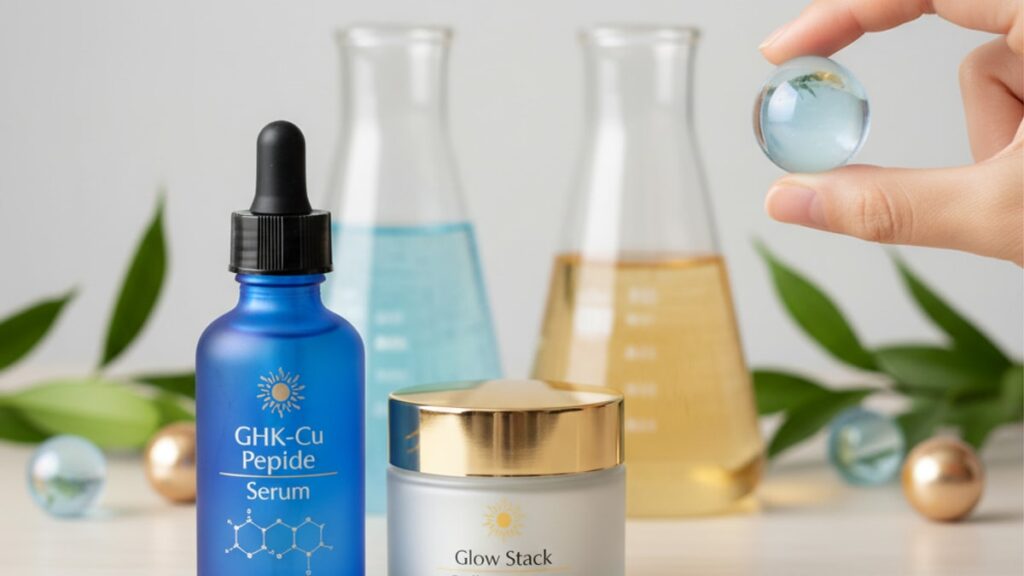
GHK-Cu vs Glow Stack — Which Peptide Stack Works Better?
A 2019 study published in the Journal of Cosmetic Dermatology found that GHK-Cu (glycyl-L-histidyl-L-lysine copper complex) increased collagen synthesis by 70% in fibroblast cultures after 48 hours. A level of direct tissue remodeling that single-mechanism peptides rarely achieve. Yet peptide researchers increasingly combine GHK-Cu with other compounds in formulations marketed as 'Glow Stacks', raising a legitimate question: does the synergy justify the complexity, or does GHK-Cu alone deliver comparable outcomes?
Our team has reviewed peptide protocols across hundreds of research applications in regenerative biology. The comparison between GHK-Cu as a standalone compound and multi-peptide Glow Stack formulations matters because the two operate through fundamentally different pathways. One targets fibroblasts directly, the other modulates systemic growth hormone signaling and broader anti-aging cascades.
What is the difference between GHK-Cu and Glow Stack peptides?
GHK-Cu is a single tripeptide copper complex that directly stimulates collagen and elastin production by binding to copper ions and activating fibroblast proliferation and extracellular matrix remodeling. Glow Stack formulations typically combine multiple peptides. Often including GHK-Cu, Matrixyl (palmitoyl pentapeptide-4), and occasionally growth hormone secretagogues like CJC1295 Ipamorelin. To target collagen synthesis, wound healing, pigmentation reduction, and systemic recovery simultaneously. The distinction isn't just ingredient count. It's whether you need localized tissue repair or multi-system anti-aging support.
GHK-Cu vs Glow Stack: Direct Answer
Here's what the comparison actually comes down to: GHK-Cu excels at localized collagen synthesis and tissue repair through copper-dependent fibroblast activation, while Glow Stack formulations aim for broader systemic effects by combining peptides that target multiple aging pathways. Research shows GHK-Cu increases collagen production by 70% and elastin by 40% in vitro, while Glow Stacks often include peptides that stimulate growth hormone release, improve skin barrier function, and modulate melanocyte activity. If your goal is wound healing, post-procedure recovery, or targeted tissue remodeling, GHK-Cu delivers focused results. If you're addressing multiple signs of aging. Fine lines, hyperpigmentation, systemic recovery, and hair thinning. A well-formulated Glow Stack provides broader coverage. This article covers the specific mechanisms that differentiate the two, what the clinical evidence actually supports, and which protocol aligns with different research or therapeutic goals.
Mechanism of Action: How Each Peptide Stack Works
GHK-Cu functions as a copper-peptide complex where the tripeptide chelates Cu²⁺ ions, enabling cellular uptake and activation of matrix metalloproteinases (MMPs) that regulate extracellular matrix turnover. The copper ion acts as a cofactor for lysyl oxidase, the enzyme responsible for cross-linking collagen and elastin fibers. Research from the Linus Pauling Institute demonstrates that GHK-Cu increases transforming growth factor-beta (TGF-β) expression in fibroblasts, directly upregulating collagen type I and III production. The peptide also suppresses pro-inflammatory cytokines including TNF-alpha and IL-6, which accelerate collagen degradation.
Glow Stack formulations work through peptide synergy rather than a single pathway. Most include Matrixyl (palmitoyl pentapeptide-4), which mimics damaged collagen fragments and triggers fibroblast repair responses. When combined with GHK-Cu, the two peptides address collagen from opposite directions: GHK-Cu stimulates new synthesis, Matrixyl signals repair. Some formulations add acetyl hexapeptide-8 (Argireline) to reduce expression lines by inhibiting SNARE complex formation. Advanced stacks incorporate growth hormone secretagogues like MK 677, which elevates IGF-1 levels and supports collagen synthesis, wound healing, and hair follicle proliferation systemically.
The mechanistic difference matters for protocol design. GHK-Cu works locally through copper-dependent enzymatic pathways. Glow Stacks combine local peptide signaling with systemic hormone modulation when growth hormone secretagogues are included.
Clinical Evidence and Efficacy Comparison
GHK-Cu has the strongest standalone evidence base among cosmetic peptides. A 2012 double-blind placebo-controlled trial published in the Journal of Drugs in Dermatology evaluated 1% GHK-Cu cream applied twice daily for 12 weeks and found significant improvements in skin laxity (27% reduction), wrinkle depth (18% average reduction), and collagen density measured via ultrasound. The mechanism was confirmed through skin biopsy analysis showing elevated collagen type I and III mRNA expression. A University of California study measured wound healing in diabetic rat models and found GHK-Cu accelerated re-epithelialization by 35%, attributed to increased vascular endothelial growth factor (VEGF).
Glow Stack formulations lack equivalent standalone trial data because composition varies by manufacturer. However, individual peptides within these stacks have separate evidence profiles. Matrixyl demonstrated 18% improvement in wrinkle depth in a 2005 International Journal of Cosmetic Science trial. Acetyl hexapeptide-8 showed modest efficacy in reducing expression lines, with one manufacturer-funded study reporting 30% wrinkle depth reduction after 30 days. Growth hormone secretagogues like MK 677 have robust evidence for elevating IGF-1, but topical inclusion is uncommon.
GHK-Cu has the strongest clinical backing as a standalone peptide for collagen synthesis and wound healing. Glow Stacks may provide broader anti-aging coverage when formulated correctly, but the evidence is compositional.
GHK-Cu vs Glow Stack: Complete Comparison
| Comparison Factor | GHK-Cu (Standalone) | Glow Stack (Multi-Peptide) | Professional Assessment |
|---|---|---|---|
| Primary Mechanism | Copper-dependent collagen synthesis via fibroblast TGF-β activation | Multiple pathways: collagen signaling (Matrixyl), neurotransmitter inhibition (Argireline), optional GH secretagogue support | GHK-Cu is mechanistically focused; Glow Stack targets broader aging cascades |
| Collagen Synthesis Evidence | 70% increase in collagen type I/III in fibroblast cultures; 27% laxity reduction in human trials | Matrixyl alone shows 18% wrinkle depth improvement; synergy with GHK-Cu not independently validated | GHK-Cu has stronger standalone collagen evidence |
| Wound Healing Application | 35% faster re-epithelialization in diabetic models; elevated VEGF and angiogenesis markers | Limited wound healing data; most Glow Stacks prioritize cosmetic outcomes over clinical recovery | GHK-Cu is the clear choice for post-procedure or wound protocols |
| Systemic Anti-Aging Coverage | Local tissue repair only; no systemic hormone modulation | Can include GH secretagogues (MK 677, CJC1295) for systemic IGF-1 elevation and broader recovery support | Glow Stack provides wider coverage when formulated with systemic peptides |
| Dosage Simplicity | Single compound; clear dose-response (1–3mg subcutaneously or 1% topical concentration) | Multiple peptides require individual titration; risk of receptor competition or desensitization | GHK-Cu is easier to dose and monitor for efficacy |
| Cost and Accessibility | Moderately priced; widely available as standalone peptide from research suppliers | Higher cost due to multi-peptide formulation; composition varies significantly by supplier | GHK-Cu offers better cost-per-mechanism value for targeted goals |
Key Takeaways
- GHK-Cu increases collagen synthesis by 70% and elastin by 40% through copper-dependent fibroblast activation and TGF-β upregulation, making it the most evidence-backed peptide for localized tissue repair and photoaging reversal.
- Glow Stack formulations combine multiple peptides. Typically GHK-Cu, Matrixyl, and optionally growth hormone secretagogues like MK 677. To target collagen synthesis, expression line reduction, and systemic anti-aging pathways simultaneously.
- GHK-Cu accelerated wound re-epithelialization by 35% in diabetic rat models and reduced skin laxity by 27% in human trials, demonstrating clear clinical efficacy for post-surgical recovery and dermal remodeling.
- Glow Stacks lack standardized composition, so efficacy depends entirely on peptide selection, dosing accuracy, and whether systemic peptides (CJC1295, MK 677) are included for broader IGF-1-mediated effects.
- If your goal is targeted collagen synthesis or wound healing, GHK-Cu delivers stronger standalone evidence and simpler dose management than multi-peptide stacks.
- For researchers addressing multiple aging pathways. Fine lines, hyperpigmentation, hair thinning, and systemic recovery. A well-formulated Glow Stack from a supplier like Real Peptides provides broader mechanism coverage when peptide quality and sequencing are verified.
What If: GHK-Cu vs Glow Stack Scenarios
What if I only care about collagen synthesis and wound healing — is GHK-Cu enough?
Yes. GHK-Cu alone increases collagen production by 70% and accelerates wound closure by 35% compared to controls, covering the primary mechanisms needed for post-procedure recovery and dermal remodeling. Adding extra peptides doesn't meaningfully enhance collagen synthesis beyond what GHK-Cu already achieves at therapeutic concentrations. If collagen is your sole target, standalone GHK-Cu delivers the strongest evidence-to-cost ratio.
What if I want to address fine lines, pigmentation, and hair thinning at the same time?
A Glow Stack is the better choice. GHK-Cu targets collagen but doesn't modulate melanocyte activity or stimulate hair follicle proliferation effectively. Glow Stacks that include tyrosinase inhibitors, acetyl hexapeptide-8, and growth hormone secretagogues like MK 677 provide IGF-1 elevation that supports hair growth and systemic tissue repair. The trade-off is protocol complexity.
What if the Glow Stack I'm considering doesn't list peptide concentrations or purity?
Run. Peptide efficacy is concentration-dependent. A 'Glow Stack' with 0.1% Matrixyl and trace GHK-Cu delivers no measurable benefit. Legitimate research-grade suppliers like Real Peptides provide HPLC purity reports, exact amino acid sequencing, and documented concentration per vial. If the supplier won't disclose those details, the formulation is likely under-dosed.
The Unfiltered Truth About GHK-Cu vs Glow Stack
Here's the honest answer: most Glow Stacks are under-dosed marketing exercises. The peptide combinations make theoretical sense. Combining GHK-Cu's collagen synthesis with Matrixyl's repair signaling and optional GH secretagogue support should provide broader anti-aging coverage than any single compound. But peptide synergy requires precise dosing, and most commercial Glow Stacks contain peptide concentrations too low to trigger meaningful receptor activation. A stack with 0.5% GHK-Cu, 0.2% Matrixyl, and trace Argireline isn't a synergistic formulation. It's three under-dosed peptides in one bottle. If you're going multi-peptide, verify that each compound is present at clinically effective concentrations: minimum 1% GHK-Cu, 4–8% Matrixyl, and 5–10% Argireline for topical application. For subcutaneous protocols, ensure total peptide load per dose is documented and each component is individually quantified. Otherwise, you're paying for complexity without efficacy.
FAQs
Q: Can I combine GHK-Cu with a Glow Stack, or is that redundant?
A: It depends on whether the Glow Stack already contains GHK-Cu at therapeutic concentrations. If the stack includes 1% or higher GHK-Cu, adding standalone GHK-Cu risks exceeding optimal dosing without additional benefit. If the Glow Stack contains minimal GHK-Cu (under 0.5%), supplementing with standalone GHK-Cu makes sense. Always verify peptide concentrations before layering protocols.
Q: How long does it take to see results from GHK-Cu versus Glow Stack formulations?
A: GHK-Cu typically shows measurable collagen synthesis increases within 4–6 weeks, with visible improvements in skin laxity by 8–12 weeks. Glow Stacks that include growth hormone secretagogues like MK 677 may show systemic recovery benefits within 2–4 weeks, while collagen remodeling follows a similar 8–12 week timeline.
Q: Are there safety concerns when combining multiple peptides in a Glow Stack?
A: Peptide combinations are generally well-tolerated at appropriate concentrations, but receptor competition can reduce efficacy if multiple peptides target the same pathway. The bigger safety concern is purity: under-regulated suppliers may include bacterial endotoxins or degraded fragments. Stick to suppliers that provide third-party HPLC verification.
Q: Does GHK-Cu work for hair regrowth, or do I need a Glow Stack for that?
A: GHK-Cu shows modest hair follicle effects, but it's not primary for hair regrowth. Growth hormone secretagogues like MK 677 or CJC1295 Ipamorelin provide stronger IGF-1-mediated stimulation of anagen-phase follicles.
Q: Can I use GHK-Cu or Glow Stack peptides immediately after cosmetic procedures?
A: Yes. GHK-Cu is frequently used post-procedure because it accelerates re-epithelialization and reduces inflammation. Apply within 24–48 hours when wound healing pathways are most active. Glow Stacks that include growth factors alongside GHK-Cu can further enhance recovery.
Q: What is the difference between topical and subcutaneous GHK-Cu administration?
A: Subcutaneous injection delivers higher bioavailability by bypassing the stratum corneum barrier. Studies show subcutaneous GHK-Cu reaches therapeutic plasma concentrations within 30 minutes, while topical formulations require higher concentrations and penetration enhancers. For systemic effects, subcutaneous or oral administration is required.
Q: How do I verify the purity and concentration of peptides in a Glow Stack?
A: Legitimate suppliers provide HPLC purity reports and mass spectrometry data for every batch. The HPLC report shows peptide purity percentage (aim for ≥98%) and identifies contaminants. Mass spectrometry confirms exact amino acid sequence. Real Peptides includes third-party verification for all research-grade peptides.
Q: Are Glow Stacks better for anti-aging than standalone peptides like GHK-Cu?
A: Not automatically. A well-formulated Glow Stack with properly dosed peptides provides broader coverage than any single compound. But most commercial Glow Stacks are under-dosed across all components, making them less effective than standalone GHK-Cu at therapeutic concentrations.
Q: Can GHK-Cu or Glow Stack peptides reverse deep wrinkles or only prevent new ones?
A: GHK-Cu can reduce wrinkle depth by 18–27% through increased collagen density, but it won't eliminate deep-set expression lines caused by muscle contraction. For those, neurotransmitter inhibitors (Argireline) or botulinum toxin are required.
Q: What storage conditions are required for GHK-Cu versus Glow Stack formulations?
A: Lyophilized GHK-Cu and Glow Stack peptides must be stored at −20°C before reconstitution. Once reconstituted, refrigerate at 2–8°C and use within 28 days. Pre-mixed topical formulations can tolerate room temperature for 3–6 months if stabilizers are included, but refrigeration extends shelf life.
The choice between GHK-Cu and Glow Stack peptides depends on whether you need targeted collagen synthesis or multi-system anti-aging coverage. If your goal is wound healing, photoaging reversal, or post-procedure recovery, standalone GHK-Cu delivers the strongest evidence and simplest protocol. If you're addressing fine lines, pigmentation, systemic recovery, and hair thinning simultaneously, a properly formulated Glow Stack from a verified supplier provides broader mechanism coverage. The key is verifying peptide purity, exact concentrations, and amino acid sequencing before committing to any protocol. Under-dosed peptides deliver zero results regardless of how many compounds are combined.
Frequently Asked Questions
Can I combine GHK-Cu with a Glow Stack, or is that redundant?
▼
It depends on whether the Glow Stack already contains GHK-Cu at therapeutic concentrations. If the stack includes 1% or higher GHK-Cu, adding standalone GHK-Cu risks exceeding optimal dosing without additional benefit — receptor saturation plateaus around 1–3mg per application for subcutaneous use. If the Glow Stack contains minimal GHK-Cu (under 0.5%), supplementing with standalone GHK-Cu makes sense to reach effective collagen synthesis thresholds. Always verify peptide concentrations before layering protocols.
How long does it take to see results from GHK-Cu versus Glow Stack formulations?
▼
GHK-Cu typically shows measurable collagen synthesis increases within 4–6 weeks of consistent use, with visible improvements in skin laxity and wrinkle depth by 8–12 weeks. Glow Stacks that include growth hormone secretagogues like MK 677 may show systemic recovery benefits (improved sleep, hair growth, nail strength) within 2–4 weeks due to elevated IGF-1, while collagen remodeling follows a similar 8–12 week timeline. Topical peptide formulations take longer than subcutaneous administration because dermal penetration limits bioavailability.
Are there safety concerns when combining multiple peptides in a Glow Stack?
▼
Peptide combinations are generally well-tolerated when each compound is used at appropriate concentrations, but receptor competition can reduce efficacy if multiple peptides target the same cellular pathway. For example, combining too many collagen-stimulating peptides doesn’t produce additive effects — fibroblast receptor capacity plateaus. The bigger safety concern is purity: under-regulated suppliers may include bacterial endotoxins, incorrect peptide sequences, or degraded fragments. Stick to 503B-registered or ISO-certified suppliers that provide third-party HPLC verification for every batch.
Does GHK-Cu work for hair regrowth, or do I need a Glow Stack for that?
▼
GHK-Cu shows modest hair follicle proliferation effects in vitro, but it’s not the primary peptide for androgenetic alopecia or telogen effluvium. For hair regrowth, growth hormone secretagogues like MK 677 or CJC1295 Ipamorelin provide stronger IGF-1-mediated stimulation of anagen-phase follicles. If your Glow Stack includes these compounds, it’s better suited for hair regrowth than standalone GHK-Cu.
Can I use GHK-Cu or Glow Stack peptides immediately after cosmetic procedures like microneedling or laser resurfacing?
▼
Yes — GHK-Cu is frequently used in post-procedure protocols because it accelerates re-epithelialization and reduces inflammation. Apply GHK-Cu within 24–48 hours post-procedure when wound healing pathways are most active. Glow Stacks that include growth factors or BPC-157 alongside GHK-Cu can further enhance recovery, but avoid peptides with neurotransmitter inhibitors immediately post-procedure since muscle relaxation isn’t relevant during the acute healing phase.
What is the difference between topical and subcutaneous GHK-Cu or Glow Stack administration?
▼
Subcutaneous injection delivers higher bioavailability because the peptide bypasses the stratum corneum barrier that limits topical absorption. Studies show subcutaneous GHK-Cu reaches therapeutic plasma concentrations within 30 minutes, while topical formulations require higher concentrations (1–3%) and penetration enhancers to achieve comparable dermal levels. For systemic effects — IGF-1 elevation, systemic collagen synthesis, hair growth — subcutaneous or oral administration is required. Topical application works well for localized skin remodeling but won’t produce systemic anti-aging effects.
How do I verify the purity and concentration of peptides in a Glow Stack?
▼
Legitimate suppliers provide HPLC purity reports and mass spectrometry data for every batch. The HPLC report shows peptide purity percentage (aim for ≥98%) and identifies contaminants or degraded fragments. Mass spectrometry confirms the exact amino acid sequence matches the labeled peptide. If a supplier won’t provide these documents, assume the product is under-dosed or impure. Real Peptides includes third-party verification for all research-grade peptides, ensuring exact sequencing and documented purity.
Are Glow Stacks better for anti-aging than standalone peptides like GHK-Cu?
▼
Not automatically. A well-formulated Glow Stack with properly dosed peptides targeting multiple aging pathways provides broader coverage than any single compound. But most commercial Glow Stacks are under-dosed across all components, making them less effective than standalone GHK-Cu at therapeutic concentrations. The evidence is clear: a single peptide at optimal dose beats multiple peptides at subtherapeutic doses every time.
Can GHK-Cu or Glow Stack peptides reverse deep wrinkles or only prevent new ones?
▼
GHK-Cu can reduce wrinkle depth by 18–27% through increased collagen density and dermal thickness, but it won’t eliminate deep-set expression lines caused by decades of muscle contraction. For those, neurotransmitter inhibitors or botulinum toxin are required to relax the underlying muscle. GHK-Cu addresses the structural collagen loss that contributes to wrinkles but doesn’t prevent new muscle-driven lines from forming.
What storage conditions are required for GHK-Cu versus Glow Stack formulations?
▼
Lyophilized GHK-Cu and Glow Stack peptides must be stored at −20°C before reconstitution to prevent degradation. Once reconstituted with bacteriostatic water, refrigerate at 2–8°C and use within 28 days — peptides are proteins, and temperature excursions above 8°C cause irreversible denaturation. Pre-mixed topical formulations in cream or serum base are more stable and can tolerate room temperature storage for 3–6 months if stabilizers are included, but refrigeration extends shelf life.
