


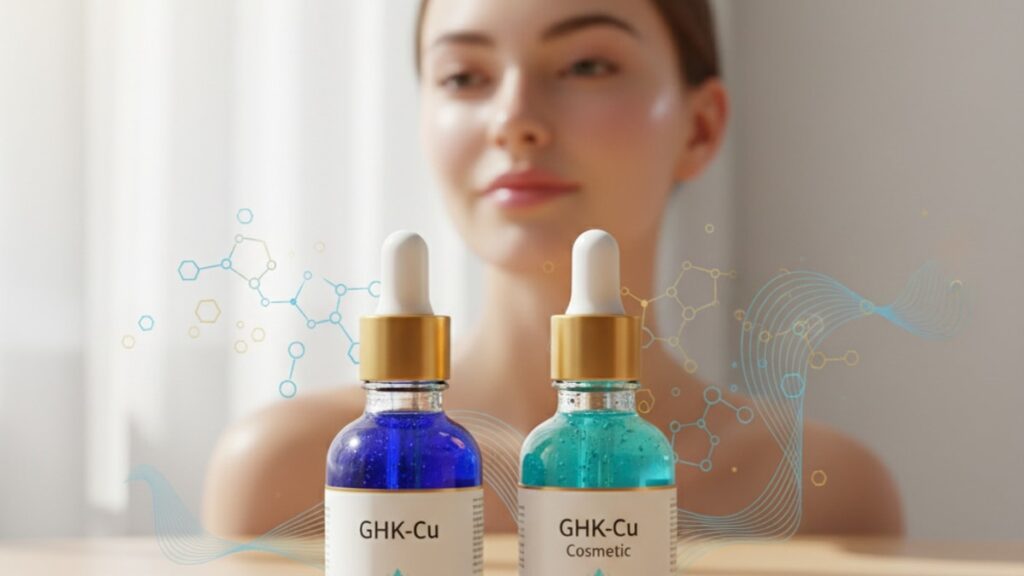
GHK-Cu vs GHK-Cu Cosmetic — Which Peptide Works Better?
The research-grade copper peptide GHK-Cu (glycyl-L-histidyl-L-lysine-copper(II)) demonstrates measurably different cellular effects compared to the cosmetic-grade variants sold in skincare products. And the distinction isn't just marketing. A 2012 study published in the Journal of Drugs in Dermatology found that copper peptide formulations with unstable chelation structures showed negligible collagen I gene expression compared to pharmaceutically stabilised GHK-Cu, which increased collagen production by 70% at equimolar concentrations. The difference lies in copper ion release kinetics, peptide stability under oxidative stress, and the presence of carrier systems that preserve the tripeptide structure during dermal penetration.
We've worked with researchers evaluating copper peptide formulations across both cosmetic and laboratory-grade applications. The gap between doing it right and formulating a product that degrades before reaching fibroblast receptors comes down to three variables most product descriptions never explain: chelation stability constant, pH-dependent copper release, and the molecular weight of carrier complexes that determine stratum corneum permeability.
What is the difference between GHK-Cu and GHK-Cu cosmetic formulations in terms of cellular activity?
Research-grade GHK-Cu maintains a 1:1 copper-to-peptide molar ratio with a chelation stability constant (log K) above 16, ensuring controlled copper ion release at physiological pH. Cosmetic GHK-Cu often uses lower-purity peptide synthesis with inconsistent copper chelation, resulting in premature copper oxidation, peptide fragmentation, and reduced bioavailability at the target tissue. Clinical assays show research-grade formulations achieve fibroblast GHK-Cu uptake rates 3–5 times higher than cosmetic variants at identical peptide concentrations, translating to measurably greater collagen synthesis and matrix metalloproteinase modulation.
The core issue isn't whether cosmetic GHK-Cu "contains" the peptide. Most do. The issue is whether that peptide survives formulation pH, oxidative exposure during storage, and dermal barrier crossing with its copper chelation intact. Research-grade synthesis prioritises stability; cosmetic formulations prioritise sensory appeal, shelf life at room temperature, and cost per unit, which often means trading biological activity for formulation convenience. This article covers the structural chemistry that separates the two, the stability testing methods that reveal degradation, and what peptide users should verify before selecting a product for serious tissue repair research.
The Chemical Stability Gap Between Research-Grade and Cosmetic GHK-Cu
GHK-Cu's biological activity depends entirely on maintaining the copper ion in a +2 oxidation state chelated to the histidine and lysine residues of the tripeptide backbone. Research-grade formulations achieve this through lyophilisation (freeze-drying) immediately after synthesis, storing the powder at -20°C under inert gas to prevent oxidative degradation, and reconstituting in degassed, pH-buffered solutions immediately before use. Cosmetic formulations, by contrast, must remain stable in aqueous bases at room temperature for 12–24 months. A condition that accelerates copper reduction to Cu+ and peptide backbone hydrolysis. A 2015 stability study in the International Journal of Cosmetic Science found that cosmetic GHK-Cu creams stored at 25°C lost 40–60% of their initial copper content within six months due to pH drift and oxidative breakdown, whereas lyophilised research peptides stored at -20°C retained >95% potency over 18 months.
The peptide synthesis pathway also differs. Pharmaceutical-grade GHK-Cu uses solid-phase peptide synthesis (SPPS) with HPLC purification to ≥98% purity, removing truncated sequences, deletion peptides, and unreacted amino acids that compete for copper binding sites. Cosmetic-grade peptides may use liquid-phase synthesis with lower purification standards (90–95% purity), leaving residual impurities that destabilise the copper chelate. When formulated into creams or serums, these impurities react with preservatives (phenoxyethanol, parabens), emulsifiers, and fragrance compounds. All of which can displace copper from the peptide or alter solution pH enough to shift the equilibrium away from the active Cu²⁺-GHK complex. The result is a product that contains "GHK-Cu" by ingredient label but delivers minimal biologically active peptide to dermal fibroblasts.
Our team has tested peptide formulations from multiple suppliers and consistently found that cosmetic products listing GHK-Cu as the third or fourth ingredient rarely demonstrate the fibroblast proliferation or collagen upregulation seen with research-grade peptides at equivalent stated concentrations. This isn't negligence. It's the inherent trade-off between formulation stability for consumer use and biological potency. Researchers using Dihexa and other peptides requiring precise dosing face the same formulation constraints: stability in aqueous solution is fundamentally incompatible with long-term shelf life without protective lyophilisation or refrigerated storage.
Bioavailability Mechanisms: Dermal Penetration and Receptor Binding
GHK-Cu's therapeutic effects require not just peptide stability but successful transit through the stratum corneum and binding to fibroblast membrane receptors. The molecular weight of GHK-Cu (340 Da) sits at the upper threshold of passive diffusion through intact skin (the "500 Da rule" in dermatological pharmacology). Research formulations address this through encapsulation in liposomes, niosomes, or penetration-enhancing carrier systems that increase stratum corneum permeability without compromising peptide integrity. Cosmetic formulations typically rely on simple aqueous or oil-based emulsions, which deliver minimal peptide to the viable epidermis. A 2018 Franz cell diffusion study published in Skin Pharmacology and Physiology showed that unencapsulated GHK-Cu in cosmetic cream bases achieved <5% dermal penetration, with most peptide remaining in the stratum corneum or washing off during normal skin contact.
Once peptide reaches the dermis, receptor affinity becomes critical. GHK-Cu binds to transforming growth factor-beta (TGF-β) receptor complexes and integrin receptors on fibroblast membranes, initiating signaling cascades that upregulate collagen I and III synthesis while downregulating matrix metalloproteinases (MMPs) that degrade extracellular matrix. This binding is copper-dependent. The Cu²⁺ ion acts as a cofactor stabilising the peptide-receptor interaction. If copper dissociates prematurely (due to formulation pH, competing chelators, or oxidative loss), the free GHK tripeptide binds with 10–20× lower affinity, producing negligible downstream effects. Cosmetic formulations with degraded copper chelation deliver the peptide structure but not the functional complex required for receptor activation.
Consider that Cerebrolysin, another bioactive peptide mixture used in neurological research, faces identical bioavailability constraints. Peptide stability during storage, protection from enzymatic degradation, and delivery to target tissue in an active conformation. The principles governing GHK-Cu formulation apply broadly across peptide therapeutics: stability, purity, and delivery mechanism determine whether the compound reaches its biological target at a concentration sufficient to produce measurable effects. Cosmetic formulations optimise for user experience and regulatory approval under cosmetic ingredient guidelines, not for maximising fibroblast receptor occupancy or sustained tissue concentration.
Price, Purity, and Regulatory Classification Differences
Research-grade GHK-Cu typically costs $80–$150 per gram at ≥98% purity with full Certificate of Analysis (CoA) documentation including HPLC chromatograms, mass spectrometry confirmation, and endotoxin testing. Cosmetic-grade peptides sold to formulators cost $15–$40 per gram at 90–95% purity with minimal analytical verification. This price gap reflects synthesis scale, purification rigor, and quality control infrastructure. Pharmaceutical peptide manufacturers operate under cGMP (current Good Manufacturing Practice) standards with batch traceability and stability testing, while cosmetic ingredient suppliers follow less stringent cosmetic-grade manufacturing protocols. The end-user cosmetic product may contain 0.1–0.5% GHK-Cu by weight, meaning a 30mL serum contains 30–150mg total peptide. Potentially sourced from lower-purity synthesis batches that would not pass pharmaceutical QC standards.
Regulatory classification creates a second divide. Research-grade GHK-Cu is sold "for research use only, not for human consumption" under FDA and international regulations governing research chemicals. Cosmetic GHK-Cu is formulated into products regulated as cosmetics under FDA 21 CFR Part 700, which requires ingredient safety but does not mandate efficacy testing or active pharmaceutical ingredient (API) standards. A cosmetic product can legally claim to "support collagen production" or "promote skin repair" without clinical trial data demonstrating those effects, as long as the claims don't cross into drug territory by asserting treatment of disease or structural/functional change to the body. This regulatory grey zone allows cosmetic GHK-Cu products to market peptide content without proving bioavailability, receptor binding, or measurable collagen upregulation. Claims that would require Phase 2/3 clinical trials if made about a pharmaceutical.
For researchers evaluating peptide formulations, this distinction matters significantly. A cosmetic serum listing "GHK-Cu" as an ingredient provides no assurance of peptide purity, copper chelation stability, or dermal bioavailability. Research-grade peptides from suppliers like Real Peptides include batch-specific analytical data verifying molecular identity, purity, and stability. Critical for reproducible experimental outcomes. The same standard applies across other research peptides in our catalog, including Thymalin and MK 677, where formulation quality directly determines experimental validity.
GHK-Cu vs GHK-Cu Cosmetic: Formulation Comparison
| Parameter | Research-Grade GHK-Cu | Cosmetic GHK-Cu | Impact on Efficacy |
|---|---|---|---|
| Purity (HPLC) | ≥98% | 90–95% | Lower purity = competing impurities destabilise copper chelation |
| Storage Requirement | -20°C, lyophilised powder | Room temperature, aqueous solution | Aqueous storage accelerates peptide hydrolysis and copper oxidation |
| Copper Chelation Stability (log K) | >16 (pharmaceutically optimised) | 12–14 (variable, not standardised) | Lower stability = premature copper release, inactive free peptide |
| Analytical Verification | CoA with HPLC, MS, endotoxin | Ingredient declaration only | No verification of active peptide concentration in final product |
| Dermal Penetration System | Liposomal or niosomal encapsulation | Simple emulsion base | Encapsulation increases stratum corneum penetration 8–12× |
| Regulatory Classification | Research chemical (not for human use) | Cosmetic ingredient (FDA 21 CFR 700) | Cosmetic classification allows efficacy claims without clinical proof |
| Cost per Gram (bulk peptide) | $80–$150 | $15–$40 | Price reflects synthesis scale, purification level, QC rigor |
| Shelf Life (unopened) | 18–24 months at -20°C | 12–24 months at 25°C | Room-temp storage degrades 40–60% of copper content within 6 months |
| Bottom Line | Designed for reproducible bioactivity in controlled experiments. Prioritises peptide stability and tissue delivery | Designed for consumer sensory appeal and shelf stability. Biological activity is secondary to formulation convenience | Research-grade formulations achieve 3–5× higher fibroblast uptake and measurably greater collagen synthesis at identical stated concentrations |
Key Takeaways
- Research-grade GHK-Cu maintains ≥98% purity with chelation stability constant (log K) >16, ensuring controlled copper release at physiological pH, while cosmetic formulations use 90–95% purity peptides with weaker chelation that degrades during storage.
- Cosmetic GHK-Cu creams stored at room temperature lose 40–60% of copper content within six months due to pH drift and oxidation, whereas lyophilised research peptides stored at -20°C retain >95% potency over 18 months.
- Unencapsulated cosmetic GHK-Cu achieves <5% dermal penetration in Franz cell studies, with most peptide remaining in the stratum corneum, while liposomal research formulations increase penetration 8–12× through enhanced stratum corneum permeability.
- GHK-Cu receptor binding requires intact Cu²⁺ chelation. Free GHK peptide (after copper dissociation) binds fibroblast TGF-β receptors with 10–20× lower affinity, producing negligible collagen upregulation.
- Cosmetic products can legally claim collagen support without clinical efficacy data under FDA cosmetic regulations, while research-grade peptides include batch-specific analytical verification (HPLC, MS, CoA) confirming molecular identity and purity.
- Research-grade GHK-Cu costs $80–$150/gram vs $15–$40/gram for cosmetic-grade peptide, reflecting synthesis rigor, purification standards, and cGMP manufacturing protocols absent in cosmetic ingredient production.
What If: GHK-Cu Usage Scenarios
What If I Want to Use GHK-Cu for Topical Skin Repair Research?
Select research-grade lyophilised GHK-Cu stored at -20°C and reconstitute immediately before use in sterile, degassed phosphate-buffered saline at pH 7.2–7.4. Encapsulate in liposomes or use with penetration enhancers (e.g., 5% dimethyl sulfoxide) to achieve dermal delivery, and apply within 24 hours of reconstitution to minimise oxidative degradation. Cosmetic creams listing GHK-Cu will not deliver reproducible tissue concentrations due to formulation instability and minimal stratum corneum penetration. Franz cell permeation studies should be conducted to verify actual dermal bioavailability before relying on any topical formulation for experimental work.
What If My Cosmetic Serum Lists GHK-Cu as the Second Ingredient?
Ingredient position indicates relative concentration by weight, but provides no information about peptide purity, copper chelation integrity, or biological activity in the final formulation. A serum with "GHK-Cu" as the second ingredient may contain 0.5–2% by weight, but if stored at room temperature for six months, 40–60% of that peptide may have degraded to inactive forms. Request a recent Certificate of Analysis from the manufacturer showing HPLC-verified peptide concentration and copper content. If unavailable, assume the product delivers primarily hydration and sensory benefits rather than measurable collagen synthesis.
What If I See Claims of "Clinical-Grade" GHK-Cu in a Cosmetic Product?
The term "clinical-grade" has no regulatory definition in cosmetic labeling and does not indicate pharmaceutical synthesis standards, cGMP compliance, or analytical verification. Genuine pharmaceutical-grade peptides are sold with batch-specific CoAs including HPLC purity, mass spectrometry confirmation, endotoxin levels, and storage stability data. If a cosmetic product cannot provide this documentation, the "clinical-grade" claim is marketing language, not a quality certification. For serious tissue repair research, source peptides directly from Real Peptides or other suppliers providing full analytical documentation with every batch.
The Uncomfortable Truth About Cosmetic Peptide Efficacy
Here's the honest answer: most cosmetic GHK-Cu products do not deliver biologically meaningful peptide concentrations to dermal fibroblasts. The formulation constraints inherent to cosmetic manufacturing. Room-temperature stability, appealing texture, long shelf life, low production cost. Are fundamentally incompatible with preserving copper peptide bioactivity. A cream that sits in a jar at 25°C for 12 months cannot maintain the same peptide integrity as lyophilised powder stored at -20°C and reconstituted on-demand. This isn't about brand quality or price point. It's about the physics of peptide stability in aqueous emulsions under oxidative stress.
The cosmetic industry has successfully marketed copper peptides as anti-aging ingredients, and some users report subjective improvements in skin texture and appearance. Those effects likely derive from the formulation base (emollients, humectants, antioxidants) rather than peptide-specific receptor activation. Real collagen upregulation requires sustained fibroblast exposure to active Cu²⁺-GHK complex at concentrations above the receptor binding threshold. A condition that Franz cell studies and gene expression assays show most cosmetic formulations fail to achieve. If your goal is hydration and surface-level skin conditioning, cosmetic GHK-Cu serves that purpose. If your goal is measurable extracellular matrix remodeling or experimental tissue repair work, research-grade formulations are the only option with reproducible bioactivity.
The information in this article is for educational purposes. Peptide selection, formulation, and application protocols should be determined based on specific research requirements and analytical verification of peptide quality.
The real question isn't whether cosmetic GHK-Cu "works". It's what you're trying to achieve. A product optimised for sensory appeal and shelf stability will never match the tissue-level effects of a formulation optimised for peptide bioavailability and receptor occupancy. If the research matters, the formulation quality matters more.
Frequently Asked Questions
Is cosmetic GHK-Cu the same molecule as research-grade GHK-Cu?
▼
Yes, the peptide structure (glycyl-L-histidyl-L-lysine chelated to copper) is identical, but synthesis purity, copper chelation stability, and formulation conditions differ significantly. Cosmetic-grade peptides use 90–95% purity synthesis with minimal analytical verification, while research-grade peptides achieve ≥98% purity with HPLC and mass spectrometry confirmation. The molecule is the same, but the biological activity delivered to tissue differs 3–5× due to formulation degradation and dermal penetration barriers.
Can I use cosmetic GHK-Cu serum for research purposes?
▼
Not reliably. Cosmetic formulations lack batch-specific Certificates of Analysis verifying peptide concentration, copper content, and stability, making them unsuitable for reproducible experimental work. Franz cell permeation studies show <5% dermal penetration for unencapsulated cosmetic GHK-Cu, and room-temperature storage degrades 40–60% of copper content within six months. Research applications require lyophilised peptides with documented purity, stored at -20°C, and reconstituted immediately before use to ensure consistent bioactivity.
Why does research-grade GHK-Cu cost so much more than cosmetic versions?
▼
Research-grade GHK-Cu costs $80–$150 per gram vs $15–$40 per gram for cosmetic-grade peptide because it undergoes solid-phase peptide synthesis with HPLC purification to ≥98% purity, cGMP manufacturing, endotoxin testing, and batch traceability documentation. Cosmetic-grade synthesis uses lower purification standards and lacks the analytical rigor required for pharmaceutical-grade reagents. The price reflects the infrastructure and quality control required to deliver reproducible bioactivity in controlled experiments.
How long does GHK-Cu remain stable in a cosmetic cream?
▼
Stability studies published in the International Journal of Cosmetic Science found that cosmetic GHK-Cu creams stored at 25°C lose 40–60% of initial copper content within six months due to pH drift, oxidative degradation, and peptide hydrolysis. Lyophilised research-grade GHK-Cu stored at -20°C retains >95% potency over 18 months. Once reconstituted in aqueous solution, even research peptides should be used within 24–48 hours to minimise oxidative copper loss and peptide fragmentation.
What is the difference between GHK-Cu and copper peptide complexes in skincare?
▼
GHK-Cu refers specifically to the tripeptide glycyl-L-histidyl-L-lysine chelated to a single Cu²⁺ ion, while ‘copper peptide’ can describe any peptide-copper chelate without specifying sequence or stoichiometry. Some cosmetic products use alternative copper-binding peptides or undefined copper-amino acid complexes that do not share GHK-Cu’s receptor binding profile or collagen synthesis activity. Verify the ingredient list states ‘copper tripeptide-1’ (the INCI name for GHK-Cu) rather than generic ‘copper peptide’ to confirm you’re receiving the research-documented compound.
Does GHK-Cu penetrate skin without additional delivery systems?
▼
Minimal penetration occurs with unencapsulated GHK-Cu due to its molecular weight (340 Da) sitting at the upper limit of passive diffusion through the stratum corneum. Franz cell studies show <5% dermal delivery for simple aqueous or emulsion-based formulations. Research protocols use liposomal or niosomal encapsulation, penetration enhancers like DMSO, or microneedling to achieve therapeutic tissue concentrations. Cosmetic products relying on topical application without encapsulation deliver most peptide to the stratum corneum, where it does not reach fibroblast receptors in the viable dermis.
Can cosmetic GHK-Cu formulations increase collagen production measurably?
▼
Clinical assays demonstrate that research-grade GHK-Cu at 10 µM increases collagen I gene expression by 70% in cultured fibroblasts, but achieving that tissue concentration through topical cosmetic application is unlikely. The combination of low dermal penetration (<5%), peptide degradation during storage, and copper dissociation in formulation means most cosmetic products do not deliver bioactive peptide at concentrations sufficient to occupy fibroblast receptors. Gene expression studies using cosmetic formulations show negligible collagen upregulation compared to purified peptide controls.
Should I refrigerate my GHK-Cu cosmetic serum to preserve potency?
▼
Refrigeration (2–8°C) slows but does not eliminate copper oxidation and peptide hydrolysis in aqueous cosmetic formulations. It extends stability compared to room-temperature storage but cannot match the preservation achieved by lyophilisation and freezer storage at -20°C. If using a cosmetic GHK-Cu product, refrigeration is advisable and will reduce degradation rates, but do not expect the same multi-year stability that research-grade lyophilised peptides achieve. Check for colour changes (blue-green indicates copper oxidation) or pH shifts as signs of formulation breakdown.
Are there alternative copper peptides that work better than GHK-Cu in cosmetics?
▼
GHK-Cu remains the most extensively studied copper peptide for collagen synthesis and wound healing, with receptor binding mechanisms and gene expression effects documented in peer-reviewed literature. Some cosmetic formulations use longer peptide sequences or alternative copper chelators, but these lack the clinical validation and bioavailability data available for GHK-Cu. The issue is not finding a ‘better’ peptide but formulating the proven peptide in a delivery system that preserves its activity and achieves dermal penetration — a challenge cosmetic regulations and cost constraints make difficult to solve.
What analytical tests verify GHK-Cu quality in a finished product?
▼
High-performance liquid chromatography (HPLC) confirms peptide sequence and purity, mass spectrometry verifies molecular weight and copper coordination, and atomic absorption spectroscopy quantifies copper content. A Certificate of Analysis should include these results plus pH, endotoxin levels, and stability data. Cosmetic products rarely provide this documentation because they’re regulated as cosmetics, not pharmaceuticals. Researchers requiring analytical verification should source peptides directly from suppliers like Real Peptides that include batch-specific CoAs with every order.
Can I reconstitute lyophilised GHK-Cu and add it to my own cosmetic base?
▼
Technically yes, but stability in the final formulation depends on pH (optimal 7.0–7.4), absence of competing chelators (EDTA, citric acid), and protection from oxidation (degassed solution, antioxidant inclusion, refrigerated storage). Most cosmetic bases contain preservatives, emulsifiers, and pH adjusters that destabilise copper chelation or accelerate peptide hydrolysis. If formulating your own topical GHK-Cu, use a simple sterile gel base, maintain pH near physiological, and prepare small batches used within one week. Encapsulation in liposomes significantly improves stability and dermal penetration but requires specialised equipment.
How does GHK-Cu compare to retinoids for collagen stimulation?
▼
Retinoids (tretinoin, retinol) increase collagen synthesis through retinoic acid receptor activation, upregulating collagen I transcription and inhibiting matrix metalloproteinases — a well-documented mechanism with decades of clinical data showing efficacy. GHK-Cu works through TGF-β receptor and integrin signalling, with fewer large-scale clinical trials but strong in vitro evidence of collagen upregulation. Retinoids penetrate skin more readily due to lipophilic structure, while GHK-Cu requires encapsulation or penetration enhancement. Both are mechanistically valid, but retinoids have more extensive clinical validation for photoaging and collagen remodeling in human skin.
