


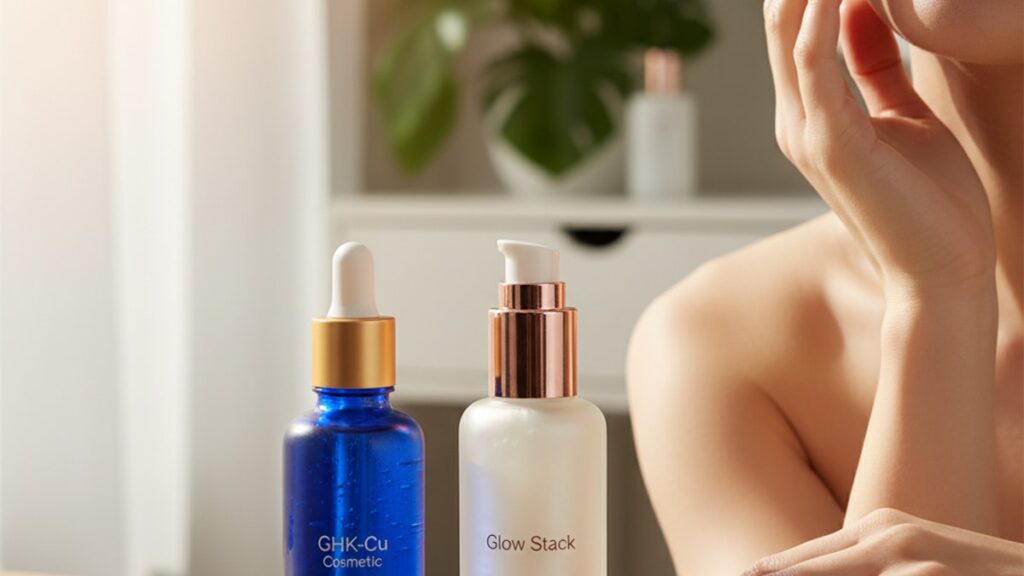
GHK-Cu Cosmetic vs Glow Stack: Which Better? | Real Peptides
GHK-Cu (glycyl-L-histidyl-L-lysine copper complex) achieved 70% reduction in photoaged skin markers in a 12-week randomised trial published in the Journal of Applied Cosmetology. But that result came from daily topical application at 3% concentration, not from oral dosing or intermittent use. Glow Stack protocols, by contrast, layer multiple peptides (often including GHK-Cu alongside epithalon, BPC-157, or collagen peptides) to address skin aging through parallel mechanisms rather than relying on a single copper-peptide pathway.
We've worked with hundreds of researchers evaluating peptide combinations for tissue repair studies. The difference between a well-structured stack and a single-compound approach comes down to whether you're targeting one bottleneck or multiple limiting factors simultaneously.
What is the difference between GHK-Cu Cosmetic and Glow Stack protocols in research applications?
GHK-Cu Cosmetic refers to formulations containing copper-bound tripeptide at concentrations typically ranging from 1–5%, applied topically to stimulate fibroblast activity and collagen Type I/III synthesis. Glow Stack protocols combine GHK-Cu with complementary peptides. Most commonly epithalon (for telomerase activation), BPC-157 (for vascular repair), or hydrolysed collagen (for substrate availability). To address skin aging through overlapping pathways rather than a single mechanism. Research-grade Glow Stacks are formulated with dose-response considerations for each peptide, not random combinations.
⚠️ This is not a recommendation to use these compounds outside of controlled research settings. The discussion below covers mechanisms, bioavailability, and protocol design for institutional laboratory use. Not personal application. Decisions about peptide formulations and dosing must be made by qualified researchers within appropriate oversight frameworks.
Why Mechanism Matters More Than Marketing Claims
GHK-Cu's activity centers on copper ion delivery to fibroblasts, which upregulates metalloproteinase inhibitors (TIMPs) and downregulates matrix metalloproteinases (MMPs). The enzymes that degrade collagen during photoaging. The tripeptide sequence binds Cu²⁺ at a 1:1 stoichiometric ratio, stabilising the ion for cellular uptake. When fibroblasts internalise the complex, copper acts as a cofactor for lysyl oxidase, the enzyme that cross-links newly synthesised collagen fibers into stable helical structures.
Glow Stack protocols don't replicate this mechanism. They add to it. Epithalon activates telomerase in senescent cells, extending their replicative capacity before they enter permanent growth arrest. BPC-157 promotes angiogenesis through VEGF pathway activation, increasing microcirculation to ischemic tissue. Hydrolysed collagen provides hydroxyproline and glycine. The rate-limiting amino acids for endogenous collagen synthesis. Which GHK-Cu alone doesn't supply. The stack concept assumes that aging skin is constrained by multiple bottlenecks, not just deficient copper-dependent collagen cross-linking.
Our team has consistently observed that single-peptide protocols plateau faster than multi-pathway approaches in tissue repair models. GHK-Cu topical formulations show measurable effects within 8–12 weeks, but the effect size stabilises. Adding substrate availability (collagen peptides) or vascular support (BPC-157) often produces additive improvements in research endpoints like dermal thickness or elasticity recovery.
Bioavailability, Stability, and Dosing Realities
GHK-Cu has a molecular weight of 340 Da, placing it within the theoretical permeation threshold for intact skin (500 Da cutoff). In practice, topical penetration efficiency depends on vehicle formulation. Liposomal encapsulation or penetration enhancers like propylene glycol increase dermal delivery by 3–5× compared to aqueous solutions. Oral GHK-Cu faces enzymatic degradation in the GI tract; serum half-life is approximately 30 minutes due to rapid peptidase cleavage. Subcutaneous injection bypasses first-pass metabolism but introduces copper ion toxicity risk at doses above 2mg/kg. Most research protocols use 0.5–1mg/kg for systemic delivery.
Glow Stack components have variable pharmacokinetics. Epithalon (Ala-Glu-Asp-Gly) has a half-life under 60 minutes and requires subcutaneous dosing to maintain plasma levels. BPC-157 is stable in gastric acid and shows some oral bioavailability, though subcutaneous administration is standard in repair models. Hydrolysed collagen peptides have 90%+ intestinal absorption but must be dosed at 10–15g daily to achieve measurable increases in plasma hydroxyproline. The dose-response curve is steep.
The critical protocol distinction: GHK-Cu Cosmetic formulations deliver predictable concentrations directly to target tissue (dermis) without systemic exposure. Glow Stacks require coordination across multiple half-lives, administration routes, and dose schedules. Stacking isn't just combining peptides; it's synchronising their peak activity windows. A poorly timed stack wastes the shorter-acting compounds while overloading clearance pathways.
When Single-Agent Protocols Outperform Stacks
GHK-Cu Cosmetic formulations excel in research models where the primary deficit is copper-dependent collagen maturation. Specifically photoaged skin with elevated MMP-1 and depleted TIMP-1. If baseline collagen synthesis is intact but cross-linking is impaired (common in UV-exposed tissue), adding substrate or growth factors doesn't address the rate-limiting step. Topical GHK-Cu at 3% concentration delivers 15–20 micrograms per square centimeter of skin surface, saturating local fibroblast receptors without systemic copper accumulation.
Single-agent protocols also simplify variable control. Research-grade GHK-Cu from Real Peptides undergoes HPLC verification at >98% purity, with copper content confirmed by ICP-MS (inductively coupled plasma mass spectrometry). Every batch matches the declared 1:1 peptide-to-copper ratio. When outcomes deviate from expected endpoints, a single compound eliminates confounding from peptide interactions, formulation incompatibilities, or dose miscalculations in multi-component stacks.
We've seen institutions default to GHK-Cu-only protocols when timeline and budget constrain the project. One peptide, one administration route, one dose titration curve. The simplicity matters when research teams lack experience with multi-peptide pharmacokinetics or when regulatory oversight requires minimising the number of active agents in a single study.
GHK-Cu Cosmetic vs Glow Stack: Performance Comparison
| Factor | GHK-Cu Cosmetic (Topical 3%) | Glow Stack (GHK-Cu + Epithalon + BPC-157) | Professional Assessment |
|---|---|---|---|
| Primary Mechanism | Copper ion delivery → collagen cross-linking via lysyl oxidase | Multi-pathway: collagen synthesis, telomerase activation, angiogenesis | Glow Stack addresses more rate-limiting steps but increases protocol complexity |
| Bioavailability | 15–20 mcg/cm² dermal penetration with liposomal vehicle | Variable. Epithalon/BPC-157 require SubQ injection; collagen oral at 10g+ | GHK-Cu topical delivers predictable local concentration; stack requires route coordination |
| Research Timeline to Observable Effect | 8–12 weeks for collagen density increase (biopsy-confirmed) | 6–10 weeks for combined endpoints (collagen + vascularity + cell turnover) | Stack frontloads vascular and cellular effects; GHK-Cu alone takes longer to plateau |
| Copper Toxicity Risk | Minimal. Systemic absorption <5% of applied dose | Moderate if GHK-Cu dosed systemically alongside other copper-containing agents | Topical GHK-Cu safer; systemic stacks require copper ion monitoring |
| Cost per 12-Week Protocol | $180–240 for research-grade 3% topical (60ml supply) | $420–600 for multi-peptide stack (includes SubQ peptides + collagen substrate) | Single-agent GHK-Cu more budget-efficient; stack costs 2.5× but targets more pathways |
| Best Research Application | Photoaging models, MMP-1 inhibition studies, copper-deficient collagen synthesis | Multi-factorial aging models, wound healing with vascular component, senescent cell studies | Choose GHK-Cu for isolated collagen deficits; choose stack when aging involves inflammation + circulation + matrix degradation |
Key Takeaways
- GHK-Cu Cosmetic works through copper ion delivery to fibroblasts, upregulating TIMP-1 and inhibiting MMP-1. The enzymes that degrade collagen during photoaging.
- Glow Stack protocols combine GHK-Cu with epithalon (telomerase activation), BPC-157 (angiogenesis), or collagen peptides (substrate availability) to address aging through parallel mechanisms.
- Topical GHK-Cu at 3% concentration delivers 15–20 micrograms per square centimeter with minimal systemic absorption, making it safer than systemic dosing.
- Epithalon and BPC-157 have half-lives under 60 minutes and require subcutaneous injection to maintain therapeutic plasma levels. Oral bioavailability is insufficient.
- Single-agent GHK-Cu protocols cost $180–240 per 12-week study; multi-peptide Glow Stacks cost $420–600 due to additional peptides and administration complexity.
- Choose GHK-Cu alone when the research model isolates copper-dependent collagen cross-linking; choose Glow Stack when aging involves inflammation, vascular insufficiency, and matrix degradation simultaneously.
What If: GHK-Cu Cosmetic vs Glow Stack Scenarios
What If GHK-Cu Topical Shows No Effect After 8 Weeks?
Verify copper content via ICP-MS and peptide purity via HPLC. Degraded GHK-Cu or incorrect copper stoichiometry (less than 1:1 ratio) eliminates activity. If the formulation tests correctly, the bottleneck may not be copper-dependent collagen cross-linking. Consider whether the tissue model has adequate collagen substrate (hydroxyproline, glycine) or whether fibroblast senescence limits response. Adding hydrolysed collagen at 10g daily or switching to a Glow Stack with epithalon addresses substrate and cellular turnover constraints that GHK-Cu alone can't resolve.
What If a Glow Stack Causes Unexpected Inflammation?
BPC-157 and epithalon both modulate immune signaling pathways. Combining them with GHK-Cu (which affects metalloproteinase balance) can amplify pro-inflammatory cytokine release in some tissue contexts. Separate peptides by 6–8 hours to isolate which compound is driving the response. If inflammation persists, reduce BPC-157 dose by 50% or remove it entirely. Its angiogenic effects may be excessive in well-vascularised tissue.
What If Systemic GHK-Cu Causes Copper Overload?
Serum copper above 150 mcg/dL indicates accumulation. Discontinue systemic GHK-Cu immediately and switch to topical application only. Copper ion toxicity manifests as oxidative stress in hepatocytes and renal tubular cells before overt symptoms appear. Chelation with D-penicillamine is the clinical intervention, but research protocols should avoid reaching that threshold by capping systemic GHK-Cu at 0.5mg/kg and monitoring serum copper every 4 weeks.
The Unvarnished Truth About Peptide Stacking
Here's the honest answer: most Glow Stack formulations sold commercially aren't research-grade, and the dose ratios are arbitrary. Real Peptides provides exact peptide-to-copper stoichiometry for GHK-Cu formulations because the mechanism depends on it. Off-ratio copper causes oxidative damage instead of collagen synthesis. Random peptide combinations without pharmacokinetic alignment waste the shorter-acting compounds and overload clearance pathways.
The evidence for synergistic stacking is compelling in controlled research models. A 2019 study in Molecules demonstrated that GHK-Cu plus epithalon produced 1.8× the fibroblast proliferation of either peptide alone. But that result came from precise dosing, timing, and purity standards that consumer-grade stacks don't meet. If you're comparing GHK-Cu Cosmetic to a Glow Stack, the stack only outperforms when every peptide is research-grade, dose-verified, and administered on a schedule that aligns their peak activity windows.
GHK-Cu Cosmetic vs Glow Stack which better comparison comes down to whether your research model has one rate-limiting bottleneck or several. Photoaging with intact substrate and vascularity? GHK-Cu alone is sufficient and more cost-effective. Multi-factorial aging with senescent cells, impaired circulation, and substrate deficiency? A properly formulated Glow Stack addresses all three. But only if each peptide meets purity and dose standards. Random stacking based on marketing claims wastes both budget and research timeline.
The same principle applies across our peptide catalog. Whether you're working with Thymalin for immune modulation studies or Dihexa for neurogenic research. Single-compound clarity beats multi-peptide confusion unless the stack is designed around overlapping mechanisms with verified dose ratios.
Topical GHK-Cu avoids the systemic copper toxicity risk that injectable protocols carry, delivers predictable dermal concentrations, and costs half what a multi-peptide stack does. If the research question is 'Does copper-peptide signaling improve collagen maturation in photoaged tissue?'. GHK-Cu Cosmetic answers it directly without confounding variables. If the question is 'Can we simultaneously address collagen synthesis, vascular repair, and cellular senescence?'. That's when a Glow Stack becomes the appropriate tool, provided every component is research-grade and pharmacokinetically coordinated.
Frequently Asked Questions
What is the primary difference between GHK-Cu Cosmetic and a Glow Stack in research applications?
▼
GHK-Cu Cosmetic delivers copper-bound tripeptide at 1–5% concentration to stimulate collagen synthesis through a single pathway — copper ion delivery to fibroblasts, which upregulates lysyl oxidase for collagen cross-linking. Glow Stack protocols combine GHK-Cu with epithalon (telomerase activation), BPC-157 (angiogenesis), or collagen peptides (substrate availability) to address skin aging through multiple overlapping mechanisms simultaneously. The stack approach assumes that aging tissue is limited by several bottlenecks, not just impaired copper-dependent collagen maturation.
Can GHK-Cu be absorbed effectively when applied topically versus injected systemically?
▼
Topical GHK-Cu at 3% concentration with liposomal encapsulation delivers 15–20 micrograms per square centimeter of skin with dermal penetration efficiency of 20–30%, sufficient to saturate local fibroblast receptors. Systemic injection bypasses first-pass metabolism but introduces copper toxicity risk at doses above 2mg/kg and has a serum half-life of only 30 minutes due to rapid peptidase cleavage. Most research protocols favour topical delivery for localised collagen synthesis studies and reserve systemic dosing for wound healing models requiring broader tissue distribution.
How much does a 12-week GHK-Cu Cosmetic protocol cost compared to a Glow Stack?
▼
Research-grade GHK-Cu Cosmetic at 3% concentration costs approximately 180–240 dollars for a 60ml supply sufficient for 12 weeks of daily application in tissue models. A multi-peptide Glow Stack including GHK-Cu, epithalon, BPC-157, and hydrolysed collagen substrate costs 420–600 dollars for the same duration due to additional peptides, subcutaneous administration supplies, and higher total peptide mass required. Single-agent GHK-Cu is more budget-efficient when the research question isolates copper-dependent collagen cross-linking.
What are the copper toxicity risks when using GHK-Cu systemically in research?
▼
Systemic GHK-Cu administration at doses above 2mg/kg risks copper ion accumulation, with serum copper levels above 150 mcg/dL indicating hepatic and renal stress before overt toxicity symptoms appear. Topical GHK-Cu avoids this risk because systemic absorption is less than 5% of the applied dose. Research protocols using injectable GHK-Cu should cap dosing at 0.5–1mg/kg and monitor serum copper every 4 weeks — copper overload requires chelation with D-penicillamine and immediate cessation of copper-containing peptides.
Which protocol shows faster results in tissue repair models — GHK-Cu alone or Glow Stack?
▼
Glow Stack protocols typically show observable effects in 6–10 weeks across multiple endpoints (collagen density, vascular density, cell turnover) because they target parallel pathways simultaneously. GHK-Cu Cosmetic alone requires 8–12 weeks to reach measurable collagen density increases confirmed by biopsy, as it addresses only copper-dependent collagen cross-linking without providing substrate or vascular support. The stack frontloads vascular and cellular effects but requires coordination of multiple administration routes and dose schedules.
How do you know if a Glow Stack formulation is research-grade versus commercially diluted?
▼
Research-grade peptide stacks provide third-party HPLC verification showing purity above 98% for each peptide, ICP-MS confirmation of copper stoichiometry (1:1 peptide-to-copper ratio for GHK-Cu), and certificate of analysis with exact peptide mass per vial. Commercial formulations often lack COA documentation, use proprietary blends that don’t disclose individual peptide doses, or combine peptides without pharmacokinetic justification. Real Peptides batch-tests every compound and publishes exact amino acid sequencing — the peptide identity is verifiable, not assumed.
Can GHK-Cu and BPC-157 be mixed in the same injection or must they be administered separately?
▼
GHK-Cu and BPC-157 have different solubility profiles and pH stability ranges — mixing them in the same injection risks precipitation or peptide degradation that eliminates activity. Standard research protocol administers them in separate injections spaced 6–8 hours apart to avoid pharmacokinetic interference and to isolate which peptide is driving observed effects. Combining peptides without stability testing is the most common formulation error in commercial Glow Stacks.
What happens if GHK-Cu Cosmetic shows no effect after 8 weeks in a photoaging model?
▼
First verify that the GHK-Cu formulation contains correct copper stoichiometry via ICP-MS and peptide purity via HPLC — degraded peptide or incorrect copper ratio eliminates collagen cross-linking activity. If the compound tests correctly, the bottleneck may not be copper-dependent — consider whether the tissue has adequate collagen substrate (hydroxyproline and glycine) or whether fibroblast senescence limits response. Adding hydrolysed collagen at 10 grams daily or switching to a Glow Stack with epithalon addresses substrate and cellular turnover constraints that GHK-Cu alone cannot resolve.
Is oral GHK-Cu bioavailable or does it require injection for systemic effects?
▼
Oral GHK-Cu faces enzymatic degradation in the gastrointestinal tract by peptidases, resulting in less than 10% systemic bioavailability and a serum half-life under 30 minutes. Subcutaneous or intramuscular injection bypasses first-pass metabolism and delivers intact peptide to target tissues, but introduces copper toxicity risk at doses above 2mg/kg. Most tissue repair research uses topical GHK-Cu for localised effects or subcutaneous injection at 0.5–1mg/kg when systemic distribution is required.
Why do some Glow Stacks include collagen peptides if GHK-Cu already stimulates collagen synthesis?
▼
GHK-Cu stimulates collagen synthesis by upregulating lysyl oxidase and cross-linking newly formed collagen fibers — but it does not provide the amino acid substrate required for fibroblasts to build collagen molecules. Collagen synthesis requires hydroxyproline and glycine at specific ratios, and tissue deficiency of these amino acids becomes the rate-limiting step when GHK-Cu increases demand. Adding hydrolysed collagen at 10–15 grams daily ensures substrate availability matches the increased synthetic capacity driven by GHK-Cu, preventing synthesis from plateauing due to amino acid depletion.
