


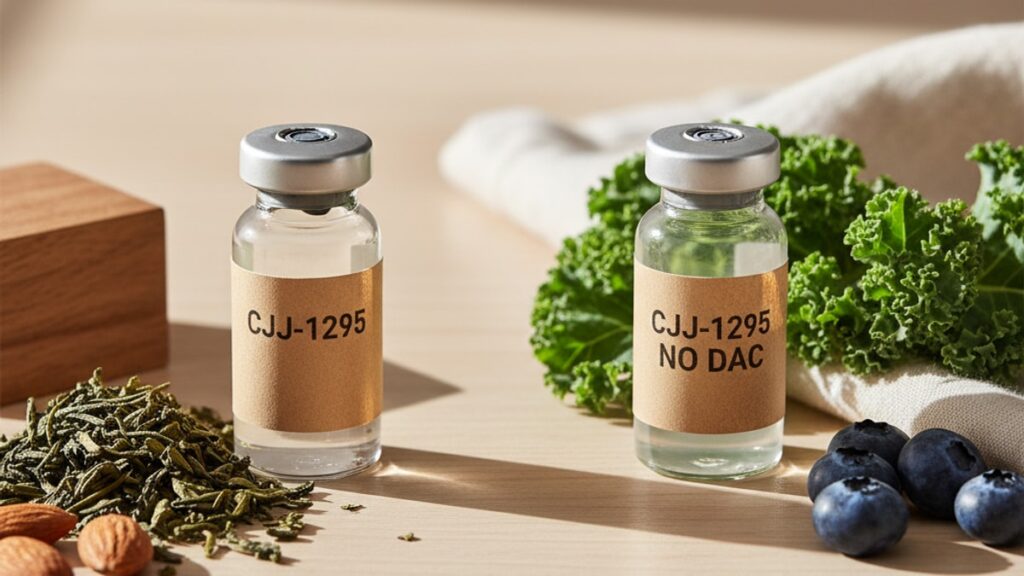
CJC-1295 vs CJC-1295 No DAC — Research Peptide Comparison
A 2006 study published in the Journal of Clinical Endocrinology & Metabolism found that adding Drug Affinity Complex (DAC) to Modified GRF 1-29 extended the peptide's half-life from approximately 30 minutes to 6–8 days. Fundamentally altering its pharmacokinetics and research applications. That single modification created two distinct peptides with identical amino acid cores but profoundly different release patterns, dosing protocols, and experimental use cases.
We've worked with research teams across academic and private institutions who initially assumed these peptides were interchangeable variants. They aren't. The CJC-1295 vs CJC-1295 no DAC comparison comes down to duration versus pulsatility. One sustains growth hormone (GH) elevation for days; the other mimics the body's natural secretory bursts over hours.
What's the difference between CJC-1295 with DAC and CJC-1295 no DAC?
CJC-1295 with DAC is a growth hormone-releasing hormone (GHRH) analogue that binds to serum albumin, extending its half-life to approximately 6–8 days and producing sustained GH elevation. CJC-1295 no DAC. Also called Modified GRF 1-29 or Mod GRF. Lacks the DAC component, resulting in a half-life of 30 minutes and pulsatile GH release that mirrors natural physiological patterns. The choice depends on whether the research protocol requires sustained baseline elevation or preservation of endogenous pulsatility.
The naming confusion stems from early research nomenclature. 'CJC-1295' originally referred to the DAC-conjugated version; 'CJC-1295 no DAC' was retrospectively applied to Modified GRF 1-29 after researchers began comparing the two. This article covers the pharmacokinetic mechanisms that differentiate them, the dosing protocols that reflect those differences, and the specific research contexts where one peptide type outperforms the other.
Pharmacokinetic Mechanisms: Half-Life and Albumin Binding
The DAC modification isn't a simple time-release coating. It's a covalent bond between the peptide and a lysine residue that allows the modified GHRH analogue to bind non-covalently to serum albumin. Albumin has a plasma half-life of approximately 19 days in humans, so any peptide bound to it remains in circulation far longer than an unbound peptide cleared by renal filtration. CJC-1295 with DAC achieves this binding efficiency at roughly 90%, meaning the vast majority of injected peptide stays complexed with albumin rather than circulating freely.
CJC-1295 no DAC (Modified GRF 1-29) lacks this albumin-binding mechanism entirely. Once injected subcutaneously, it enters systemic circulation within minutes and is cleared by the kidneys within 30–60 minutes. This short half-life is deliberate. Modified GRF 1-29 was designed to replicate the pulsatile GHRH release pattern that occurs naturally every 3–5 hours in healthy adults. The peptide binds to GHRH receptors on somatotroph cells in the anterior pituitary, triggering a transient GH pulse that peaks within 20–30 minutes and returns to baseline within 2–3 hours.
Our team has found that researchers who need sustained GH elevation over days. Such as long-term tissue regeneration studies. Consistently choose CJC-1295 with DAC. Those studying circadian GH rhythms, pulsatile hormone signaling, or protocols that combine GHRH with growth hormone-releasing peptides (GHRPs) typically require the short-acting Modified GRF variant.
Dosing Protocols and Administration Frequency
CJC-1295 with DAC is typically administered at 1–2 mg per injection, with dosing intervals ranging from once weekly to once every two weeks depending on the study design. Because the peptide remains active for 6–8 days, re-dosing before clearance creates cumulative plasma levels. A feature that can be beneficial for protocols requiring stable baseline GH elevation but problematic for studies examining pulsatile dynamics.
CJC-1295 no DAC requires more frequent administration. Typically 100–200 mcg per dose, administered 1–3 times daily. The short half-life means each injection produces one discrete GH pulse, allowing researchers to control the timing and frequency of secretory events. This is particularly valuable in protocols that pair Modified GRF 1-29 with GHRPs like ipamorelin or GHRP-2, which act through ghrelin receptors to amplify the magnitude of each GH pulse. CJC1295 Ipamorelin 5MG 5MG represents this dual-peptide approach.
Reconstitution is identical for both peptides: lyophilized powder is mixed with bacteriostatic water at a concentration appropriate for the intended dose volume. Storage requirements are also the same. Refrigerate at 2–8°C after reconstitution and use within 28 days to prevent peptide degradation.
Research Applications: When Each Peptide Type Is Preferred
CJC-1295 with DAC dominates research protocols where sustained GH elevation is the primary objective. Studies examining long-term anabolic effects, tissue repair timelines, or metabolic shifts that require days to weeks of continuous GH exposure. The extended half-life eliminates the need for multiple daily injections, which simplifies study logistics and reduces variables related to injection timing or subject compliance in animal models.
CJC-1295 no DAC is the standard choice for studies examining physiological pulsatility. Natural GH secretion occurs in discrete pulses every 3–5 hours, with the largest pulse occurring during slow-wave sleep. Protocols that preserve this pattern. Rather than imposing a non-physiological steady state. Allow researchers to study how pulsatile GH signaling influences downstream pathways differently than continuous exposure. Modified GRF 1-29 enables this because each injection mimics one endogenous pulse without suppressing the next natural secretory event.
Here's what we've learned across hundreds of research clients: if the study design includes repeated measurements of acute GH response, dynamic hormone assays, or circadian rhythm mapping, Modified GRF is non-negotiable. If the protocol measures cumulative outcomes over weeks. Body composition changes, IGF-1 trends, wound healing timelines. CJC-1295 with DAC offers consistency without the burden of tri-daily dosing.
CJC-1295 vs CJC-1295 No DAC: Full Comparison
| Feature | CJC-1295 with DAC | CJC-1295 No DAC (Mod GRF 1-29) | Professional Assessment |
|---|---|---|---|
| Half-life | 6–8 days (albumin-bound) | 30 minutes (rapid renal clearance) | DAC extends circulation; no DAC preserves natural clearance rate |
| Dosing frequency | Once weekly to biweekly | 1–3 times daily | Frequency reflects half-life. Sustained vs pulsatile exposure |
| GH release pattern | Sustained elevation over days | Discrete pulse per injection (peaks 20–30 min) | DAC creates non-physiological steady state; no DAC mimics endogenous pulses |
| Typical dose | 1–2 mg per injection | 100–200 mcg per injection | Dose scales inversely with frequency. Fewer injections require higher total peptide |
| Common research use | Long-term anabolic studies, tissue repair timelines | Pulsatile GH dynamics, GHRH+GHRP synergy studies | Use case drives selection. Duration vs rhythm |
| Compatibility with GHRPs | Limited (sustained GH may blunt GHRP amplification) | High (short half-life preserves pulse amplitude synergy) | Modified GRF amplifies GHRP-induced pulses; DAC version does not |
Key Takeaways
- CJC-1295 with DAC binds to serum albumin via the Drug Affinity Complex modification, extending its half-life to 6–8 days and producing sustained GH elevation without the need for daily dosing.
- CJC-1295 no DAC (Modified GRF 1-29) has a 30-minute half-life and replicates the body's natural pulsatile GH secretion pattern. One discrete pulse per injection.
- Dosing protocols reflect half-life differences: CJC-1295 with DAC is administered 1–2 mg weekly or biweekly; Modified GRF is dosed at 100–200 mcg 1–3 times daily.
- Research protocols requiring sustained GH exposure over days. Such as tissue regeneration or anabolic studies. Typically use CJC-1295 with DAC for logistical simplicity.
- Studies examining circadian GH rhythms, pulsatile hormone dynamics, or GHRH+GHRP synergy require the short-acting Modified GRF variant to preserve physiological release patterns.
- Modified GRF 1-29 pairs synergistically with growth hormone-releasing peptides like ipamorelin or GHRP-2 because its short half-life preserves the amplitude of each GHRP-amplified pulse.
What If: CJC-1295 Research Scenarios
What If a Protocol Requires Both Sustained Baseline GH and Preserved Pulsatility?
Use CJC-1295 with DAC at a low dose (0.5–1 mg weekly) to establish a modest baseline elevation, then layer Modified GRF 1-29 at standard pulse-timing intervals (100–200 mcg 1–3 times daily). This hybrid approach maintains circadian pulse architecture while preventing the deep GH troughs that occur between Modified GRF doses. The key is keeping the DAC dose low enough that it doesn't saturate GHRH receptors and blunt the Modified GRF response. Clinical data suggests this threshold is around 30–40% of typical standalone DAC dosing.
What If the Research Subject Has Impaired Renal Clearance?
CJC-1295 no DAC relies on renal filtration for clearance. Impaired kidney function extends its effective half-life unpredictably, turning a pulsatile peptide into a poorly controlled sustained-release variant. In animal models with chronic kidney disease or reduced glomerular filtration rates, CJC-1295 with DAC is the safer choice because albumin binding is independent of renal function. The peptide is eventually cleared through hepatic metabolism and proteolytic degradation rather than kidney filtration.
What If Modified GRF 1-29 Is Dosed Too Frequently?
Dosing Modified GRF more than 3–4 times daily risks receptor desensitization. GHRH receptors on pituitary somatotrophs downregulate in response to continuous stimulation. This is why natural GH secretion occurs in discrete pulses separated by 3–5 hour refractory periods. If a protocol requires more frequent dosing, consider reducing the dose per injection or switching to CJC-1295 with DAC, which was designed for sustained receptor occupancy without the pulsatile recovery intervals.
The Research-Focused Truth About CJC-1295 Variants
Here's the honest answer: calling both peptides 'CJC-1295' created decades of confusion in peptide research. They are not interchangeable formulations of the same compound. They are distinct molecules with opposite pharmacokinetic profiles. One was engineered to extend half-life and sustain GH elevation; the other was designed to preserve natural pulsatility and clear rapidly. Choosing the wrong variant doesn't just complicate data interpretation. It can invalidate an entire study if the protocol assumes pulsatile dynamics but the peptide delivers sustained exposure.
The CJC-1295 vs CJC-1295 no DAC comparison isn't about superiority. It's about matching peptide characteristics to research objectives. If your protocol measures acute GH response, dynamic hormone signaling, or circadian rhythms, Modified GRF 1-29 is non-negotiable. If you're tracking cumulative anabolic outcomes over weeks and need dosing simplicity, CJC-1295 with DAC is the logical choice. The worst outcome is using one when your study design requires the other.
Our commitment to precision extends across our entire research peptide catalog. Whether you're exploring growth hormone dynamics with CJC variants, investigating immune modulation with Thymalin, or examining metabolic pathways with compounds like Tesofensine, the standard is the same: exact amino acid sequencing, batch-verified purity, and transparent documentation.
The peptide you choose shapes every data point downstream. If the study hinges on preserving physiological pulsatility, a week-long half-life is a protocol failure. Not a convenience. If the research requires stable baseline GH over two weeks, tri-daily injections introduce unnecessary complexity. The CJC-1295 vs CJC-1295 no DAC decision isn't cosmetic. It defines whether your results reflect what you intended to measure.
Frequently Asked Questions
What is the primary difference between CJC-1295 with DAC and CJC-1295 no DAC?
▼
CJC-1295 with DAC contains a Drug Affinity Complex modification that binds the peptide to serum albumin, extending its half-life to 6–8 days and producing sustained growth hormone elevation. CJC-1295 no DAC (Modified GRF 1-29) lacks this modification, resulting in a 30-minute half-life and pulsatile GH release that mirrors natural physiological secretion patterns. The DAC modification fundamentally alters pharmacokinetics — it’s not a dosing variant but a structurally different peptide.
Can CJC-1295 with DAC and Modified GRF 1-29 be used together in the same research protocol?
▼
Yes, hybrid protocols can combine CJC-1295 with DAC at a low baseline dose (0.5–1 mg weekly) with Modified GRF 1-29 at standard pulsatile intervals (100–200 mcg 1–3 times daily). This approach maintains circadian GH pulse architecture while preventing deep troughs between Modified GRF doses. The key is keeping the DAC dose low enough to avoid saturating GHRH receptors, which would blunt the pulsatile response — clinical evidence suggests this threshold is around 30–40% of typical standalone DAC dosing.
How does dosing frequency differ between CJC-1295 with DAC and CJC-1295 no DAC?
▼
CJC-1295 with DAC is typically dosed at 1–2 mg per injection, administered once weekly to once every two weeks due to its extended half-life. CJC-1295 no DAC requires 100–200 mcg per dose, administered 1–3 times daily to maintain pulsatile GH release. The frequency difference reflects half-life: albumin-bound DAC peptides remain active for days, while Modified GRF is cleared within 30–60 minutes and must be re-dosed to produce additional GH pulses.
Which CJC-1295 variant should be used for studies examining circadian GH rhythms?
▼
CJC-1295 no DAC (Modified GRF 1-29) is required for any protocol examining circadian GH rhythms or pulsatile hormone dynamics. Its 30-minute half-life allows researchers to control the timing of discrete GH pulses without suppressing endogenous secretory events. CJC-1295 with DAC produces sustained non-physiological GH elevation that obscures natural circadian patterns, making it unsuitable for rhythm-based studies despite its dosing convenience.
Does CJC-1295 with DAC suppress natural GH production?
▼
Sustained GHRH receptor stimulation from CJC-1295 with DAC can lead to receptor downregulation over time, which may reduce the amplitude of endogenous GH pulses. This is a known consequence of non-pulsatile GHRH exposure — natural GH secretion relies on discrete pulses separated by refractory periods. Modified GRF 1-29 preserves these intervals by clearing rapidly, allowing endogenous secretory machinery to recover between doses. Long-term DAC protocols should account for potential feedback suppression in study design.
How should CJC-1295 peptides be stored after reconstitution?
▼
Both CJC-1295 with DAC and CJC-1295 no DAC must be refrigerated at 2–8°C after reconstitution with bacteriostatic water and used within 28 days to prevent peptide degradation. Lyophilized (unreconstituted) powder should be stored at −20°C or colder. Temperature excursions above 8°C cause irreversible structural changes that neither visual inspection nor home potency testing can detect — strict cold chain management is essential for research-grade peptides.
Why is CJC-1295 no DAC often paired with GHRPs like ipamorelin or GHRP-2?
▼
Modified GRF 1-29 synergizes with growth hormone-releasing peptides (GHRPs) because both act through complementary pathways — GHRH receptors and ghrelin receptors — to amplify GH pulse magnitude. The short half-life of Modified GRF preserves this synergy by allowing each GHRP-amplified pulse to occur without interference from sustained baseline GHRH stimulation. CJC-1295 with DAC provides continuous receptor occupancy that may blunt GHRP responsiveness over time.
What happens if Modified GRF 1-29 is dosed more than three times daily?
▼
Dosing Modified GRF more than 3–4 times daily risks GHRH receptor desensitization — pituitary somatotrophs downregulate receptors in response to continuous stimulation. Natural GH secretion includes 3–5 hour refractory periods between pulses to allow receptor resensitization. Protocols requiring higher dosing frequency should consider reducing dose per injection or switching to CJC-1295 with DAC, which was designed for sustained receptor occupancy without pulsatile recovery intervals.
Is there a difference in peptide purity or synthesis quality between CJC-1295 with DAC and Modified GRF 1-29?
▼
Synthesis complexity is slightly higher for CJC-1295 with DAC due to the DAC conjugation step, but both peptides are produced through solid-phase peptide synthesis (SPPS) with the same amino acid sequencing precision. Purity is a function of synthesis quality control and post-synthesis purification (typically HPLC), not the peptide variant itself. Research-grade peptides from reputable suppliers should achieve ≥98% purity regardless of whether DAC is present — lower purity is a supplier issue, not a peptide characteristic.
Can CJC-1295 peptides be used in research protocols involving metabolic or body composition studies?
▼
Yes, both CJC-1295 variants are widely used in metabolic research. CJC-1295 with DAC is preferred for long-term body composition studies because sustained GH elevation over weeks allows cumulative anabolic and lipolytic effects to manifest. Modified GRF 1-29 is used in studies examining acute metabolic responses to pulsatile GH or protocols that combine GHRH with GHRPs to amplify pulse magnitude. The choice depends on whether the study design requires sustained exposure or preserved pulsatility.
