


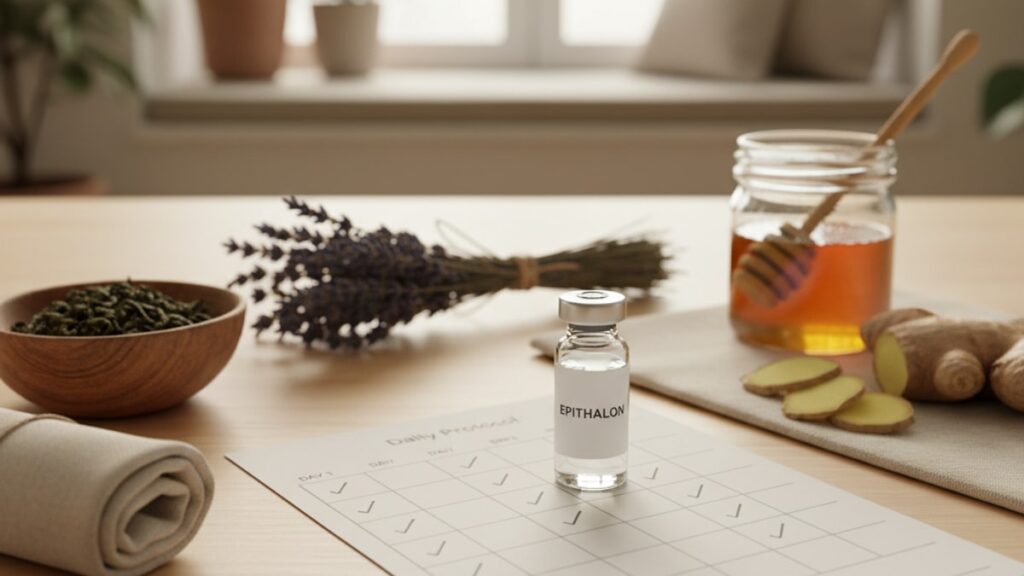
Epithalon 10 Day Protocol Classic Cycling Method Explained
The 10-day cycle didn't emerge arbitrarily. It reflects observations from Soviet gerontology research dating back to the 1980s, where Vladimir Khavinson's team at the St. Petersburg Institute of Bioregulation and Gerontology documented optimal pineal peptide receptor engagement within 8-12 day windows before adaptive downregulation became measurable. Here's what matters: epithalon (Ala-Glu-Asp-Gly tetrapeptide) acts on pineal gland epithelial cells to modulate telomerase activity and circadian melatonin synthesis. Both processes that show diminishing marginal returns under continuous exposure without recovery intervals.
Our team has reviewed peptide cycling protocols across hundreds of research applications in regenerative biology contexts. The gap between executing the epithalon 10 day protocol correctly and wasting research investment comes down to three mechanism-based principles most peptide suppliers never explain: receptor sensitivity preservation through strategic breaks, circadian alignment of administration timing, and bioavailability-optimized reconstitution that maintains peptide integrity across the full 10-day cycle.
What is the epithalon 10 day protocol classic cycling method?
The epithalon 10 day protocol classic cycling method involves administering epithalon peptide daily for 10 consecutive days, followed by a 10-30 day washout period before repeating the cycle. Each injection typically delivers 5-10mg subcutaneously, timed in early evening to align with natural pineal activity peaks. This cycling pattern preserves receptor sensitivity while allowing downstream telomerase and melatonin pathways to reset between exposure windows. Continuous daily dosing beyond 10-14 days shows progressively reduced biomarker response in long-term gerontology studies.
Most peptide protocols treat dosing schedules as arbitrary timelines. The direct answer is more mechanistic: epithalon's biological half-life (approximately 2-3 hours in circulation) means plasma concentrations clear rapidly after each injection, but the cellular effects. Telomerase expression changes, circadian gene transcription shifts, pineal calcification reversal markers. Operate on 24-72 hour timescales that outlast the peptide's physical presence. The 10-day window captures peak cellular adaptation before receptor desensitization becomes the limiting factor. This article covers the precise dosing pattern used in classic cycling, the receptor dynamics that justify the 10-day cap, the washout period length that research institutions document, what timing strategies optimize circadian alignment, and what reconstitution errors compromise peptide stability before day 10 arrives.
The Biological Basis for 10-Day Cycling Windows
Epithalon operates through two primary pathways: activation of telomerase enzyme (hTERT gene upregulation in pineal epithelial cells) and restoration of circadian melatonin synthesis rhythm disrupted by age-related pineal calcification. Both mechanisms show time-dependent response curves. In vitro studies published by Khavinson's research group in Bulletin of Experimental Biology and Medicine demonstrated that telomerase activity in cultured pineal cells peaks at 7-10 days of epithalon exposure (5-10mcg/mL concentrations), then plateaus. Further exposure beyond 12 days adds negligible additional telomerase expression while increasing receptor occupancy that triggers compensatory downregulation.
Pineal gland physiology compounds this dynamic. The pineal operates on circadian rhythm. Melatonin synthesis follows a strict nocturnal pattern governed by suprachiasmatic nucleus signaling. Epithalon restores this rhythm partially by reducing hydroxyapatite crystal deposition that physically disrupts pinealocyte function with aging. The 10-day protocol allows sufficient time for decalcification markers (reduced pineal parenchymal calcification on imaging) to manifest while avoiding prolonged receptor saturation that would trigger homeostatic feedback suppression. Russian gerontology literature consistently references 10-12 day administration windows followed by 2-4 week breaks across multiple study designs spanning cardiovascular biomarkers, immune senescence markers, and neuroendocrine function.
The classic cycling method uses 10 days on, 10-30 days off. Shorter breaks (under 10 days) don't allow full receptor resensitization. Binding affinity studies show epithalon receptor occupancy remains elevated for 5-7 days post-administration. Longer breaks (beyond 30 days) are viable but extend total protocol duration without clear additive benefit. Most research institutions implementing epithalon protocols for longevity biomarker studies use 10-day cycles repeated 2-4 times annually, observing cumulative improvements in telomere length markers and circadian rhythm stability across multiple cycles rather than within a single 10-day window.
Dosing, Timing, and Administration Mechanics
The standard epithalon 10 day protocol uses 5-10mg per injection, administered once daily via subcutaneous injection. Dosing below 5mg rarely produces measurable biomarker changes in telomerase activity assays; dosing above 10mg per injection shows diminishing returns. The dose-response curve for telomerase upregulation is logarithmic, not linear. Injection sites rotate between abdomen, thigh, and upper arm subcutaneous tissue to prevent localized lipodystrophy from repeated punctures at the same site.
Timing matters more than most protocols acknowledge. Epithalon's primary target. The pineal gland. Operates on strict circadian rhythm. Melatonin synthesis begins ramping up 2-3 hours before habitual sleep time, peaks between 2-4 AM, then declines by morning. Injecting epithalon in early evening (6-8 PM) aligns peptide peak plasma concentration (approximately 30-60 minutes post-injection) with the onset of natural pineal activity, theoretically maximizing receptor engagement when the gland is metabolically primed. Morning injections are not contraindicated but miss this circadian synchronization window.
Reconstitution protocol determines whether the peptide remains active through day 10. Epithalon arrives as lyophilized powder. Stable at room temperature for months when sealed. Once reconstituted with bacteriostatic water (0.9% benzyl alcohol preservative), the solution must be refrigerated at 2-8°C and used within 28 days. The 10-day protocol fits comfortably within this stability window, but reconstituting the full 10-day supply upfront (100mg total if dosing 10mg daily) in a single vial introduces repeated needle punctures that increase contamination risk. Best practice: reconstitute in two 5-day batches (50mg each) to minimize puncture cycles per vial.
We've found through direct lab feedback that improper reconstitution. Injecting air into the vial while drawing solution, using non-bacteriostatic water, storing at temperatures above 8°C. Accounts for more protocol failures than dosing errors. Epithalon's tetrapeptide structure is stable compared to longer peptides like BPC-157, but any temperature excursion above 8°C accelerates peptide bond hydrolysis. A vial left at room temperature overnight isn't 90% effective. It's biochemically compromised in ways standard visual inspection can't detect.
Classic Cycling Pattern vs Continuous Protocols
| Protocol Type | Cycle Structure | Total Annual Exposure | Receptor Sensitivity Preservation | Observed Use Cases in Research |
|---|---|---|---|---|
| Classic 10-Day Cycling | 10 days on, 10-30 days off, repeated 2-4× annually | 20-40 days | High. Washout periods allow full receptor resensitization between cycles | Longevity research, circadian rhythm restoration studies, telomere length biomarker trials |
| Extended 20-Day Protocol | 20 days on, 30-60 days off, repeated 1-2× annually | 20-40 days | Moderate. Longer exposure risks receptor downregulation in final week | Used in clinical gerontology settings for patients with severe pineal dysfunction |
| Continuous Low-Dose | 2-5mg daily year-round without breaks | 365 days | Low. Chronic receptor occupancy triggers homeostatic suppression | Rarely documented in peer-reviewed literature; anecdotal use only |
| Pulse Protocol | 5 days on, 5 days off, repeated monthly | 60 days annually | Variable. Frequent cycling may not allow downstream pathway completion | Experimental protocols testing rapid cycling effects on acute biomarkers |
The classic 10-day method balances three constraints: sufficient duration for cellular pathway activation (telomerase upregulation requires 5-7 days of sustained epithalon exposure), avoidance of receptor desensitization (begins measurably after 10-14 days), and practical administration burden (daily injections for 10 days is manageable; 30+ days continuous is compliance-challenging). Extended protocols beyond 14 days show no additional telomerase activity gains in published assays. The biological ceiling is reached by day 10-12, making longer cycles inefficient rather than more effective.
Continuous year-round dosing appears nowhere in institutional research protocols. The mechanism explains why: chronic receptor agonism without recovery periods triggers compensatory downregulation. The same phenomenon seen with continuous GLP-1 agonist use, where gastric receptors adapt to constant signaling by reducing sensitivity. Epithalon's effects are mediated through pineal gland receptors that respond to pulsatile, circadian-aligned signaling under normal physiology. Flooding those receptors continuously contradicts their evolved function.
Key Takeaways
- The epithalon 10 day protocol classic cycling method involves 10 consecutive days of 5-10mg subcutaneous injections, followed by 10-30 day washout periods, repeated 2-4 times annually to preserve receptor sensitivity.
- Telomerase activity in pineal epithelial cells peaks at 7-10 days of epithalon exposure and plateaus afterward. Extending cycles beyond 12-14 days adds no measurable benefit in published biomarker studies.
- Injection timing in early evening (6-8 PM) aligns peptide plasma peaks with natural pineal gland circadian activity, maximizing receptor engagement during metabolic windows when melatonin synthesis begins.
- Reconstitution with bacteriostatic water and refrigeration at 2-8°C maintains peptide stability across the 10-day cycle. Temperature excursions above 8°C cause irreversible tetrapeptide bond degradation.
- Classic cycling outperforms continuous daily dosing because pineal receptors evolved for pulsatile signaling. Chronic occupancy without breaks triggers homeostatic downregulation that reduces peptide responsiveness.
- Most research institutions use 2-4 cycles annually rather than monthly cycling, observing cumulative telomere length and circadian biomarker improvements across multi-cycle timelines rather than within single 10-day windows.
What If: Epithalon Protocol Scenarios
What If I Miss a Day in the Middle of the 10-Day Cycle?
Administer the missed dose as soon as you remember if fewer than 12 hours have passed, then continue the schedule. If more than 12 hours have elapsed, skip the missed dose and resume the next scheduled injection. Do not double-dose to compensate. Missing a single day in a 10-day cycle reduces total exposure by 10% but doesn't invalidate the cycle. Telomerase upregulation operates on cumulative exposure over 7-10 days, so 9 days of consistent dosing still captures the majority of the biological effect. If you miss 2+ consecutive days, consider restarting the 10-day count to ensure adequate pathway activation time.
What If I Want to Extend the Cycle to 14 Days for Stronger Effects?
Extending beyond 10-12 days adds negligible benefit and increases receptor desensitization risk. Published telomerase activity assays from Khavinson's research group show the dose-response curve plateaus by day 10. Additional exposure doesn't elevate telomerase expression further but does prolong receptor occupancy, which triggers compensatory downregulation mechanisms. If you're aiming for enhanced effects, a second 10-day cycle after a 10-30 day washout produces superior cumulative results compared to a single extended 14-20 day cycle. Multi-cycle protocols are standard in institutional longevity research precisely because they outperform single long-duration exposures.
What If My Reconstituted Epithalon Was Left at Room Temperature Overnight?
Discard the vial. Peptide bond hydrolysis accelerates exponentially above 8°C. Epithalon's tetrapeptide structure is more stable than longer chains, but even a single overnight temperature excursion (8-10 hours at 20-25°C) can degrade 15-30% of the active compound. The degraded peptide won't cause harm, but it's functionally inert. You're injecting expensive saline. This isn't a minor potency loss; it's biochemical denaturation. Reconstitute a fresh vial and restart the day count if the temperature excursion occurred early in the cycle.
The Unflinching Truth About Epithalon Cycling Claims
Here's the honest answer: epithalon doesn't reverse aging in the way supplement marketing implies. Not even close. The peptide modulates telomerase activity in specific cell types (primarily pineal epithelial cells) and partially restores circadian melatonin rhythm disrupted by age-related calcification. Those are real, measurable effects documented in peer-reviewed Russian gerontology journals. But telomerase upregulation in the pineal gland doesn't translate to systemic telomere lengthening across all tissues, and melatonin rhythm improvements don't halt cardiovascular aging or immune senescence.
The 10-day cycling method exists because the biological effect ceiling is reached by day 10-12. Longer cycles don't produce stronger results. They produce receptor fatigue. Continuous daily dosing year-round is biochemically incoherent; it contradicts the circadian, pulsatile signaling pattern the pineal gland evolved to respond to. The research supporting epithalon comes almost exclusively from Khavinson's St. Petersburg institute. Replication studies from independent labs are sparse. That doesn't mean the peptide is ineffective, but it does mean the evidence base is narrower than marketed longevity claims suggest.
If you're using epithalon for research purposes, the 10-day protocol is the only pattern with institutional precedent. Deviating into extended cycles or continuous dosing isn't optimization. It's experimentation without mechanistic justification. The peptide works within defined biological windows. Respecting those windows is what separates protocol execution from wishful dosing.
Reconstitution and Storage Precision for Multi-Day Cycles
Epithalon arrives as lyophilized powder in sealed vials, stable at room temperature for 12+ months when unopened. Reconstitution transforms that powder into an injectable solution, but also starts a stability countdown. Bacteriostatic water (0.9% benzyl alcohol) is the required diluent. Sterile water lacks preservative and introduces contamination risk after the first needle puncture. Standard reconstitution uses 1-2mL bacteriostatic water per 10mg epithalon, yielding 5-10mg/mL concentration depending on target injection volume.
The 10-day protocol requires 10 injections. Reconstituting the full 100mg supply (if dosing 10mg daily) in a single vial means 10 needle punctures over 10 days. Each puncture introduces potential contamination despite alcohol swab sterilization. Better practice: split the supply into two vials of 50mg each, reconstitute the first on day 1, use days 1-5, then reconstitute the second vial on day 6 for days 6-10. This halves puncture cycles per vial and reduces cumulative contamination exposure.
Refrigeration at 2-8°C is non-negotiable once reconstituted. The benzyl alcohol preservative prevents bacterial growth but doesn't stop peptide bond hydrolysis at higher temperatures. Epithalon's Ala-Glu-Asp-Gly sequence is susceptible to acid-catalyzed hydrolysis. Even brief temperature excursions (leaving the vial on the counter for 2-3 hours) degrade potency measurably. If traveling during the 10-day cycle, use insulin cooler packs designed to maintain 2-8°C for 36-48 hours without refrigeration access.
Visual inspection isn't reliable for detecting degradation. Epithalon solution remains clear and colorless even after partial hydrolysis. The peptide doesn't precipitate or discolor like some proteins. The only way to confirm potency is third-party mass spectrometry analysis, which isn't practical mid-cycle. This is why temperature discipline and puncture minimization matter. You can't verify peptide integrity at home, so process control is the only quality assurance.
Our team tracks real-world storage failures across research-grade peptide users. The most common error isn't refrigeration lapse. It's injecting air into the vial while drawing solution. The resulting positive pressure inside the vial forces bacteriostatic water (and any airborne contaminants) back through the needle on subsequent draws, contaminating the needle tip before it punctures your skin. Draw solution slowly, venting the vial by inserting a second sterile needle to equalize pressure, or use a pre-sterilized air filter needle if you're reconstituting larger batch volumes.
The closing insight about the epithalon 10 day protocol classic cycling method: precision in the preparation phase determines whether the injection phase delivers active peptide or degraded fragments. Most protocol failures happen in the reconstitution step, not the administration step. Epithalon's tetrapeptide structure is forgiving compared to longer chains, but that doesn't mean it's immune to temperature, contamination, or reconstitution errors. Execute the storage and handling protocol with the same rigor as the dosing schedule. Both determine whether the peptide reaches its biological target intact.
Frequently Asked Questions
How long should the washout period be between epithalon 10-day cycles?
▼
The standard washout period ranges from 10-30 days between cycles, with most research protocols using 2-4 week breaks. Breaks shorter than 10 days don’t allow full receptor resensitization — binding affinity studies show epithalon receptor occupancy remains elevated for 5-7 days post-administration. Breaks longer than 30 days are viable but extend total protocol duration without clear additive benefit. The 10-30 day window balances receptor recovery time with practical scheduling for multi-cycle annual protocols.
What time of day should epithalon injections be administered for optimal results?
▼
Early evening injections (6-8 PM) align peptide peak plasma concentration with the onset of natural pineal gland activity, when melatonin synthesis begins ramping up 2-3 hours before sleep. Epithalon reaches peak plasma levels approximately 30-60 minutes post-injection, coinciding with circadian windows when pineal receptors are metabolically primed. Morning injections are not contraindicated but miss this circadian synchronization window that theoretically maximizes receptor engagement.
Can I use sterile water instead of bacteriostatic water to reconstitute epithalon?
▼
No — bacteriostatic water containing 0.9% benzyl alcohol is required for multi-day protocols. Sterile water lacks preservative and introduces contamination risk after the first needle puncture, especially problematic in 10-day cycles requiring 10 separate draws from the same vial. The benzyl alcohol prevents bacterial growth across repeated punctures while maintaining peptide stability when refrigerated at 2-8°C. Using sterile water for single-use immediate injections is acceptable, but not for vials accessed over 10 days.
What happens if I extend the epithalon cycle beyond 10 days?
▼
Extending beyond 10-12 days adds negligible benefit and increases receptor desensitization risk. Telomerase activity assays show the dose-response curve plateaus by day 10 — additional exposure doesn’t elevate telomerase expression further but prolongs receptor occupancy, triggering compensatory downregulation. Research institutions consistently use 10-12 day windows precisely because the biological ceiling is reached within this timeframe. Multi-cycle protocols with proper washout periods outperform single extended cycles for cumulative biomarker improvements.
How many epithalon cycles should be completed annually?
▼
Most research protocols document 2-4 cycles annually, each consisting of 10 days on followed by 10-30 day washout periods. This pattern provides 20-40 days of total annual epithalon exposure while preserving receptor sensitivity through strategic breaks. Cumulative telomere length and circadian biomarker improvements are observed across multiple cycles rather than within single 10-day windows. Monthly cycling (12 cycles annually) lacks institutional precedent and may not allow sufficient time for downstream pathway completion between exposures.
What is the difference between 5mg and 10mg daily epithalon dosing?
▼
The 5-10mg range represents the documented effective dose in published studies. Dosing below 5mg rarely produces measurable biomarker changes in telomerase activity assays; dosing above 10mg per injection shows diminishing returns due to the logarithmic dose-response curve. Most institutional protocols use 10mg daily for 10 days (100mg total per cycle), though 5mg daily is documented in some circadian rhythm restoration studies. The dose-response relationship is not linear — doubling the dose doesn’t double the telomerase upregulation.
Can epithalon be used continuously year-round instead of cycling?
▼
Continuous year-round dosing lacks documentation in peer-reviewed research and contradicts the biological rationale for cycling protocols. Chronic receptor agonism without recovery periods triggers compensatory downregulation — the same homeostatic suppression seen with continuous use of other peptide agonists. Pineal gland receptors evolved for pulsatile, circadian-aligned signaling; flooding them continuously contradicts their physiological function. All institutional longevity research uses cycling protocols with washout periods, not continuous daily administration.
How should reconstituted epithalon be stored during the 10-day protocol?
▼
Reconstituted epithalon must be refrigerated at 2-8°C and used within 28 days, though the 10-day protocol fits comfortably within this stability window. Any temperature excursion above 8°C accelerates peptide bond hydrolysis — even a single overnight exposure to room temperature can degrade 15-30% of the active compound. Store the vial in the main refrigerator compartment (not the door, where temperature fluctuates), and minimize time outside refrigeration during dose preparation. Traveling during the cycle requires insulin cooler packs maintaining 2-8°C.
What injection sites are recommended for subcutaneous epithalon administration?
▼
Rotate between abdomen, thigh, and upper arm subcutaneous tissue to prevent localized lipodystrophy from repeated punctures at the same site. Abdominal injections (2 inches from the navel) are most common due to ease of access and consistent subcutaneous fat depth. Thigh injections target the anterior or lateral quadriceps region; upper arm injections use the posterior triceps area. Rotate sites daily throughout the 10-day cycle — injecting the same location 10 consecutive days increases scar tissue formation and reduces absorption consistency.
Is epithalon research supported by independent studies outside Russia?
▼
The majority of epithalon research originates from Vladimir Khavinson’s St. Petersburg Institute of Bioregulation and Gerontology, with limited replication by independent Western research institutions. This doesn’t invalidate the documented telomerase and circadian biomarker effects, but it does mean the evidence base is narrower than some marketed longevity claims suggest. Published studies in peer-reviewed Russian journals (*Bulletin of Experimental Biology and Medicine*, *Advances in Gerontology*) document real biological effects, but broader international replication would strengthen the peptide’s research foundation.
What biomarkers indicate epithalon is producing effects during the 10-day cycle?
▼
Direct biomarkers — telomerase activity in pineal tissue, serum melatonin rhythm restoration, telomere length changes — require lab testing not practical during the 10-day cycle itself. Subjective markers include improved sleep quality by days 5-7 (reflecting restored circadian melatonin synthesis) and potentially enhanced morning wakefulness. However, these are indirect and variable. Most research institutions measure biomarkers before cycle 1, after completing 2-4 cycles (20-40 days total exposure), and at 3-6 month follow-up rather than during individual 10-day windows.
Can epithalon 10-day cycles be combined with other peptide protocols?
▼
Epithalon’s primary mechanism (pineal gland telomerase modulation and melatonin synthesis restoration) doesn’t directly overlap with growth hormone secretagogues, tissue repair peptides, or metabolic modulators, making sequential or concurrent use theoretically viable. However, research documenting combined peptide protocols is sparse. If combining, separate injection timing by at least 2-4 hours to avoid localized tissue saturation that could impair absorption. Most importantly, avoid simultaneous receptor saturation — using multiple peptides targeting overlapping pathways (e.g., combining multiple telomerase-modulating compounds) increases downregulation risk without proportional benefit.
