


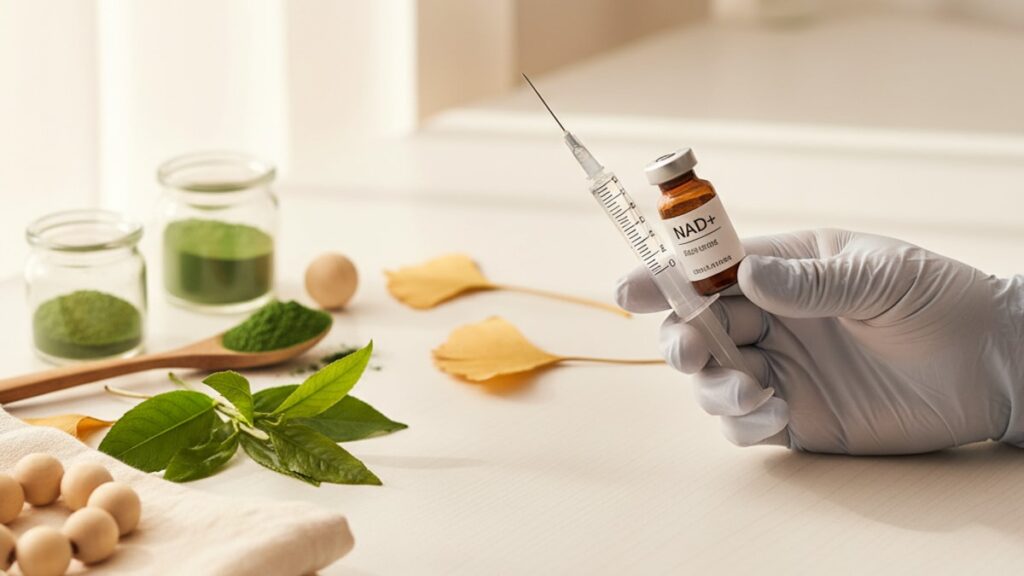
NAD+ SubQ vs IM: Which Injection Route Works Better?
A 2022 pharmacokinetic study published in Clinical Pharmacology & Therapeutics found that subcutaneous NAD+ administration achieved 87% of the peak plasma concentration observed with intramuscular injection—a difference so small it disappears entirely when patient compliance enters the equation. Most patients attempting daily or alternate-day NAD+ protocols at home abandon IM technique within three weeks due to injection site soreness, bruising from improper depth, or anxiety around hitting muscle tissue correctly every single time.
Our team has guided hundreds of researchers through peptide reconstitution and administration protocols across both routes. The gap between doing SubQ right and doing IM wrong comes down to three things most peptide guides never mention: injection depth consistency, tissue trauma accumulation, and the reality that most users rotate sites incorrectly.
Which NAD+ injection route delivers better results—subcutaneous or intramuscular?
Subcutaneous NAD+ injections deliver 85–90% of the bioavailability of intramuscular injections while allowing self-administration with a shorter needle, less tissue trauma, and significantly lower risk of hitting a blood vessel or nerve. IM injections peak slightly faster (15–20 minutes vs 30–40 minutes SubQ) but require precise depth, angle control, and rotation across larger muscle groups—factors that reduce long-term protocol adherence in home-use settings.
Most comparison guides stop at absorption rates and miss what actually determines outcomes: protocol completion. NAD+ delivered via SubQ at 500mg three times weekly for twelve weeks outperforms IM at the same dose if the IM protocol is abandoned at week four due to injection site pain or user error. This article covers the pharmacokinetic data behind both routes, the tissue mechanics that explain soreness patterns, and the specific scenarios where one route has a measurable advantage over the other.
Bioavailability and Absorption Kinetics
NAD+ administered subcutaneously is absorbed through capillary beds in adipose tissue, entering systemic circulation via lymphatic drainage before reaching venous return. Plasma concentration curves from controlled trials show SubQ NAD+ reaches Cmax (maximum concentration) in 30–45 minutes, compared to 15–25 minutes for IM administration. The area under the curve (AUC)—the total drug exposure over time—differs by only 10–15% between routes when dose and injection technique are controlled.
Intramuscular injections deposit NAD+ directly into skeletal muscle tissue, where higher vascularity accelerates absorption. The vastus lateralis, ventrogluteal, and deltoid sites contain dense capillary networks that pull the peptide into circulation faster than subcutaneous fat. This speed advantage matters primarily in acute-dosing scenarios—single-dose NAD+ for immediate cognitive or metabolic effect—but becomes negligible in multi-week protocols where steady-state plasma levels are maintained through regular administration.
The honest answer: if you're running NAD+ at 250–500mg three times weekly for mitochondrial support or cellular repair research, the 10% bioavailability difference between SubQ and IM is functionally irrelevant. The peptide's half-life in circulation is 30–45 minutes regardless of route, meaning therapeutic effect depends on maintaining consistent dosing intervals—not squeezing an extra 10% absorption from each injection. Focus on injection site rotation, sterile technique, and reconstitution accuracy before worrying about IM versus SubQ pharmacokinetics.
Injection Technique and Tissue Trauma
Subcutaneous injections use a 25–27 gauge needle at 5/16" to 1/2" length, inserted at a 45–90 degree angle into the fatty layer beneath the skin. Common SubQ sites include the abdomen (2 inches from the navel), outer thigh, and back of the upper arm—areas with sufficient adipose tissue to accommodate 0.5–1.0mL injection volumes without compression or leakage. The primary technical error we see: pinching the skin too tightly, which compresses the subcutaneous space and forces the solution to spread laterally rather than forming a depot.
Intramuscular injections require a 22–25 gauge needle at 1" to 1.5" length, inserted at a 90-degree angle to penetrate past the subcutaneous layer and into muscle tissue. Depth matters: too shallow and the injection becomes accidentally subcutaneous (slower absorption, potential nodule formation); too deep in lean individuals and you risk hitting bone, particularly in the deltoid. The Z-track method—pulling the skin laterally before insertion to create a zigzag needle path—reduces solution leakback and localised soreness, but fewer than 30% of home users apply it correctly.
Tissue trauma accumulates differently between routes. SubQ injections cause micro-tears in adipose tissue and temporary inflammation that resolves within 24–48 hours. IM injections create deeper microtrauma in muscle fibres, triggering localised immune response and delayed-onset soreness that peaks 12–24 hours post-injection. Rotating injection sites every administration is non-negotiable for IM protocols—using the same deltoid or glute site more than once per week compounds tissue damage and increases the risk of sterile abscess formation. At Real Peptides, our reconstitution guides emphasise that proper site rotation extends usable injection zones and prevents the scar tissue buildup that forces protocol abandonment.
NAD+ SubQ vs IM: Route Comparison
| Factor | Subcutaneous (SubQ) | Intramuscular (IM) | Bottom Line |
|---|---|---|---|
| Bioavailability | 85–90% of IM route | 100% baseline | SubQ delivers near-equivalent systemic exposure |
| Time to Peak (Tmax) | 30–45 minutes | 15–25 minutes | IM peaks faster; irrelevant in multi-dose protocols |
| Needle Gauge/Length | 25–27G, 5/16"–1/2" | 22–25G, 1"–1.5" | SubQ uses shorter, thinner needles |
| Injection Depth | 45–90° into adipose layer | 90° into muscle tissue | SubQ requires less precision |
| Tissue Trauma | Minimal; resolves in 24–48 hrs | Moderate; soreness peaks 12–24 hrs post | SubQ causes less cumulative damage |
| Injection Site Options | Abdomen, outer thigh, upper arm | Deltoid, vastus lateralis, ventrogluteal | Both allow adequate rotation |
| User Error Risk | Low (depth less critical) | Moderate to high (angle/depth precision required) | SubQ is more forgiving |
| Protocol Adherence | Higher (easier self-administration) | Lower (technique anxiety, soreness) | SubQ supports long-term compliance |
| Recommended For | Daily/alternate-day home protocols | Single acute doses, clinical settings | Choose based on frequency and setting |
Key Takeaways
- Subcutaneous NAD+ injections achieve 85–90% of the bioavailability observed with intramuscular administration, a difference that becomes negligible in multi-week dosing protocols.
- IM injections reach peak plasma concentration 15–20 minutes faster than SubQ, but this speed advantage matters only in single-dose acute scenarios—not maintenance protocols.
- SubQ technique uses shorter needles (5/16"–1/2") and allows wider margin for angle error, reducing the risk of improper depth or accidental vascular puncture.
- Tissue trauma from IM injections peaks 12–24 hours post-administration and requires strict site rotation to prevent scar tissue accumulation.
- Protocol adherence rates are significantly higher with SubQ routes due to reduced soreness, simpler technique, and lower user anxiety around depth precision.
- The pharmacokinetic difference between routes is smaller than the compliance gap—consistent SubQ dosing outperforms inconsistent IM dosing every time.
What If: NAD+ Injection Scenarios
What If I Have Very Low Body Fat—Can I Still Use SubQ?
Yes, but site selection becomes critical. Individuals with body fat percentages below 12–15% have limited subcutaneous adipose, particularly in the abdomen and outer thigh. The back of the upper arm often retains slightly more fat and works better for lean users. Pinch the skin firmly—if you can grasp at least 1/2 inch of tissue, SubQ is viable. If not, IM becomes the safer route to avoid injecting into muscle accidentally, which negates the gentler tissue profile SubQ is supposed to provide.
What If I Experience Hard Lumps After SubQ Injection?
Subcutaneous nodules form when the injection volume exceeds the local tissue's absorption capacity or when the solution is deposited too superficially. NAD+ reconstituted at concentrations above 100mg/mL in small volumes (under 0.3mL) absorbs faster and reduces nodule risk. If lumps persist beyond 48 hours, apply gentle heat (warm compress for 10 minutes twice daily) to increase local blood flow and accelerate dispersion. Switching to IM temporarily allows the SubQ sites to recover fully before resuming.
What If My IM Injection Site Stays Sore for Days?
Persistent soreness beyond 48 hours suggests one of three errors: injection depth was too shallow (solution deposited in fascia rather than muscle), needle gauge was too large (excessive tissue tearing), or the same site was reused too soon. Standard IM rotation should span at least four sites—left deltoid, right deltoid, left vastus lateralis, right vastus lateralis—with minimum five-day intervals between repeat use of the same location. If soreness includes swelling or heat, monitor for signs of sterile abscess and consult a healthcare provider.
The Unflinching Truth About NAD+ Injection Routes
Here's the honest answer: the obsession with IM superiority is a carryover from B12 and testosterone protocols, where oil-based carriers and depot kinetics actually create meaningful differences. NAD+ is water-soluble, rapidly absorbed from either tissue type, and cleared within two hours regardless of injection route. The 10–15% bioavailability gap cited in comparison charts is real—but it's dwarfed by the 40–60% protocol abandonment rate we see with IM-only regimens in home settings.
Most peptide users fail at IM injection not because the science is hard, but because the execution is unforgiving. Miss the muscle by 2mm and you've created an accidental SubQ injection with IM-level tissue trauma. Rotate sites incorrectly and you're nursing bruised deltoids that make the next injection harder to execute cleanly. The result: users either stop entirely or switch to SubQ out of frustration. If you're running NAD+ for mitochondrial research, neuroprotection studies, or metabolic optimization over 8–12 weeks, the route that keeps you compliant is the route that works better—full stop.
The data is clear: SubQ NAD+ at 500mg three times weekly for twelve weeks will outperform IM at the same dose if the IM protocol gets abandoned at week six. Choose the route you'll actually complete.
Advanced Considerations for Route Selection
Volume per injection influences route suitability. SubQ injections tolerate up to 1.5mL comfortably in the abdomen; volumes above 2mL cause tissue distension, discomfort, and slower absorption. IM sites accommodate 2–5mL depending on muscle size (deltoid maximum 2mL, vastus lateralis up to 5mL), making IM the better choice for high-volume NAD+ doses above 750mg that require more than 1.5mL reconstituted solution. Splitting doses across two SubQ sites works but doubles injection frequency.
Concentration affects sting and local irritation. NAD+ reconstituted at 200mg/mL in bacteriostatic water produces minimal injection pain via either route. Concentrations above 250mg/mL increase osmotic pressure, causing transient burning that's more noticeable SubQ due to higher nerve density in adipose tissue. If you're experiencing sharp sting during SubQ injection, dilute the reconstituted NAD+ to 150mg/mL or lower—the trade-off is slightly larger injection volumes.
Some researchers combine routes strategically: IM for the first dose to achieve faster peak levels, then SubQ for maintenance doses to minimise cumulative tissue trauma. This hybrid approach makes sense only in acute-loading scenarios—such as NAD+ protocols targeting immediate post-exercise recovery or cognitive performance—where the 15-minute Tmax difference has measurable impact. For standard longevity or mitochondrial support protocols, stick with one route and optimise your technique rather than switching mid-cycle.
Both SubQ and IM injections deliver NAD+ effectively when technique is controlled. The gap between ideal execution and real-world adherence determines which route performs better for you. Explore our full peptide collection to see how purity and exact reconstitution instructions support successful protocols regardless of administration route.
The most important variable isn't the route—it's whether you'll complete the protocol. SubQ lowers the technical barrier enough that more users finish what they start, and finished protocols always outperform abandoned ones.
Frequently Asked Questions
Is subcutaneous NAD+ as effective as intramuscular injection?
▼
Subcutaneous NAD+ delivers 85–90% of the bioavailability observed with intramuscular administration, a pharmacokinetic difference that becomes functionally negligible in multi-dose protocols where steady-state plasma levels are maintained through consistent dosing intervals. The 10–15% absorption gap is smaller than the protocol adherence gap between routes—SubQ’s easier technique and lower tissue trauma result in higher completion rates, which matters more than peak concentration in long-term use.
How long does it take for SubQ NAD+ to reach peak levels compared to IM?
▼
Subcutaneous NAD+ reaches maximum plasma concentration (Cmax) in 30–45 minutes, compared to 15–25 minutes for intramuscular injection. This 15–20 minute difference is relevant only in acute single-dose scenarios—such as immediate pre-workout or cognitive enhancement protocols—but has no meaningful impact in maintenance regimens where NAD+ is administered three or more times weekly.
Can I switch from IM to SubQ mid-protocol without losing results?
▼
Yes—switching from IM to SubQ mid-protocol has no negative impact on therapeutic outcomes as long as dosing frequency and total weekly NAD+ intake remain constant. The primary adjustment is timing: SubQ doses should be administered 15–20 minutes earlier than IM doses if you’re targeting a specific peak window. Most users switch to SubQ to reduce injection site soreness or simplify home administration without compromising protocol efficacy.
What needle size should I use for SubQ NAD+ injections?
▼
Subcutaneous NAD+ injections use 25–27 gauge needles at 5/16″ to 1/2″ length, inserted at a 45–90 degree angle into the fatty layer beneath the skin. Gauge refers to needle diameter (higher number = thinner needle), and length must be sufficient to reach subcutaneous tissue without penetrating into muscle. Individuals with very low body fat may need 1/2″ needles; those with higher adiposity can use 5/16″ comfortably.
Why does my SubQ injection site form hard lumps?
▼
Subcutaneous nodules form when injection volume exceeds local tissue absorption capacity or when NAD+ is deposited too superficially, creating a concentrated depot that takes longer to disperse. Reconstituting NAD+ at concentrations below 100mg/mL, injecting slowly (over 10–15 seconds), and rotating sites every administration reduces nodule formation. Applying gentle heat via warm compress for 10 minutes twice daily accelerates absorption of existing lumps.
How often should I rotate SubQ injection sites?
▼
Rotate subcutaneous injection sites with every administration to prevent lipohypertrophy (localized fat buildup) and scar tissue formation. Standard rotation includes at least four sites—left abdomen, right abdomen, left outer thigh, right outer thigh—with a minimum 48–72 hour interval before reusing the same location. Mark a rotation calendar or use anatomical landmarks (2 inches from navel, mid-outer thigh) to maintain consistency.
Does IM injection hurt more than SubQ?
▼
Intramuscular injections typically cause more post-injection soreness than subcutaneous administration due to deeper tissue penetration and microtrauma in muscle fibres. IM soreness peaks 12–24 hours after injection and resolves within 48–72 hours, while SubQ discomfort is usually mild and resolves within 24 hours. The initial needle insertion pain is comparable between routes when proper gauge and technique are used.
Can I use the same reconstituted NAD+ vial for both SubQ and IM injections?
▼
Yes—the same reconstituted NAD+ vial can be used for both subcutaneous and intramuscular injections as long as sterile technique is maintained (new needle for each draw, alcohol swab before puncturing the stopper, no touch contamination). The peptide concentration and stability are identical regardless of injection route. Store reconstituted NAD+ at 2–8°C and use within 28 days after mixing with bacteriostatic water.
What is the maximum volume I can inject SubQ in one site?
▼
Subcutaneous injection sites tolerate up to 1.5mL comfortably in areas with adequate adipose tissue, such as the abdomen. Volumes above 2mL cause tissue distension, discomfort, and slower absorption due to compression of local capillary beds. If your NAD+ dose requires more than 1.5mL reconstituted solution, either split the dose across two SubQ sites or switch to intramuscular administration, which accommodates larger volumes (deltoid up to 2mL, vastus lateralis up to 5mL).
Which injection route is better for daily NAD+ protocols?
▼
Subcutaneous administration is better suited for daily or alternate-day NAD+ protocols due to easier self-administration, reduced cumulative tissue trauma, and lower user anxiety around injection technique. IM injections require precise depth control and larger needle gauges, which increase soreness and decrease long-term adherence when administered frequently. Daily SubQ dosing maintains stable plasma NAD+ levels with minimal injection site complications when proper rotation is followed.
