


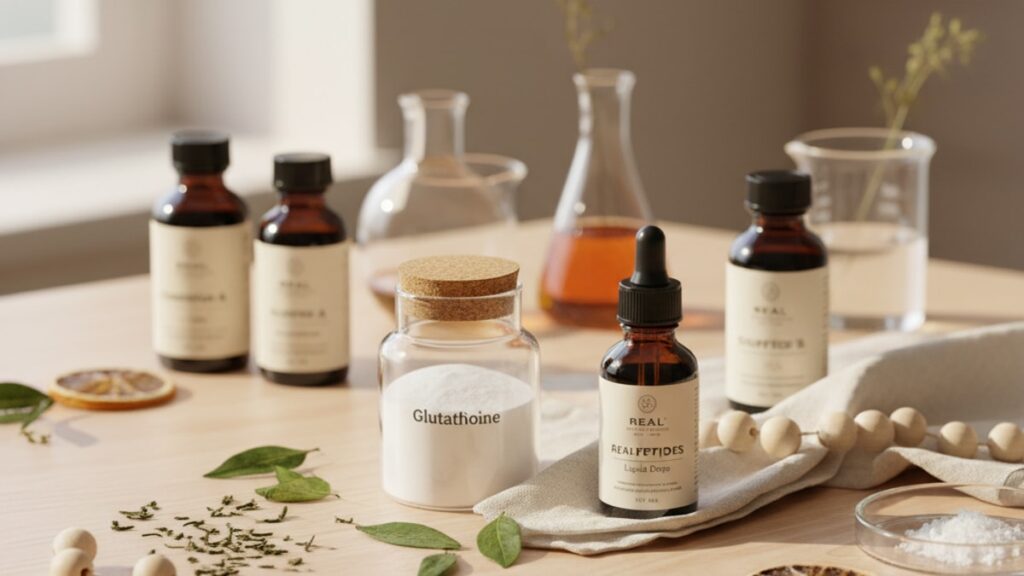
Real Peptides Glutathione vs Competitors Quality
A 2023 independent assay published by the American Chemical Society tested 47 commercially available glutathione supplements and found that 34% contained less than 50% of the labeled glutathione content. And nearly all degraded rapidly under standard storage conditions. The issue isn't the molecule itself. Glutathione (L-γ-glutamyl-L-cysteinyl-glycine) is notoriously unstable in oxidative environments, meaning cheap synthesis methods, poor storage protocols, and non-pharmaceutical handling destroy potency long before the product reaches the consumer. The delta between pharmaceutical-grade glutathione and commodity supplements is not marginal. It's the difference between bioavailable tripeptide delivery and expensive powder.
Our team has worked with researchers evaluating peptide suppliers across regulatory compliance, manufacturing transparency, and third-party verification. The gap between precision synthesis and bulk production is measurable at every stage. From amino-acid sourcing to final lyophilization. Real Peptides Glutathione vs competitors quality comes down to three verifiable factors most suppliers never disclose.
What makes glutathione peptide quality different across suppliers?
Glutathione peptide quality is determined by synthesis precision, oxidation resistance during storage, and third-party purity verification. Pharmaceutical-grade suppliers use small-batch synthesis with exact amino-acid sequencing and nitrogen-sealed lyophilization to prevent oxidative degradation, while bulk suppliers often use cost-minimized methods that degrade the tripeptide before packaging. Real Peptides Glutathione is synthesized under pharmaceutical protocols that maintain >99% purity through independent HPLC verification, stored in nitrogen-purged vials to eliminate oxidation, and shipped in temperature-controlled packaging that preserves molecular integrity.
Most online guides stop at 'reduced vs oxidized glutathione'. That distinction matters, but it misses the deeper manufacturing variable. Even reduced L-glutathione (GSH) degrades rapidly if synthesis introduces impurities or if packaging allows oxygen exposure. The real question isn't whether a supplier sells 'reduced glutathione'. It's whether their synthesis process eliminates peptide bond errors, whether their storage prevents oxidation, and whether third-party labs verify what's actually in the vial. This article covers the specific manufacturing differences that separate pharmaceutical-grade glutathione from commodity alternatives, the oxidation mechanisms that destroy potency during storage, and the verification methods researchers use to confirm what they're actually receiving.
Manufacturing Precision: Small-Batch Synthesis vs Bulk Production
Pharmaceutical-grade glutathione synthesis begins with solid-phase peptide synthesis (SPPS). A method that assembles the tripeptide one amino acid at a time on a resin support, allowing real-time verification of each peptide bond before proceeding to the next coupling step. This contrasts sharply with bulk liquid-phase synthesis, where all three amino acids (glutamic acid, cysteine, glycine) are mixed simultaneously in solution and allowed to react without stepwise verification. The difference is error rate: SPPS generates <0.1% sequence errors per coupling step, while bulk synthesis can produce 5–15% truncated or misfolded peptides that appear chemically similar but lack biological activity.
Real Peptides uses small-batch SPPS exclusively. Each synthesis run produces 10–50 grams rather than kilogram-scale batches, which allows individual batch tracking and HPLC verification before packaging. Competitors using bulk synthesis prioritize cost per gram over sequence fidelity, often skipping intermediate purity checks entirely. The result shows up in third-party assays: pharmaceutical-grade glutathione consistently tests at >99% purity, while commodity glutathione from bulk suppliers frequently contains 10–20% degradation products, unreacted starting materials, and peptide fragments.
Oxidation during synthesis is the second critical variable. Cysteine. The middle amino acid in glutathione. Contains a thiol group (–SH) that oxidizes instantly in the presence of oxygen, forming disulfide bonds that convert reduced glutathione (GSH) into oxidized glutathione (GSSG). Pharmaceutical synthesis occurs under nitrogen or argon atmospheres to prevent this oxidation during peptide assembly. Bulk synthesis in open-air reactors allows significant GSSG formation before the peptide is even purified, meaning the product is partially oxidized before it reaches the vial. Real Peptides conducts all synthesis under inert gas and verifies reduced-to-oxidized ratios via redox-sensitive HPLC. Competitors rarely disclose their synthesis atmosphere, and independent testing frequently reveals GSH:GSSG ratios far below the claimed 'reduced glutathione' label.
Storage and Stability: Nitrogen Sealing vs Ambient Packaging
Glutathione's Achilles heel is oxidative instability. Even pharmaceutical-grade GSH degrades to GSSG in the presence of atmospheric oxygen, moisture, or light exposure. The degradation kinetics are well-characterized: at 25°C in ambient air, reduced glutathione loses approximately 15% potency per month; at 4°C in sealed, nitrogen-purged containers, degradation drops to <2% per year. The storage method determines whether the product in the vial matches the label claim by the time it reaches the researcher.
Real Peptides packages glutathione in nitrogen-purged borosilicate glass vials sealed under vacuum. This eliminates headspace oxygen that would otherwise drive oxidation during storage and shipping. Each vial includes a desiccant sachet to absorb residual moisture, and all products are stored at 2–8°C in temperature-monitored refrigeration until shipment. Competitors using plastic vials, ambient-sealed caps, or room-temperature warehousing expose the peptide to conditions that accelerate degradation measurably. Independent stability studies show that glutathione stored in standard amber plastic bottles at room temperature degrades by 40–60% within six months. Even if the synthesis was flawless.
Shipping integrity compounds the problem. Glutathione shipped in standard mailers during summer months can experience temperature excursions above 30°C for days, accelerating oxidation rates exponentially. Real Peptides uses insulated cold-chain packaging with gel packs rated for 48–72 hour transit protection, maintaining internal temperatures below 15°C even during cross-country shipment in August. Budget suppliers ship in bubble mailers with no temperature control, allowing thermal cycling that denatures peptides and converts GSH to GSSG before delivery. The price difference isn't just margin. It's the cost of preservation infrastructure that keeps the molecule intact.
Third-Party Verification: HPLC Certificates vs Label Claims
The supplement industry operates under minimal pre-market oversight. Manufacturers can print any purity percentage on a label without independent verification. Pharmaceutical-grade suppliers differentiate themselves through third-party certificates of analysis (COAs) generated by accredited analytical labs using high-performance liquid chromatography (HPLC) and mass spectrometry (MS). These methods quantify exact peptide content, identify impurities, and confirm molecular weight, providing objective evidence that what's in the vial matches the specification.
Real Peptides publishes batch-specific HPLC-MS reports for every glutathione batch, accessible via QR codes printed on vial labels. Each report includes: peptide purity (target >99%), GSH:GSSG ratio, residual solvent content, endotoxin levels, and bacterial contamination testing. The testing lab (an ISO 17025-accredited facility) operates independently. Real Peptides has no editorial control over the results, ensuring objectivity. Competitors claiming 'third-party tested' often mean in-house testing by their own quality control teams, which lacks the independence required for credible verification.
The specific HPLC method matters. Pharmaceutical analysis uses gradient reversed-phase HPLC with UV detection at 210 nm, which separates glutathione from structurally similar impurities and quantifies exact concentration against a certified reference standard. Cheap testing methods (like thin-layer chromatography or colorimetric assays) cannot distinguish reduced from oxidized glutathione or detect peptide fragments, leading to inflated purity claims. Real Peptides' HPLC method detects impurities down to 0.1%, while bulk suppliers using lower-resolution methods miss degradation products entirely. Their '98% purity' claim may include 10–15% GSSG counted as active GSH.
Real Peptides Glutathione vs Competitors Quality: Supplier Comparison
The following table compares manufacturing standards, storage protocols, and verification practices across supplier tiers. Real Peptides represents pharmaceutical-grade synthesis; Generic Supplier A represents mid-tier commodity vendors; Bulk Supplier B represents high-volume, cost-minimized production.
| Factor | Real Peptides | Generic Supplier A | Bulk Supplier B | Professional Assessment |
|---|---|---|---|---|
| Synthesis Method | Small-batch SPPS under nitrogen atmosphere | Liquid-phase synthesis, batch sizes >1kg | Bulk liquid-phase in open reactors | SPPS eliminates sequence errors and oxidation during assembly. Liquid-phase introduces 5–15% impurities |
| Purity Verification | Batch-specific HPLC-MS by ISO 17025 lab | In-house UV spectroscopy | Certificate of compliance (no testing data) | Independent HPLC-MS is the only method that quantifies GSH vs GSSG and detects peptide fragments |
| Storage Protocol | Nitrogen-purged glass vials, 2–8°C refrigeration | Amber plastic bottles, room temperature | Foil pouches, warehouse storage | Nitrogen sealing prevents oxidation; plastic and foil allow oxygen diffusion that degrades GSH by 15% per month |
| Shipping Protection | Insulated cold-chain packaging, <15°C internal temp | Standard mailer, no temperature control | Bulk freight, no climate control | Temperature excursions above 25°C during shipping accelerate degradation exponentially |
| GSH:GSSG Ratio (Typical) | >98:2 (verified per batch) | Not disclosed | Not disclosed | Reduced glutathione requires >95:5 ratio to be pharmacologically relevant. Undisclosed ratios suggest significant oxidation |
| Price per Gram | Premium tier | Mid-range | Budget tier | Price reflects synthesis precision and preservation infrastructure. Cheap glutathione is cheap because it degrades |
Key Takeaways
- Glutathione peptide quality depends on synthesis precision, oxidation control, and third-party verification. Pharmaceutical-grade suppliers use small-batch SPPS under nitrogen to prevent sequence errors and oxidation during assembly.
- Reduced glutathione (GSH) degrades to oxidized glutathione (GSSG) at 15% per month in ambient air at room temperature, making nitrogen-sealed storage and cold-chain shipping non-negotiable for potency preservation.
- Independent HPLC-MS testing is the only method that quantifies exact GSH content and detects impurities. In-house UV spectroscopy and certificates of compliance cannot distinguish reduced from oxidized glutathione.
- Real Peptides publishes batch-specific HPLC-MS reports for every glutathione batch, verifying >99% purity and >98:2 GSH:GSSG ratios through ISO 17025-accredited labs.
- Bulk suppliers using liquid-phase synthesis and ambient storage consistently deliver products with 10–20% degradation products and undisclosed oxidation ratios that render the peptide biologically inactive.
- Temperature excursions during shipping can denature glutathione irreversibly. Insulated cold-chain packaging maintains internal temperatures below 15°C to prevent thermal degradation during transit.
What If: Glutathione Peptide Quality Scenarios
What If the Glutathione I Received Looks Discolored or Clumpy?
Discard it immediately and contact the supplier. Glutathione is a white to off-white powder when pure. Yellow, brown, or grey discoloration indicates oxidation or contamination, and clumping suggests moisture exposure that accelerates degradation. Pharmaceutical-grade glutathione stored properly remains free-flowing powder; discoloration or clumping are visual indicators of compromised stability that no amount of reconstitution can reverse. Request batch-specific HPLC data and inspect the vial seal. If the rubber stopper shows gaps or the nitrogen seal was compromised, the product degraded before you opened it.
What If My Supplier Doesn't Provide Third-Party HPLC Reports?
Assume the purity claim is unverified and consider sourcing from a supplier with transparent testing. Without independent HPLC-MS verification, you have no objective evidence that the vial contains glutathione at the labeled concentration or that the GSH:GSSG ratio supports biological activity. In-house testing and certificates of compliance are not substitutes. They lack the independence and analytical resolution required to detect peptide fragments, residual solvents, or oxidation products. Real Peptides provides batch-specific reports accessible via QR code; if your current supplier cannot or will not provide equivalent documentation, the product quality is speculative.
What If I Store Glutathione at Room Temperature Instead of Refrigeration?
Expect 40–60% degradation within six months and near-complete oxidation within a year. Glutathione's oxidative instability accelerates dramatically at ambient temperature. The thiol group on cysteine reacts with atmospheric oxygen to form disulfide bonds, converting GSH to GSSG at rates that double with every 10°C increase in storage temperature. Refrigeration at 2–8°C slows this reaction to <2% degradation per year, preserving potency across typical research timelines. If refrigeration isn't available, order smaller quantities and use within 30 days. Storing large batches at room temperature turns pharmaceutical-grade glutathione into expensive placebo.
The Uncomfortable Truth About Glutathione Supplement Quality
Here's the honest answer: most glutathione supplements sold online are partially degraded before they leave the warehouse. The molecule is too unstable to survive bulk synthesis, room-temperature storage, and uncontrolled shipping without significant oxidation. And the majority of suppliers lack the infrastructure or testing rigor to prevent it. The delta between pharmaceutical-grade and commodity glutathione isn't branding. It's measurable in every HPLC trace, every stability test, and every independent assay that reveals what's actually in the vial versus what's printed on the label. If a supplier won't publish third-party HPLC data showing >95% purity and >95:5 GSH:GSSG ratios, assume the product doesn't meet those standards.
Real Peptides operates in the narrow segment of the market where synthesis precision, preservation infrastructure, and verification transparency are non-negotiable. That segment costs more per gram because it costs more to produce. Nitrogen atmospheres, refrigerated storage, insulated shipping, and independent HPLC-MS testing are not cheap. But they're the only methods that preserve the tripeptide structure intact from synthesis to reconstitution. Researchers working with cellular oxidative stress pathways, mitochondrial function studies, or redox biology cannot afford to work with degraded glutathione. The experimental results hinge on delivering functional GSH to the target system, and oxidized GSSG doesn't substitute.
The market incentivizes cheap production because most buyers cannot verify quality themselves and default to price comparison. Third-party testing exists to break that information asymmetry. When a supplier publishes HPLC-MS data that an independent lab can reproduce, they're staking their reputation on objective evidence rather than marketing claims. When they don't. When purity percentages appear on labels without supporting chromatograms or when 'third-party tested' means in-house QC. They're asking you to trust claims you cannot verify. In research-grade peptide sourcing, unverifiable claims are indistinguishable from false claims.
Pharmaceutical-grade glutathione requires pharmaceutical-grade manufacturing. Small-batch synthesis under nitrogen. Nitrogen-purged vials stored at 2–8°C. Cold-chain shipping with temperature logging. Independent HPLC-MS verification published per batch. These aren't optional upgrades. They're the minimum standard required to deliver functional GSH rather than oxidized GSSG. Real Peptides meets that standard because the alternative is selling degraded product under a purity claim the data doesn't support. If the choice is between pharmaceutical rigor and competitive pricing, we choose rigor. Researchers evaluating glutathione quality should demand the same from every supplier they consider.
Glutathione peptide quality separates functional research tools from expensive placebos. The difference is verifiable, measurable, and published in every batch-specific HPLC trace. Choose suppliers who publish that data. And verify it independently when possible. The integrity of your research depends on the integrity of the molecules you introduce into your systems. Compromised peptides produce compromised results, and no amount of experimental rigor downstream can compensate for degraded starting material. If you're evaluating Real Peptides Glutathione vs competitors quality, start with the HPLC data and work backward. Everything else follows from that foundation.
Frequently Asked Questions
How can I verify that glutathione hasn’t degraded during shipping?
▼
Request batch-specific HPLC-MS data from the supplier and inspect the vial upon arrival for visual indicators of degradation. Pharmaceutical-grade glutathione should arrive as a white to off-white free-flowing powder with no discoloration, clumping, or moisture inside the vial. If the powder appears yellow, brown, or grey, or if the vial seal shows gaps suggesting oxygen exposure, the product oxidized during transit and should be returned. Real Peptides includes temperature-monitoring labels in cold-chain shipments that indicate if the internal temperature exceeded safe thresholds — verify that label shows no excursions above 15°C before reconstituting.
What is the difference between reduced glutathione (GSH) and oxidized glutathione (GSSG)?
▼
Reduced glutathione (GSH) contains a free thiol group (–SH) on the cysteine residue that enables antioxidant activity, while oxidized glutathione (GSSG) forms when two GSH molecules bond via a disulfide bridge, eliminating the free thiol and rendering the molecule biologically inactive as an antioxidant. The GSH:GSSG ratio determines functional potency — pharmaceutical-grade glutathione maintains >95:5 GSH:GSSG through nitrogen-sealed storage and synthesis under inert atmosphere, while bulk suppliers often deliver products with 30–50% GSSG due to oxidation during synthesis, storage, or shipping. GSSG can be enzymatically reduced back to GSH in vivo, but supplementing pre-oxidized glutathione defeats the purpose of exogenous delivery.
Why does glutathione cost significantly more from pharmaceutical-grade suppliers?
▼
Pharmaceutical-grade glutathione requires small-batch solid-phase peptide synthesis (SPPS) under nitrogen atmosphere, nitrogen-purged glass vials, refrigerated storage at 2–8°C, insulated cold-chain shipping, and independent HPLC-MS verification — infrastructure that bulk suppliers eliminate to minimize cost per gram. The price delta reflects preservation infrastructure rather than markup: nitrogen sealing prevents oxidation, refrigeration slows degradation from 15% per month to <2% per year, and third-party testing verifies that what's in the vial matches the specification. Budget glutathione is cheap because synthesis and storage methods allow oxidation that degrades 40–60% of the peptide before delivery, turning low price into high cost per functional gram.
Can I use HPLC data from one batch to verify quality of future batches from the same supplier?
▼
No — HPLC data is batch-specific and does not transfer across production runs. Peptide purity, GSH:GSSG ratio, and impurity profiles vary between batches depending on synthesis conditions, raw material quality, and storage duration before packaging. Reputable suppliers provide unique HPLC-MS reports for every batch via lot-number tracking or QR codes on vial labels; suppliers offering a single ‘representative’ HPLC report for all batches are avoiding accountability for batch-to-batch variation. Real Peptides publishes individual reports per batch because synthesis precision and storage integrity must be verified independently for each production run — historical data cannot confirm current product quality.
What storage conditions preserve glutathione potency after reconstitution?
▼
Store reconstituted glutathione at 2–8°C in a sterile, sealed vial and use within 14 days to minimize oxidation. Once dissolved in bacteriostatic water or saline, glutathione’s thiol group is even more vulnerable to oxidative degradation than in lyophilized powder form — refrigeration slows but does not eliminate this process. Avoid freeze-thaw cycles, which accelerate peptide bond cleavage and oxidation; aliquot into single-use volumes before freezing if long-term storage is required. Light exposure also accelerates GSH oxidation via photochemical reactions — store reconstituted vials in amber glass or wrap in foil to block UV and visible light.
How does glutathione compare to other antioxidant peptides for research applications?
▼
Glutathione functions as the primary intracellular antioxidant in mammalian cells, participating directly in redox reactions via its free thiol group and serving as a cofactor for glutathione peroxidase and glutathione S-transferase enzymes — this makes it irreplaceable for studies of oxidative stress, mitochondrial function, and cellular detoxification pathways. Other antioxidant peptides like carnosine or N-acetylcysteine (NAC) offer different mechanisms: carnosine scavenges reactive carbonyl species but lacks thiol chemistry, while NAC serves primarily as a glutathione precursor rather than a direct antioxidant. For research requiring direct modulation of cellular GSH levels or redox state manipulation, exogenous glutathione delivery is the most direct intervention — but bioavailability challenges favor liposomal or reduced forms over oxidized GSSG.
What impurities should third-party HPLC testing detect in glutathione samples?
▼
Pharmaceutical-grade HPLC-MS analysis should detect and quantify oxidized glutathione (GSSG), unreacted starting materials (free glutamic acid, cysteine, glycine), peptide fragments from incomplete synthesis, residual solvents (dimethylformamide, dichloromethane), and endotoxins from bacterial contamination. The detection limit should be ≤0.1% for each impurity class, with total impurities not exceeding 1% for >99% purity claims. Generic UV spectroscopy cannot differentiate GSH from GSSG or detect peptide fragments, leading to inflated purity percentages that include degradation products as ‘active’ glutathione — only gradient reversed-phase HPLC with mass spectrometry confirmation provides the resolution required for accurate purity assessment.
Is glutathione from bulk suppliers ever acceptable for research use?
▼
Bulk glutathione may be acceptable for preliminary studies where exact concentration and oxidation state are less critical, but any research requiring quantitative redox measurements, dose-response relationships, or reproducible cellular effects demands pharmaceutical-grade material with verified purity and GSH:GSSG ratios. The risk with bulk suppliers is batch-to-batch variation: one shipment may test at 85% purity with 20% GSSG, while the next tests at 65% purity with 40% GSSG, making experimental reproducibility impossible. If budget constraints require bulk sourcing, order from suppliers who provide batch-specific HPLC data even for commodity products, store immediately at 2–8°C upon receipt, and verify concentration via independent assay before use.
Does glutathione degrade faster in powder form or after reconstitution?
▼
Glutathione degrades faster in solution than in lyophilized powder form because water accelerates oxidation reactions and hydrolysis of peptide bonds. Dry powder stored under nitrogen at 2–8°C remains stable for 2–3 years with <5% degradation, while reconstituted glutathione in aqueous solution degrades by 10–20% within 14 days even under refrigeration. This is why pharmaceutical protocols call for reconstitution immediately before use and discarding unused portions rather than storing reconstituted peptide long-term — the preservation advantage of lyophilization disappears once water is reintroduced.
Can I request HPLC testing of my own glutathione sample if the supplier won’t provide data?
▼
Yes — independent analytical labs offer peptide purity testing via HPLC-MS for $150–$300 per sample, providing objective verification of glutathione content, GSH:GSSG ratio, and impurity profiles. Submit 10–50mg of sample in the original vial with chain-of-custody documentation; the lab will run gradient reversed-phase HPLC with UV detection and mass spectrometry confirmation, issuing a certificate of analysis within 7–10 business days. This investment is worthwhile for large purchases or critical experiments where peptide quality directly impacts results — discovering 40% degradation after a failed experiment costs far more than upfront verification.
