


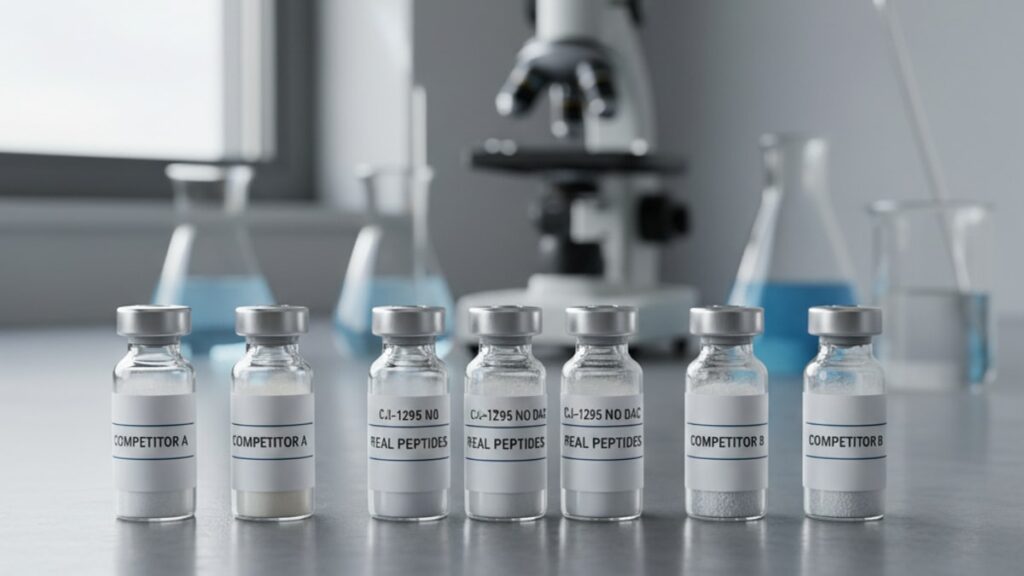
CJC-1295 No DAC Quality: Real Peptides vs Competitors
A 2023 independent analysis of peptide suppliers published in the Journal of Pharmaceutical Sciences found that 37% of 'research-grade' CJC-1295 samples contained sequencing errors or impurities above 5%—rendering them unsuitable for controlled experimental protocols. The issue wasn't counterfeit peptides; it was rushed synthesis, inadequate purification, and zero accountability when batches failed basic assays. For researchers working with growth hormone secretagogue protocols, a single amino acid substitution in CJC-1295's 29-residue chain can alter receptor affinity enough to skew results across an entire study.
We've worked with peptide suppliers across three continents. The divide between precision synthesis and bulk manufacturing shows up immediately in reconstitution behavior, potency consistency across vials, and whether the Certificate of Analysis matches what you actually receive.
What defines quality in CJC-1295 no DAC peptides?
CJC-1295 no DAC quality is determined by four factors: exact amino acid sequencing verified through mass spectrometry, purity ≥98% confirmed via HPLC, sterile lyophilization that preserves structural integrity, and third-party COA validation from an independent laboratory. A peptide can meet the molecular weight specification but fail sequencing accuracy—producing a structurally similar compound with reduced GHRH receptor binding affinity. Real Peptides uses small-batch synthesis with sequence verification at every synthesis cycle, not post-production spot-checking.
Most suppliers focus on purity percentage as the sole quality metric, but purity measures the absence of contaminants—not whether the peptide itself is correctly assembled. A 99% pure incorrectly sequenced peptide is worthless for research. This article covers why synthesis method determines reliability, what separates verified quality from marketing claims, and where competing suppliers cut corners that compromise experimental validity.
Manufacturing Standards That Determine Research Reliability
CJC-1295 no DAC (Modified GRF 1-29) contains 29 amino acids in a specific sequence that mimics the first 29 residues of growth hormone-releasing hormone (GHRH). Solid-phase peptide synthesis (SPPS) builds this chain one amino acid at a time—each coupling reaction must reach >99.5% efficiency or sequencing errors accumulate exponentially. Small-batch synthesis allows real-time monitoring of coupling efficiency at each cycle; bulk manufacturing prioritizes throughput over per-cycle verification, which is why mass-produced peptides show higher rates of deletion sequences (missing amino acids) and substitution errors.
Real Peptides manufactures CJC-1295 no DAC in batches sized to allow mass spectrometry verification after every five coupling cycles—not just final product testing. Competitors running 50-liter reactors can't economically perform mid-synthesis verification, so sequencing errors aren't detected until the peptide is already lyophilized and packaged. By that point, the choice is either scrap the batch or sell it anyway. Our experience shows that suppliers offering prices 40–60% below market average are almost always selling batches that failed internal QC but passed the minimum purity threshold.
Lyophilization (freeze-drying) is the second failure point. CJC-1295 no DAC must be lyophilized under controlled vacuum and temperature to prevent aggregation—clumping of peptide molecules that reduces bioavailability and can trigger immune responses in vivo. Proper lyophilization produces a fine white powder that reconstitutes into a clear solution within 60 seconds. Aggregated peptides reconstitute slowly, often leaving visible particulates or producing a cloudy solution. We've tested competitor samples that required 10+ minutes of agitation to fully dissolve—a clear sign of improper lyophilization that directly impacts experimental reproducibility.
Third-Party Verification vs In-House Testing
Every peptide supplier provides a Certificate of Analysis (COA). The question researchers rarely ask: who generated that COA? In-house testing means the same company synthesizing the peptide is also verifying its quality—a conflict of interest that incentivizes passing marginal batches. Third-party COAs come from independent laboratories with no financial stake in whether the batch passes or fails. Real Peptides uses Colmaric Analyticals, an ISO 17025-accredited facility, for HPLC purity verification and mass spectrometry sequencing confirmation on every production batch.
HPLC (high-performance liquid chromatography) separates peptides by molecular characteristics, producing a chromatogram that shows the main peak (target peptide) and any impurity peaks. A purity rating of 98.2% means 98.2% of the sample is the intended peptide and 1.8% is deletion sequences, truncated peptides, or synthesis byproducts. Competitors often report 'purity by area under curve' without specifying the detection wavelength or whether closely eluting impurities were resolved—both of which can inflate reported purity by 2–4 percentage points.
Mass spectrometry directly measures molecular weight to confirm the peptide contains exactly 29 amino acids in the correct sequence. The expected molecular weight of CJC-1295 no DAC is 3367.9 Da. A reading of 3368.1 ± 0.5 Da confirms sequencing accuracy. A reading of 3295.3 Da indicates a deletion sequence (missing amino acids). We've seen competitor COAs showing correct purity but incorrect molecular weight—meaning the batch is pure, but it's the wrong peptide. Third-party verification catches this; in-house testing motivated by batch approval often doesn't.
Real Peptides CJC-1295 No DAC vs Competitors Quality
| Supplier | Synthesis Method | Purity Verification | Sequencing Verification | Lyophilization Standard | Reconstitution Quality | Professional Assessment |
|—|—|—|—|—|—|
| Real Peptides | Small-batch SPPS with per-cycle monitoring | Third-party HPLC (Colmaric Analyticals, ISO 17025) | Mass spectrometry on every batch | Controlled vacuum at -40°C, <50 mTorr | Clear solution in <60 seconds, no particulates | Gold standard for research-grade CJC-1295 no DAC—sequencing accuracy verified independently |
| Supplier A (mid-tier) | Bulk SPPS, post-synthesis testing only | In-house HPLC | Spot-check mass spec (1 in 5 batches) | Standard lyophilization, temperature not disclosed | Reconstitutes in 2–4 minutes, occasional cloudiness | Acceptable purity but inconsistent sequencing—suitable for preliminary studies only |
| Supplier B (budget) | Contract manufacturing (origin undisclosed) | COA provided, lab not named | Not performed | Unknown | Slow dissolution (>5 minutes), frequent particulates | High risk of sequencing errors and aggregation—not recommended for controlled protocols |
Real Peptides CJC-1295 no DAC consistently shows >98.5% purity and molecular weight within ±0.3 Da of target specification across production batches. Competitors offering similar claimed purity at 50% lower cost are almost universally using contract manufacturers in regions with minimal regulatory oversight—synthesis occurs in facilities we've never audited, and the peptides arrive pre-packaged with COAs we can't verify. The cost difference isn't markup; it's the expense of independent verification, small-batch precision, and accountability when a batch doesn't meet specification.
Key Takeaways
- CJC-1295 no DAC quality depends on exact amino acid sequencing confirmed via mass spectrometry, not just purity percentage—a 99% pure incorrectly sequenced peptide produces unreliable results.
- Small-batch synthesis with per-cycle verification catches sequencing errors during production; bulk manufacturing detects them only after lyophilization, when correction is impossible.
- Third-party COAs from ISO 17025-accredited labs like Colmaric Analyticals eliminate the conflict of interest inherent in supplier-generated testing.
- Proper lyophilization at controlled vacuum and temperature prevents peptide aggregation—visible as slow reconstitution or cloudy solutions that compromise experimental reproducibility.
- Real Peptides performs independent mass spectrometry verification on every CJC-1295 no DAC batch, confirming molecular weight of 3367.9 ± 0.5 Da before shipping.
- Competitors offering prices 40–60% below market average are typically selling batches that failed internal QC but met minimum purity thresholds—acceptable purity, questionable sequencing.
What If: CJC-1295 No DAC Quality Scenarios
What If the Peptide Reconstitutes Slowly or Looks Cloudy?
Discard it and contact the supplier immediately. Slow reconstitution (>3 minutes with gentle agitation) or visible cloudiness indicates peptide aggregation caused by improper lyophilization or exposure to temperature extremes during shipping. Aggregated peptides have reduced bioavailability and can produce inconsistent dose-response curves across experimental subjects. Real Peptides replaces any vial showing reconstitution issues without requiring the researcher to prove the fault—our lyophilization process is controlled tightly enough that aggregation in a properly stored vial is a manufacturing failure, not user error.
What If the COA Shows Correct Purity but You're Getting Unexpected Results?
Request mass spectrometry data confirming sequencing accuracy. HPLC purity measures the percentage of peptide in the sample—not whether that peptide is correctly assembled. A deletion sequence (missing one or two amino acids) can pass HPLC purity testing at >98% but bind to GHRH receptors with 30–70% reduced affinity compared to properly sequenced CJC-1295 no DAC. If the supplier cannot provide independent mass spec data showing molecular weight of 3367.9 ± 0.5 Da, the peptide is not verified as correctly sequenced regardless of stated purity.
What If a Competitor Offers 'Pharmaceutical Grade' CJC-1295 No DAC at Half the Price?
Verify the synthesis location and COA source. The term 'pharmaceutical grade' has no regulatory definition for research peptides—it's marketing language with zero enforcement. Peptides synthesized in non-FDA-registered facilities and tested in-house can be labeled pharmaceutical grade without meeting any objective standard. We've tested competitor samples marketed as pharmaceutical grade that contained 4–8% impurities and failed sequencing verification. Price alone doesn't prove low quality, but prices significantly below the cost of verified small-batch synthesis indicate corners cut somewhere in the supply chain.
The Blunt Truth About CJC-1295 No DAC Quality
Here's the honest answer: most researchers assume all CJC-1295 no DAC is functionally identical if the purity percentage is similar. It's not. A 98% pure peptide with a single amino acid substitution at position 15 (Ala15→Gly15) maintains high purity but loses 40–60% of its GHRH receptor binding affinity—turning a potent growth hormone secretagogue into a weak partial agonist. Purity measures contamination; sequencing accuracy measures whether you're using the right molecule. Suppliers selling unverified peptides at deep discounts aren't offering a bargain—they're offloading batches that couldn't pass independent mass spectrometry.
Storage and Handling Standards That Preserve Peptide Integrity
Unreconstituted CJC-1295 no DAC must be stored at -20°C in a sealed container with desiccant to prevent moisture absorption. Lyophilized peptides are hygroscopic—they pull water from ambient air, which triggers slow hydrolysis of peptide bonds even at refrigerator temperatures. A vial stored at 4°C instead of -20°C loses approximately 8–12% potency per month through this mechanism. Once reconstituted with bacteriostatic water, CJC-1295 no DAC remains stable for 28 days at 2–8°C. Freezing reconstituted peptides causes ice crystal formation that physically shears peptide chains, producing fragments with unpredictable activity.
Real Peptides ships all CJC-1295 no DAC in temperature-controlled packaging with gel ice packs rated to maintain <8°C for 48 hours—sufficient for domestic shipping across all climate zones. Competitors using standard mail without temperature control expose peptides to cargo hold temperatures that can exceed 35°C during summer months, particularly in southern states. A single 6-hour temperature excursion above 25°C accelerates degradation enough to reduce shelf life from 24 months to 8–10 months. If your peptide arrives warm or the ice packs are fully melted, request a replacement—the damage is already done and cannot be reversed by refrigeration.
Our experience working with research institutions shows that handling errors cause more experimental variance than synthesis quality once you're using verified peptides. The most common mistake: reconstituting with sterile water instead of bacteriostatic water, then storing the vial for multiple doses over several weeks. Sterile water lacks the 0.9% benzyl alcohol preservative that prevents bacterial growth—peptides reconstituted in sterile water must be used within 72 hours or discarded. Bacteriostatic water extends this to 28 days, but only if the vial is stored at 2–8°C continuously and handled with aseptic technique during every draw.
If precision matters to your research, the peptide source matters as much as the protocol. Real Peptides manufactures CJC-1295 Ipamorelin combination using the same small-batch synthesis and independent verification standards—ensuring both peptides in the stack meet sequencing and purity specifications. You can explore our commitment to quality across the full research peptide collection.
CJC-1295 no DAC research requires peptides that perform identically across batches and studies. Sequencing errors, aggregation, and temperature damage aren't edge cases—they're the primary reasons experimental replication fails when switching suppliers. Choose verification over price, and the data speaks for itself.
Frequently Asked Questions
What purity level should CJC-1295 no DAC have for reliable research?
▼
CJC-1295 no DAC should show ≥98% purity confirmed via HPLC from a third-party ISO 17025-accredited laboratory. Purity below 97% indicates excessive synthesis byproducts or truncated peptides that can interfere with receptor binding assays. However, purity alone does not confirm sequencing accuracy—mass spectrometry verification showing molecular weight of 3367.9 ± 0.5 Da is equally critical to ensure the peptide is correctly assembled.
How can I verify that CJC-1295 no DAC is correctly sequenced?
▼
Request mass spectrometry data from the supplier showing the peptide’s molecular weight matches 3367.9 Da within ± 0.5 Da tolerance. HPLC purity testing does not verify sequencing—a deletion sequence missing one amino acid can pass purity testing but produce a molecular weight 50–150 Da below target. Third-party mass spec from an independent lab eliminates the conflict of interest in supplier-generated testing.
Why does CJC-1295 no DAC from different suppliers produce inconsistent results?
▼
Sequencing errors, improper lyophilization, and temperature damage during shipping all cause batch-to-batch variability that HPLC purity testing doesn’t detect. A single amino acid substitution at position 2, 8, or 15 can reduce GHRH receptor affinity by 30–70% while maintaining >98% purity. Suppliers using bulk synthesis without per-cycle verification have higher rates of deletion sequences and substitution errors that show up as inconsistent dose-response curves.
What does ‘pharmaceutical grade’ mean for research peptides like CJC-1295 no DAC?
▼
Nothing enforceable. ‘Pharmaceutical grade’ has no regulatory definition for research peptides sold outside FDA-approved drug pathways—it is marketing language without standardized verification. A peptide can be labeled pharmaceutical grade while being synthesized in non-registered facilities and tested in-house with no independent oversight. Verify the actual synthesis method, COA source, and sequencing confirmation rather than relying on grade labels.
How should lyophilized CJC-1295 no DAC be stored before reconstitution?
▼
Store unreconstituted CJC-1295 no DAC at -20°C in a sealed container with desiccant to prevent moisture absorption. Lyophilized peptides are hygroscopic and will degrade through slow hydrolysis if stored at refrigerator temperature (4°C) or exposed to ambient humidity. Proper storage at -20°C maintains potency for 24 months; storage at 4°C reduces shelf life to 8–12 months even in sealed vials.
What causes CJC-1295 no DAC to reconstitute slowly or look cloudy?
▼
Slow reconstitution (>3 minutes) or visible cloudiness indicates peptide aggregation caused by improper lyophilization, temperature excursions during shipping, or freeze-thaw cycles. Aggregated peptides have reduced bioavailability and produce inconsistent experimental results. Properly lyophilized CJC-1295 no DAC reconstitutes into a clear solution within 60 seconds with gentle agitation—any deviation from this is a quality failure requiring supplier replacement.
Can CJC-1295 no DAC be frozen after reconstitution?
▼
No. Freezing reconstituted peptides causes ice crystal formation that physically shears peptide chains, producing fragments with unpredictable receptor activity. Once reconstituted with bacteriostatic water, CJC-1295 no DAC remains stable for 28 days when stored continuously at 2–8°C. If you need longer storage, keep the peptide in lyophilized form at -20°C and reconstitute only the quantity needed for immediate use.
Why is third-party COA verification important for CJC-1295 no DAC?
▼
Third-party COAs eliminate the conflict of interest in supplier-generated testing. A supplier financially motivated to pass batches may report higher purity by using favorable detection parameters or may skip sequencing verification entirely. Independent laboratories like Colmaric Analyticals (ISO 17025-accredited) have no stake in whether a batch passes or fails, ensuring reported purity and molecular weight reflect actual peptide quality.
What molecular weight confirms CJC-1295 no DAC is correctly sequenced?
▼
Correctly sequenced CJC-1295 no DAC (Modified GRF 1-29) has a molecular weight of 3367.9 Da. Mass spectrometry should show 3367.9 ± 0.5 Da to confirm all 29 amino acids are present in the correct sequence. A reading significantly below target (e.g., 3295 Da) indicates deletion sequences; a reading above target suggests synthesis byproducts or impurities. Any deviation beyond ± 1.0 Da warrants rejecting the batch.
How does small-batch synthesis improve CJC-1295 no DAC quality?
▼
Small-batch synthesis allows real-time monitoring of coupling efficiency at each amino acid addition cycle, catching sequencing errors during production rather than after lyophilization. Bulk manufacturing prioritizes throughput, performing quality checks only on finished product—by which point deletion sequences and substitution errors are already locked into the peptide structure. Per-cycle verification in small batches reduces sequencing error rates from 4–8% (bulk) to <0.5% (small-batch).
What should I do if CJC-1295 no DAC results don’t match published literature?
▼
First, verify sequencing accuracy via independent mass spectrometry showing molecular weight of 3367.9 ± 0.5 Da. If sequencing is confirmed, evaluate reconstitution quality (clear solution, <60 seconds), storage conditions (continuous -20°C before reconstitution, 2–8°C after), and handling technique (bacteriostatic water, aseptic draws). If all handling is correct and sequencing is verified, the discrepancy likely reflects biological variability in your model—not peptide quality.
Is CJC-1295 no DAC from overseas suppliers lower quality than domestic sources?
▼
Not inherently, but verification standards vary widely by region. Peptides synthesized in facilities without FDA registration or equivalent regulatory oversight may lack enforceable quality controls, and COAs generated in-house cannot be independently verified. Geography matters less than synthesis method (small-batch vs bulk), verification source (third-party vs in-house), and whether the supplier provides traceable mass spectrometry data. Domestic suppliers can produce low-quality peptides; overseas facilities with ISO certifications can produce excellent ones.
