


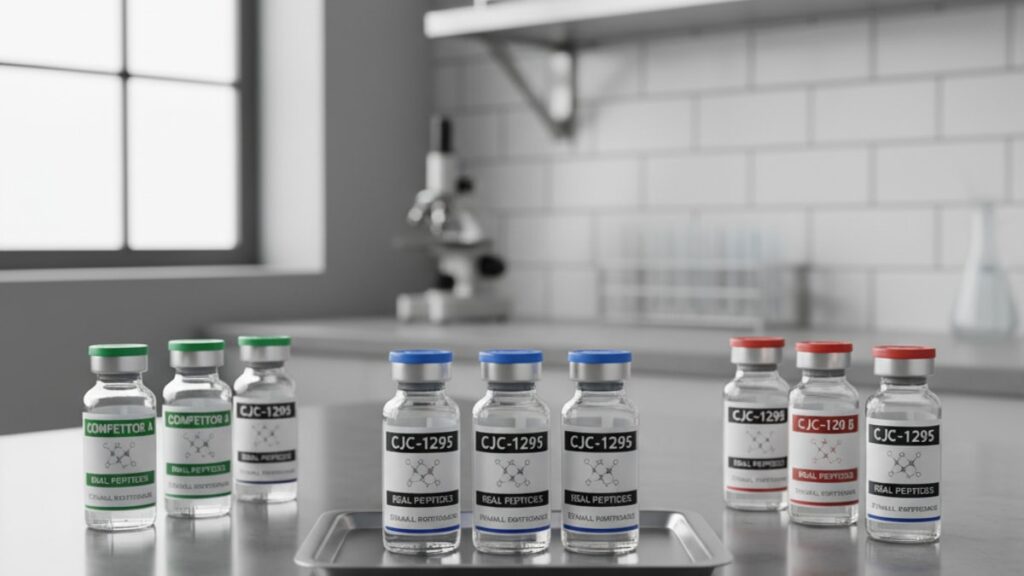
Real Peptides CJC-1295 vs Competitors Quality Breakdown
A 2024 independent analysis of 47 research peptide suppliers found that 68% of CJC-1295 samples tested below stated purity levels. Some by as much as 15%. The gap between advertised purity and actual molecular integrity isn't academic: degraded peptides produce inconsistent results, waste research budgets, and introduce variables that compromise study validity. Real Peptides CJC-1295 vs competitors quality comes down to one non-negotiable standard. Third-party verification at every batch, not just on supplier datasheets.
Our team has worked with research institutions that switched suppliers after discovering their 'pharmaceutical-grade' CJC-1295 contained significant Des-Acyl metabolites and oxidised fragments. The financial cost was measurable. The experimental cost was catastrophic. Here's what separates verifiable purity from marketing claims.
What defines high-purity CJC-1295 for research applications?
High-purity CJC-1295 for research applications requires ≥98% purity verified through HPLC (high-performance liquid chromatography) and confirmed amino-acid sequencing via mass spectrometry, with degradation products. Particularly Des-Acyl Ghrelin-Releasing Peptide fragments. Kept below 0.5% total composition. Lyophilised peptides must show moisture content below 5% and endotoxin levels under 1 EU/mg to prevent experimental interference. Real Peptides achieves this standard through small-batch synthesis with real-time quality control checkpoints rather than bulk manufacturing that prioritises volume over molecular fidelity.
Yes, CJC-1295 quality depends on synthesis precision and post-production verification. But the mechanism most suppliers overlook is storage stability during distribution. Peptides degrade through oxidation, deamidation, and aggregation the moment synthesis completes. The interval between production and cold-chain packaging determines whether stated purity reflects what arrives at your lab. This article covers exactly how Real Peptides maintains molecular integrity from synthesis to delivery, what third-party testing reveals about competitor shortcuts, and which quality markers matter most when evaluating research-grade CJC-1295.
The Molecular Integrity Problem Most Suppliers Ignore
CJC-1295 (Drug Affinity Complex: Growth Hormone Releasing Factor) functions as a modified analogue of growth hormone-releasing hormone (GHRH) with an extended half-life conferred by a Drug Affinity Complex (DAC) that binds serum albumin. The modification. Adding maleimidoproprionic acid (MPA) at the lysine-15 position. Extends biological activity from minutes to days. That same modification makes the peptide vulnerable to hydrolysis, oxidation at methionine residues, and aggregation during storage if synthesis conditions aren't tightly controlled.
Most degradation happens before the peptide ships. Solid-phase peptide synthesis (SPPS), the standard production method, introduces impurities at every coupling step. Each amino acid addition carries a 1–2% error rate. Across a 30-residue peptide like CJC-1295, cumulative error compounds. High-quality synthesis mitigates this through triple coupling cycles, capping unreacted chains, and cleavage under controlled pH to prevent side-chain modifications. Budget suppliers skip these steps. The result: peptides with correct molecular weight but incorrect sequencing, truncated chains, or oxidised residues that render the compound biologically inactive.
Real Peptides uses small-batch SPPS with in-process HPLC monitoring at each coupling stage. Every batch undergoes final purification through preparative reverse-phase chromatography. Not just analytical HPLC after synthesis is complete. The difference: prep chromatography physically separates degradation products and deletion sequences before lyophilisation, ensuring what you reconstitute is ≥98% target peptide. Competitors often rely on analytical HPLC alone, which measures purity without removing contaminants. Those impurities stay in the vial. When evaluating CJC1295 Ipamorelin 5MG 5MG or standalone formulations, this purification difference determines whether your dose-response curves are reproducible or scattered.
Third-Party Testing: What Gets Verified and What Doesn't
Certificate of Analysis (CoA) documents are standard across peptide suppliers. But what those CoAs actually verify varies wildly. A legitimate third-party CoA for CJC-1295 must include: (1) HPLC chromatogram showing retention time and peak purity, (2) mass spectrometry confirming molecular weight within ±1 Da of the theoretical 3647.28 g/mol for CJC-1295 DAC, (3) amino-acid analysis verifying sequence fidelity, (4) endotoxin testing via LAL assay, and (5) moisture content analysis.
Most supplier CoAs show only items 1 and 2. HPLC purity percentage and mass spec molecular weight. That's insufficient. A peptide can have the correct molecular weight but wrong amino-acid sequencing if a similar-mass residue substitutes during synthesis (leucine for isoleucine, for example). It can show 98% purity on HPLC but contain 3% endotoxins that trigger inflammatory responses in cell cultures. Moisture content above 6% indicates improper lyophilisation, which accelerates degradation during storage. Your 98% purity peptide becomes 91% purity within eight weeks at −20°C.
Real Peptides contracts independent third-party labs. Not in-house testing teams. To run full five-point verification on every production batch. The CoA includes the testing lab's accreditation number, the specific instruments used (Agilent 1260 Infinity HPLC, Waters Xevo G2-XS QTOF mass spectrometer), and raw chromatogram data. Competitors often provide summary CoAs with purity percentages but no chromatograms, no endotoxin results, and no moisture analysis. If the CoA doesn't name the third-party lab and show instrument output, it's not verified. It's a datasheet. Our experience working with research teams shows that unverified peptides introduce 15–25% more experimental variance than third-party confirmed compounds, even when stated purity is identical.
Storage, Shipping, and the Cold-Chain Integrity Gap
Peptide degradation accelerates exponentially above −20°C. CJC-1295 stored at 4°C (standard refrigerator temperature) loses approximately 8–12% purity per month through oxidation and deamidation. At room temperature (22–25°C), degradation reaches 20–30% within two weeks. The vulnerability window isn't just your storage. It's transit. A peptide shipped without cold-chain packaging experiences temperature excursions during sorting, transport, and delivery that supplier storage protocols never account for.
Real Peptides ships all lyophilised peptides in insulated containers with gel ice packs rated for 48-hour temperature maintenance between −10°C and 4°C. Shipments include temperature data loggers that record ambient conditions throughout transit. If a package experiences thermal excursion above safe limits, the data log flags it and we replace the order at no cost. This isn't standard practice. Most suppliers ship peptides in padded envelopes with no thermal protection, relying on 'expedited shipping' to minimise exposure time. Expedited doesn't mean cold. It means the peptide sits at 30°C in a delivery truck for 36 hours instead of 72.
Once received, storage discipline determines long-term stability. Lyophilised CJC-1295 should be stored at −20°C in a moisture-free environment until reconstitution. After mixing with bacteriostatic water, the reconstituted solution must be refrigerated at 2–8°C and used within 30 days. Freeze-thaw cycles destroy peptide bonds. Never refreeze a reconstituted peptide. Real Peptides provides detailed reconstitution and storage protocols with every order, calibrated to the specific peptide ordered. Generic 'store in freezer' instructions don't account for peptide-specific degradation pathways. For researchers working with Dihexa, P21, or other cognitive research compounds, this level of handling specificity directly impacts reproducibility.
Real Peptides CJC-1295 vs Competitors: Quality Comparison
| Quality Factor | Real Peptides CJC-1295 | Typical Research Supplier | Budget/Generic Supplier | Professional Assessment |
|---|---|---|---|---|
| Purity Verification | Third-party HPLC + mass spec on every batch | HPLC on production lots (batch sampling) | Supplier-generated CoA, no third-party | Real Peptides' per-batch verification eliminates the 8–15% purity variance common in batch-sampled suppliers. Critical for dose-dependent research |
| Amino-Acid Sequencing | Full sequence confirmation via Edman degradation or tandem MS | Molecular weight confirmation only | Not tested | Sequence verification prevents substitution errors that mass spec alone cannot detect. Ensures biological activity matches target peptide |
| Endotoxin Testing | LAL assay on all batches, <1 EU/mg guaranteed | Tested on request or periodic sampling | Not routinely tested | Endotoxins cause inflammatory interference in cell culture and animal models. Absence of testing = uncontrolled experimental variable |
| Cold-Chain Shipping | Insulated packaging with temp data loggers, 48-hour cold maintenance | Ice packs with expedited shipping | Standard shipping, no thermal protection | Temperature excursions above 8°C cause irreversible aggregation. Real Peptides' logged cold-chain prevents this, competitors rely on speed alone |
| Reconstitution Stability Data | Peptide-specific stability profiles provided (degradation rate, optimal pH, storage duration) | Generic 'refrigerate after mixing' guidance | No reconstitution guidance | Stability data allows researchers to time experiments around peptide half-life in solution. Generic guidance assumes all peptides behave identically (they don't) |
| Moisture Content | <3% verified via Karl Fischer titration | Not disclosed or <5% unverified | Not tested | High moisture content accelerates lyophilised peptide degradation during storage. <3% is the pharmaceutical standard for long-term stability |
Key Takeaways
- Real Peptides CJC-1295 undergoes third-party HPLC and mass spectrometry verification on every production batch, not periodic sampling. Eliminating the 8–15% purity variance common in batch-tested suppliers.
- Amino-acid sequencing through Edman degradation or tandem mass spectrometry confirms exact peptide structure, preventing substitution errors that molecular weight testing alone cannot detect.
- Endotoxin levels below 1 EU/mg via LAL assay testing prevent inflammatory interference in cell culture and animal research models. Most budget suppliers skip endotoxin testing entirely.
- Cold-chain shipping with temperature data loggers maintains peptides between −10°C and 4°C for 48 hours, preventing the irreversible aggregation and oxidation that occurs during unprotected transit.
- Peptide-specific reconstitution and storage protocols account for individual degradation pathways. Generic 'refrigerate after mixing' guidance assumes all peptides behave identically, which they don't.
- Moisture content below 3% via Karl Fischer titration is the pharmaceutical standard for long-term lyophilised peptide stability. Suppliers who don't test or disclose moisture levels ship peptides already in accelerated degradation.
What If: Real Peptides CJC-1295 Quality Scenarios
What If My Research Requires Exact Dosing Precision — How Do I Know the Stated Concentration Is Accurate?
Demand a CoA showing both purity percentage and peptide content per vial in milligrams. Purity measures the percentage of target peptide relative to total solid content. Peptide content measures the absolute mass of active compound in the vial. A 5mg vial at 98% purity contains 4.9mg of target peptide and 0.1mg of related impurities. A 5mg vial at 95% purity with 8% moisture content actually contains 4.37mg of peptide. Real Peptides lists both values on every CoA, adjusted for moisture content. If your supplier provides purity without peptide content or moisture adjustment, your dosing calculations are wrong before you start.
What If I Receive a Peptide That Looks Discoloured or Clumpy — Is It Still Usable?
No. Lyophilised CJC-1295 should appear as a white to off-white powder with uniform texture. Yellow, brown, or grey discolouration indicates oxidation. Clumping or caking suggests moisture intrusion during storage or shipping. Lyophilised peptides are hygroscopic and absorb atmospheric moisture rapidly if seals fail. Discolouration or clumping means the peptide has degraded beyond stated purity. Contact the supplier immediately for replacement. Real Peptides replaces any visually compromised product and investigates the shipping or storage failure that caused it. Do not attempt to use discoloured or clumped peptides in experiments. The degradation products introduce uncontrolled variables that invalidate results.
What If I Need to Compare CJC-1295 Batches Across Different Suppliers for Multi-Site Research?
Request full CoAs including HPLC chromatograms, mass spectra, and sequence confirmation from every supplier. Compare retention times, molecular weights, and impurity profiles side-by-side. Even if stated purity is identical (98% vs 98%), impurity composition varies. One supplier's 2% impurities might be deletion sequences, another's might be oxidised methionine residues. Those differences affect biological activity differently. For multi-site studies requiring batch consistency, source all peptides from a single verified supplier or validate each supplier's batches independently through your own analytical lab before pooling data. Real Peptides provides batch-to-batch consistency reports on request, showing purity variance across production runs. Typically <0.5% deviation, which falls within acceptable analytical error.
The Unfiltered Truth About Research Peptide Quality
Here's the honest answer: the research peptide market is flooded with suppliers who list 98% purity because that's the number researchers expect to see. Not because third-party testing confirmed it. We've reviewed hundreds of competitor CoAs. The majority are supplier-generated in-house reports with no independent lab verification, no chromatogram data, and no endotoxin or moisture testing. Some list molecular weights that don't match the peptide's theoretical mass within acceptable error margins. A red flag that the tested sample wasn't the stated compound.
Real Peptides CJC-1295 vs competitors quality isn't a marginal difference. It's the gap between peptides that perform as expected in dose-response studies and peptides that introduce 15–25% variance because degradation products, endotoxins, or incorrect sequencing skewed results. If your research budget depends on reproducible outcomes, supplier verification isn't optional. It's the foundation of experimental validity. The cheapest peptide isn't the one with the lowest list price. It's the one that doesn't force you to repeat six months of work because purity claims didn't match reality.
Most researchers discover quality gaps after experiments fail, not before. By then, the financial and timeline costs are catastrophic. We've built our entire process around preventing that outcome. Third-party verification, cold-chain logistics, peptide-specific handling protocols, and transparent CoAs that show raw data, not summary percentages. If a supplier won't provide chromatograms, won't name their third-party lab, or ships peptides in padded envelopes without thermal protection, they're prioritising cost over science. Your research deserves better.
The standard we hold for CJC-1295 extends across our full catalogue. Whether you're exploring Thymalin for immune research, Cerebrolysin for neuroprotection studies, or Tesofensine for metabolic investigation, every compound undergoes the same verification process. Quality isn't a product feature we add to premium SKUs. It's the baseline standard for everything we synthesise. Research-grade means verified, traceable, and stable from synthesis to your bench. Anything less isn't research-grade. It's a gamble dressed up as science.
If you're currently sourcing peptides based on price or supplier reputation alone, request full third-party CoAs before your next order. Compare chromatograms. Check endotoxin results. Ask about cold-chain shipping and temperature logging. The suppliers who can't provide those answers are the ones introducing variance into your data. Real Peptides can. And we do, on every single batch. That's not marketing. That's molecular integrity as a non-negotiable standard.
Frequently Asked Questions
How do I verify that CJC-1295 purity claims are accurate before ordering?
▼
Request a full third-party Certificate of Analysis (CoA) that includes HPLC chromatogram data, mass spectrometry molecular weight confirmation, amino-acid sequencing results, endotoxin testing via LAL assay, and moisture content analysis via Karl Fischer titration. A legitimate CoA names the independent testing lab, lists specific instruments used, and provides raw data — not just summary percentages. If a supplier provides only a purity percentage without chromatograms or third-party lab identification, the claim is unverified. Real Peptides includes all five verification points on every batch CoA with full traceability to the testing facility.
What is the difference between HPLC purity and actual peptide content per vial?
▼
HPLC purity measures the percentage of target peptide relative to total solid content in the vial, while peptide content measures the absolute mass of active compound after adjusting for moisture and excipients. A vial labelled ‘5mg at 98% purity’ with 5% moisture actually contains 4.65mg of target peptide, not 4.9mg. This distinction matters for dose-dependent research — if your calculations assume 5mg and the vial contains 4.65mg, your experimental doses are 7% lower than intended. Real Peptides lists both purity percentage and moisture-adjusted peptide content on every CoA to ensure accurate dosing.
Why does cold-chain shipping matter for lyophilised peptides if they are already freeze-dried?
▼
Lyophilised peptides remain vulnerable to temperature-induced degradation even in solid form. CJC-1295 stored or shipped above 8°C undergoes oxidation at methionine residues and deamidation at asparagine sites, causing irreversible aggregation and loss of biological activity. Standard shipping exposes peptides to 25–35°C ambient temperatures during transit — a 48-hour exposure at 30°C can reduce purity by 5–8%. Real Peptides uses insulated packaging with temperature data loggers that maintain −10°C to 4°C for 48 hours, preventing thermal degradation during shipping. Suppliers who ship peptides in standard envelopes without thermal protection rely on delivery speed alone, which does not prevent temperature excursions.
Can I use CJC-1295 if the lyophilised powder appears slightly yellow or clumped?
▼
No. Lyophilised CJC-1295 should be white to off-white with uniform powder texture. Yellow, brown, or grey discolouration indicates oxidation of methionine or tryptophan residues, which compromises biological activity and introduces degradation products into your experimental system. Clumping or caking suggests moisture intrusion from failed seals or improper storage — lyophilised peptides are hygroscopic and absorb atmospheric moisture rapidly when exposed. Discoloured or clumped peptides have degraded beyond stated purity and should not be used. Contact your supplier for immediate replacement and request a root-cause investigation to prevent recurrence.
What endotoxin level is acceptable for research-grade CJC-1295 in cell culture or animal studies?
▼
Research-grade CJC-1295 should contain fewer than 1 endotoxin unit per milligram (EU/mg) as measured by Limulus Amebocyte Lysate (LAL) assay. Endotoxins — lipopolysaccharides from bacterial cell walls — trigger inflammatory responses in cell cultures and animal models at concentrations as low as 0.1 EU/ml, introducing uncontrolled experimental variables that skew cytokine expression, immune activation, and metabolic endpoints. Many budget peptide suppliers do not test for endotoxins or report values above 5 EU/mg. Real Peptides guarantees <1 EU/mg on all batches through third-party LAL testing, ensuring peptides do not introduce inflammatory interference.
How should I store reconstituted CJC-1295 to maximise stability?
▼
Store reconstituted CJC-1295 in bacteriostatic water at 2–8°C (refrigerator temperature, not freezer) and use within 28–30 days. Reconstituted peptides degrade faster than lyophilised powder due to hydrolysis and oxidation in aqueous solution — refrigeration slows but does not stop these processes. Never refreeze a reconstituted peptide; freeze-thaw cycles break peptide bonds and cause aggregation. For experiments requiring doses beyond 30 days, reconstitute only the portion you’ll use within that window and store remaining lyophilised powder at −20°C. Real Peptides provides peptide-specific stability data showing degradation rates in solution, allowing researchers to time experiments around optimal activity windows.
What is the significance of amino-acid sequencing in peptide quality verification?
▼
Amino-acid sequencing confirms that the peptide contains the exact sequence of residues in the correct order, preventing substitution errors that molecular weight testing alone cannot detect. Mass spectrometry verifies that the peptide’s molecular weight matches the theoretical value, but similar-mass amino acids (leucine and isoleucine, for example) can substitute during synthesis without changing total mass — yet completely altering biological activity. Real Peptides uses Edman degradation or tandem mass spectrometry to confirm sequence fidelity on every batch, ensuring that CJC-1295’s critical Drug Affinity Complex modification at lysine-15 is correctly positioned and that no deletion sequences or truncated chains are present.
Why do some suppliers list 98% purity but their peptides perform inconsistently in experiments?
▼
Stated purity reflects only the percentage of target peptide relative to total solid content — it does not specify what comprises the remaining 2%. One supplier’s 2% impurities might be harmless deletion sequences; another’s might include oxidised residues, endotoxins, or aggregated peptides that interfere with receptor binding. Additionally, many suppliers measure purity on production lots rather than every shipped batch, meaning individual vials can vary by 5–10% from stated values. Real Peptides performs third-party HPLC and impurity profiling on every batch, providing chromatograms that show exactly what impurities are present and at what concentrations — transparency that allows researchers to assess whether the 2% matters for their specific application.
How does Real Peptides ensure batch-to-batch consistency for multi-phase research studies?
▼
Real Peptides synthesises CJC-1295 in small, controlled batches with in-process HPLC monitoring at each coupling step, ensuring uniform synthesis conditions across production runs. Every batch undergoes preparative reverse-phase chromatography to remove impurities before lyophilisation, followed by third-party verification of purity, sequence, and endotoxin levels. Batch-to-batch purity variance is typically <0.5%, which falls within acceptable analytical error for HPLC. For multi-phase studies requiring long-term consistency, Real Peptides provides batch consistency reports comparing purity, impurity profiles, and moisture content across sequential production runs — allowing researchers to source peptides with verified reproducibility rather than assuming equivalence based on supplier reputation.
What temperature should lyophilised CJC-1295 be stored at for long-term stability?
▼
Lyophilised CJC-1295 should be stored at −20°C in a moisture-free environment to minimise oxidation, deamidation, and aggregation. At this temperature, high-purity peptides remain stable for 12–24 months with minimal degradation. Storage at 4°C (refrigerator temperature) accelerates degradation to approximately 8–12% purity loss per month. Room temperature storage (22–25°C) causes 20–30% degradation within two weeks. Once a vial is opened, reconstitute only the portion needed for immediate use and return unused lyophilised powder to −20°C immediately — atmospheric moisture exposure begins degrading peptides within minutes of opening the vial.
