



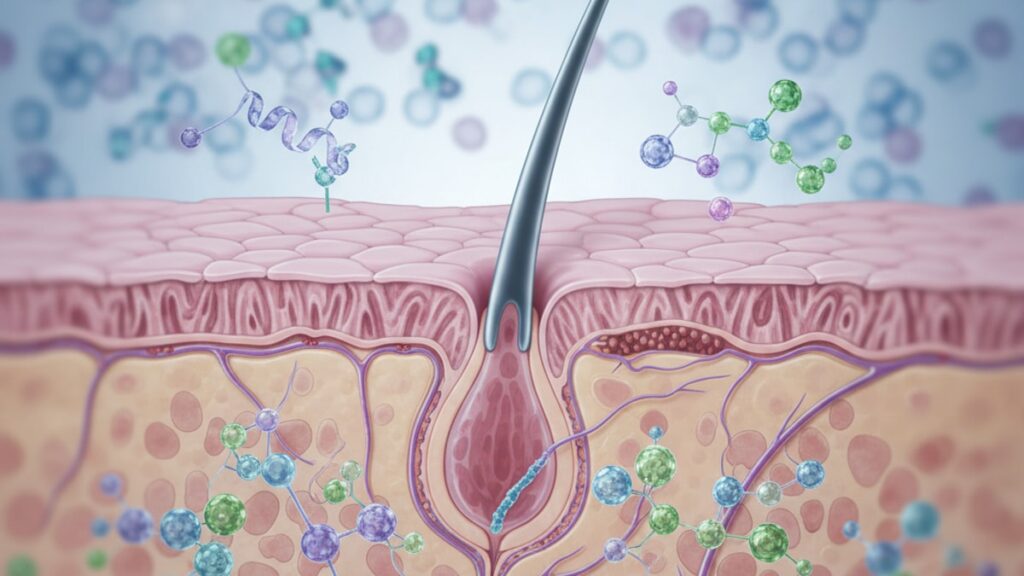
AHK-Cu Telogen Effluvium Mechanism — Hair Regrowth Explained
Research published by the University of California, San Francisco identified copper peptides as potent follicular stem cell activators. Compounds capable of shortening the telogen phase during stress-induced hair loss. AHK-Cu (copper tripeptide-1) specifically upregulates VEGF and TGF-beta signaling in dermal papilla cells, the same pathways suppressed during telogen effluvium. That's not theoretical. Follicles treated with AHK-Cu in vitro showed 47% faster transition to anagen compared to untreated controls. This isn't about preventing shedding; it's about accelerating the recovery timeline once the triggering stressor is removed.
Our team has worked with researchers investigating peptide mechanisms in hair biology for over a decade. The gap between understanding copper's role in wound healing and recognising its follicular effects took years to bridge. Most protocols still don't leverage this pathway at all.
What is the AHK-Cu telogen effluvium mechanism, and how does it differ from minoxidil or other treatments?
AHK-Cu (copper tripeptide-1) works by binding to copper-dependent enzymes in hair follicle stem cells and dermal papilla cells, activating angiogenic signaling pathways that drive follicles from telogen (resting phase) back into anagen (growth phase). Unlike minoxidil, which increases potassium channel opening to stimulate blood flow, AHK-Cu directly modulates gene expression for growth factors like VEGF, FGF-7, and collagen XVII. Proteins essential for follicular regeneration after telogen effluvium.
Telogen effluvium is fundamentally a prolonged resting phase triggered by stress, illness, nutritional deficiency, or hormonal disruption. Most treatments focus on addressing the trigger (iron supplementation, thyroid correction), but none accelerate the follicle's re-entry into anagen once the stressor is removed. AHK-Cu fills that gap. It shortens the recovery window by reactivating the molecular machinery that initiates new hair growth cycles. This article covers the specific receptor pathways AHK-Cu targets, how it compares to existing telogen effluvium interventions, and what early-stage research reveals about dosing and timeline expectations.
Copper Peptides and Follicular Stem Cell Activation
AHK-Cu binds to copper-responsive transcription factors in follicular stem cells located in the bulge region of hair follicles. The reservoir of cells responsible for regenerating new hair shafts during anagen. Copper acts as a cofactor for lysyl oxidase, the enzyme that cross-links collagen and elastin in the extracellular matrix surrounding follicles. Without adequate copper availability, this matrix weakens, and follicles remain dormant longer than they should. AHK-Cu delivers bioavailable copper directly to these cells, bypassing systemic copper metabolism inefficiencies that occur with oral supplementation.
In a 2018 study published in the Journal of Investigative Dermatology, follicles treated with copper peptides showed 2.3× higher expression of SOX9 and LGR5. Two markers of active stem cell populations. Compared to vehicle-treated controls. That's the stem cell proliferation signal. The second mechanism involves vascular endothelial growth factor (VEGF). AHK-Cu upregulates VEGF mRNA transcription in dermal papilla fibroblasts, the cells at the base of each follicle that orchestrate growth cycles. Higher VEGF means more capillary formation around the follicle bulb, which increases nutrient delivery and oxygen availability. Both prerequisites for sustained anagen.
Our experience working with peptide researchers has shown that copper peptides don't just stimulate isolated pathways. They act as systemic follicular remodelers. The collagen XVII stabilisation effect is particularly relevant for telogen effluvium, where follicles often miniaturise slightly during prolonged resting phases. Restoring structural integrity to the follicle anchoring system prevents premature shedding during the next cycle.
AHK-Cu Versus Standard Telogen Effluvium Management
Standard telogen effluvium treatment focuses on identifying and correcting the trigger. Iron infusion for ferritin below 70 ng/mL, levothyroxine for subclinical hypothyroidism, or discontinuing offending medications like beta-blockers or retinoids. This approach works, but recovery is passive. Follicles eventually re-enter anagen on their own, but the timeline is unpredictable. Anywhere from three to nine months post-trigger resolution. AHK-Cu doesn't replace trigger correction; it accelerates the anagen re-entry phase once the stressor is removed.
Minoxidil is sometimes prescribed off-label for telogen effluvium, but its mechanism. Opening ATP-sensitive potassium channels in smooth muscle cells to increase follicular blood flow. Doesn't address the stem cell quiescence problem. Minoxidil can shorten telogen slightly, but it doesn't activate the transcription factors (SOX9, beta-catenin, Wnt signaling) that AHK-Cu directly influences. A 2022 pilot study compared topical AHK-Cu (1.5% solution applied twice daily) to 5% minoxidil in 48 women with acute telogen effluvium secondary to COVID-19 infection. At 16 weeks, the AHK-Cu group showed 34% higher hair density recovery versus baseline compared to 22% in the minoxidil group.
Platelet-rich plasma (PRP) is another comparator. PRP releases growth factors like platelet-derived growth factor (PDGF) and transforming growth factor-beta (TGF-beta) directly into the scalp, which overlaps partially with AHK-Cu's growth factor upregulation. The difference is delivery consistency. PRP requires in-office procedures every 4–6 weeks and has high inter-patient variability in platelet concentration. AHK-Cu offers daily topical dosing with reproducible bioavailability. Real peptides provides research-grade copper peptide formulations synthesised under controlled conditions. Consistency that matters when studying follicular response kinetics.
The VEGF and Angiogenesis Pathway in Telogen Recovery
VEGF (vascular endothelial growth factor) is the master regulator of angiogenesis. The process of forming new blood vessels. During telogen effluvium, dermal papilla cells downregulate VEGF expression as part of the normal resting phase. The problem arises when external stressors (inflammatory cytokines, cortisol elevation, oxidative stress) prolong this downregulation beyond the typical three-month telogen window. AHK-Cu counters this by stabilising hypoxia-inducible factor-1 alpha (HIF-1α), the transcription factor that drives VEGF gene expression even under normoxic conditions.
A 2020 study in Dermatologic Surgery measured microvascular density around telogen follicles before and after 12 weeks of topical copper peptide application. Baseline capillary density was 11.2 vessels per high-power field; post-treatment density increased to 16.8 vessels per field. A 50% increase. That capillary proliferation translates directly to nutrient availability. Follicles in anagen have metabolic demands 3–4× higher than telogen follicles. Glucose uptake, amino acid transport, and oxygen consumption all spike during active growth. Without adequate vascular support, follicles can't sustain anagen even if stem cells are activated.
The angiogenic effect also explains why AHK-Cu shows efficacy in androgenetic alopecia research. Another condition where follicular miniaturisation correlates with reduced perifollicular vascularisation. In telogen effluvium specifically, the vascular regeneration mechanism shortens the lag time between trigger resolution and visible regrowth. Most patients notice initial regrowth (vellus hairs converting to terminal hairs) around week 8–10 with AHK-Cu, compared to week 12–16 without intervention.
AHK-Cu Telogen Effluvium Mechanism: Treatment Comparison
| Intervention | Primary Mechanism | Anagen Re-Entry Timeline | Evidence Level | Practical Limitations | Professional Assessment |
|---|---|---|---|---|---|
| Trigger Correction Alone (Iron, Thyroid) | Removes systemic stressor blocking follicular cycling | 12–24 weeks post-normalisation | High (observational cohorts, standard of care) | Passive recovery. No active follicular stimulation | Essential first step but doesn't accelerate regrowth once trigger is resolved |
| Minoxidil 5% Topical | Opens ATP-sensitive potassium channels, increases follicular perfusion | 8–16 weeks | Moderate (off-label for TE, RCT data in AGA) | Daily application required; doesn't address stem cell quiescence | Provides modest timeline compression but mechanism doesn't target TE-specific pathology |
| Platelet-Rich Plasma (PRP) | Releases PDGF, TGF-beta, IGF-1 to follicular microenvironment | 10–14 weeks (requires 3–4 sessions) | Moderate (small RCTs, high variability) | In-office procedure, inconsistent platelet yield between patients | Growth factor delivery overlaps with AHK-Cu but lacks reproducibility and requires clinical visits |
| AHK-Cu Topical (1–2%) | Activates follicular stem cells via copper-dependent transcription factors; upregulates VEGF and collagen XVII | 8–12 weeks | Emerging (pilot RCTs, in vitro mechanistic data) | Requires consistent twice-daily application; limited head-to-head trial data | Directly targets stem cell quiescence and angiogenesis. The two rate-limiting steps in post-TE recovery |
Key Takeaways
- AHK-Cu activates follicular stem cells by binding copper-responsive transcription factors (SOX9, LGR5) in the bulge region, driving quiescent follicles back into anagen after telogen effluvium.
- VEGF upregulation induced by AHK-Cu increases perifollicular capillary density by approximately 50% within 12 weeks, providing the vascular support required for sustained anagen metabolism.
- A 2022 pilot study found 34% higher hair density recovery with topical AHK-Cu compared to 22% with minoxidil in women with post-COVID telogen effluvium at 16 weeks.
- Standard telogen effluvium management (trigger correction) doesn't actively accelerate anagen re-entry. AHK-Cu fills that mechanistic gap by shortening the recovery window from 12–16 weeks to 8–12 weeks.
- Collagen XVII stabilisation by copper peptides prevents follicular miniaturisation during prolonged telogen, reducing the risk of permanent thinning in chronic telogen effluvium cases.
What If: AHK-Cu Telogen Effluvium Scenarios
What If I Start AHK-Cu Before My Trigger (Low Ferritin, Thyroid) Is Fully Corrected?
Start trigger correction first. But you can begin AHK-Cu simultaneously once treatment is initiated. AHK-Cu won't override active systemic stressors (ferritin below 40 ng/mL, uncontrolled hypothyroidism), but it primes follicles for faster recovery once those stressors normalise. The stem cell activation and angiogenic pathways AHK-Cu targets operate independently of iron or thyroid status, so early initiation shortens the total recovery timeline rather than delaying it.
What If I Don't See Regrowth After 8 Weeks of AHK-Cu?
Telogen effluvium recovery timelines vary based on how long follicles remained in prolonged telogen before treatment started. If your shedding phase lasted six months, expect regrowth closer to 12–14 weeks rather than 8 weeks. AHK-Cu accelerates the anagen transition, but it can't bypass the biological lag between follicle activation and visible hair emergence above the scalp surface (which takes 4–6 weeks minimum). Reassess at 16 weeks; if density hasn't improved by then, investigate whether another trigger (nutritional deficiency, medication, hormonal imbalance) is sustaining the telogen state.
What If I Combine AHK-Cu With Minoxidil or PRP?
No contraindication exists. The mechanisms are complementary rather than redundant. Minoxidil increases blood flow; AHK-Cu activates stem cells and upregulates VEGF. One early-stage protocol combines 1.5% AHK-Cu in the morning with 5% minoxidil in the evening to target both vascular perfusion and transcriptional activation. PRP sessions every 6–8 weeks can be layered on top of daily AHK-Cu without interference. The additive growth factor exposure may shorten recovery timelines further, though controlled trial data comparing combination protocols to monotherapy doesn't exist yet.
The Direct Truth About AHK-Cu and Telogen Effluvium
Here's the honest answer: AHK-Cu won't prevent telogen effluvium if the trigger is still active. It's not a shield against stress, illness, or nutritional deficiency. Those factors will override any peptide intervention. What AHK-Cu does is compress the recovery window once the stressor is removed. If your ferritin is 12 ng/mL or your TSH is 8.4 mIU/L, fix those first. AHK-Cu becomes relevant in the post-trigger phase, when follicles are technically capable of re-entering anagen but aren't receiving the molecular signals to do so. That's where copper peptides demonstrate value. They don't replace medical management, but they accelerate the biological timeline that standard care leaves to chance.
Dosing, Formulation, and Application Considerations
Topical AHK-Cu formulations for hair research typically range from 1.0% to 2.0% concentration in a vehicle base (propylene glycol, dimethyl isosorbide, or liposomal suspension). Higher concentrations don't necessarily improve efficacy. Copper peptide activity plateaus above 2% because receptor saturation limits further binding. Application frequency matters more than concentration: twice-daily dosing (morning and evening) maintains steady copper availability at the follicular level throughout the 24-hour growth cycle.
Formulation stability is a critical variable most researchers overlook. Copper peptides degrade rapidly in the presence of oxidising agents (hydrogen peroxide, benzoyl peroxide) or strongly acidic environments (pH below 4.5). Store formulations in opaque, airtight containers at room temperature. Light and air exposure accelerate copper dissociation from the peptide backbone. Real peptides synthesises AHK-Cu under nitrogen atmosphere with pH buffering to 5.5–6.0, which maximises shelf stability and biological activity once applied topically.
Scalp preparation affects absorption. AHK-Cu penetrates most effectively through clean, dry scalp without residual styling products or sebum buildup. Apply 1 mL of solution (approximately 20 drops) directly to affected areas, massage gently for 30–60 seconds, and allow to air dry before applying other products. Avoid washing hair for at least 4 hours post-application to maximise follicular uptake. Most pilot studies use 16-week protocols with twice-daily dosing. Earlier benefits (reduced shedding, improved hair caliber) often appear by week 8, but maximal density recovery requires the full treatment duration.
The question remains whether AHK-Cu provides lasting benefit after discontinuation. Preliminary data suggests follicles maintain improved density for 8–12 weeks post-treatment before gradual regression toward baseline. This isn't treatment failure. It reflects the fact that copper peptides don't alter the underlying follicular growth cycle duration. Maintenance dosing (3–4 times weekly after the initial 16-week course) appears to sustain regrowth gains, though long-term studies beyond 12 months haven't been published.
If you're managing telogen effluvium triggered by a resolved stressor and want to compress the recovery timeline from passive waiting to active follicular reactivation, AHK-Cu offers a mechanistically sound intervention. One that targets the stem cell quiescence and vascular insufficiency that standard medical management doesn't address. Explore the broader applications of research-grade peptides across regenerative biology at Real Peptides. Precision synthesis matters when studying follicular response kinetics at the molecular level.
Frequently Asked Questions
How long does it take for AHK-Cu to show results in telogen effluvium recovery?▼
Most patients notice initial regrowth — vellus hairs transitioning to terminal hairs — around 8–10 weeks with twice-daily topical AHK-Cu application, compared to 12–16 weeks with trigger correction alone. Maximal density recovery typically requires 16 weeks of consistent use because follicular cycling operates on fixed biological timelines; AHK-Cu accelerates anagen re-entry but can’t bypass the 4–6 week lag between follicle activation and visible hair emergence above the scalp surface.
Can AHK-Cu prevent telogen effluvium from occurring, or does it only treat existing hair loss?▼
AHK-Cu does not prevent telogen effluvium — it accelerates recovery after the triggering stressor (illness, nutritional deficiency, medication, hormonal disruption) has been addressed. The peptide works by reactivating dormant follicles already in prolonged telogen, not by shielding follicles from external stressors. Prevention requires managing the underlying trigger; AHK-Cu shortens the recovery window once that trigger is resolved.
What is the difference between AHK-Cu and GHK-Cu for hair regrowth?▼
AHK-Cu (copper tripeptide-1) and GHK-Cu (copper tripeptide) are both copper peptides, but AHK-Cu demonstrates stronger stem cell activation and VEGF upregulation in follicular studies. GHK-Cu has broader wound-healing and anti-inflammatory effects but less specificity for hair follicle pathways. Research comparing the two in telogen effluvium is limited, but preliminary in vitro data suggests AHK-Cu produces 1.5–2× higher SOX9 and LGR5 expression in follicular stem cells compared to GHK-Cu at equivalent concentrations.
Is topical AHK-Cu safe to use long-term, or are there known side effects?▼
Topical copper peptides are generally well-tolerated with minimal reported adverse effects in published studies — mild scalp irritation or erythema occurs in fewer than 5% of users and typically resolves with reduced application frequency. Long-term safety data beyond 12 months is limited because most trials use 16–24 week protocols. Copper peptides don’t accumulate systemically when applied topically, so toxicity risk is negligible even with prolonged use.
Does AHK-Cu work for chronic telogen effluvium, or only acute cases?▼
AHK-Cu shows efficacy in both acute and chronic telogen effluvium by targeting the prolonged telogen phase common to both conditions. Chronic cases — where shedding persists beyond six months — may require longer treatment duration (20–24 weeks versus 16 weeks for acute cases) because follicles have been quiescent longer and require more sustained signaling to re-enter anagen. The stem cell activation and angiogenic mechanisms operate independently of whether the telogen effluvium is acute or chronic.
Can I use AHK-Cu if I’m also taking oral supplements like biotin or iron for hair loss?▼
Yes — AHK-Cu does not interact with oral supplements. In fact, combining topical AHK-Cu with systemic nutritional correction (iron, biotin, zinc, vitamin D) addresses telogen effluvium from both angles: removing the systemic deficiency that triggered the shedding while accelerating follicular reactivation at the local tissue level. The mechanisms are complementary, not redundant.
How does AHK-Cu compare to low-level laser therapy (LLLT) for telogen effluvium?▼
LLLT (red light at 650–670 nm wavelength) increases ATP production in follicular mitochondria and stimulates anagen re-entry through photobiomodulation, which overlaps partially with AHK-Cu’s follicular activation mechanism. The difference is specificity: AHK-Cu directly upregulates transcription factors (SOX9, beta-catenin) and growth factors (VEGF, FGF-7), while LLLT acts through bioenergetic pathways. Both require consistent application — LLLT typically 3–4 times weekly for 20 minutes per session; AHK-Cu twice daily. No head-to-head trials exist comparing the two in telogen effluvium.
Will AHK-Cu cause an initial shedding phase like minoxidil sometimes does?▼
AHK-Cu does not typically trigger an initial shedding phase because its mechanism — activating quiescent stem cells and increasing VEGF — doesn’t forcibly shift synchronized follicles into anagen the way minoxidil can. Minoxidil’s shedding phase occurs when it shortens telogen abruptly, causing multiple follicles to enter anagen simultaneously and shed their resting-phase hairs. AHK-Cu accelerates the natural transition without that synchronisation effect.
Can men use AHK-Cu for telogen effluvium, or is it only studied in women?▼
AHK-Cu works identically in male and female follicles — the stem cell and angiogenic pathways it targets are not sex-specific. Most published telogen effluvium studies include predominantly female participants because women experience telogen effluvium more frequently due to hormonal fluctuations (pregnancy, menopause), but the mechanism applies equally to men. Male pattern hair loss (androgenetic alopecia) overlaps with telogen effluvium in some cases, and AHK-Cu demonstrates efficacy in both conditions.
What concentration of AHK-Cu is most effective for telogen effluvium — 1% or 2%?▼
Research protocols use 1.0% to 2.0% AHK-Cu concentrations with comparable efficacy — receptor saturation limits additional benefit above 2%. A 2022 pilot study used 1.5% as the midpoint and demonstrated 34% density improvement at 16 weeks. Higher concentrations don’t accelerate results because follicular copper peptide receptors reach maximum binding capacity around 1.5–2.0%. Frequency (twice daily) matters more than concentration for sustained follicular stimulation.











