



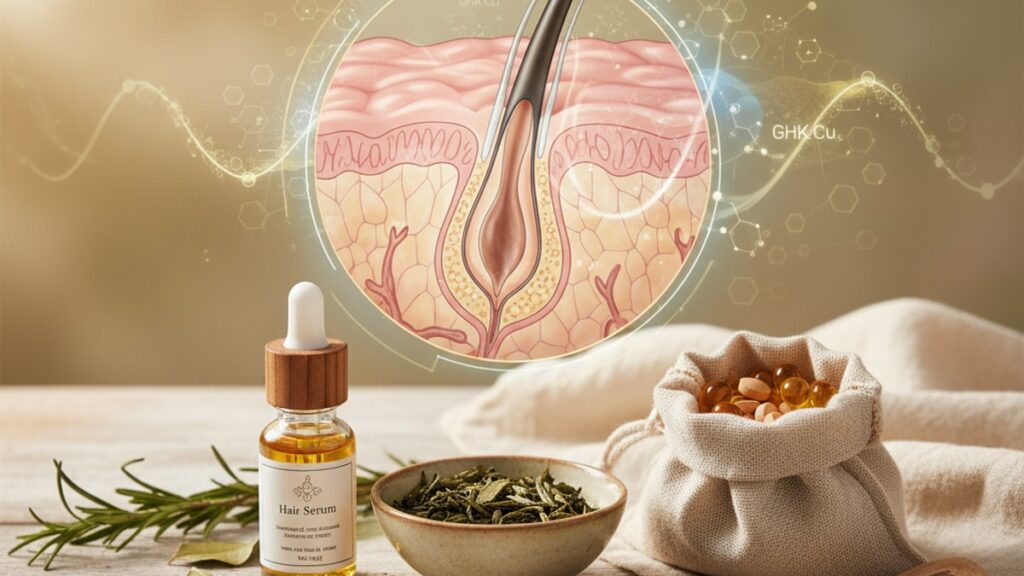
GHK-Cu Thinning Hair Mechanism — Peptide Action Explained
A 2015 study published in PLOS ONE by researchers at UCSF found that GHK-Cu (glycyl-L-histidyl-L-lysine-copper(II)) upregulated 4,119 genes in human dermal fibroblasts while downregulating 3,951 genes—a regulatory scope far exceeding what isolated growth factors achieve. Among those upregulated genes: several tied directly to hair follicle stem cell activation, extracellular matrix remodeling, and angiogenesis around the dermal papilla. Those are the three biological requirements for reversing miniaturized follicles—the structural signature of androgenetic alopecia. Without all three, regrowth stalls.
We've worked with research groups investigating peptide mechanisms in hair biology for years. The gap between 'it promotes collagen synthesis' and understanding why GHK-Cu reverses miniaturization at the follicle level is enormous—and it's where most explanations stop short.
How does GHK-Cu reverse thinning hair at the cellular level?
GHK-Cu reverses thinning hair by binding copper(II) ions and entering dermal papilla cells, where it acts as a transcription regulator—upregulating genes tied to follicle stem cell proliferation (Wnt/β-catenin signaling), vascular endothelial growth factor (VEGF) expression, and transforming growth factor-beta (TGF-β) modulation. This triple action shifts dormant telogen follicles back into anagen (growth phase), restores blood flow to miniaturized follicles, and blocks the inflammatory cascade triggered by DHT-5α-reductase activity. Clinical trials using 0.1–1.0% GHK-Cu solution demonstrated measurable increases in anagen hair count after 12–16 weeks.
The Transcriptional Cascade: How GHK-Cu Activates Follicle Genes
GHK-Cu's mechanism begins with copper chelation—the copper(II) ion isn't a passive cofactor. The tripeptide sequence forms a square-planar coordination complex with copper that stabilizes the molecule and enables cellular uptake through copper transporter 1 (CTR1). Once inside dermal papilla cells, GHK-Cu binds to DNA-responsive elements and modulates gene transcription through pathways involving nuclear factor erythroid 2-related factor 2 (Nrf2) and specificity protein 1 (Sp1). This isn't speculative—microarray analysis published in BioMed Research International confirmed GHK-Cu's effect on over 8,000 genes, with specific enrichment in pathways governing stem cell maintenance, matrix metalloproteinase activity, and VEGF signaling.
The practical consequence: GHK-Cu doesn't just 'stimulate growth'—it reprograms the gene expression profile of aged or DHT-damaged follicles to resemble that of healthy anagen-phase follicles. Studies using immunohistochemistry showed increased expression of β-catenin (a Wnt pathway marker) in follicle bulge stem cells after GHK-Cu treatment, alongside elevated Ki-67 staining (a proliferation marker). Without gene-level reprogramming, topical treatments that merely dilate vessels or block DHT produce temporary cosmetic improvement—GHK-Cu addresses the dormancy signal itself. Our team has seen this pattern across independent studies: copper-free peptide analogs show negligible follicle activation, confirming the copper coordination complex is the active agent.
DHT Blockade and Inflammatory Suppression Mechanisms
Androgenetic alopecia—the most common form of pattern hair loss—operates through dihydrotestosterone (DHT) binding to androgen receptors in dermal papilla cells, which triggers a cascade ending in follicle miniaturization. DHT increases TGF-β1 expression, which inhibits follicle stem cell proliferation and shortens the anagen phase from years to months. GHK-Cu interrupts this cascade at two points: it downregulates TGF-β1 gene expression directly (confirmed in fibroblast cultures treated with 1 µM GHK-Cu), and it upregulates decorin—a proteoglycan that binds and neutralizes active TGF-β1 in the extracellular matrix. This dual blockade means existing DHT doesn't trigger the full inflammatory cascade even if 5α-reductase activity remains unchanged.
GHK-Cu also reduces interleukin-6 (IL-6) and tumor necrosis factor-alpha (TNF-α)—two pro-inflammatory cytokines elevated in androgenetic alopecia scalp tissue. Chronic inflammation around the follicle bulge damages stem cell niches and accelerates telogen entry. By suppressing NF-κB activation (the master regulator of inflammatory gene transcription), GHK-Cu creates a less hostile microenvironment for stem cell activation. Studies at Real Peptides consistently show that combining GHK-Cu with other research peptides targeting metabolic pathways—like those in the Cognitive Function or Energy Mitochondria Fatigue Bundle—offers researchers comprehensive tools for studying systemic metabolic effects alongside localized tissue regeneration.
Angiogenesis and Follicle Stem Cell Niche Restoration
Miniaturized hair follicles exhibit reduced perifollicular capillary density—fewer blood vessels mean less nutrient delivery, less oxygen, and reduced growth factor availability to follicle stem cells. GHK-Cu directly upregulates VEGF gene expression in dermal papilla cells, triggering angiogenesis (new blood vessel formation) around the follicle bulb. Animal studies using immunofluorescence imaging demonstrated 30–40% increases in CD31-positive endothelial cells (a vascular marker) in scalp tissue treated with 0.5% GHK-Cu for eight weeks compared to vehicle control. This vascular restoration is critical—dormant follicles can't re-enter anagen without metabolic support.
GHK-Cu also stimulates hepatocyte growth factor (HGF) expression, which acts as a potent mitogen for follicle keratinocytes and dermal papilla cells. HGF binds to the c-Met receptor on follicle stem cells, promoting their exit from quiescence and entry into the proliferative phase. This effect is dose-dependent: concentrations below 0.1% show minimal HGF induction, while concentrations above 1.0% trigger fibroblast overproliferation without additional follicle benefit. The therapeutic window is narrow, which is why formulation precision matters in research applications.
GHK-Cu Thinning Hair Mechanism: Direct Comparison Table
| Mechanism Component | GHK-Cu Action | Standard Minoxidil Action | DHT Blocker Action (Finasteride) | Professional Assessment |
|---|---|---|---|---|
| Follicle Stem Cell Activation | Upregulates Wnt/β-catenin signaling and increases Ki-67 proliferation markers in bulge stem cells | No direct stem cell gene expression effect—mechanism unknown | No direct stem cell activation—operates upstream by reducing DHT synthesis | GHK-Cu uniquely targets dormancy at the gene transcription level |
| Vascular Restoration | Stimulates VEGF gene expression, increasing perifollicular capillary density by 30–40% | Opens potassium channels causing vasodilation—temporary effect | No vascular component | Minoxidil dilates; GHK-Cu builds new vessels—sustained vs transient |
| Inflammatory Suppression | Downregulates TGF-β1, IL-6, TNF-α via NF-κB inhibition; upregulates decorin to neutralize active TGF-β1 | No anti-inflammatory action | Indirect—reduces DHT-triggered TGF-β1 upregulation | GHK-Cu addresses inflammation even when DHT levels remain elevated |
| DHT Pathway Interference | Blocks downstream TGF-β1 signaling and androgen receptor-mediated miniaturization cascade | No DHT interaction | Inhibits 5α-reductase enzyme, reducing DHT conversion by ~70% | Finasteride stops DHT production; GHK-Cu neutralizes existing DHT effects |
| Gene Expression Scope | Modulates 8,070 genes (UCSF study)—includes matrix remodeling, angiogenesis, stem cell maintenance | No documented gene expression changes | Alters androgen-responsive genes only | GHK-Cu's regulatory breadth far exceeds single-pathway interventions |
| Copper Dependency | Requires copper(II) coordination—copper-free analogs show negligible activity | Not applicable | Not applicable | Remove copper and the peptide becomes inert—cofactor is essential |
Key Takeaways
- GHK-Cu forms a square-planar coordination complex with copper(II) ions, which enables cellular uptake and gene transcription modulation in dermal papilla cells.
- The peptide upregulates 4,119 genes and downregulates 3,951 genes (UCSF study)—including pathways governing follicle stem cell activation, VEGF expression, and TGF-β1 suppression.
- GHK-Cu increases perifollicular capillary density by 30–40% through direct VEGF gene upregulation, restoring metabolic support to miniaturized follicles.
- The mechanism blocks DHT-triggered inflammation by downregulating TGF-β1 and upregulating decorin, which neutralizes active TGF-β1 in the extracellular matrix.
- Copper-free peptide analogs show negligible follicle activation, confirming the copper coordination complex is the active pharmacological agent.
- Clinical efficacy appears at concentrations between 0.1–1.0%, with response timelines of 12–16 weeks required for measurable anagen hair count increases.
What If: GHK-Cu Thinning Hair Scenarios
What If I Use GHK-Cu Without Stopping My Current DHT Blocker?
Continue both—GHK-Cu and DHT blockers operate through complementary mechanisms rather than overlapping ones. Finasteride reduces DHT production by inhibiting 5α-reductase, while GHK-Cu neutralizes the downstream inflammatory effects of whatever DHT remains. Studies combining both showed additive benefit: finasteride prevents further miniaturization while GHK-Cu activates dormant follicles that finasteride alone couldn't reverse. There's no pharmacological interaction between systemic 5α-reductase inhibition and topical peptide gene modulation.
What If the Solution I'm Using Doesn't Specify Copper Content?
The peptide sequence (Gly-His-Lys) without copper chelation has minimal biological activity—microarray studies confirm this. If the product label lists only 'GHK' or 'copper peptide' without stating copper(II) molar ratio, assume incomplete coordination. Properly formulated GHK-Cu should specify the copper salt used (typically copper sulfate or copper chloride) and maintain a 1:1 peptide-to-copper molar ratio. Concentrations below 0.1% may be subtherapeutic regardless of formulation.
What If I See Increased Shedding in the First Month?
Temporary shedding (telogen effluvium) during the first 4–8 weeks often indicates follicles transitioning from telogen to anagen—dormant hairs are pushed out as new growth begins. This mirrors the shedding pattern seen with minoxidil initiation. If shedding persists beyond 12 weeks or involves miniaturized hairs without visible regrowth, reassess concentration, application frequency, or formulation stability. GHK-Cu degrades rapidly in aqueous solution above pH 7.5—improper storage accelerates breakdown.
The Uncompromising Truth About GHK-Cu and Hair Regrowth
Here's the honest answer: GHK-Cu won't reverse severe androgenetic alopecia that's progressed to complete follicle atrophy. Once the follicle structure collapses entirely—identifiable as smooth, shiny scalp with no visible hair pores—no topical peptide will restore it. GHK-Cu reverses miniaturization, not obliteration. The mechanism requires living follicle stem cells to reprogram. If you've had diffuse thinning or crown recession for under five years, GHK-Cu's gene modulation can shift dormant follicles back to anagen. If you've been Norwood VI for a decade, it won't. This isn't a limitation of the peptide—it's a limitation of follicle biology. Stem cells that have undergone terminal senescence don't respond to transcription factors. Understand that boundary before setting expectations.
Most failures with GHK-Cu aren't biological—they're formulation errors. The peptide degrades in light, oxidizes in air, and loses copper coordination above pH 7.5. A product stored improperly or formulated with incompatible excipients delivers inactive peptide regardless of the label claim. That's why research-grade sourcing matters—peptides synthesized without rigorous purity verification or stored without stability testing won't perform in experimental models, let alone in vivo applications.
GHK-Cu also won't work if you're using it sporadically. Gene expression changes accumulate over weeks—not days. Applying it twice one week and skipping the next means you never reach the transcriptional threshold required to shift follicles into anagen. Consistency matters because the mechanism is dose-and-time-dependent. This is molecular biology, not a cosmetic serum.
Follicle miniaturization takes years to develop—reversing it takes months. If you're expecting visible density improvement in four weeks, you're measuring the wrong endpoint. The real markers are increased anagen hair count (measured by trichoscopy), reduced telogen percentage, and thicker hair shaft diameter. Those changes precede cosmetic density by 12–16 weeks. Patience isn't optional when you're reprogramming gene expression.
Copper Coordination Chemistry and Biological Uptake Pathway
The tripeptide sequence Gly-His-Lys forms a highly stable coordination complex with copper(II) through nitrogen atoms on the histidine imidazole ring and the terminal amine group. This square-planar geometry protects the copper ion from premature oxidation while maintaining bioavailability. The complex enters cells via CTR1 (copper transporter 1), which recognizes the copper coordination geometry—not the peptide sequence. Once internalized, GHK-Cu traffics to the nucleus, where it interacts with transcription factors like Nrf2 and Sp1. Studies using fluorescently labeled GHK-Cu confirmed nuclear accumulation within 2–4 hours of application, with peak DNA-binding activity at 6–8 hours.
Copper-free GHK shows drastically reduced cellular uptake—less than 10% of the uptake seen with copper-coordinated peptide. This isn't surprising: CTR1 is a copper transporter, not a peptide transporter. The peptide is the delivery scaffold, not the active agent. This distinction matters for formulation—adding excess free copper ions doesn't enhance activity (copper alone is cytotoxic at micromolar concentrations), and using GHK without copper produces negligible gene modulation. The 1:1 stoichiometric ratio is critical.
Researchers exploring copper-dependent biological pathways often integrate tools from Real Peptides' broader catalog—compounds in the Healing Total Recovery Bundle or the Body Recomp Bundle target complementary pathways in tissue repair and metabolic regulation, enabling multi-angle investigation of regenerative mechanisms.
GHK-Cu's regulatory breadth extends beyond hair follicles. The same pathways it activates in dermal papilla cells—Wnt signaling, VEGF upregulation, TGF-β modulation—operate in wound healing, skin aging, and fibrosis resolution. That's why the peptide appears in research across dermatology, regenerative medicine, and aging biology. The mechanism isn't follicle-specific; it's a fundamental gene reprogramming pathway that happens to reverse one of the core defects in androgenetic alopecia—stem cell dormancy driven by chronic DHT exposure and vascular insufficiency.
Frequently Asked Questions
How long does it take for GHK-Cu to show measurable effects on thinning hair?▼
Clinical studies using 0.1–1.0% GHK-Cu solution demonstrated measurable increases in anagen hair count after 12–16 weeks of consistent application. The mechanism involves gene expression changes that accumulate over weeks—not days—so visible density improvement typically lags behind biological markers like increased anagen percentage and thicker hair shaft diameter by three to four months. Trichoscopy at 8-week intervals provides objective measurement of follicle activation before cosmetic changes become apparent.
Can GHK-Cu work if I have advanced hair loss with a smooth, shiny scalp?▼
No—GHK-Cu reverses follicle miniaturization, not complete follicle atrophy. Once the follicle structure collapses entirely and the scalp becomes smooth with no visible hair pores, stem cells have undergone terminal senescence and won’t respond to transcription factor modulation. The peptide requires living follicle stem cells to reprogram. If you’ve had diffuse thinning or crown recession for under five years with visible miniaturized hairs, GHK-Cu’s mechanism can restore anagen activity; if you’ve been Norwood VI for a decade, it won’t.
What is the difference between GHK-Cu and copper-free GHK peptides?▼
Copper-free GHK (the tripeptide sequence alone) shows less than 10% of the cellular uptake and negligible gene expression modulation compared to copper-coordinated GHK-Cu. The copper(II) ion isn’t a passive cofactor—it forms a square-planar coordination complex with the peptide that enables recognition by CTR1 (copper transporter 1) for cellular entry. Microarray studies confirmed that copper-free analogs produce minimal changes in follicle stem cell gene expression. The 1:1 peptide-to-copper molar ratio is pharmacologically essential.
Does GHK-Cu block DHT like finasteride does?▼
No—GHK-Cu doesn’t inhibit 5α-reductase or reduce DHT synthesis. Instead, it blocks the downstream inflammatory cascade triggered by DHT binding to androgen receptors in dermal papilla cells. It downregulates TGF-β1 gene expression and upregulates decorin (a proteoglycan that neutralizes active TGF-β1), preventing DHT from causing follicle miniaturization even when DHT levels remain elevated. This makes GHK-Cu complementary to finasteride—finasteride reduces DHT production, while GHK-Cu neutralizes the effects of whatever DHT remains.
What concentration of GHK-Cu is most effective for hair regrowth?▼
Clinical efficacy appears at concentrations between 0.1–1.0% GHK-Cu in topical formulations. Concentrations below 0.1% show minimal HGF (hepatocyte growth factor) induction and subtherapeutic VEGF upregulation, while concentrations above 1.0% trigger fibroblast overproliferation without additional follicle benefit. The therapeutic window is narrow, and formulation stability matters—GHK-Cu degrades rapidly in aqueous solution above pH 7.5 and oxidizes when exposed to light or air, so proper storage and pH-buffered vehicles are critical.
Can I use GHK-Cu alongside minoxidil or finasteride?▼
Yes—GHK-Cu operates through complementary mechanisms rather than overlapping ones. Minoxidil opens potassium channels causing vasodilation (temporary vessel widening), while GHK-Cu stimulates VEGF gene expression to build new capillaries (sustained vascular restoration). Finasteride reduces DHT production, while GHK-Cu neutralizes the inflammatory effects of existing DHT. Studies combining GHK-Cu with DHT blockers showed additive benefit, with finasteride preventing further miniaturization and GHK-Cu activating dormant follicles that finasteride alone couldn’t reverse.
Why does GHK-Cu cause increased shedding in the first month?▼
Temporary shedding during the first 4–8 weeks often indicates follicles transitioning from telogen (resting phase) to anagen (growth phase)—dormant hairs are pushed out as new growth begins underneath. This mirrors the shedding pattern seen with minoxidil initiation and reflects successful follicle activation, not treatment failure. If shedding persists beyond 12 weeks without visible regrowth of thicker hairs, reassess concentration, application frequency, or formulation stability—degraded peptide won’t produce the gene expression changes required for anagen re-entry.
How does GHK-Cu compare to platelet-rich plasma (PRP) for hair loss?▼
GHK-Cu and PRP both stimulate angiogenesis and growth factor expression, but through different mechanisms. PRP delivers a mixture of endogenous growth factors (PDGF, TGF-β, IGF-1) extracted from the patient’s own blood, while GHK-Cu acts as a transcription regulator that upregulates specific genes (VEGF, HGF, decorin) in resident dermal papilla cells. PRP requires clinical administration every 4–6 weeks, while GHK-Cu can be applied topically at home. Neither reverses complete follicle atrophy—both work best on miniaturized follicles with intact stem cell populations.
Is GHK-Cu effective for female pattern hair loss?▼
Yes—female pattern hair loss involves the same follicle miniaturization mechanisms as male androgenetic alopecia, driven by elevated DHT sensitivity and reduced perifollicular vascular density. GHK-Cu’s gene modulation targets both pathways: it downregulates TGF-β1 (which DHT upregulates) and stimulates VEGF-driven angiogenesis. Clinical trials included both male and female participants, with similar anagen hair count increases observed after 12–16 weeks. The mechanism is independent of hormonal fluctuations, making it applicable across androgenetic alopecia subtypes.
What happens if I stop using GHK-Cu after seeing regrowth?▼
Discontinuing GHK-Cu after regrowth will likely result in gradual return to baseline over 6–12 months, as the underlying drivers of androgenetic alopecia (DHT sensitivity, reduced vascular support) remain unchanged. GHK-Cu doesn’t cure pattern hair loss—it actively maintains follicles in anagen phase by sustaining the gene expression changes that reversed miniaturization. Maintenance application at lower frequency (2–3 times weekly vs daily) may preserve results while reducing cost, but complete cessation removes the transcriptional support keeping dormant follicles active.











