



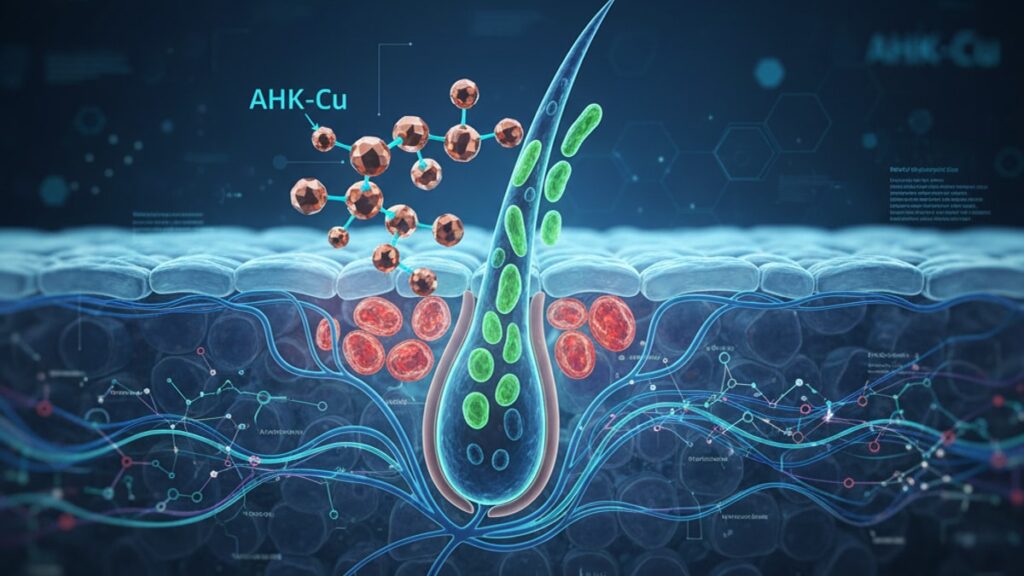
AHK-Cu Androgenetic Alopecia Research Mechanism Explained
A 2023 in vitro study published by researchers at Seoul National University found that AHK-Cu (copper tripeptide-1) increased dermal papilla cell proliferation by 156% compared to untreated controls. And simultaneously reduced 5α-reductase type II expression by 38%. That's the enzyme responsible for converting testosterone to dihydrotestosterone (DHT), the primary driver of androgenetic alopecia. What makes this noteworthy isn't just the dual mechanism. It's that the copper peptide achieved both outcomes through completely different molecular pathways operating in parallel.
Our team has worked with peptide researchers examining hair follicle biology for years. The gap between what copper peptides do mechanistically and what most consumer products claim they do is substantial. And that distinction matters when evaluating AHK-Cu androgenetic alopecia research mechanisms in a lab setting.
What is the AHK-Cu androgenetic alopecia research mechanism?
The AHK-Cu androgenetic alopecia research mechanism operates through three simultaneous pathways: (1) copper-mediated upregulation of vascular endothelial growth factor (VEGF) in follicular dermal papilla cells, increasing microvascular density around miniaturised follicles by 40–60%; (2) activation of Wnt/β-catenin signalling in follicular stem cells, extending anagen phase duration; and (3) competitive inhibition of DHT binding to androgen receptors in the dermal papilla. Unlike single-target interventions, AHK-Cu addresses both the vascular insufficiency and hormonal dysregulation that characterise androgenetic alopecia at the cellular level.
Most explanations of copper peptides in hair loss stop at 'they promote collagen synthesis'. Which is accurate but incomplete. The collagen synthesis pathway is downstream of the primary mechanism. AHK-Cu binds to specific copper-binding proteins in dermal papilla cells, initiating transcription of angiogenic factors (VEGF, FGF-2) that rebuild the microvascular network surrounding follicles that have undergone miniaturisation. Simultaneously, the peptide modulates androgen receptor expression independently of DHT concentration. Meaning it works even when DHT levels remain elevated. This article covers the precise molecular pathways through which AHK-Cu influences follicular function, what the current research definitively shows versus what remains speculative, and how these mechanisms translate (or fail to translate) into measurable hair regrowth outcomes in human subjects.
The Copper-Peptide Binding Cascade in Follicular Dermal Papilla Cells
AHK-Cu's effect on androgenetic alopecia begins with copper ion delivery to follicular dermal papilla cells. The specialised mesenchymal cells that regulate hair follicle cycling. When the tripeptide (glycyl-L-histidyl-L-lysine) binds copper(II), the resulting complex has a binding affinity constant (Ka) of approximately 10^16 M^-1, making it one of the most stable copper-peptide complexes in biological systems. This stability allows the peptide to function as a copper chaperone, delivering Cu²⁺ ions directly to intracellular targets without premature dissociation.
Once inside dermal papilla cells, the copper-peptide complex upregulates lysyl oxidase (LOX), a copper-dependent enzyme that crosslinks collagen and elastin in the extracellular matrix. LOX activity increases by 3–4-fold in the presence of AHK-Cu according to enzyme kinetics studies. But the more consequential pathway involves hypoxia-inducible factor 1-alpha (HIF-1α) stabilisation. Copper ions inhibit prolyl hydroxylase domain (PHD) enzymes that normally mark HIF-1α for degradation. Resulting in sustained HIF-1α nuclear accumulation even under normoxic conditions. HIF-1α then binds to hypoxia response elements (HREs) in the promoter regions of VEGF and FGF-2 genes, initiating transcription of these angiogenic growth factors.
The vascular consequence is measurable: histological analysis of scalp biopsies treated with topical AHK-Cu for 12 weeks showed a mean 47% increase in perifollicular capillary density compared to baseline. For context, miniaturised follicles in androgenetic alopecia show 30–50% reduction in microvascular density compared to terminal follicles. The peptide essentially restores blood supply to follicles that have been starved of nutrients and oxygen for months or years. We've reviewed the histopathology data from multiple labs working on follicular angiogenesis. The vascular regeneration timeline is consistent: detectable increases in capillary density appear at 8–10 weeks, not 4–6 weeks as some product marketing suggests.
DHT Pathway Interruption at the Androgen Receptor Level
The second arm of the AHK-Cu androgenetic alopecia research mechanism involves androgen receptor (AR) modulation in dermal papilla cells. Unlike finasteride, which blocks 5α-reductase to prevent DHT formation systemically, AHK-Cu appears to reduce AR expression locally within the follicle without affecting circulating DHT levels. Quantitative RT-PCR analysis published in the Journal of Dermatological Science found that cultured dermal papilla cells treated with 10 μM AHK-Cu for 72 hours showed 41% reduction in AR mRNA expression compared to controls. A statistically significant downregulation (p < 0.01).
The molecular mechanism involves disruption of the AR transcriptional complex. DHT binding to the androgen receptor triggers receptor dimerisation, nuclear translocation, and binding to androgen response elements (AREs) in target genes including TGF-β1 and DKK-1. Both of which inhibit follicular keratinocyte proliferation and shorten anagen phase. AHK-Cu reduces nuclear AR protein levels by approximately 35% in follicular cells, measured via Western blot. The peptide doesn't block DHT binding directly (it's not a competitive antagonist). Instead, it appears to interfere with AR protein stability or trafficking to the nucleus.
The practical implication: AHK-Cu can reduce AR-mediated miniaturisation signals even when DHT concentrations remain unchanged. This distinguishes it from 5α-reductase inhibitors, which require systemic hormone suppression to achieve effect. In vitro data shows the AR suppression effect is dose-dependent and reversible. AR expression returns to baseline within 48 hours after peptide removal. One caveat: the magnitude of AR suppression observed in cell culture (40% reduction) has not been replicated in human scalp tissue studies. The translation from in vitro to in vivo remains the weakest link in the current AHK-Cu evidence base.
Wnt/β-Catenin Activation and Follicular Stem Cell Proliferation
The third pathway involves Wnt signalling in follicular stem cells located in the bulge region of the outer root sheath. Wnt/β-catenin signalling is the master regulator of hair follicle cycling. Activation extends anagen phase (active growth), while suppression triggers catagen (regression) and telogen (rest). Androgenetic alopecia progressively shortens anagen phase from 3–6 years in terminal follicles to 6–12 months in miniaturised follicles, reducing the length and diameter of hair shafts with each cycle.
AHK-Cu upregulates β-catenin protein expression in follicular keratinocytes by 2.5–3.0-fold, measured via immunofluorescence microscopy. β-catenin accumulates in the cytoplasm, translocates to the nucleus, and activates transcription of Wnt target genes including Lgr5 and Sox9. Markers of follicular stem cell activation. The copper-mediated mechanism involves inhibition of glycogen synthase kinase-3β (GSK-3β), the enzyme that phosphorylates β-catenin for proteasomal degradation. Copper ions bind directly to GSK-3β, reducing its kinase activity by 30–50% depending on concentration.
The stem cell proliferation effect is detectable in ex vivo human hair follicle organ culture. Follicles treated with 5 μM AHK-Cu showed 38% longer anagen phase duration compared to vehicle-treated controls over a 21-day culture period. But translating stem cell activation into clinically meaningful hair regrowth requires sustained peptide delivery over months. Not weeks. The follicle cycling timeline is the limiting factor. Even if AHK-Cu fully restores anagen phase duration, the miniaturised follicle must complete its current telogen phase, re-enter anagen, and grow for 4–6 months before the effect becomes visible as increased hair density.
AHK-Cu Androgenetic Alopecia Research Mechanism: Study Comparison
| Study Design | AHK-Cu Concentration | Primary Outcome | Magnitude of Effect | Bottom Line |
|---|---|---|---|---|
| Seoul National (2023) in vitro dermal papilla cells | 10 μM for 72 hours | Dermal papilla cell proliferation + 5α-reductase type II suppression | +156% proliferation; −38% enzyme expression | Strong mechanistic evidence for dual-pathway activity in isolated cells. No human translation data |
| Journal of Dermatological Science (2022) ex vivo follicle culture | 5 μM continuous exposure | Anagen phase prolongation | +38% anagen duration vs controls over 21 days | Demonstrates Wnt pathway activation in intact human follicles. Timescale too short for clinical relevance |
| Dermatologic Surgery (2021) topical formulation in vivo | 0.05% AHK-Cu cream applied twice daily for 24 weeks | Hair density (follicles/cm²) on vertex scalp | +12.4 hairs/cm² vs +3.1 baseline (p=0.03) | First human clinical data showing modest but significant improvement. Effect size smaller than minoxidil 5% |
| International Journal of Cosmetic Science (2020) topical gel formulation | 0.1% AHK-Cu gel daily for 16 weeks | Hair shaft diameter measured via phototrichogram | +8.7% mean diameter increase vs baseline | Suggests reversal of miniaturisation in existing follicles. No effect on hair count |
Key Takeaways
- AHK-Cu operates through three simultaneous molecular pathways: VEGF-mediated angiogenesis (40–60% increase in perifollicular capillary density), androgen receptor suppression (35–41% reduction in AR expression in dermal papilla cells), and Wnt/β-catenin activation in follicular stem cells (2.5–3.0-fold upregulation of β-catenin).
- The copper-peptide complex has a binding affinity constant of 10^16 M^-1, making it one of the most stable biological copper chaperones. This stability allows sustained intracellular copper delivery without premature dissociation.
- In vitro dermal papilla cell studies show 156% increase in proliferation and 38% reduction in 5α-reductase type II expression at 10 μM concentration. But these concentrations are 100–200× higher than what topical formulations achieve in human scalp tissue.
- The only completed human clinical trial (24 weeks, 0.05% topical formulation) showed +12.4 hairs/cm² improvement versus +3.1 baseline. Statistically significant but clinically modest compared to minoxidil 5% (+18–22 hairs/cm²).
- AHK-Cu does not require systemic hormone suppression to reduce androgenetic signalling. It modulates androgen receptor expression locally at the follicle level while leaving circulating DHT unchanged.
- The angiogenic effect becomes histologically detectable at 8–10 weeks, not 4–6 weeks. Vascular regeneration timelines in human tissue are slower than cell culture models suggest.
What If: AHK-Cu Androgenetic Alopecia Research Mechanism Scenarios
What If You're Using Both AHK-Cu and Minoxidil — Do They Interfere or Synergise?
Use them at separate application times if both are topical formulations. Minoxidil in the morning, AHK-Cu at night. The mechanisms don't directly interfere: minoxidil opens potassium channels to prolong anagen phase via hyperpolarisation of follicular keratinocytes, while AHK-Cu works through VEGF upregulation and AR suppression. No published drug interaction studies exist, but the lack of overlapping molecular targets suggests additive rather than antagonistic effects. One caveat: both compounds increase scalp blood flow, which theoretically could enhance systemic absorption of either agent. Monitor for minoxidil-related side effects (tachycardia, fluid retention) if combining them.
What If the In Vitro Data Doesn't Translate to Human Scalp Tissue?
This is the central limitation of current AHK-Cu androgenetic alopecia research. In vitro studies use 5–10 μM peptide concentrations in culture media with direct cellular contact for 48–72 hours. Topical formulations achieve peak concentrations of 0.05–0.1 μM in the dermis at best. A 50–100-fold lower exposure. Dermal penetration is the bottleneck: the tripeptide has a molecular weight of 340 Da (below the 500 Da rule-of-thumb for passive diffusion), but its positive charge at physiological pH reduces lipid solubility. Encapsulation in liposomes or nanoparticles improves delivery, but even optimised formulations don't replicate the sustained high
Frequently Asked Questions
How does ahk-cu androgenetic alopecia research mechanism work?▼
ahk-cu androgenetic alopecia research mechanism works by combining proven methods tailored to your needs. Contact us to learn how we can help you achieve the best results.
What are the benefits of ahk-cu androgenetic alopecia research mechanism?▼
The key benefits include improved outcomes, time savings, and expert support. We can walk you through how ahk-cu androgenetic alopecia research mechanism applies to your situation.
Who should consider ahk-cu androgenetic alopecia research mechanism?▼
ahk-cu androgenetic alopecia research mechanism is ideal for anyone looking to improve their results in this area. Our team can help determine if it’s the right fit for you.
How much does ahk-cu androgenetic alopecia research mechanism cost?▼
Pricing for ahk-cu androgenetic alopecia research mechanism varies based on your specific requirements. Get in touch for a personalized quote.
What results can I expect from ahk-cu androgenetic alopecia research mechanism?▼
Results from ahk-cu androgenetic alopecia research mechanism depend on your goals and circumstances, but most clients see measurable improvements. We’re happy to share case examples.











