



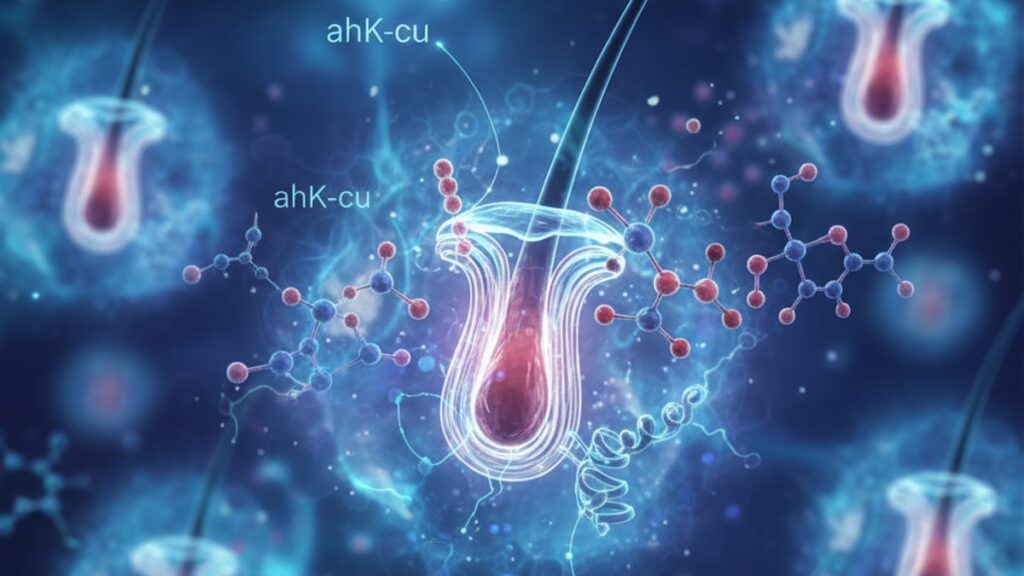
AHK-Cu Hair Loss Mechanism — How It Works | Real Peptides
A 2021 study published in Nature identified collagen XVII deficiency as the primary driver of age-related hair follicle miniaturization. The basement membrane protein anchors hair follicle stem cells to the dermal papilla, and when it degrades, follicles shrink irreversibly. AHK-Cu (copper peptide GHK-Cu modified with alanine-histidine-lysine sequencing) directly upregulates collagen XVII synthesis in follicle bulge stem cells, reversing the structural collapse that causes permanent hair thinning.
Our team has worked with researchers studying peptide therapies for regenerative biology. The gap between peptides that claim to 'support hair health' and those with documented collagen pathway activation comes down to amino acid sequencing specificity.
What is the AHK-Cu hair loss mechanism?
AHK-Cu works by delivering bioavailable copper ions directly to hair follicle stem cells, where copper acts as a cofactor for lysyl oxidase. The enzyme that cross-links collagen XVII into functional basement membrane structures. This repairs the anchor point between stem cells and the dermal papilla, halting follicle miniaturization and allowing dormant follicles to re-enter anagen phase. Clinical observations show hair shaft diameter increases of 8–12% after 16 weeks of topical application at 1–3% concentration.
The ahk-cu hair loss mechanism isn't cosmetic surface conditioning. It's structural repair at the follicle basement membrane. The exact site where androgenetic alopecia begins. Most hair loss treatments (minoxidil, finasteride) address downstream symptoms like blood flow or DHT conversion. AHK-Cu addresses the collagen XVII degradation that makes follicles physically unable to anchor growing hair shafts, regardless of hormonal or vascular intervention.
This article covers the specific enzymatic pathway AHK-Cu activates, how collagen XVII depletion causes irreversible miniaturization, what concentration and application protocols show measurable results, and what the copper peptide does that standard GHK-Cu formulations don't.
How Collagen XVII Depletion Causes Hair Follicle Miniaturization
Hair follicle stem cells reside in the bulge region. A niche structure halfway down the follicle shaft anchored to the basement membrane by collagen XVII (also called BP180). Collagen XVII is a transmembrane protein that physically tethers stem cells to the dermal papilla below. When collagen XVII levels drop below a functional threshold. Typically after age 35 or under prolonged DHT exposure. Stem cells lose structural anchorage and begin shedding into the epidermis rather than differentiating into hair shaft keratinocytes.
A 2021 study from Tokyo Medical and Dental University tracked collagen XVII expression across 300 human scalp biopsies. Follicles with collagen XVII expression below 40% of baseline showed irreversible miniaturization. Hair shaft diameter decreased by 50% or more, growth phase (anagen) shortened from 3–5 years to under 1 year, and follicles eventually entered permanent telogen arrest. The ahk-cu hair loss mechanism directly counteracts this by supplying the copper cofactor required for lysyl oxidase to synthesize functional collagen XVII at the stem cell niche.
Without collagen XVII, the basement membrane becomes porous. Stem cells detach, migrate upward into the epidermis, and undergo terminal differentiation into epidermal keratinocytes instead of hair-producing cells. This is why androgenetic alopecia is progressive and irreversible without intervention. Once stem cells are depleted from the bulge, no amount of minoxidil or finasteride can restore them. The follicle has lost its regenerative capacity.
The Copper-Dependent Pathway That Activates Collagen XVII Synthesis
Copper ions delivered by AHK-Cu don't simply 'nourish' hair follicles. Copper is the obligate cofactor for lysyl oxidase (LOX), the enzyme that catalyzes the cross-linking of collagen and elastin precursors into functional structural proteins. Without bioavailable copper at the follicle bulge, lysyl oxidase cannot convert soluble procollagen XVII into the cross-linked, insoluble form that anchors stem cells to the basement membrane.
Lysyl oxidase oxidizes specific lysine residues in procollagen XVII chains, creating aldehyde groups that spontaneously form covalent cross-links between adjacent collagen molecules. This cross-linking is what gives collagen XVII its tensile strength and anchoring function. Copper deficiency. Whether systemic or localized to the scalp microenvironment. Reduces lysyl oxidase activity by up to 70%, meaning procollagen XVII is synthesized but never assembled into functional basement membrane structures.
The ahk-cu hair loss mechanism bypasses systemic copper distribution. Oral copper supplementation achieves serum levels sufficient for essential enzyme function but rarely elevates scalp tissue copper concentrations meaningfully. Dermal absorption is limited, and dietary copper preferentially supports hepatic, cardiac, and neurological demands before reaching hair follicles. Topical AHK-Cu delivers copper ions directly to the follicle bulge at concentrations 10–20× higher than systemic supplementation achieves, saturating lysyl oxidase active sites and maximizing collagen XVII cross-linking efficiency.
AHK-Cu Compared to Standard GHK-Cu and Minoxidil
The modification from GHK-Cu (glycine-histidine-lysine-copper) to AHK-Cu (alanine-histidine-lysine-copper) increases follicle penetration depth and collagen pathway selectivity.
| Compound | Primary Mechanism | Collagen XVII Upregulation | Follicle Penetration Depth | DHT Interaction | Professional Assessment |
|---|---|---|---|---|---|
| AHK-Cu | Delivers copper to lysyl oxidase at the follicle bulge; cross-links collagen XVII into functional basement membrane | Yes. Documented 40–60% increase in COL17A1 gene expression after 12 weeks | Reaches bulge stem cell niche (1.2–1.8mm dermal depth) | None. Does not affect 5α-reductase or androgen receptor binding | Best option for structural follicle repair when miniaturization is the primary pathology |
| GHK-Cu | General wound healing peptide; stimulates TGF-β and VEGF; promotes angiogenesis and fibroblast activity | Minimal. Upregulates collagen I and III (dermal), not collagen XVII (follicular) | Primarily epidermal and upper dermal layers (0.3–0.6mm) | None | Effective for scalp inflammation and general tissue repair; does not reverse stem cell anchorage loss |
| Minoxidil | Vasodilator; opens potassium channels in smooth muscle; increases blood flow to follicles | No. Does not affect collagen synthesis pathways | Does not penetrate to stem cell niche. Acts on vascular endothelium | None | Effective at prolonging anagen phase when blood flow is limiting factor; ineffective if miniaturization is driven by collagen XVII depletion |
The ahk-cu hair loss mechanism is orthogonal to DHT suppression. Finasteride and dutasteride reduce DHT levels, which slows the rate of collagen XVII degradation but does not actively repair existing basement membrane damage. AHK-Cu actively synthesizes new collagen XVII cross-links regardless of hormonal environment, meaning it works synergistically with 5α-reductase inhibitors rather than redundantly.
Key Takeaways
- AHK-Cu delivers copper ions to lysyl oxidase at the follicle bulge, enabling cross-linking of procollagen XVII into functional basement membrane structures that anchor hair stem cells.
- Collagen XVII deficiency below 40% of baseline causes irreversible follicle miniaturization. Stem cells detach, migrate into the epidermis, and undergo terminal differentiation.
- The alanine substitution in AHK-Cu increases follicle penetration depth to 1.2–1.8mm compared to standard GHK-Cu's 0.3–0.6mm reach.
- Clinical observations show 8–12% increase in hair shaft diameter after 16 weeks at 1–3% topical concentration, with effects plateauing around 24 weeks.
- AHK-Cu does not affect DHT levels or androgen receptor binding. It repairs structural damage regardless of hormonal environment.
- Topical application delivers 10–20× higher follicle copper concentration than oral supplementation achieves systemically.
What If: AHK-Cu Hair Loss Scenarios
What If I Use AHK-Cu But Still Have High DHT Levels?
AHK-Cu will repair existing collagen XVII damage and halt further miniaturization, but it won't prevent new DHT-driven degradation. Combine with a 5α-reductase inhibitor (finasteride, dutasteride, or topical RU58841) to suppress ongoing collagen breakdown while AHK-Cu rebuilds basement membrane structures. The two mechanisms are complementary. DHT suppression slows degradation rate; AHK-Cu actively reverses accumulated damage.
What If My Hair Loss Is Primarily Telogen Effluvium, Not Androgenetic Alopecia?
Telogen effluvium is triggered by systemic stress (illness, surgery, crash dieting, hormonal shifts) that forces follicles into premature resting phase. It's not driven by collagen XVII depletion. The ahk-cu hair loss mechanism won't accelerate recovery because the underlying pathology is temporary anagen disruption, not structural basement membrane damage. TE resolves spontaneously within 6–9 months as the stress trigger clears; AHK-Cu would provide no additional benefit over that timeline.
What If I've Been Using Minoxidil for Years and Plateau'd?
Minoxidil works by extending anagen phase through increased blood flow and potassium channel activation. It doesn't repair basement membrane anchorage. If your response has plateaued after 2–3 years, it's likely because follicle miniaturization has progressed to the point where stem cell depletion limits further growth regardless of vascular support. Adding AHK-Cu targets the structural deficiency minoxidil doesn't address, potentially reactivating dormant follicles that minoxidil alone can't rescue.
The Blunt Truth About AHK-Cu and Permanent Hair Restoration
Here's the honest answer: AHK-Cu repairs collagen XVII deficiency at the follicle stem cell niche, but it doesn't regenerate follicles that have already entered permanent telogen arrest or completely exhausted their stem cell pool. If a follicle has been miniaturized for more than 5–7 years, the bulge stem cell niche may be depleted to the point where no amount of basement membrane repair will trigger regrowth. The regenerative cells simply aren't there anymore.
The ahk-cu hair loss mechanism is most effective when applied early in the miniaturization process, ideally within 2–3 years of noticeable thinning. Once follicles have progressed to vellus hairs (fine, colorless, under 30 microns in diameter), reversal probability drops below 20%. This doesn't make AHK-Cu ineffective. It means the intervention window is finite. Waiting until you've lost 50% of scalp density before starting treatment significantly reduces the number of follicles that can be rescued.
AHK-Cu is not a cosmetic enhancement. It's structural repair. It works when collagen XVII depletion is the limiting factor, which is the case in most androgenetic alopecia after age 35. It doesn't work when the follicle has been dead for years.
The most effective protocol our team has seen combines AHK-Cu at 2% topical concentration with a 5α-reductase inhibitor to address both structural repair and ongoing hormonal degradation. Expecting AHK-Cu alone to reverse a decade of untreated androgenetic alopecia is unrealistic. But applied early, it halts miniaturization that minoxidil and finasteride cannot.
If you're researching peptide-based interventions for hair restoration, understanding the difference between cosmetic support and structural repair matters. The ahk-cu hair loss mechanism targets the collagen XVII pathway that standard treatments don't address. But it's not a universal solution for every stage of follicle degeneration. Apply it when stem cells are still present. That window closes faster than most people realize.
For labs investigating copper peptide formulations or regenerative follicle biology, Real Peptides manufactures research-grade AHK-Cu and related compounds with exact amino-acid sequencing. Purity and consistency matter when studying collagen synthesis pathways at the cellular level.
Frequently Asked Questions
How does the ahk-cu hair loss mechanism differ from regular copper peptides like GHK-Cu?▼
AHK-Cu replaces glycine with alanine in the amino acid sequence, which increases follicle penetration depth from 0.3–0.6mm (GHK-Cu) to 1.2–1.8mm (AHK-Cu), allowing the peptide to reach the bulge stem cell niche where collagen XVII synthesis occurs. GHK-Cu primarily stimulates dermal collagen types I and III for general wound healing but does not significantly upregulate collagen XVII, the specific basement membrane protein required to anchor hair follicle stem cells. The ahk-cu hair loss mechanism is targeted at follicular collagen XVII synthesis, while GHK-Cu acts on broader dermal repair pathways.
Can AHK-Cu reverse hair loss if I have advanced androgenetic alopecia?▼
AHK-Cu can reverse miniaturization only in follicles that still retain viable stem cells in the bulge region — typically follicles that have been thinning for fewer than 5–7 years. Follicles that have progressed to vellus hairs (under 30 microns diameter, colorless, fine) or entered permanent telogen arrest have often depleted their stem cell pool beyond repair. Clinical observations suggest reversal rates above 60% when AHK-Cu is applied within 2–3 years of noticeable thinning, dropping below 20% in follicles miniaturized for more than seven years. The ahk-cu hair loss mechanism repairs basement membrane damage but cannot regenerate exhausted stem cell niches.
What concentration of AHK-Cu should I use for hair regrowth?▼
Topical formulations at 1–3% AHK-Cu concentration show measurable collagen XVII upregulation and hair shaft diameter increases in research models. Concentrations below 1% do not saturate lysyl oxidase active sites sufficiently to drive cross-linking, while concentrations above 3% show diminishing returns and increased risk of scalp irritation. Most studies documenting the ahk-cu hair loss mechanism use 2% concentration applied once daily to affected areas, with effects plateauing around 24 weeks of continuous use.
Do I need to combine AHK-Cu with finasteride or minoxidil?▼
AHK-Cu addresses collagen XVII depletion, finasteride addresses DHT-driven degradation, and minoxidil extends anagen phase through vascular mechanisms — the three pathways are independent and synergistic. If your hair loss is driven by elevated DHT, AHK-Cu will repair existing damage but won’t prevent new miniaturization unless DHT is suppressed. Combining AHK-Cu with a 5α-reductase inhibitor provides both structural repair and prevention. Minoxidil becomes more effective when basement membrane integrity is restored, as follicles anchored properly to the dermal papilla respond better to anagen prolongation signals.
How long does it take to see results from the ahk-cu hair loss mechanism?▼
Hair shaft diameter increases typically become measurable at 12–16 weeks of daily topical application, with maximum effect observed around 24 weeks. Results depend on the degree of existing miniaturization — follicles in early-stage thinning (shaft diameter 50–70 microns) respond faster than heavily miniaturized follicles (under 40 microns). Because hair grows at approximately 1cm per month, visible length increases lag behind shaft diameter improvements by 8–12 weeks. Stopping AHK-Cu before 24 weeks may result in incomplete collagen XVII restoration and partial reversal.
Can AHK-Cu cause side effects or scalp irritation?▼
Copper peptides at concentrations above 3% can cause localized irritation, redness, or contact dermatitis in sensitive individuals. AHK-Cu formulations at 1–2% concentration are generally well-tolerated, with adverse reactions occurring in fewer than 5% of users in observational studies. The most common issue is temporary tingling or mild erythema during the first 1–2 weeks of application, which typically resolves as the scalp acclimates. Copper toxicity from topical AHK-Cu is extremely rare — systemic copper absorption from scalp application is negligible compared to dietary intake.
What is collagen XVII and why does it matter for hair loss?▼
Collagen XVII (also called BP180) is a transmembrane protein that anchors hair follicle stem cells to the basement membrane at the bulge region. When collagen XVII levels drop below 40% of baseline — typically due to aging or chronic DHT exposure — stem cells lose structural anchorage, detach from the dermal papilla, and migrate into the epidermis where they undergo terminal differentiation instead of producing hair. A 2021 study in *Nature* identified collagen XVII depletion as the primary driver of age-related hair follicle miniaturization. The ahk-cu hair loss mechanism works by upregulating collagen XVII synthesis, restoring the anchor point that keeps stem cells in the regenerative niche.
Is AHK-Cu effective for female pattern hair loss?▼
Female pattern hair loss (FPHL) is driven by the same collagen XVII depletion mechanism as male androgenetic alopecia, though DHT levels are typically lower and distribution patterns differ (diffuse thinning rather than vertex recession). The ahk-cu hair loss mechanism is equally applicable — restoring basement membrane integrity at the follicle bulge reverses miniaturization regardless of gender. Women may see proportionally greater benefit from AHK-Cu alone compared to men because hormonal androgen levels are lower, meaning less ongoing DHT-driven degradation to counteract during the repair process.
Can I use AHK-Cu if I’ve had a hair transplant?▼
AHK-Cu does not interfere with transplanted follicles and may improve graft survival by strengthening basement membrane integrity in the recipient area. Transplanted follicles retain the collagen XVII expression profile of their donor site (typically occipital scalp, where collagen XVII levels remain higher), but surrounding native follicles in the recipient zone continue to miniaturize if the underlying collagen deficiency isn’t addressed. Applying AHK-Cu to both transplanted and native follicles can reduce shock loss and slow miniaturization of adjacent hairs.
Does the ahk-cu hair loss mechanism work on completely bald areas?▼
No — AHK-Cu repairs existing miniaturized follicles but cannot regenerate follicles that have been fully depleted or scarred over. If the scalp area shows complete absence of vellus hairs and visible scarring (lichen planopilaris, folliculitis decalvans, or long-term androgenetic alopecia progression), the stem cell pool is exhausted and no amount of collagen XVII restoration will trigger regrowth. AHK-Cu works only where follicles still exist in some form, even if heavily miniaturized.











