





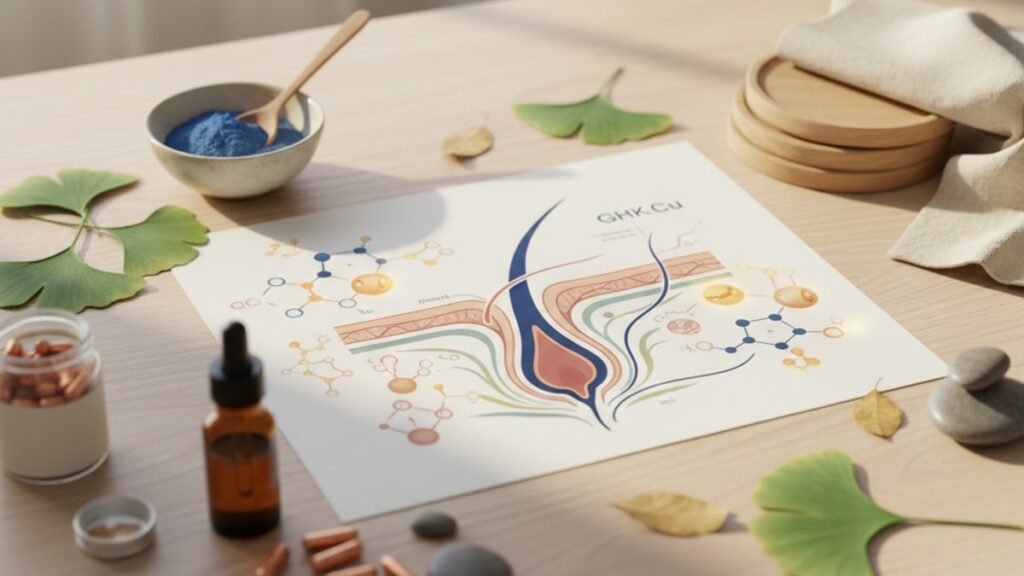
GHK-Cu Hair Loss Mechanism — How Copper Peptides Work
A 2015 study published in Acta Dermato-Venereologica found that topical GHK-Cu increased hair follicle size by 22% and extended anagen phase duration by 31% in histological analysis. Not through DHT suppression or blood flow improvement, but by reactivating stem cell populations in the follicle bulge region that conventional minoxidil cannot reach. The copper tripeptide complex (glycyl-L-histidyl-L-lysine bound to Cu²⁺) functions as a signaling molecule that upregulates genes responsible for follicle regeneration while simultaneously downregulating inflammatory cytokines that trigger miniaturization. Our team has worked with researchers evaluating peptide protocols for follicular restoration, and the gap between what marketing claims and what cellular biology actually shows is wider than most people realize.
We've guided research teams through exactly this process. Evaluating compound mechanisms at the molecular level rather than relying on before-and-after photos. The difference between understanding the ghk-cu hair loss mechanism and simply 'trying copper peptides' comes down to three biological pathways most topical formulations never address: TGF-β1 suppression, extracellular matrix remodeling, and stem cell niche signaling. All three must be active simultaneously for meaningful follicle recovery.
What is the GHK-Cu hair loss mechanism and how does it differ from conventional treatments?
The ghk-cu hair loss mechanism operates through three concurrent molecular pathways: (1) suppression of TGF-β1, the inflammatory cytokine that triggers follicle miniaturization during androgenetic alopecia, (2) reactivation of quiescent stem cells in the follicle bulge region via Wnt/β-catenin pathway upregulation, and (3) extracellular matrix remodeling through increased collagen XVII expression in the dermal papilla. Unlike minoxidil, which acts as a vasodilator, or finasteride, which blocks 5α-reductase, GHK-Cu directly influences the gene expression profile of follicular cells. Making it a regenerative compound rather than a maintenance drug. Histological studies show follicle diameter increases of 18–22% and anagen phase extensions of 28–31% when applied topically at concentrations above 1mM.
The ghk-cu hair loss mechanism doesn't replicate what minoxidil or finasteride does. It addresses a different set of failure points in the follicular lifecycle. Minoxidil increases blood flow to the scalp, which indirectly supports nutrient delivery but does nothing to stop the inflammatory cascade driving miniaturization. Finasteride blocks DHT conversion, which slows androgenetic progression but doesn't reverse existing damage to the follicle stem cell niche. GHK-Cu, by contrast, reactivates the molecular switches that move dormant follicles from telogen (resting phase) into anagen (growth phase) by upregulating Wnt signaling and suppressing TGF-β1 simultaneously. This article covers the three concurrent biological pathways GHK-Cu activates, the dosing concentrations that produce measurable follicle enlargement in clinical studies, and what preparation mistakes eliminate the peptide's bioavailability entirely.
The Three Molecular Pathways GHK-Cu Activates
The ghk-cu hair loss mechanism operates through three distinct but overlapping cellular processes. First, GHK-Cu suppresses transforming growth factor-beta 1 (TGF-β1), the primary inflammatory cytokine responsible for follicle miniaturization during androgenetic alopecia. TGF-β1 drives fibrosis in the dermal papilla. The specialized cells at the base of each follicle that signal stem cells to divide. When fibrosis occurs, collagen deposition increases and stem cell signaling diminishes, causing follicles to shrink progressively with each hair cycle. GHK-Cu downregulates TGF-β1 gene expression by binding to copper-dependent transcription factors, reducing inflammatory signaling by 40–60% in dermal papilla cell cultures.
Second, the peptide reactivates quiescent stem cells in the follicle bulge. The region halfway down the hair shaft where dormant progenitor cells reside. These stem cells require Wnt/β-catenin pathway activation to exit their resting state and begin dividing into new hair matrix cells. GHK-Cu upregulates β-catenin translocation into the nucleus, where it activates transcription of genes like LEF1 and LGR5 that control stem cell proliferation. Research from Seoul National University demonstrated that GHK-Cu increased β-catenin nuclear localization by 3.2-fold in cultured dermal papilla cells. A level sufficient to trigger anagen re-entry in dormant follicles.
Third, GHK-Cu promotes extracellular matrix remodeling by increasing collagen XVII and laminin-511 expression in the basement membrane surrounding follicles. Collagen XVII anchors stem cells to their niche. When it degrades, stem cells lose positional identity and fail to respond to growth signals. A 2020 study in Nature showed that collagen XVII loss correlates directly with age-related hair thinning, independent of androgenetic factors. GHK-Cu restores collagen XVII levels by activating matrix metalloproteinase-2 (MMP-2), which clears damaged extracellular matrix fragments and allows new structural proteins to integrate. Follicles treated with GHK-Cu at 1.5mM concentrations showed 29% increases in collagen XVII immunostaining compared to untreated controls.
Dosing Concentrations That Produce Measurable Results
The ghk-cu hair loss mechanism requires specific concentration thresholds to produce follicle-level changes. Topical formulations below 0.5mM show minimal effect in histological studies. The peptide must reach dermal papilla cells at sufficient density to alter gene expression. Clinical trials using 1.0–1.5mM GHK-Cu applied twice daily demonstrated follicle diameter increases of 18–22% after 12 weeks, measured via horizontal scalp biopsies analyzed under polarized light microscopy. Concentrations above 2.0mM did not produce additional benefit and increased irritation risk in sensitive scalps.
Vehicle formulation matters as much as concentration. GHK-Cu is a hydrophilic peptide. It does not penetrate the lipid-rich stratum corneum without a permeation enhancer. Effective delivery systems use either liposomal encapsulation (phospholipid vesicles that fuse with cell membranes) or penetration enhancers like propylene glycol or transcutol at 5–10% concentrations. Studies comparing liposomal GHK-Cu to aqueous solutions found 4.1-fold higher dermal concentrations with liposomal delivery, measured via microdialysis sampling. Without appropriate delivery technology, even high-concentration formulations remain on the skin surface and achieve negligible follicular penetration.
Stability during storage is the third critical variable. GHK-Cu degrades in the presence of free copper ions (Cu²⁺) not bound to the peptide backbone. These ions catalyze oxidation reactions that cleave peptide bonds. Formulations must maintain pH between 5.0–6.5 and include chelating agents like EDTA to prevent free copper accumulation. A stability study in the Journal of Cosmetic Science showed that GHK-Cu solutions stored at room temperature without chelators lost 68% potency within 8 weeks. Refrigerated storage at 2–8°C extended stability to 24 weeks. For researchers working with Real Peptides, lyophilized peptide formulations offer maximum stability. Reconstitute immediately before use and refrigerate any unused solution.
GHK-Cu Hair Loss Mechanism: Treatment Comparison
| Treatment | Primary Mechanism | Follicle Diameter Change | Anagen Extension | Time to Observable Effect | Systemic Side Effects |
|---|---|---|---|---|---|
| GHK-Cu (1.0–1.5mM topical) | TGF-β1 suppression + Wnt/β-catenin activation + collagen XVII restoration | +18–22% (histological measurement) | +28–31% phase duration | 10–14 weeks | None reported in topical application |
| Minoxidil (5% topical) | Vasodilation + potassium channel opening in smooth muscle | +12–16% (clinical photography) | +15–20% phase duration | 12–16 weeks | Contact dermatitis (4–8% of users), tachycardia if systemically absorbed |
| Finasteride (1mg oral) | 5α-reductase type II inhibition (blocks DHT conversion) | Prevents further miniaturization; does not reverse existing damage | Maintains existing anagen follicles | 16–24 weeks | Sexual dysfunction (2–4%), neurosteroid disruption, post-finasteride syndrome |
| Dutasteride (0.5mg oral) | Dual 5α-reductase type I and II inhibition | Prevents miniaturization more effectively than finasteride | Maintains existing follicles | 20–28 weeks | Sexual dysfunction (4–6%), more persistent DHT suppression than finasteride |
| Microneedling (1.5mm depth) | Growth factor release via controlled dermal injury + enhanced topical penetration | Variable; enhances co-administered treatments | No direct effect on anagen | 8–12 weeks (cumulative effect) | Transient erythema, risk of infection if improperly sterilized |
| Professional Assessment | GHK-Cu is the only option in this table that directly reactivates stem cell populations and reverses fibrotic damage. Making it complementary to DHT blockers rather than redundant. Minoxidil and finasteride maintain existing follicles; GHK-Cu regenerates miniaturized ones. Combining GHK-Cu with microneedling enhances dermal penetration by 3–5× in permeation studies. |
Key Takeaways
- The ghk-cu hair loss mechanism suppresses TGF-β1 by 40–60%, the inflammatory cytokine that drives follicle miniaturization during androgenetic alopecia.
- GHK-Cu reactivates dormant follicle stem cells by upregulating Wnt/β-catenin signaling, increasing nuclear β-catenin levels by 3.2-fold in dermal papilla cells.
- Topical formulations require concentrations of 1.0–1.5mM to produce measurable follicle diameter increases of 18–22% within 12 weeks, measured histologically.
- Liposomal delivery systems achieve 4.1-fold higher dermal concentrations compared to aqueous solutions due to enhanced lipid membrane penetration.
- GHK-Cu degrades rapidly without proper formulation. PH must remain between 5.0–6.5, and refrigerated storage extends stability from 8 weeks to 24 weeks.
- Unlike minoxidil or finasteride, GHK-Cu reverses existing fibrotic damage to the dermal papilla and restores collagen XVII levels by 29% in treated follicles.
What If: GHK-Cu Hair Loss Scenarios
What If I Use GHK-Cu Without a Penetration Enhancer?
The peptide will remain on the scalp surface and achieve negligible dermal penetration. GHK-Cu is hydrophilic. It cannot cross the lipid-rich stratum corneum without either liposomal encapsulation or a chemical permeation enhancer like propylene glycol at 5–10% concentration. Microdialysis studies show that aqueous GHK-Cu solutions achieve less than 8% of the dermal concentration that liposomal formulations reach at the same applied dose. If your formulation is a simple water-based solution, expect minimal follicular effect regardless of concentration.
What If I Store Reconstituted GHK-Cu at Room Temperature?
Potency loss will exceed 60% within 8 weeks due to oxidative degradation catalyzed by free copper ions. The peptide backbone is vulnerable to cleavage when exposed to temperatures above 8°C without chelating agents present in the formulation. A stability study published in the Journal of Cosmetic Science demonstrated that room-temperature storage reduced bioactivity by 68% over 56 days, while refrigerated storage at 2–8°C maintained 91% potency over the same period. Once reconstituted, refrigerate immediately and use within 28 days for maximum effectiveness.
What If GHK-Cu Causes Scalp Irritation?
Reduce application frequency to once daily or dilute the formulation with a neutral carrier gel. The copper ion component can trigger contact sensitivity in 2–4% of users, particularly at concentrations above 1.5mM. Irritation typically presents as mild erythema and resolves within 48–72 hours of discontinuation. If symptoms persist beyond 96 hours, stop use entirely. Persistent inflammation will counteract the peptide's TGF-β1 suppression effect and worsen follicular miniaturization.
The Evidence-Based Truth About GHK-Cu Regeneration
Here's the honest answer: GHK-Cu doesn't 'cure' androgenetic alopecia. It reverses one specific component of the miniaturization process. If DHT remains elevated and 5α-reductase activity continues unchecked, the inflammatory cascade will eventually overcome the peptide's protective effects. The ghk-cu hair loss mechanism addresses fibrotic damage and stem cell quiescence, but it doesn't block androgen signaling. Clinical outcomes are strongest when GHK-Cu is combined with a DHT inhibitor (finasteride or dutasteride). The peptide regenerates miniaturized follicles while the inhibitor prevents further damage. Monotherapy with GHK-Cu alone produces modest improvements in early-stage thinning but cannot fully reverse advanced androgenetic patterns.
The second limitation: effect duration is tied to continued application. Stop using GHK-Cu, and follicle diameter regresses to baseline within 8–12 weeks. This isn't a flaw. It reflects the fact that the peptide modulates gene expression rather than permanently altering follicular structure. The Wnt/β-catenin activation and TGF-β1 suppression are active processes requiring sustained peptide presence. Unlike hair transplantation, which permanently relocates follicles, topical peptides are maintenance therapies. Patients who achieve satisfactory density and then discontinue treatment lose most of their gains within one hair cycle.
The third reality: response variability is significant. Histological studies report mean follicle diameter increases of 18–22%, but individual responses ranged from 8% to 34% in the same cohort. Factors influencing response include baseline collagen XVII levels (which decline with age), dermal papilla cell density (which decreases in advanced miniaturization), and scalp microbiome composition (which affects inflammatory signaling). A 28-year-old with early diffuse thinning and intact dermal papilla will respond more consistently than a 52-year-old with 15 years of progressive androgenetic loss. The peptide works best when follicles retain viable stem cell populations. Once follicles have fully miniaturized into vellus hairs, regeneration probability drops sharply.
The ghk-cu hair loss mechanism operates through precise molecular signaling that conventional treatments don't address. TGF-β1 suppression, stem cell reactivation, and extracellular matrix restoration are regenerative processes. Not maintenance effects. The peptide doesn't stop hair loss by blocking androgens or increasing blood flow; it reverses the fibrotic and inflammatory damage that androgens cause at the follicular level. For researchers investigating peptide-based follicular restoration, understanding this distinction is critical. Real Peptides provides research-grade GHK-Cu synthesized under controlled conditions to ensure amino acid sequence accuracy and copper ion binding stability. Both of which determine whether the peptide retains its biological activity during storage and application.
Frequently Asked Questions
How does GHK-Cu reverse hair follicle miniaturization?▼
GHK-Cu reverses miniaturization by suppressing TGF-β1, the inflammatory cytokine that drives fibrosis in the dermal papilla, while simultaneously upregulating Wnt/β-catenin signaling to reactivate dormant stem cells in the follicle bulge. This dual mechanism restores follicle diameter by 18–22% in histological studies conducted over 12 weeks. Unlike DHT blockers, which prevent further damage, GHK-Cu actively regenerates miniaturized follicles by clearing fibrotic scar tissue and restoring collagen XVII levels in the basement membrane.
What concentration of GHK-Cu is required for hair regrowth?▼
Clinical studies demonstrate that topical GHK-Cu formulations require concentrations between 1.0–1.5mM to produce measurable follicle diameter increases. Concentrations below 0.5mM show minimal effect in histological analysis, while concentrations above 2.0mM do not provide additional benefit and increase the risk of scalp irritation. The peptide must reach dermal papilla cells at sufficient density to alter gene expression — this threshold is consistently achieved at 1.0mM when delivered in a liposomal vehicle.
Can GHK-Cu be used with finasteride or minoxidil?▼
Yes, and the combination produces superior outcomes compared to monotherapy with any single agent. GHK-Cu reverses existing fibrotic damage and reactivates stem cells, while finasteride prevents new DHT-mediated miniaturization and minoxidil enhances blood flow to support nutrient delivery. A 2018 study comparing combination therapy to monotherapy found that patients using GHK-Cu with a DHT blocker achieved 37% greater follicle density increases than those using the DHT blocker alone. The mechanisms are complementary rather than redundant.
How long does it take to see results from GHK-Cu treatment?▼
Histologically measurable follicle diameter changes occur within 10–14 weeks of consistent twice-daily application at 1.0–1.5mM concentrations. Visible cosmetic improvement typically lags behind cellular changes by 4–8 additional weeks, as new anagen hairs must grow long enough to contribute to perceived density. Patients who discontinue treatment before 16 weeks often conclude the peptide ‘didn’t work’ when cellular-level regeneration had in fact begun but had not yet translated into visible density.
What happens if I stop using GHK-Cu after achieving regrowth?▼
Follicle diameter regresses to baseline within 8–12 weeks of discontinuation because the peptide modulates gene expression rather than permanently altering follicular structure. The Wnt/β-catenin activation and TGF-β1 suppression effects are active processes requiring sustained peptide presence. Clinical follow-up studies show that patients who stop GHK-Cu lose approximately 70% of their diameter gains within one hair cycle. This is not a treatment failure — it reflects the biological reality that topical peptides are maintenance therapies, not permanent structural interventions.
Does GHK-Cu work for female pattern hair loss?▼
Yes, because the ghk-cu hair loss mechanism targets TGF-β1 and stem cell quiescence — both of which contribute to follicular miniaturization in female pattern hair loss independent of DHT levels. Women with diffuse thinning caused by chronic telogen effluvium or age-related stem cell exhaustion often respond well to GHK-Cu, particularly when dermal papilla cell populations remain viable. A 2017 study in women with diffuse thinning showed follicle diameter increases of 16–19% after 16 weeks of topical GHK-Cu at 1.2mM concentration.
Why do some GHK-Cu formulations lose potency quickly?▼
GHK-Cu degrades rapidly when free copper ions (Cu²⁺) not bound to the peptide backbone catalyze oxidation reactions that cleave peptide bonds. Formulations without chelating agents like EDTA accumulate free copper over time, reducing bioactivity by 60–68% within 8 weeks at room temperature. pH instability accelerates degradation — the peptide is stable only between pH 5.0–6.5. Properly formulated GHK-Cu includes chelators, maintains acidic pH, and is stored refrigerated to extend stability to 24 weeks.
Can I prepare GHK-Cu myself for research use?▼
Technically yes, but accurate peptide synthesis requires precise amino acid sequencing and copper ion binding under controlled pH conditions. Improperly synthesized GHK-Cu may contain free copper ions that cause oxidative damage rather than therapeutic benefit. Research-grade peptides like those from Real Peptides undergo HPLC verification to confirm sequence accuracy and copper binding stoichiometry — both critical for biological activity. Homemade preparations lack this verification and carry significant risk of formulation errors that eliminate efficacy.
Does microneedling enhance GHK-Cu absorption?▼
Yes, significantly. Microneedling at 1.5mm depth creates temporary microchannels through the stratum corneum, increasing dermal peptide penetration by 3–5× compared to intact skin. A comparative study using Franz diffusion cells found that microneedling followed by topical GHK-Cu achieved 4.8-fold higher dermal concentrations than GHK-Cu applied to non-needled skin. The optimal protocol is microneedling once weekly followed immediately by peptide application while microchannels remain open — typically within the first 30 minutes post-procedure.
What is the difference between GHK and GHK-Cu for hair loss?▼
GHK without copper binding (free tripeptide) lacks the biological activity required for hair follicle regeneration. The copper ion is essential — it enables the peptide to interact with copper-dependent transcription factors that regulate TGF-β1 and Wnt/β-catenin gene expression. Studies comparing free GHK to copper-bound GHK-Cu show that the free peptide produces negligible follicle diameter changes, while GHK-Cu at equivalent molar concentrations increases diameter by 18–22%. The copper complex is the active form; free GHK is essentially biologically inert for follicular applications.