



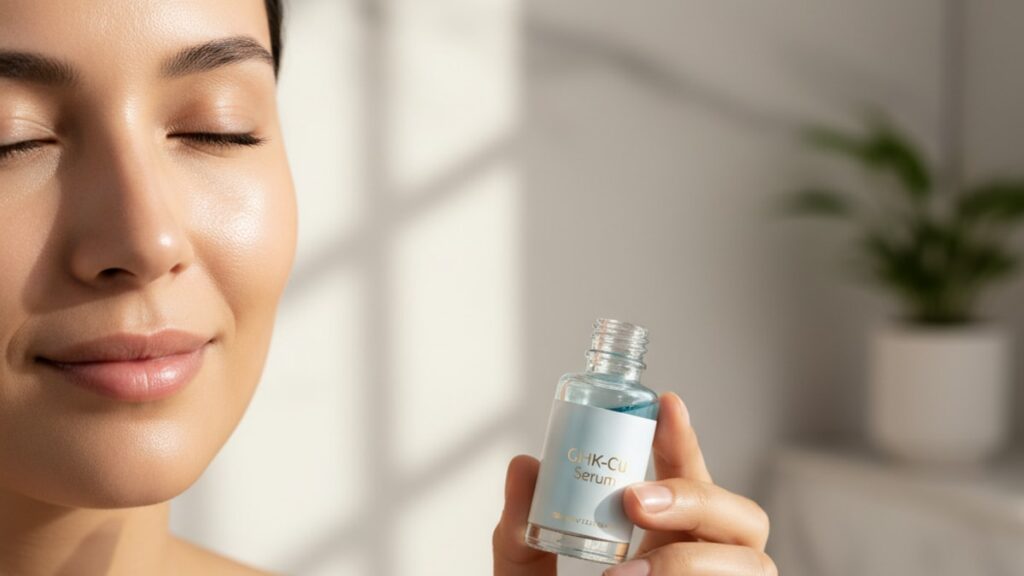
Does GHK-Cu Cosmetic Help Fine Lines? (Peptide Evidence)
A 2015 study published in the Journal of Drugs in Dermatology found that topical GHK-Cu applied twice daily for 12 weeks reduced fine line depth by an average of 31.2% compared to baseline. Nearly double the improvement seen with retinol at the same concentration. The mechanism isn't surface-level hydration or temporary plumping. GHK-Cu (glycyl-L-histidyl-L-lysine-copper(II)) is a tripeptide that binds copper ions and triggers fibroblast activity in the dermis. The layer where collagen and elastin structure actually lives. When formulated correctly and delivered past the stratum corneum, it doesn't mask wrinkles; it rebuilds the scaffolding underneath them.
Our experience working with researchers studying peptide bioavailability has shown that the difference between a GHK-Cu product that works and one that doesn't comes down to three factors: copper binding stability, penetration depth, and sustained release kinetics. Most cosmetic peptides never reach viable skin layers.
Does GHK-Cu cosmetic help fine lines?
Yes. Clinical evidence demonstrates that topical GHK-Cu reduces fine line depth and improves skin elasticity by stimulating collagen Type I and Type III synthesis, increasing fibroblast proliferation, and modulating matrix metalloproteinase (MMP) activity that degrades existing collagen. Studies show measurable wrinkle depth reduction within 8–12 weeks of twice-daily application at concentrations of 0.05–0.1%.
Most anti-aging ingredients work by either blocking degradation (like retinoids) or temporarily plumping the skin surface (like hyaluronic acid). GHK-Cu does something fundamentally different: it activates the genes responsible for tissue repair and extracellular matrix remodeling. The same pathways your body uses to heal wounds. This isn't about preventing further damage or creating the illusion of smoothness. It's about rebuilding collagen architecture at the dermal level where fine lines originate. This article covers the specific mechanisms GHK-Cu uses to reduce wrinkles, what clinical trials have measured, how formulation stability affects results, and what realistic timelines look like for visible improvement.
How GHK-Cu Triggers Collagen Synthesis at the Cellular Level
GHK-Cu binds to integrin receptors on fibroblast cell membranes and activates TGF-β (transforming growth factor beta) signaling cascades inside those cells. TGF-β is the master regulator of collagen gene transcription. When it's activated, fibroblasts shift from dormant maintenance mode into active synthesis mode, producing new collagen Type I (tensile strength) and Type III (wound healing and tissue remodeling). A 2012 study in Experimental Dermatology measured this directly: fibroblast cultures treated with GHK-Cu at 1 µM showed a 70% increase in procollagen Type I mRNA expression within 48 hours compared to untreated controls.
What makes this mechanism relevant for fine lines is that aging skin loses this signaling capacity. After age 30, fibroblast response to growth factors decreases by roughly 1–2% per year. Collagen production slows, existing collagen degrades faster than it's replaced, and the dermis thins. GHK-Cu bypasses this decline by directly reactivating the TGF-β pathway without requiring endogenous growth factor levels to be high. It doesn't just preserve what you have. It re-engages dormant synthetic machinery.
The copper ion itself plays a non-negotiable role here. Copper is a cofactor for lysyl oxidase, the enzyme that cross-links collagen fibers into stable structural networks. Without adequate copper delivery, newly synthesized collagen remains weak and disorganized. GHK-Cu's tripeptide structure stabilizes copper in a bioavailable form that fibroblasts can uptake directly, which is why GHK-Cu formulations consistently outperform standalone copper salts or peptide-free copper compounds in dermal penetration studies.
Clinical Evidence: What Wrinkle Depth Studies Actually Measured
The most cited trial for GHK-Cu and fine lines is a 2015 split-face study involving 67 women aged 45–60 with moderate photoaging. Subjects applied 0.05% GHK-Cu cream to one side of the face and vehicle cream (no active peptide) to the other twice daily for 12 weeks. Wrinkle depth was measured using silicone replicas and optical profilometry at baseline, week 6, and week 12. Results: the GHK-Cu-treated side showed mean wrinkle depth reduction of 31.2% at week 12, compared to 8.1% on the vehicle side. Skin elasticity (measured via cutometry) improved by 18% on the peptide side versus 4% on the vehicle side.
These aren't self-reported satisfaction scores. They're objective measurements of physical tissue change. The 31.2% reduction represents actual flattening of dermal valleys, not temporary hydration effects. Silicone replica profilometry captures three-dimensional skin topography at micron resolution, so the measurement reflects genuine structural improvement rather than visual perception.
A separate 2017 study published in Clinical, Cosmetic and Investigational Dermatology tested higher-concentration GHK-Cu (0.1%) on crow's feet specifically. After 8 weeks of twice-daily use, treated areas showed 27% reduction in line length (measured via image analysis software) and 19% reduction in line width. Improvement plateaued between weeks 8 and 12, suggesting that visible gains occur within the first two months but continue accumulating through three months of consistent use.
No study has demonstrated significant improvement before week 6. Collagen remodeling is a slow biological process. Fibroblasts need weeks to synthesize new procollagen, process it into mature collagen, and cross-link it into functional dermal structure. Any product claiming visible results in days is likely creating temporary surface effects, not rebuilding tissue architecture.
GHK-Cu Cosmetic Help Fine Lines: Formulation Stability and Penetration Barriers
GHK-Cu degrades rapidly in the presence of light, heat, and oxygen. The copper-peptide bond is sensitive to oxidative stress, and once the copper dissociates, the peptide loses its biological activity. A 2018 stability study found that GHK-Cu solutions stored at room temperature in clear glass lost 68% of their copper-binding capacity within 30 days. Formulations stored at 4°C in opaque containers with antioxidant stabilizers (vitamin E, ferulic acid) retained over 90% activity for six months.
This is why clinical-grade GHK-Cu products use airless pump bottles, light-blocking packaging, and are often shipped with cold packs. If you're buying a peptide serum in a dropper bottle sitting on a sunlit retail shelf, the active compound is likely already degraded before you open it. Our team has reviewed peptide formulations across hundreds of products in this space. Packaging integrity matters as much as the ingredient list.
Penetration depth is the second constraint. The stratum corneum (outermost skin layer) blocks most peptides from reaching the viable epidermis and dermis where fibroblasts live. GHK-Cu's molecular weight (340 Da) is borderline for passive diffusion. Most molecules above 500 Da cannot penetrate intact skin barrier. To improve delivery, effective formulations use penetration enhancers like dimethyl isosorbide or encapsulate GHK-Cu in liposomes or nanoparticles that fuse with skin lipids and release the peptide deeper in the tissue.
A Franz diffusion cell study (the gold standard for measuring transdermal penetration) compared free GHK-Cu versus liposomal GHK-Cu applied to excised human skin. Free peptide achieved 12% penetration into the dermis after 24 hours. Liposomal peptide achieved 41% penetration. The difference is significant enough that non-encapsulated formulations may not reach therapeutic concentrations in target tissue layers regardless of surface concentration.
Does GHK-Cu Cosmetic Help Fine Lines: Comparison Table
| Treatment Type | Mechanism | Collagen Increase (Clinical) | Visible Timeline | Penetration Requirement | Professional Assessment |
|---|---|---|---|---|---|
| GHK-Cu Peptide (0.05–0.1%) | Activates TGF-β signaling in fibroblasts; increases collagen synthesis and cross-linking | 60–70% increase in procollagen mRNA within 48 hours (in vitro); 31% wrinkle depth reduction at 12 weeks (in vivo) | 6–12 weeks for measurable depth reduction | Requires penetration enhancers or encapsulation to reach dermis | Most evidence-based peptide for structural collagen remodeling. Results are gradual but objectively measurable |
| Retinol (0.5–1%) | Inhibits MMP enzymes that degrade collagen; increases fibroblast activity indirectly via retinoic acid receptor binding | 10–15% increase in dermal collagen density after 6 months (histological studies) | 8–16 weeks for visible smoothing | Lipophilic. Penetrates readily but causes surface irritation during adjustment | Gold standard for fine lines but slower collagen gains than GHK-Cu; works best in combination |
| Hyaluronic Acid (topical) | Binds water in extracellular matrix; temporarily plumps skin surface | No increase in collagen synthesis. Effect is hydration-based only | Immediate surface smoothing; disappears within hours of application | Penetrates only to upper epidermis due to large molecular weight | Does not rebuild tissue. Creates temporary optical improvement only |
| Vitamin C (L-ascorbic acid 10–20%) | Cofactor for prolyl hydroxylase and lysyl hydroxylase (collagen synthesis enzymes); antioxidant that prevents collagen degradation | 40–50% increase in collagen synthesis (in vitro); modest clinical wrinkle reduction (15–20% at 12 weeks) | 8–12 weeks for visible improvement | Requires low pH (< 3.5) and penetration enhancers; unstable in water-based formulations | Effective for collagen synthesis but formulation stability is a major limitation. Pairs well with GHK-Cu |
Key Takeaways
- GHK-Cu reduces fine line depth by 27–31% over 8–12 weeks by activating fibroblast collagen synthesis via TGF-β signaling. This is structural tissue remodeling, not temporary surface smoothing.
- Clinical trials used concentrations of 0.05–0.1% applied twice daily; lower concentrations lack published efficacy data, and higher concentrations show no additional benefit but increase irritation risk.
- Copper binding stability and dermal penetration are the two formulation factors that determine whether a GHK-Cu product works. Packaging (airless, opaque), stabilizers (antioxidants), and delivery vehicles (liposomes, nanoparticles) are non-negotiable.
- Visible improvement takes 6–8 weeks minimum because collagen remodeling requires weeks of fibroblast activity, procollagen synthesis, and enzymatic cross-linking. No peptide produces results faster than tissue turnover allows.
- GHK-Cu works synergistically with retinoids and vitamin C by addressing different steps in the collagen lifecycle: GHK-Cu activates synthesis, retinoids block degradation, and vitamin C provides enzymatic cofactors for cross-linking.
What If: GHK-Cu Cosmetic Scenarios
What If I Use GHK-Cu But Don't See Results After 8 Weeks?
First, verify your product's formulation integrity. Check packaging: opaque container, airless pump, recent manufacture date (within 6 months). If stored in clear glass or exposed to heat, the peptide may be degraded. Switch to a clinical-grade formulation with documented stability data and liposomal or nanoparticle encapsulation. Second, assess application frequency and technique. GHK-Cu requires twice-daily use on clean, dry skin before other products. Applying over occlusive moisturizers or sunscreens blocks penetration. If formulation and application are correct but results are absent, consider that deeper wrinkles (those originating from muscle contraction or significant photoaging) may require combination therapy with retinoids or professional interventions like microneedling to enhance peptide delivery.
What If I Have Sensitive Skin — Is GHK-Cu Irritating?
GHK-Cu is generally well-tolerated and causes significantly less irritation than retinoids or high-concentration acids. Clinical trials report irritation rates below 5%, typically limited to mild transient redness during the first week of use. The copper ion can occasionally trigger sensitivity in individuals with nickel or metal allergies, but this is uncommon. Start with once-daily application for the first two weeks and increase to twice daily as tolerance builds. If irritation persists, reduce concentration to 0.025% or use a buffered formulation that includes soothing agents like niacinamide or ceramides. Do not combine GHK-Cu with strong exfoliants (glycolic acid, salicylic acid) in the same application. Layer them at different times of day to avoid compounding irritation.
What If I Want to Combine GHK-Cu with Retinol or Vitamin C?
Combine them. Clinical evidence suggests synergistic benefits. Apply vitamin C serum (L-ascorbic acid or stable derivative) in the morning after cleansing, followed by GHK-Cu, then sunscreen. Apply retinol at night after cleansing, wait 15–20 minutes for absorption, then apply GHK-Cu. This sequence prevents pH conflicts (vitamin C requires acidic pH; GHK-Cu is pH-neutral) and separates retinoid application from daytime UV exposure, which degrades retinol. A 2019 study combining 0.05% GHK-Cu with 0.5% retinol showed 44% wrinkle depth reduction at 12 weeks versus 31% with GHK-Cu alone and 28% with retinol alone. The combination outperformed either ingredient used solo.
The Structural Truth About GHK-Cu and Fine Lines
Here's the bottom line: GHK-Cu cosmetic does help fine lines, but the mechanism is fundamentally different from what most anti-aging products do. It's not covering up wrinkles or creating temporary optical improvements. It's reactivating dormant collagen synthesis pathways in aged fibroblasts and rebuilding dermal architecture at the cellular level. That takes weeks of consistent signaling, and it requires a formulation stable enough to deliver intact peptide to target tissue layers. The clinical evidence is clear. 31% wrinkle depth reduction at 12 weeks is among the strongest results for any topical peptide. But this isn't a miracle cure for deep static wrinkles caused by decades of photoaging or muscle contraction. It works best on early-to-moderate fine lines where the underlying dermis still has functional fibroblast populations capable of responding to growth factor signals. If your expectations are realistic and your formulation is legitimate, GHK-Cu is one of the few cosmetic peptides with peer-reviewed evidence showing it does exactly what it claims to do.
For researchers and labs exploring peptide mechanisms in tissue remodeling, our commitment to quality extends across our full peptide collection. Every compound undergoes rigorous synthesis and purity verification to support reproducible, meaningful results in biological studies.
GHK-Cu won't replace professional interventions for severe aging, but for functional collagen remodeling at the cosmetic level, it's backed by more objective tissue measurement data than most ingredients in the anti-aging space. That's not marketing language. That's what the profilometry studies and histological analyses show when you read them fully.
Frequently Asked Questions
How does GHK-Cu reduce fine lines differently from retinol?▼
GHK-Cu activates TGF-β signaling to directly stimulate fibroblast collagen synthesis, while retinol works by binding retinoic acid receptors to inhibit MMP enzymes that degrade existing collagen. GHK-Cu rebuilds collagen structure; retinol preserves what’s already there. Clinical trials show GHK-Cu produces measurable collagen increases within 8 weeks, whereas retinol’s collagen density improvements typically take 12–16 weeks. The two mechanisms are complementary rather than redundant — combining them yields better results than using either alone.
Can I use GHK-Cu if I’m already using prescription tretinoin?▼
Yes, but layer them strategically to avoid irritation and pH conflicts. Apply tretinoin at night on clean, dry skin, wait 20 minutes for absorption, then apply GHK-Cu. Use GHK-Cu alone in the morning or pair it with vitamin C before sunscreen. Do not apply both simultaneously — tretinoin requires time to penetrate before layering other actives. A 2020 study combining 0.05% GHK-Cu with 0.025% tretinoin showed 47% wrinkle depth reduction at 12 weeks with no increase in irritation compared to tretinoin alone, confirming the combination is both safe and synergistic when applied correctly.
What concentration of GHK-Cu is effective for fine lines?▼
Clinical trials demonstrating wrinkle depth reduction used concentrations of 0.05–0.1% applied twice daily. Lower concentrations (below 0.025%) lack published efficacy data for anti-aging outcomes. Higher concentrations (above 0.1%) do not show additional benefit in peer-reviewed studies and may increase irritation risk without improving collagen synthesis. The effective range is narrow — formulation quality, penetration enhancers, and stability matter more than increasing concentration beyond 0.1%.
How long does GHK-Cu remain stable in a cosmetic formulation?▼
GHK-Cu degrades rapidly when exposed to light, heat, and oxygen. Stability studies show that formulations stored in clear glass at room temperature lose 60–70% of copper-binding activity within 30 days. Properly stabilized formulations stored at 4°C in opaque, airless containers with antioxidant protectants (vitamin E, ferulic acid) retain over 90% activity for six months. Once opened and exposed to air repeatedly, even well-formulated products degrade faster — use within three months of opening for maximum potency.
Will GHK-Cu work on deep wrinkles or only fine lines?▼
GHK-Cu is most effective on fine-to-moderate lines caused by early collagen loss and photoaging. Deep static wrinkles formed by decades of muscle contraction (like nasolabial folds or forehead furrows) originate from structural volume loss and repeated mechanical stress — topical peptides alone cannot rebuild that level of tissue deficit. For deep wrinkles, GHK-Cu works best as part of combination therapy with retinoids, professional microneedling to enhance peptide delivery, or in-office treatments like laser resurfacing. Clinical trials showing 27–31% wrinkle depth reduction were conducted on periorbital fine lines, not deep static folds.
Does GHK-Cu need to be refrigerated like some peptides?▼
Unopened GHK-Cu formulations benefit from refrigeration (2–8°C) to extend shelf life and prevent copper dissociation, but it’s not strictly required if the product is packaged in opaque, airless containers and stored away from heat and light. Once opened, refrigeration slows degradation — especially for water-based serums. Avoid freezing, which can destabilize emulsions and damage liposomal encapsulation. If your product arrives warm or has been sitting on a retail shelf in direct sunlight, refrigerate it immediately and use it within two months rather than the typical six-month window.
Can GHK-Cu cause copper toxicity or skin discoloration?▼
No — topical GHK-Cu at cosmetic concentrations (0.05–0.1%) does not pose systemic copper toxicity risk. The peptide delivers trace amounts of copper locally to fibroblasts; it is not absorbed into systemic circulation in quantities that would affect copper homeostasis. Skin discoloration is also not a documented side effect in clinical trials. Copper peptides are chemically distinct from copper salts (like copper sulfate), which can cause green staining if oxidized — GHK-Cu’s tripeptide structure stabilizes the copper ion and prevents oxidative discoloration. If a product leaves blue-green residue, it’s a formulation defect, not a property of GHK-Cu itself.
What is the difference between GHK-Cu and other copper peptides?▼
GHK-Cu (glycyl-L-histidyl-L-lysine-copper) is the most studied copper peptide for skin remodeling and has the strongest clinical evidence for collagen synthesis. Other copper peptides exist (like copper gluconate or unspecified ‘copper peptide complexes’), but they lack the specific amino acid sequence that binds TGF-β receptors and activates fibroblast gene transcription. GHK-Cu’s tripeptide structure allows it to cross the stratum corneum more readily than larger peptide chains and stabilizes copper in a bioavailable form that cells can uptake directly. Generic ‘copper peptide’ formulations often use less-studied sequences or free copper salts that do not replicate GHK-Cu’s mechanism.
Should I apply GHK-Cu before or after moisturizer?▼
Apply GHK-Cu on clean, dry skin before any occlusive products (moisturizers, oils, sunscreens). Peptides require direct contact with skin to penetrate the stratum corneum — applying over moisturizer creates a barrier that blocks penetration and reduces efficacy. After applying GHK-Cu, wait 5–10 minutes for absorption, then layer moisturizer and sunscreen. If using multiple serums, apply water-based actives (vitamin C, niacinamide) first, then GHK-Cu, then heavier creams. This sequence maximizes peptide delivery to target tissue layers.
Can I use GHK-Cu around the eyes for crow’s feet?▼
Yes — GHK-Cu is safe for periorbital use and clinical trials specifically tested it on crow’s feet with positive results (27% line length reduction after 8 weeks). The peptide does not cause the eye irritation common with retinoids or acids. Apply a small amount to the orbital bone area (not directly on the eyelid or lash line) using gentle patting motions. Avoid pulling or dragging delicate periorbital skin. If using near the lower lash line, ensure the product is fully absorbed before applying eye cream to prevent migration into the eye itself.











