




The world of peptide research is sprawling, and let's be honest, it can be formidable. When you're dealing with compounds as precise as AOD 9604, the line between groundbreaking data and a wasted batch is incredibly thin. It often comes down to one thing: protocol. Our team has spent years not just synthesizing the highest-purity peptides but also observing how researchers use them—and where they stumble. So, if you're asking 'how to use AOD 9604,' you're asking the right question. It's the question that precedes reliable, repeatable results.
We've seen it all. Researchers with impeccable study designs whose results are compromised by a simple mistake in reconstitution. Labs that lose weeks of work due to improper storage. It’s frustrating, and it’s entirely avoidable. That's why we wanted to put together a definitive resource, based on our collective experience in the industry. This isn't just a list of steps; it's a look into the methodology required to give a powerful research compound like AOD 9604 the respect it deserves and to get the quality data your work demands. It all starts with understanding what you're working with.
First, What Exactly is AOD 9604?
Before you can even think about using it, you need to understand its identity. AOD 9604 isn't just some randomly assembled string of molecules; it's a very specific, modified fragment of Human Growth Hormone (hGH). Specifically, it's derived from the C-terminal region, encompassing amino acids 177-191, with a tyrosine molecule added at the N-terminus for stabilization.
This is the critical part. The entire purpose of isolating this fragment was to capture the potent fat-burning (lipolytic) properties of hGH without triggering the other, often less desirable, effects associated with the full hormone. We're talking about things like insulin resistance or the proliferative effects (cell growth) that can be a significant concern in certain research contexts. AOD 9604 was engineered for a targeted mission: to stimulate lipolysis and inhibit lipogenesis (the formation of new fat) by mimicking the way natural growth hormone regulates fat metabolism.
It does this without competing for the hGH receptor and without impacting serum IGF-1 levels. This is a nuanced but incredibly important distinction. It means that in a research setting, its mechanism of action is highly specific, making it a cleaner variable to study than its parent hormone. When you source AOD 9604 from a lab like ours at Real Peptides, you're getting a compound synthesized with that precise sequence in mind. Purity isn't just a buzzword for us; it's the foundation of predictable research. Anything less, and you're not truly studying AOD 9604—you're studying a compound plus its contaminants, and that's a recipe for skewed data.
The Critical First Step: Reconstitution
This is it. The single most common point of failure we see. You can have the purest lyophilized (freeze-dried) peptide in the world, but if you mishandle it during reconstitution, you've essentially destroyed your investment before the first experiment even begins. The peptide chains are delicate.
They demand respect.
Our team can't stress this enough—follow these steps with meticulous care. Don't rush it. Your entire research project depends on this moment.
Your Essential Toolkit:
- Your Vial of Lyophilized AOD 9604: It should arrive as a solid, dry puck or powder at the bottom of the vial.
- Bacteriostatic Water: This is sterile water containing 0.9% benzyl alcohol, an antimicrobial preservative. It's the gold standard for reconstituting peptides for research and ensures the solution remains sterile through multiple uses.
- Sterile Syringes: You'll need at least one for drawing the bacteriostatic water and another for your research administration. An insulin syringe (marked in IU/mL) is standard for administration due to its fine gradations.
- Alcohol Prep Pads: For sterilizing the vial stoppers.
The Reconstitution Protocol—Our Recommended Method:
-
Preparation is Everything: Start by letting your vial of AOD 9604 and the bacteriostatic water come to room temperature. This prevents any thermal shock to the delicate peptide.
-
Sterilize Your Surfaces: Wipe the rubber stopper of both the AOD 9604 vial and the bacteriostatic water vial with an alcohol prep pad. Let them air dry. Don't blow on them. Just let the alcohol do its job.
-
Calculate Your Volume: This is where precision matters. Let's use a common example. If you have a 5mg (5000mcg) vial of AOD 9604 and you want a final concentration that's easy to measure, say 500mcg per 0.1mL, you'll need to add 1mL of bacteriostatic water. The math: 5000mcg / 500mcg = 10 doses. If you want each dose to be 0.1mL, you need 10 * 0.1mL = 1mL total volume. Always do the math first.
-
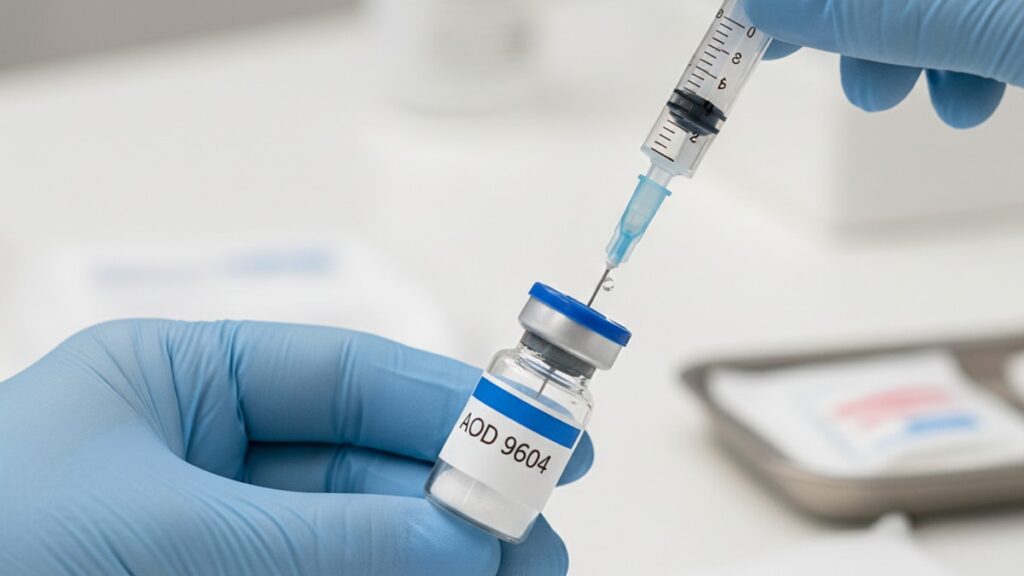
The Gentle Introduction: Draw your calculated amount of bacteriostatic water into a sterile syringe. Now—and this is the most crucial part—insert the needle into the AOD 9604 vial, angling it so the water runs down the inside wall of the glass vial. Do not, under any circumstances, shoot the water directly onto the lyophilized peptide puck. That force can shear and damage the peptide bonds. This single mistake is catastrophic.
-
Patience, Not Power: Once the water is in, remove the syringe. You'll see the powder start to dissolve. To help it along, gently swirl the vial in a slow, circular motion or roll it between your palms. That's it. DO NOT SHAKE IT. Shaking is aggressive. It causes foaming and, more importantly, it can mechanically break (denature) the peptide chains, rendering them useless. The solution should become completely clear within a few minutes. If it remains cloudy, you may have a purity problem with your source peptide.
Once it's clear, it's reconstituted and ready for research use. And it must be immediately moved to its new home: the refrigerator.
How to Use AOD 9604: Research Protocols and Timing
Now we get to the core of the matter. With a properly reconstituted and stored vial of AOD 9604, how is it typically used in a research setting? The primary administration method studied is subcutaneous (SubQ) injection, using an insulin syringe into a pinched layer of adipose tissue.
But the real variable—the one that research aims to optimize—is timing. The goal is generally to introduce the peptide when the body is most receptive to its lipolytic signaling. Our experience and review of existing literature show three primary protocols being investigated.
| Protocol Timing | Rationale & Mechanism | Potential Research Focus |
|---|---|---|
| Morning (Fasted) | Administering first thing in the morning on an empty stomach aims to leverage the body's naturally low insulin levels. This state is already primed for fat breakdown (lipolysis), and the theory is that AOD 9604 can amplify this natural metabolic window. | Studying baseline metabolic rate, all-day fat oxidation, and the peptide's effects on appetite signaling throughout the day. |
| Pre-Workout (Fasted) | This protocol involves administration about 30-45 minutes before a cardiovascular or resistance training session, also on an empty stomach. The hypothesis is that the peptide can mobilize fatty acids from adipose tissue, making them more readily available for the body to use as fuel during the impending exercise. | Investigating exercise-induced lipolysis, energy substrate utilization during physical activity, and potential impacts on endurance or performance metrics. |
| Pre-Bedtime | Administered shortly before sleep, this protocol is designed to align with the body's natural, largest pulse of growth hormone release, which occurs during deep sleep. While AOD 9604 doesn't work on the GH receptor, this timing seeks to complement the body's nocturnal metabolic and recovery processes. | Researching overnight metabolic activity, the peptide's influence on sleep-related fat metabolism, and its potential role in recovery models. |
Which protocol is 'best'? That's what research is for. The answer depends entirely on the specific question being asked. A study focused on athletic performance would naturally gravitate toward the pre-workout protocol, while one focused on baseline metabolic changes might prefer the morning administration. Consistency is the non-negotiable element. Whichever protocol is chosen, it must be adhered to strictly to produce meaningful data.
A typical research dosage often falls in the range of 250-500mcg per administration. It's critical to start with a well-defined hypothesis and a consistent protocol. Changing variables mid-stream is the fastest way to invalidate your results.
Top 10 Peptides RANKED for MAXIMUM Performance
This video provides valuable insights into how to use aod 9604, covering key concepts and practical tips that complement the information in this guide. The visual demonstration helps clarify complex topics and gives you a real-world perspective on implementation.
Storage & Stability: Protecting Your Research Investment
We've touched on this, but it deserves its own section. Honestly, it's that important. Peptides are not like aspirin; you can't just leave them on a counter. They are biological molecules that degrade under heat, light, and agitation.
Before Reconstitution (Lyophilized Powder):
- Rule #1: Keep it cold. For long-term storage (months to years), a freezer is ideal. For short-term storage (a few weeks), a standard refrigerator is perfectly acceptable.
- Rule #2: Keep it dark. Store the vial in its box or in a dark part of the fridge to protect it from light degradation.
- Rule #3: Keep it dry. The lyophilized state is what makes it stable. Don't introduce moisture until you're ready to reconstitute.
After Reconstitution (Liquid Solution):
- The Rule is Simple: Refrigerate. Always. Once in a liquid solution, the peptide is far more fragile. It must be kept in a refrigerator (around 2-8°C or 36-46°F).
- Shelf Life: The clock is now ticking. A reconstituted vial of AOD 9604, when handled with sterile technique and stored properly, is generally considered stable for research use for up to 4 weeks. After that, degradation accelerates, and the potency can no longer be guaranteed. We've seen researchers try to stretch a vial for 2 months, and their data becomes wildly inconsistent. It's just not worth it.
Think of your peptide supply like perishable food. Before you open it, it's shelf-stable. Once you open it (reconstitute it), it needs to be refrigerated and used within a specific timeframe. Ignoring this is the scientific equivalent of leaving milk on the counter overnight and expecting it to be fine in the morning.
Advanced Research: Synergies and Stacking
In more advanced research models, scientists often study compounds in combination to observe potential synergistic effects. This is where the highly specific mechanism of AOD 9604 becomes a major asset. Because it works on fat metabolism without directly interacting with the GH receptor or significantly elevating IGF-1, it can be studied alongside other peptides that do work on those pathways.
For instance, it's common to see research protocols that pair AOD 9604 with a Growth Hormone Releasing Hormone (GHRH) analogue like CJC-1295 or a Ghrelin mimetic (GHS) like Ipamorelin. The scientific rationale is straightforward: the GHRH/GHS peptides stimulate the body's own release of growth hormone, while AOD 9604 works on its separate lipolytic pathway. The research question becomes: does this dual-pronged approach—enhancing natural GH pulses while also directly targeting fat cells—produce a more pronounced effect than either compound alone? It's a classic example of investigating potential 1+1=3 scenarios in biology.
This is complex work. It requires an even deeper understanding of the mechanisms at play and an unflinching commitment to protocol. We always advise that researchers master the use of a single compound before attempting to study complex stacks. Get your baseline data right first. Only then can you accurately interpret the results of a multi-compound protocol.
Interpreting Results and Managing Expectations
Here's some real talk from our team. No peptide is a magic wand. AOD 9604 is a powerful tool for research into lipolysis, but its effects are part of a larger biological system. In any well-designed study, other variables must be meticulously controlled. You can't study a fat-loss agent in a model where caloric intake and energy expenditure are random and unmonitored. That's not science; it's chaos.
When observing the effects of AOD 9604, the changes are typically gradual and consistent, not dramatic and overnight. It's a tool that encourages a specific metabolic process. The visibility and magnitude of that process are inherently tied to the surrounding conditions—the 'diet' and 'exercise' of the research model.
Furthermore, it's important to have the right tools to measure the outcome. Relying on crude measurements like total body weight can be misleading. A proper study would look at more specific markers, like changes in adipose tissue mass, fatty acid oxidation rates, or relevant blood markers. For a visual deep-dive on how to track these kinds of nuanced changes, our friends at MorelliFit have some excellent videos on their YouTube channel that break down body composition analysis in a way that’s really accessible.
Success in peptide research is about patience, precision, and realistic expectations. It’s about understanding the mechanism, controlling the variables, and trusting the process. When you combine that disciplined approach with a product of guaranteed purity—the kind we stake our reputation on at Real Peptides—you create the ideal conditions for generating clean, valuable, and publishable data. It’s a demanding field, but for those who get it right, the potential for discovery is immense.
It all circles back to the beginning. The quality of your starting material and the integrity of your protocol are the two pillars that support everything else. Get those right, and you're well on your way. If you're ready to ensure your research is built on a foundation of impeccable quality, Get Started Today by exploring our catalog of research-grade peptides. For more ongoing discussions and insights from the forefront of peptide research, be sure to connect with us on Facebook where we share updates from our team.
Frequently Asked Questions
How much bacteriostatic water should I add to my AOD 9604 vial?
▼
The amount depends on the dosage you want per unit. A common practice for a 5mg (5000mcg) vial is to add 1mL of bacteriostatic water. This creates a solution where every 0.1mL contains 500mcg of the peptide, making measurement straightforward.
What happens if I accidentally shake the vial after reconstituting?
▼
Shaking the vial can damage the delicate peptide chains through a process called mechanical shearing or denaturing. This can significantly reduce the peptide’s effectiveness. Always swirl or gently roll the vial to dissolve the powder, never shake it.
Can I mix AOD 9604 with another peptide in the same syringe?
▼
While some advanced protocols study multiple peptides, we strongly advise against mixing them in the same syringe unless a specific protocol validates their stability when combined. Mixing can potentially compromise the integrity and pH of the molecules, affecting their efficacy.
How long is AOD 9604 good for after I mix it?
▼
Once reconstituted with bacteriostatic water and stored properly in a refrigerator, AOD 9604 is typically stable for research use for up to 4 weeks. After this period, its potency begins to degrade, and results may become inconsistent.
Do I need to use AOD 9604 on an empty stomach?
▼
For research purposes, administration on an empty stomach is the standard protocol. The presence of food, particularly carbohydrates and fats, can cause an insulin spike which may interfere with the lipolytic (fat-burning) action of AOD 9604, confounding research results.
What is the difference between AOD 9604 and HGH Fragment 176-191?
▼
AOD 9604 is a stabilized version of the HGH Fragment 176-191. It includes the same amino acid sequence but adds a tyrosine molecule at the end of the chain, which enhances its stability and makes it more effective as a research compound.
Where is the best place to administer a subcutaneous injection for research?
▼
The most common site for subcutaneous administration in research models is the abdomen. A pinch of adipose (fat) tissue is gently lifted, and the needle is inserted at a 45 to 90-degree angle. Rotating sites is a good practice to ensure consistency.
Is the effect of AOD 9604 localized to the injection site?
▼
No, the effect is systemic. Once administered subcutaneously, AOD 9604 is absorbed into the bloodstream and circulates throughout the body to exert its effects on fat metabolism. It does not spot-reduce fat at the injection site.
Can I use sterile water instead of bacteriostatic water?
▼
You can, but it’s not ideal for multi-use vials. Sterile water lacks the antimicrobial preservative (benzyl alcohol), so once opened, the vial should be considered for single use to prevent bacterial contamination. Bacteriostatic water allows for multiple sterile withdrawals.
How should I store the peptide before reconstituting it?
▼
Before reconstitution, the lyophilized (freeze-dried) powder is most stable. For long-term storage, keep it in a freezer. For short-term storage of a few weeks, a refrigerator is sufficient. Always keep it protected from light.
Will AOD 9604 affect IGF-1 levels in research subjects?
▼
No, one of the key characteristics of AOD 9604 is that it does not significantly affect serum IGF-1 levels. Its mechanism is targeted towards lipolysis without interacting with the signaling pathways that regulate IGF-1, unlike full-spectrum hGH.











