



It’s a question we get all the time, and honestly, it’s one of the most critical. You’ve invested in high-purity, research-grade peptides—meticulously synthesized compounds like the ones we craft here at Real Peptides—and the final step before use involves reconstitution. That step almost always involves bacteriostatic water. But what you do with that vial of BAC water after its first use can make or break the integrity of your entire project.
And—let’s be honest—this is crucial. Mishandling your diluent is a fast track to compromising incredibly valuable research materials and, even worse, invalidating your data. Our team sees it as a fundamental aspect of lab discipline. It’s not just about keeping things tidy; it’s about an unflinching commitment to precision at every single stage. So, we're going to walk you through the definitive protocol for how to store BAC water after opening, based on our collective decades of experience in biotechnology.
What Exactly Is Bacteriostatic Water, Anyway?
Before we dive into storage, let's quickly align on what we're dealing with. It sounds simple, but the nuance is important. Bacteriostatic water isn't just plain sterile water. It’s a specific preparation containing sterile water for injection and, critically, 0.9% benzyl alcohol. That small addition is the game-changer.
The benzyl alcohol acts as a preservative. This is where the term “bacteriostatic” comes from. It doesn’t necessarily kill all microorganisms on contact (that would be bactericidal), but it effectively inhibits their growth and reproduction. Think of it as pressing the pause button on any potential bacterial contaminants that might be introduced into the vial after the factory seal is broken. This is precisely why it’s the gold standard for reconstituting medications or peptides that will be used more than once from the same vial. Sterile water, by contrast, contains no preservative. Once you puncture that vial, it’s a race against time and contamination. You use it once, and you discard the rest. With BAC water, the benzyl alcohol gives you a safe, extended window of use.
The Moment You Open the Vial: A Critical Juncture
The second a needle punctures that rubber stopper, the sterile environment is technically breached. From that point forward, you are relying on two things: the preservative action of the benzyl alcohol and your own impeccable aseptic technique. This is not a moment for carelessness. The air in your lab, the surface of the stopper, the needle itself—they are all potential sources of contamination.
Our experience shows that this is where protocols can get sloppy. A researcher might be in a hurry, forget to swab the top, or use the same needle for multiple vials. Each of these small missteps dramatically increases the risk of introducing bacteria. The benzyl alcohol is a fantastic safety net, but it's not a magic shield. It can be overwhelmed, especially if poor handling introduces a significant microbial load. So, the first step in proper storage actually begins with proper handling during withdrawal. We can't stress this enough.
The Non-Negotiable Rule: Refrigeration is Key
Here it is. The single most important takeaway. Once opened, a vial of bacteriostatic water must be refrigerated. Always.
That's the key.
We recommend a specific temperature range: 2°C to 8°C (36°F to 46°F). This is the standard temperature for most laboratory and medical refrigerators. Why so specific? This cool environment works in tandem with the benzyl alcohol. It dramatically slows down the metabolic processes of any potential bacteria that may have been introduced, making it much harder for them to multiply. It also helps maintain the chemical stability of the benzyl alcohol itself, ensuring it remains effective for its intended lifespan.
Now, this is where it gets interesting. Where in the refrigerator you store it also matters. Our team has found that the door is the absolute worst place. Why? Temperature fluctuations. Every time you open the fridge, the items in the door are hit with a blast of warm, room-temperature air. This constant cycling of temperatures can degrade the preservative's efficacy over time. The best spot is in the main body of the refrigerator, preferably on a middle shelf toward the back, where the temperature is most stable and consistent.
Why Retatrutide is The Most Effective FAT LOSS Peptide
This video provides valuable insights into how to store bac water after opening, covering key concepts and practical tips that complement the information in this guide. The visual demonstration helps clarify complex topics and gives you a real-world perspective on implementation.
Can You Freeze Bacteriostatic Water? A Common Question We Hear
This question comes up a lot, often from people thinking they can extend the shelf life indefinitely. The short answer from our professional standpoint is a firm no. Please do not freeze your bacteriostatic water.
Here's the scientific reasoning behind our recommendation. When you freeze the solution, you risk what's called phase separation. The water and the benzyl alcohol can freeze at slightly different rates, and upon thawing, they may not reintegrate into a perfectly homogenous 0.9% solution. You could end up with areas within the vial that have a higher concentration of benzyl alcohol and others that have a lower one—essentially creating pockets of under-protected sterile water. This makes the preservative action unreliable, which completely defeats the purpose of using BAC water in the first place.
It’s a risk with absolutely no reward. Proper refrigeration provides the full, recommended shelf life without introducing the catastrophic variable of non-homogenous mixing. Don’t do it.
Shelf Life After Opening: The 28-Day Countdown
So, how long is it good for once it's opened and refrigerated? The universally accepted standard, supported by USP (United States Pharmacopeia) guidelines and manufacturers, is 28 days.
This is not an arbitrary number. It’s based on studies of the benzyl alcohol's effectiveness over time after a vial has been repeatedly punctured. After about four weeks, you can no longer be confident that the preservative is working at full strength. Its potency can begin to decline, and the risk of contamination begins to climb. For the integrity of your research—especially when you're working with precious materials from our small-batch synthesis at Real Peptides—risking it beyond 28 days is simply not worth it.
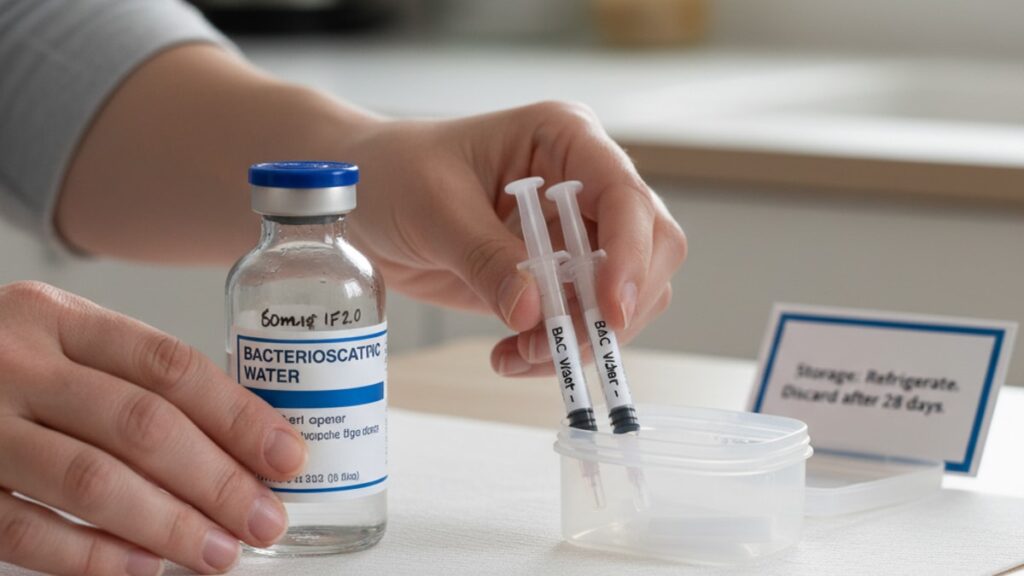
Here’s a simple but non-negotiable practice our entire team follows: the moment you open a new vial of BAC water, write the date on it with a permanent marker. Or, even better, write the “discard after” date, which is 28 days from the opening date. This removes all guesswork. When that date arrives, you discard the vial, regardless of how much is left. It's a small cost for absolute peace of mind.
Best Practices for Handling and Withdrawal: Our Team's Protocol
Proper storage is only half the battle. Impeccable handling technique is the other half. You can have the perfect storage conditions, but if you're introducing contaminants with every use, it won't matter. Here is the protocol we insist on.
-
Prepare Your Space: Always work on a clean, disinfected surface. Minimize air currents if possible. This isn't surgery, but you should adopt a similar mindset of cleanliness.
-
Scrub the Hub: Before every single withdrawal, vigorously scrub the rubber stopper (the hub) of the BAC water vial with a sterile 70% isopropyl alcohol pad. Let it air dry for a few seconds. Don't blow on it. Don't wipe it with something else. Just let the alcohol do its job and evaporate. This sterilizes the puncture site.
-
Use Sterile Equipment, Every Time: This is a big one. Use a brand new, sterile syringe and a brand new, sterile needle for every single time you access the vial. Reusing syringes or needles is one of the fastest ways to introduce contamination from one vial to another or from the environment into your BAC water.
-
Equalize Pressure: To make withdrawal easier and to avoid creating a strong vacuum inside the vial, first draw up an amount of air into the syringe equal to the volume of BAC water you plan to withdraw. Inject the air into the vial (above the liquid level), then invert the vial and draw out the desired amount of liquid. This keeps the pressure inside normalized.
-
Work Efficiently: Don't leave the needle sitting in the vial for an extended period. Puncture, withdraw, and remove. The less time the system is open, the better. Immediately after withdrawal, store the vial back in its designated spot in the refrigerator.
Adhering to this protocol transforms the process from a potential liability into a reliable, repeatable scientific technique. It protects your investment and ensures your results are built on a solid foundation.
Recognizing Signs of Contamination: When to Discard
Even with the best technique, things can sometimes go wrong. It’s important to know what to look for. Before every use, hold the vial up to a light and visually inspect the contents. You're looking for a few tell-tale signs of trouble:
- Cloudiness or Haziness: Bacteriostatic water should be perfectly clear, like pure water. Any cloudiness is a major red flag that indicates potential bacterial or fungal growth.
- Particulate Matter: You should see no floating specks, dust, or other particles inside the vial. The solution should be completely free of any visible contaminants.
- Discoloration: Any change from its original crystal-clear appearance, such as a yellow or brownish tinge, means the solution has been compromised.
Our team has a simple, unflinching rule: When in doubt, throw it out. A new vial of BAC water is an insignificant expense compared to the time, cost, and effort that go into a research project. Trying to salvage a questionable vial is the definition of a false economy. Discard it safely and start fresh with a new one. Your data will thank you.
Storage Methods Compared: What Our Experience Shows
To make it crystal clear, we've put together a simple comparison table that summarizes the storage options and why there's really only one correct choice.
| Storage Method | Temperature Range | Pros | Cons | Our Recommendation |
|---|---|---|---|---|
| Refrigerator (Main Body) | 2°C to 8°C (36°F to 46°F) | Maximizes shelf life (28 days). Maintains preservative efficacy. Aligns with all safety standards. | Requires refrigerator space. | This is the ONLY correct method. Non-negotiable. |
| Room Temperature | None. It's convenient but wrong. | Drastically increases risk of bacterial growth. Degrades the benzyl alcohol faster. Unsafe. | NEVER do this. Discard any vial left out for an extended period. | |
| Freezer | < 0°C (< 32°F) | None. Does not extend shelf life beyond 28 days. | Risks phase separation of benzyl alcohol, rendering it ineffective and unreliable upon thawing. | AVOID. The risk of creating a non-homogenous solution is too high. |
| Refrigerator (Door) | Fluctuates | Better than room temperature. | Constant temperature swings can stress the preservative and reduce its effective lifespan. | Not ideal. Use the main body of the fridge for stability. |
The Bigger Picture: Why Diluent Integrity Matters for Your Research
At the end of the day, why do we care so much about a simple vial of water? Because it’s not just water. It’s the vehicle for delivering the highly specific, high-purity peptides you're researching. The quality of your diluent directly impacts the quality of your reconstituted solution.
Think about the effort that goes into creating a research-grade peptide. Here at Real Peptides, our process involves painstaking small-batch synthesis to ensure the exact amino-acid sequencing and impeccable purity. We do this because we know that reliable research demands reliable reagents. Using a contaminated or compromised diluent is like putting contaminated fuel into a high-performance engine. You nullify all the precision and quality that came before it. It’s a critical, non-negotiable element in the chain of quality that ensures your experiments are valid and your results are reproducible.
Your work deserves better. It demands a protocol that respects the investment you've made. Proper storage of your BAC water is a foundational part of that protocol.
For those who are visual learners, our friends over at the MorelliFit YouTube channel often have excellent, practical demonstrations of various lab and research techniques that can be incredibly helpful for seeing these principles in action. It's a fantastic resource we often recommend.
This isn't just about following rules; it's about adopting a mindset of excellence that touches every part of your work. From sourcing the best peptides to storing your supplies correctly, every step contributes to the integrity of the outcome. If you’re ready to ensure every single component of your research is held to the highest possible standard, it's time to Get Started Today by choosing reagents you can trust.
It’s a commitment to quality, from our lab to yours. We encourage you to join the ongoing conversation and ask more questions on our Facebook page, where our community of researchers shares insights and best practices daily. Protecting your work starts with these fundamental details, and we're here to make sure you have the right information every step of the way.
Frequently Asked Questions
What happens if I accidentally leave my opened BAC water out overnight?
▼
Our team strongly recommends discarding it. A single night at room temperature provides a significant opportunity for any introduced bacteria to multiply, potentially overwhelming the benzyl alcohol preservative. It’s not worth the risk to your research.
Can I use BAC water after the 28-day mark if it still looks clear?
▼
No, we advise against it. The absence of visible contamination doesn’t guarantee the effectiveness of the benzyl alcohol. After 28 days, its preservative qualities are no longer certain, and the risk of microscopic, invisible contamination increases significantly.
Is there a difference between brands of bacteriostatic water?
▼
As long as it is a legitimate, sealed product from a reputable supplier that specifies it contains 0.9% benzyl alcohol, the core product is the same. The key is ensuring you’re sourcing it from a trusted vendor to avoid counterfeit or improperly prepared solutions.
Why is benzyl alcohol the chosen preservative?
▼
Benzyl alcohol is used because it is a safe and effective bacteriostatic agent at the low 0.9% concentration. It’s well-studied, stable at refrigerated temperatures, and effectively inhibits the growth of most common bacteria that could be introduced into a multi-use vial.
Does the 28-day rule apply even if I only used the vial once?
▼
Yes, it does. The 28-day countdown begins the moment the vial’s stopper is first punctured, regardless of how many times you access it afterward. The clock starts with that first breach of the sterile seal.
Can I pre-load syringes with reconstituted peptide and store them?
▼
This is a complex question that depends heavily on the specific peptide’s stability. While some may be stable for a short time, many are not. As a general rule, our team recommends reconstituting fresh for each use to ensure maximum potency and avoid degradation.
What is the proper way to dispose of expired BAC water?
▼
You can typically dispose of it down the sink with running water, as the volume and concentration of benzyl alcohol are very low. The glass vial should be disposed of in a sharps container if it was used with needles, or otherwise in your regular lab glass disposal.
Will using BAC water affect the potency of my peptide?
▼
No, it’s the standard and recommended diluent for most research peptides intended for multi-use. It is designed to be a neutral vehicle that preserves the peptide solution without interfering with its structure or function, provided storage protocols are followed.
Can I use a larger gauge needle to make withdrawal faster?
▼
We advise against it. A larger needle creates a larger hole in the rubber stopper, which can compromise its ability to reseal effectively. This can increase the risk of contamination over time. We recommend using the smallest appropriate gauge, typically 23-25g.
What’s the difference between Bacteriostatic Water and Sterile Water?
▼
The key difference is the preservative. Bacteriostatic water contains 0.9% benzyl alcohol to inhibit bacterial growth in multi-use vials. Sterile water has no preservatives and is strictly for single use only; any remainder must be discarded immediately after opening.
My BAC water arrived warm from shipping. Is it still good?
▼
Yes, an unopened, factory-sealed vial is sterile and stable at room temperature during shipping. The critical storage protocols, specifically refrigeration and the 28-day rule, only begin *after* you have opened the vial for the first time.
Can I use expired but unopened BAC water?
▼
Our team strongly advises against this. The expiration date on an unopened vial ensures its sterility and the stability of the solution. Using an expired product, even if sealed, introduces an unnecessary variable and risk into your research.











