





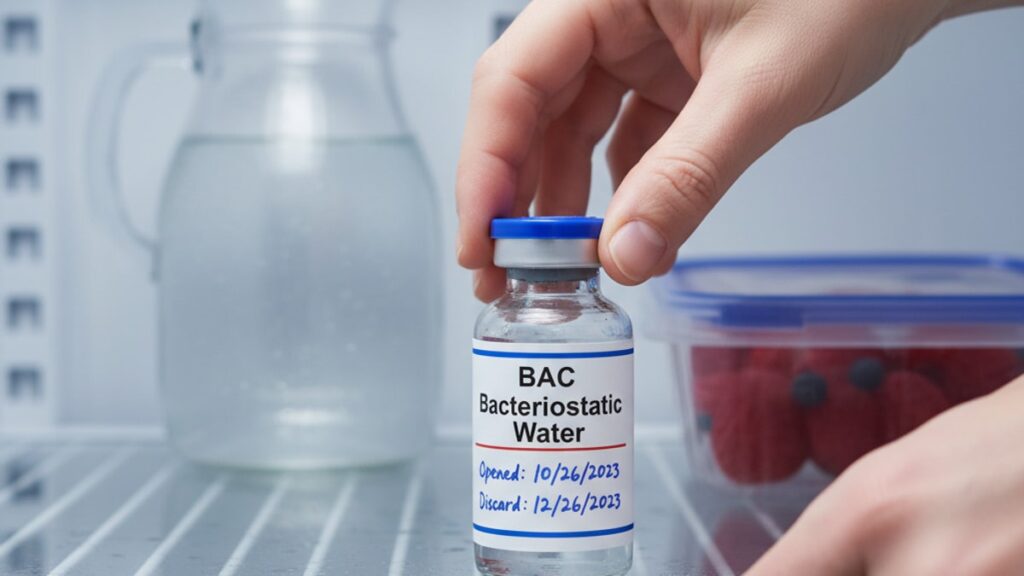
It’s one of the most common questions we get from labs and independent researchers alike. It seems simple on the surface, but the answer has layers of nuance that can genuinely make or break the integrity of a research project. So, how long does bac water last in the fridge? The short answer you’ll find everywhere is “28 days.” But honestly, that’s just the beginning of the conversation, not the end of it.
Here at Real Peptides, our team has spent years not just synthesizing high-purity peptides, but also consulting with researchers on the protocols that ensure those peptides yield clean, repeatable data. We’ve seen firsthand how something as seemingly minor as the handling of a reconstitution agent can introduce variables that compromise months of work. This isn't just about a date on a vial; it's about upholding the rigorous standards your work demands. We're here to unpack the science, the best practices, and the professional observations we've gathered over the years—so you can be confident in every single step of your process.
First, What Exactly Is Bacteriostatic Water?
Before we can talk about its shelf life, we have to be perfectly clear on what we’re dealing with. It’s a surprisingly misunderstood compound. Bacteriostatic water, or “bac water,” is not just sterile water. That’s a critical distinction.
It’s a preparation of sterile, non-pyrogenic water that contains a very specific addition: 0.9% benzyl alcohol (9mg/mL). This isn't for flavor. The benzyl alcohol acts as a bacteriostatic agent—which is a scientific way of saying it stops bacteria from reproducing. It doesn't necessarily kill all bacteria on contact (that would be bactericidal), but it creates an environment so hostile to them that they can’t multiply. This is the entire reason bac water was developed. It allows for a vial to be entered multiple times with a sterile needle to draw out solution over a period of time without it becoming a petri dish for airborne contaminants.
Sterile water for injection, on the other hand, is just that—sterile water. Once you puncture the vial, its sterility is compromised. It’s designed for single use only. If you were to draw from it multiple times, you’d be running a serious risk of introducing and cultivating bacteria. Our team can't stress this enough—using sterile water in a multi-use protocol is a recipe for catastrophic data contamination.
The 28-Day Rule: Guideline, Not Gospel
Okay, let's tackle the big one. That 28-day number. Where does it come from? It's the standard timeframe cited by manufacturers and the USP (United States Pharmacopeia). This duration is based on the effective lifespan of the benzyl alcohol as a preservative under ideal conditions. After approximately 28 days, the preservative’s ability to inhibit bacterial growth can no longer be guaranteed. It might begin to degrade, losing its potency and leaving your reconstituted peptide vulnerable.
But here’s the professional insight we’ve gained—that 28-day clock starts ticking the moment you first puncture the rubber stopper. Not when you take it out of the box. Not when you put it in the fridge. The very first puncture. And it assumes you're doing everything else perfectly.
Think of it less as a hard expiration date and more as a maximum safety window. Pushing beyond it isn't just risky; it's scientifically unsound. You're introducing a significant variable—potential contamination or a degraded preservative—that has no place in controlled research. We’ve seen researchers try to “stretch” a vial to 35 or 40 days to save a few dollars, only to end up with skewed results that cost them far more in wasted time and resources. It’s just not worth it.
Factors That Can Wreck Your Bac Water's Shelf Life
That 28-day window is entirely dependent on a chain of best practices. If any link in that chain breaks, the window shrinks. Sometimes dramatically. Our experience shows that these are the most common points of failure.
1. Your Starting Materials and Technique
It all begins here. You must start with a sealed, unexpired vial of bacteriostatic water from a reputable source. The sterility of the vial before you even open it is paramount. Then comes your technique—what we call aseptic technique. Are you swabbing the rubber stopper with an alcohol prep pad before every single entry? Are you using a brand new, sterile needle and syringe for every single draw? Reusing a needle, even once, is a cardinal sin in the lab. It introduces skin flora, airborne particles, and whatever else it touched directly into your supposedly sterile solution. This is, without a doubt, the fastest way to contaminate a vial.
2. Storage Temperature—Consistency is King
Refrigeration is non-negotiable. The ideal temperature range is between 2°C and 8°C (36°F and 46°F). But where you store it in the fridge matters immensely. The door of the refrigerator is the absolute worst place. Why? It's subject to the most frequent and dramatic temperature fluctuations every time you open it. This thermal instability can accelerate the degradation of both the benzyl alcohol and, more importantly, the delicate peptide you've reconstituted. We always recommend storing vials in a sealed container in the main body of the fridge, preferably towards the back where the temperature is most stable. Don’t let it freeze, either. Freezing can cause the peptide to fall out of the solution or denature, rendering it useless.
3. Frequency of Punctures
The more times you puncture that rubber stopper, the more opportunities you create for contamination. Every entry, no matter how careful you are, is a roll of the dice. A researcher drawing from a vial twice a day is putting it under significantly more stress than someone drawing from it every other day. The physical act of piercing the stopper can also degrade it over time, potentially compromising the seal. If you have a protocol that requires very frequent draws, it might be more prudent to reconstitute smaller amounts in separate vials.
4. The Peptide Itself
This is a point that gets overlooked. Sometimes, the bac water is perfectly fine, but the peptide reconstituted within it is not. Different peptides have vastly different stability profiles once in solution. Some are robust and can last the full 28 days without issue. Others are incredibly fragile and may begin to degrade in a matter of days, regardless of the preservative. It's absolutely critical to understand the specific stability data for the peptide you're working with. Here at Real Peptides, we emphasize that the quality of the peptide—its purity and correct sequencing—plays a huge role in its post-reconstitution stability.
Delhi University CSAS Phase 2 | How to fill Preferences✅Step By Step Process @CUETCounsellingAdda
This video provides valuable insights into how long does bac water last in fridge, covering key concepts and practical tips that complement the information in this guide. The visual demonstration helps clarify complex topics and gives you a real-world perspective on implementation.
Warning Signs: How to Tell if Your Solution is Compromised
You should never have to guess. Your eyes are your first and best tool for inspection. Before every single draw, hold the vial up to a light source and look at it closely.
- Cloudiness or Particulates: A properly reconstituted solution should be perfectly clear. Any signs of cloudiness, haziness, floating specks, or a milky appearance are massive red flags. This almost always indicates bacterial or fungal growth. Discard the vial immediately. No exceptions.
- Discoloration: Has the solution changed color? A yellowish or brownish tinge that wasn't there before is another sign of contamination or chemical degradation. Discard it.
- Change in Viscosity: Does the liquid seem thicker or thinner than it should? This is less common but can indicate a problem.
If you see any of these visual cues, your research for that vial is over. The risk of using a contaminated solution—which can lead to wildly inaccurate results or, in a clinical context, serious harm—is far too great. When in doubt, throw it out. That's the mantra of every good researcher.
Our Team's Non-Negotiable Protocol for Handling Bac Water
Over the years, we've developed a set of best practices that we consider the gold standard. Following these steps minimizes virtually all common risks and helps ensure that your bac water—and the precious peptides within it—remain viable for as long as possible.
- Start with Impeccable Quality: Use only sterile, sealed, and unexpired bacteriostatic water and high-purity peptides from a trusted supplier. This is the foundation of everything. Garbage in, garbage out.
- Establish a Sterile Field: Work on a clean, disinfected surface. Wash your hands thoroughly. Wear gloves. Minimize air movement (turn off fans, close windows) to reduce airborne contaminants.
- Prep the Vials: Use a fresh 70% isopropyl alcohol pad to vigorously scrub the rubber stoppers on both the bac water vial and the peptide vial for at least 15 seconds. Let them air dry completely.
- Use a Fresh, Sterile Syringe for Every Step: Never, ever reuse a syringe or needle. Not even to draw up more water. Once it's been used, it's done.
- Label Everything: This is so simple, yet so often forgotten. As soon as you reconstitute the peptide, label the vial with the peptide name, the concentration, and—most importantly—the date and time of reconstitution. Use a permanent marker. This isn't optional.
- Store Immediately and Correctly: Once labeled, place the vial in its designated container and put it in the stable, cold part of your refrigerator. Don't leave it sitting out on the bench.
For a more detailed visual guide on these techniques, we've found video walkthroughs to be incredibly helpful. You can find excellent examples of proper lab technique on channels like the MorelliFit YouTube channel, which often breaks down complex processes into easy-to-follow steps.
Choosing Your Reconstitution Liquid: A Quick Comparison
Bac water is the workhorse for most multi-use peptides, but it's not the only option. The right choice depends entirely on the peptide and your research protocol.
| Reconstitution Liquid | Key Ingredient | Best For | Typical Shelf Life (Post-Puncture) |
|---|---|---|---|
| Bacteriostatic Water | Sterile Water + 0.9% Benzyl Alcohol | Peptides requiring multiple draws (e.g., BPC-157, TB-500) | Up to 28 days (refrigerated) |
| Sterile Water for Injection | Pure Sterile Water | Single-use applications; peptides unstable with benzyl alcohol | Immediate use only; discard leftover |
| 0.6% Acetic Acid Solution | Sterile Water + 0.6% Acetic Acid | Peptides that require a more acidic pH for stability/solubility (e.g., some Growth Factors) | Varies by peptide; typically shorter than bac water |
Our team has found that a surprising number of research errors stem from using the wrong reconstitution liquid. Using bac water for a peptide that's known to be unstable in the presence of benzyl alcohol, for instance, will degrade the product before you even begin your experiments. Always, always check the technical data sheet for the specific peptide you're working with. It will specify the recommended diluent.
The Real Cost of Cutting Corners
Let’s be honest—the temptation to use a vial for 30 or 35 days is often rooted in trying to maximize a budget. We get it. Research is expensive. But this is a classic case of being penny-wise and pound-foolish. The potential cost of using a compromised solution is immense. You risk invalidating your data, which means you have to repurchase reagents and repeat the experiments—erasing any initial savings and then some. You risk damaging your professional reputation by publishing or presenting data that isn't reproducible.
This is why we're so relentless about quality at Real Peptides. We know that the integrity of your work depends on the integrity of our products. When you source peptides from us, you're getting something that has been meticulously synthesized and verified for purity. We see it as our responsibility to also provide the knowledge you need to handle those peptides correctly. Your success is our success. If you're ready to work with a partner who is as invested in your results as you are, we encourage you to Get Started Today.
The 28-day rule for how long bac water lasts in the fridge is your most reliable safety net. It's a standard established through rigorous testing to protect you and your research. While impeccable technique and storage can ensure you get the full 28 days of viability, pushing beyond that timeframe is a gamble against microbiology—and the house always wins. Treat every vial with respect, adhere to protocol, and when that 28th day arrives, it’s time to say goodbye and start fresh. Your data will thank you for it.
We're always sharing more insights and best practices with the research community. For ongoing discussions, tips, and to connect with our team, be sure to follow us on our Facebook page. We believe in building a community dedicated to advancing science with integrity and precision.
Frequently Asked Questions
What happens if I use bac water that’s older than 28 days?
▼
After 28 days, the benzyl alcohol preservative may lose its effectiveness. Using it poses a significant risk of introducing bacterial contamination into your research, which can lead to inaccurate results or solution degradation.
Can I freeze reconstituted peptides to make them last longer?
▼
Freezing is generally not recommended unless specified by the peptide’s manufacturer. The freeze-thaw cycle can denature many peptides, destroying their structure and rendering them inactive. Always check the specific storage protocol for your compound.
Is cloudy bac water always a sign of contamination?
▼
Yes. A properly stored and handled solution of bacteriostatic water and a reconstituted peptide should always be clear. Our team’s advice is unequivocal: any cloudiness, haze, or visible particles should be treated as contamination, and the vial must be discarded immediately.
Why exactly is benzyl alcohol used as the preservative?
▼
Benzyl alcohol is used because it’s an effective bacteriostatic agent at the 0.9% concentration. It inhibits the growth and reproduction of most common bacteria that could be introduced into the vial during multiple entries, preserving the solution’s sterility.
How is bac water different from sterile water?
▼
Bacteriostatic water contains 0.9% benzyl alcohol as a preservative, making it suitable for multi-use vials. Sterile water contains no preservatives and is strictly for single-use applications, as it can become contaminated after the first puncture.
Does the type of peptide affect the 28-day rule?
▼
Absolutely. The 28-day rule applies to the bacteriostatic water itself. However, many peptides are far less stable and may degrade in a matter of days or weeks, even when stored perfectly in bac water. You must follow the stability guidelines for the specific peptide.
What’s the best place in the fridge to store my vials?
▼
We recommend storing vials in the main body of the refrigerator, towards the back. This area has the most stable temperature. Avoid the fridge door, as it experiences frequent temperature fluctuations that can degrade the solution.
Can I use a vial of bac water if the expiration date on the label has passed?
▼
No. You should never use a vial of bacteriostatic water that is past its printed expiration date, even if it’s unopened. The sterility and preservative efficacy of the sealed product cannot be guaranteed beyond that date.
Is it okay to pre-load syringes for later use?
▼
Our team strongly advises against this practice. Plastic syringes are not designed for long-term storage of chemical solutions. Peptides can adhere to the plastic or stopper, altering the dose, and the risk of contamination increases significantly over time.
What if I accidentally leave my reconstituted vial out of the fridge overnight?
▼
This can seriously compromise the peptide’s stability. While the bac water might prevent bacterial growth for a short period, many peptides degrade rapidly at room temperature. For data integrity, it would be safest to discard the vial.
Do I need to let the vial warm up before drawing from it?
▼
No, it’s not necessary. You can draw from the vial while it is still cold from the refrigerator. The small volume drawn will quickly acclimate to room temperature.
Can I mix two different peptides in the same vial of bac water?
▼
This is not recommended. Mixing peptides can lead to unknown chemical interactions, degradation, or precipitation. Each peptide should be reconstituted and stored in its own separate, clearly labeled vial to ensure purity and stability.











