



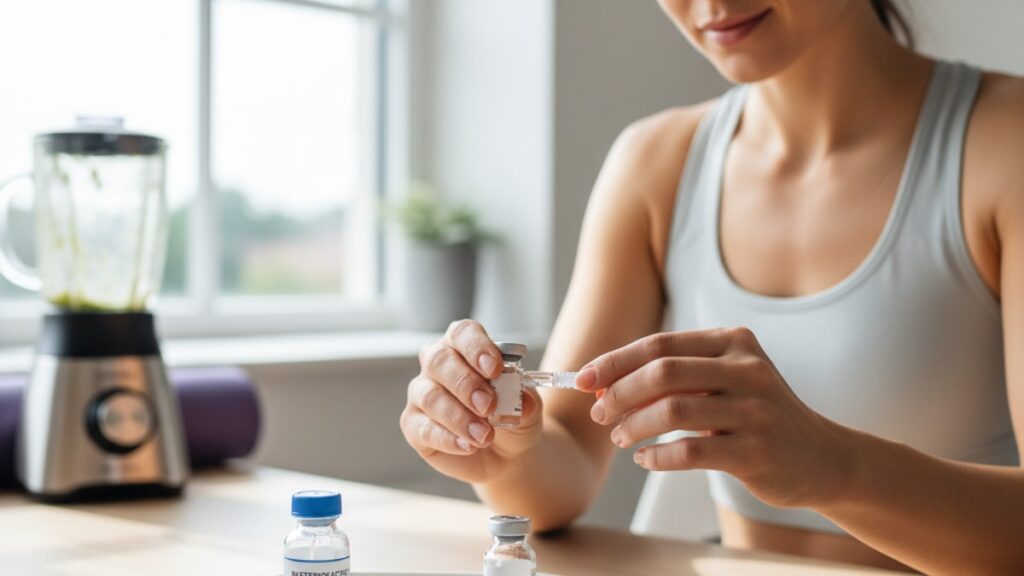
It’s one of the most common questions our team gets, and honestly, it’s one of the most critical. You’ve invested in high-purity, research-grade peptides—like the ones we meticulously synthesize here at Real Peptides—and now you’re at the final, crucial step before your experiment can even begin: reconstitution. The vial in front of you says 10mg, but the lyophilized powder inside is a tiny, almost insignificant-looking disc. How do you turn that into a precisely dosed, usable solution? Specifically, how much BAC water for 10mg peptide vials is the right amount?
This isn't just about adding water to a powder. It’s about accuracy, integrity, and the validity of your entire research project. Getting this wrong can—and often does—lead to skewed data, inconsistent results, and wasted resources. We’ve seen it happen. That's why we're putting our collective lab experience on paper to walk you through not just the 'how,' but the 'why.' This is the definitive breakdown, straight from the people who live and breathe peptide synthesis and handling.
Why This Calculation Is Non-Negotiable
Let’s be perfectly clear—getting the reconstitution ratio right isn't just a best practice; it's the foundation of reliable data. Peptides are powerful signaling molecules, and their effects are incredibly dose-dependent. An error of just a few micrograms can be the difference between a successful experiment and one that produces baffling, unrepeatable results. It’s a game of precision.
Think about it. We go to extraordinary lengths to ensure every vial of peptide that leaves our U.S. facility has impeccable purity and exact amino-acid sequencing. We use small-batch synthesis for a reason—it allows for stringent quality control that larger, mass-produced operations simply can't match. That commitment to precision on our end is completely undermined if the dilution on your end is based on guesswork. You need to know, with absolute certainty, that when you draw 10 units into your syringe, you are administering the exact intended dose. Anything less introduces a catastrophic variable into your work.
And another thing—improper reconstitution doesn't just mess with dosing. It can physically damage the peptide. These are delicate chains of amino acids, and slamming them with the wrong diluent or using a brutish technique can denature them, rendering them useless. So, this process is about protecting both your research outcomes and the integrity of the molecule itself. We can't stress this enough.
The Essential Toolkit for Reconstitution
Before you even think about the math, you need the right tools. Attempting this with subpar equipment is like trying to perform surgery with a butter knife. It’s not going to end well. Our team insists on having these items on hand every single time. No exceptions.
- Your 10mg Peptide Vial: The star of the show. Note that lyophilized (freeze-dried) peptides look different. Some are fluffy powders, others are solid discs. A 10mg vial might look almost empty—this is normal.
- Bacteriostatic (BAC) Water: This is sterile water mixed with 0.9% benzyl alcohol. The alcohol acts as a preservative, preventing bacterial growth after the vial's rubber stopper has been punctured. This is the gold standard for multi-use peptide solutions.
- Sterile Syringes: You’ll need at least two. One larger syringe (typically 3mL or 5mL) is for adding the BAC water to the vial. A smaller insulin syringe (calibrated in units, usually 1mL or 0.5mL) is for drawing your precise doses for administration.
- Alcohol Prep Pads: For sterilizing the rubber stoppers on both your peptide vial and the BAC water vial. Contamination is the enemy.
That’s it. It’s a simple list, but every item is critical. Don't be tempted to substitute. Using tap water or even just sterile water without the bacteriostatic agent is asking for trouble, especially if you plan to store and use the vial over several days or weeks.
The Math: Breaking Down Dilution Ratios
This is where people get intimidated, but the math is actually straightforward once you understand the variables. The goal is to create a solution where a specific, easily measurable volume contains the exact dose you need. It's all about concentration.
First, a crucial conversion: 1 milligram (mg) = 1000 micrograms (mcg).
Your vial contains 10mg of peptide, which is equal to 10,000mcg.
This number—10,000mcg—is your constant. It’s the total amount of peptide you have to work with. The variable you control is how much BAC water you add to it. The amount of water you add will determine the final concentration of the solution.
Let's explore the most common scenarios:
Scenario 1: Adding 1mL of BAC Water
This is a very common and simple choice. An insulin syringe holds 1mL, which is marked as 100 units.
- Total Peptide: 10,000mcg
- Total Diluent: 1mL (or 100 units)
- Calculation: 10,000mcg of peptide divided by 100 units of water.
- Resulting Concentration: 100mcg of peptide per 1 unit on the insulin syringe.
This makes dosing incredibly easy. If you need a 500mcg dose, you draw 5 units. If you need 250mcg, you draw 2.5 units (or the halfway mark between the 2 and 3).
Scenario 2: Adding 2mL of BAC Water
Sometimes a more diluted solution is preferred, especially for smaller, more sensitive dosing protocols. It allows for finer control.
- Total Peptide: 10,000mcg
- Total Diluent: 2mL (or 200 units, since you're using two full 1mL syringes)
- Calculation: 10,000mcg of peptide divided by 200 units of water.
- Resulting Concentration: 50mcg of peptide per 1 unit on the insulin syringe.
Now, that same 500mcg dose would require you to draw 10 units. A 250mcg dose would be 5 units. See how it gives you more room for error on the syringe markings? For very small doses (like 50mcg or 100mcg), this method is often superior.
Scenario 3: Adding 3mL of BAC Water
This is less common for a 10mg vial unless you're working with exceptionally small microdoses, but the principle remains the same.
- Total Peptide: 10,000mcg
- Total Diluent: 3mL (or 300 units)
- Calculation: 10,000mcg of peptide divided by 300 units of water.
- Resulting Concentration: 33.33mcg of peptide per 1 unit on the insulin syringe.
The math gets a little less clean here, but it's still perfectly manageable. A 100mcg dose would be 3 units. A 500mcg dose would be 15 units.
Our team has found that for most general research applications involving a 10mg vial, the 1mL or 2mL dilution offers the best balance of convenience and precision.
Why Retatrutide is The Most Effective FAT LOSS Peptide
This video provides valuable insights into how much bac water for 10mg peptide, covering key concepts and practical tips that complement the information in this guide. The visual demonstration helps clarify complex topics and gives you a real-world perspective on implementation.
Dilution Comparison for a 10mg (10,000mcg) Vial
To make it even clearer, here’s a quick-reference table our own researchers use. This visual can really help solidify the concept.
| BAC Water Added | Total Volume (Units) | Concentration per 1 Unit | Volume for 250mcg Dose | Volume for 500mcg Dose | Volume for 1000mcg (1mg) Dose |
|---|---|---|---|---|---|
| 1 mL | 100 Units | 100 mcg / unit | 2.5 Units | 5 Units | 10 Units |
| 2 mL | 200 Units | 50 mcg / unit | 5 Units | 10 Units | 20 Units |
| 3 mL | 300 Units | 33.3 mcg / unit | 7.5 Units | 15 Units | 30 Units |
This table should be your go-to guide. It removes the guesswork and lays out the direct consequences of your dilution choice. Simple, right?
Our Step-by-Step Reconstitution Protocol
Okay, theory is great. But let's get practical. Here is the exact, unflinching protocol we follow in our labs. Follow this, and you'll protect the peptide and ensure perfect reconstitution every single time.
Step 1: Preparation is Everything.
Lay out all your tools on a clean, sterile surface. Wash your hands thoroughly. Pop the plastic caps off both the BAC water vial and your 10mg peptide vial. Don't skip this.
Step 2: Sterilize the Stoppers.
Take an alcohol prep pad and vigorously wipe the rubber stopper on top of both vials. This removes any surface contaminants. Let them air dry for a moment.
Step 3: Draw Your BAC Water.
Take your larger 3mL syringe. Pull back the plunger to the amount you plan to use (e.g., to the 1mL or 2mL mark). This fills the syringe with air. Insert the needle into the BAC water vial and inject the air. This pressurizes the vial and makes it much easier to draw the liquid out. Now, draw your chosen amount of BAC water into the syringe.
Step 4: The Slow Injection—This is CRITICAL.
Take the syringe filled with BAC water and carefully insert the needle into your 10mg peptide vial. Here's the most important part: DO NOT just shoot the water directly onto the lyophilized powder. This can damage the fragile peptide structure. Instead, angle the needle so the stream of water runs down the inside glass wall of the vial. Depress the plunger slowly and gently. Let the water trickle down and pool, allowing the powder to dissolve gradually.
Step 5: No Shaking. Ever.
Once all the water is in, remove the syringe. You might see some undissolved powder. Your instinct will be to shake it. Don't. Shaking can shear the peptide chains apart, a process called denaturation. Instead, gently roll the vial between your fingers or palms. You can also swirl it in a slow, gentle circular motion. Be patient. It might take a few minutes, but it will fully dissolve into a clear solution.
Step 6: Proper Storage.
Once reconstituted, your peptide is now in a liquid state and is far less stable than when it was freeze-dried. It must be stored in the refrigerator (around 2-8°C or 36-46°F). Never freeze a reconstituted peptide unless the specific molecule's data sheet says it's acceptable—for most, it’s not.
For a visual walkthrough of this entire process, our team often directs people to helpful videos. There are great resources on platforms like YouTube that show these techniques in detail, like the ones you might find on the MorelliFit channel, which breaks down complex topics visually.
Common Mistakes We've Seen Researchers Make
We've been in this industry for a long time, and we've heard all the horror stories. Learning from others' mistakes is a lot less painful (and less expensive) than making them yourself. Here are the most common pitfalls.
- The Aggressive Shake: We mentioned it before, but it bears repeating. Shaking a vial of peptides is the fastest way to destroy your investment. Gentle rolling or swirling only.
- Using the Wrong Water: Someone uses tap water or bottled water because they ran out of BAC water. This introduces bacteria and minerals that can contaminate and degrade the peptide almost instantly. The solution won't be sterile and is absolutely not safe for research.
- The Dreaded mg/mcg Mix-up: This is the most frequent calculation error. Someone forgets to convert 10mg to 10,000mcg and their math is off by a factor of 1000. Their intended 100mcg dose becomes a 0.1mcg dose, and they wonder why their experiment yields no results. Always do the conversion first.
- Poor Storage Habits: Leaving the reconstituted vial out on the lab bench at room temperature for hours or days is a death sentence for the peptide's stability. It must be refrigerated immediately after use.
- Direct Water Jet: Injecting the BAC water with force directly onto the powder can cause foaming and mechanical stress on the molecule. The 'run-down-the-side' technique is gentle and effective.
Avoiding these simple errors is half the battle. When you start with a product as pure as what we provide at Real Peptides, you want to make sure your handling protocol is just as impeccable. When you're ready to ensure your research has the best possible foundation, you can explore our full catalog and Get Started Today.
Beyond the 10mg Vial
While this post focuses on the common question of how much BAC water for 10mg peptide vials, the principles are universal. Whether you have a 2mg vial or a 5mg vial, the logic is identical. You just have to adjust your starting number.
- For a 5mg vial: You're starting with 5,000mcg of peptide.
- For a 2mg vial: You're starting with 2,000mcg of peptide.
Then, you apply the same logic. If you add 1mL (100 units) of BAC water to a 5mg (5,000mcg) vial, your concentration will be 50mcg per unit. It's the same simple division: total micrograms divided by total units of water.
Understanding this core principle means you'll never be confused by a different vial size again. It empowers you to be adaptable and precise, no matter what your research protocol demands.
This entire process, from calculation to careful handling, is about respecting the science. It’s about controlling variables to produce clean, reliable, and meaningful data. It's a skill, and like any skill, it gets easier and more intuitive with practice. Our goal is to be your partner in that process, providing not just the highest-quality materials but also the expertise to help you use them effectively.
For more insights from our team and updates on the latest in peptide research, be sure to follow us on Facebook where we share regular posts and engage with the scientific community. We believe in building a foundation of shared knowledge. After all, your success is our success.
Frequently Asked Questions
Can I use sterile water instead of bacteriostatic water?
▼
You can for a single-use application, but it’s not recommended. Sterile water lacks the benzyl alcohol preservative, so once you puncture the vial, bacteria can grow. For any peptide solution you plan to use more than once, BAC water is essential for safety and stability.
How long is a reconstituted 10mg peptide good for in the fridge?
▼
This depends on the specific peptide, but a general guideline for most peptides reconstituted with BAC water is 3-4 weeks when stored properly in a refrigerator. Always refer to the data sheet for your specific peptide for the most accurate stability information.
What happens if I accidentally shake the vial?
▼
Shaking can cause the delicate peptide chains to break apart or ‘denature,’ which can render them ineffective. While a single brief shake might not destroy the entire vial, it’s a very risky practice that should always be avoided in favor of gentle swirling or rolling.
Why does my 10mg peptide vial look almost empty?
▼
This is completely normal. Peptides are lyophilized (freeze-dried) for stability, a process which removes water and leaves behind a very small, compact disc or powder. The 10mg refers to the weight of the active peptide, not the volume it takes up.
Is it better to use 1mL or 2mL of BAC water for a 10mg vial?
▼
It’s a matter of preference and dosing requirements. Using 1mL gives you a higher concentration (100mcg/unit), which is convenient for larger doses. Using 2mL provides a lower concentration (50mcg/unit), which allows for more precise measurement of smaller doses.
My reconstituted peptide solution looks cloudy. What should I do?
▼
A properly reconstituted peptide solution should be perfectly clear. If it’s cloudy, it could indicate that the peptide has degraded, it was reconstituted improperly, or there is bacterial contamination. Our team strongly advises against using any solution that is not clear.
Can I pre-load syringes for the week?
▼
We generally advise against this. Peptides are most stable in the glass vial. Some peptides can bind to the plastic in syringes over time, potentially altering the dose you administer. It’s always best practice to draw each dose immediately before administration.
Does the brand of BAC water matter?
▼
As long as you are using a reputable, sterile, and properly formulated bacteriostatic water (0.9% benzyl alcohol), the specific brand is less important. The key is to ensure it is not expired and has been stored correctly.
What’s the best type of syringe for dosing?
▼
For administering doses, a U-100 insulin syringe is the standard. They are clearly marked in units, making the calculations we’ve outlined simple and accurate. They also have very fine needles suitable for research applications.
Do I need to let the peptide vial warm up before reconstituting?
▼
Yes, it’s a good practice. If you’ve been storing your lyophilized peptide in the refrigerator, allow it to sit at room temperature for about 15-20 minutes before adding the BAC water. This helps prevent condensation inside the vial.
What if I accidentally add too much BAC water?
▼
Don’t panic. As long as you know exactly how much you added, you can simply recalculate your concentration. For example, if you meant to add 1mL but added 1.5mL, your new concentration for a 10mg vial would be 10,000mcg / 150 units = 66.6mcg per unit. Just adjust your math accordingly.
