



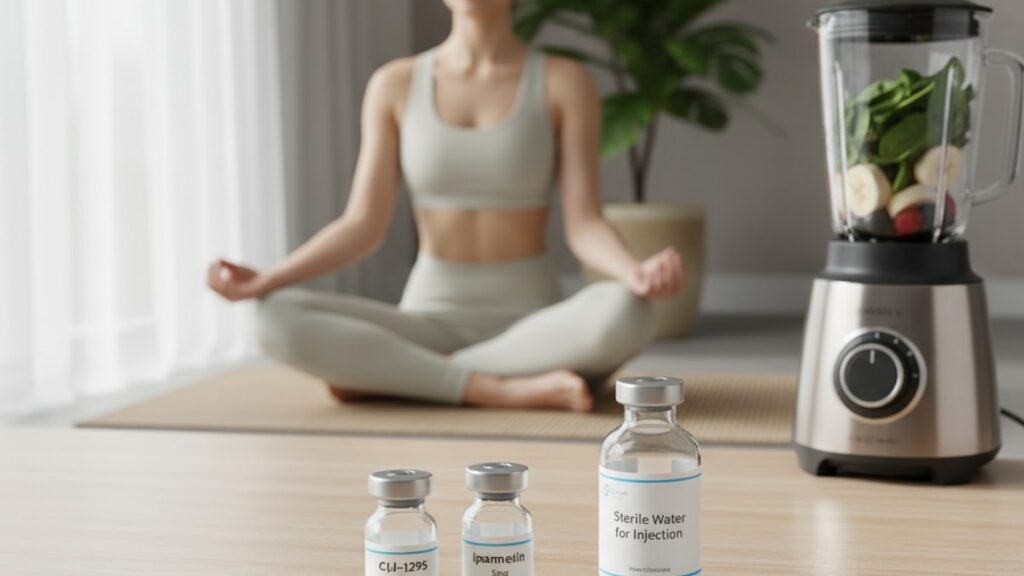
So, you have a vial of high-purity, lyophilized CJC 1295 Ipamorelin 5mg. That small, unassuming puck of white powder at the bottom represents a significant investment in your research. And—let's be honest—the step between receiving that vial and having a usable solution can feel a little daunting. We get it. Our team has spoken with countless researchers, and this exact process is often a source of anxiety. One wrong move, one miscalculation, and the integrity of a very delicate molecule could be compromised.
That’s precisely why we’re writing this. This isn’t just another set of instructions; it’s our definitive protocol, born from years of experience in the biotechnology space. At Real Peptides, our obsession is purity and precision, from the moment we begin our small-batch synthesis to the point where you, the researcher, prepare it for use. We believe that providing impeccable peptides is only half the job. The other half is ensuring you have the expert knowledge to handle them correctly. Consider this your direct line to our lab’s best practices.
First Things First: Understanding Your Peptide
Before you even think about picking up a labware, it's critical to understand what you're working with. Lyophilization, or freeze-drying, is a sophisticated process used to preserve delicate biological materials. It removes water content, rendering the peptide stable for shipping and storage at room temperature. The result is that small, solid 'cake' or powder in your vial. It’s incredibly fragile. The long-chain amino acid structures that make peptides like CJC 1295 and Ipamorelin effective are held together by delicate bonds. Shaking, introducing contaminants, or using the wrong solvent can break these bonds, rendering the peptide useless. It’s a catastrophic failure of protocol.
This is why starting with a quality product is non-negotiable. When we manufacture peptides at Real Peptides, we're focused on exact amino-acid sequencing and purity. That foundational quality means the peptide is robust enough to handle proper reconstitution—but it doesn't make it invincible. Your technique is the final, critical link in the chain of custody that preserves its integrity. Think of yourself as the final steward of the molecule's potential.
The Essential Toolkit: Assembling Your Supplies
Success here is all about preparation. Scrambling for a missing alcohol pad mid-process is a recipe for contamination and mistakes. Our team recommends setting up a clean, dedicated workspace and laying out every single item before you begin. It’s a simple step that makes a world of difference.
Here’s what you absolutely need:
- Your Vial of CJC 1295 / Ipamorelin 5mg: This is your starting point. Before you uncap it, inspect the vial. Check that the seal is intact and there are no cracks in the glass.
- Bacteriostatic (BAC) Water: This is the solvent of choice. It's sterile water mixed with 0.9% benzyl alcohol, an antimicrobial agent that prevents bacterial growth after the vial's vial seal has been punctured multiple times. This is crucial for maintaining sterility over the life of the reconstituted solution. Using simple sterile water is an option, but it lacks this preservative, dramatically shortening the vial's usable lifespan. We can't stress this enough—don't use tap water, distilled water, or any other liquid.
- sterile labware: You’ll need at least two. One larger labware (typically 3mL or 5mL) is for accurately measuring and transferring the BAC water into your peptide vial.
- Alcohol Prep Pads: Sterility is everything. You'll need these to wipe the rubber stoppers of both your peptide vial and your BAC water vial before every puncture. Every single time. No exceptions.
Honestly, though, the quality of these supplies matters. Flimsy labware with dull transfer line can core the vial seal, introducing tiny rubber particles into your solution. It’s a small detail that can have big downstream consequences. Invest in good tools.
I Stacked Retatrutide and MOTS-c for 60 Days and THIS Happened!
This video provides valuable insights into how to reconstitute cjc 1295 ipamorelin 5mg, covering key concepts and practical tips that complement the information in this guide. The visual demonstration helps clarify complex topics and gives you a real-world perspective on implementation.
The Protocol: Step-by-Step Reconstitution
With your supplies gathered and your calculations double-checked, it's time for the procedure itself. Stay deliberate and focused.
Step 1: Preparation and Sanitization
Wash your hands thoroughly. Pop the plastic protective caps off both your peptide vial and your BAC water vial. Take an alcohol prep pad and vigorously scrub the vial seal on each vial for several seconds. Let them air dry. Don't blow on them—that just introduces new contaminants.
Step 2: Drawing the Bacteriostatic Water
Take your larger 3mL labware. This is important because it equalizes the pressure in the BAC water vial, making it much easier to draw the liquid. Insert the transfer line through the center of the BAC water's vial seal. Check for any large air bubbles. If you see them, you can gently flick the labware to make them rise to the top and then expel them.
Step 3: Introducing the Solvent to the Peptide (The Critical Step)
This is where technique is everything. Here's the most important part—do not directing the stream straight onto the lyophilized cake powder. This forceful stream can damage the molecules. Instead, angle the transfer line so the water runs slowly down the inside wall of the glass vial. Depress the transfer control gently and deliberately until all the water has been transferred.
Step 4: Mixing the Solution
Once the water is in, remove the labware. You'll notice the powder starting to dissolve on its own. Now, you need to gently mix it. DO NOT SHAKE THE VIAL. We can't say this enough. Shaking will shear the peptide chains. Instead, gently roll the vial between your fingers or palms. You can also swirl it in a slow, circular motion. Continue this until the solution is completely clear and there are no visible powder particles left. This usually only takes a minute or two. The final solution should look just like water.
That's it. You’ve successfully reconstituted your peptide. Now, the focus shifts to proper storage to maintain its potency.
Proper Storage: Protecting Your Investment
Reconstitution changes everything. The stable, lyophilized powder is now a delicate liquid solution that is highly susceptible to degradation from heat and light.
Once mixed, the vial must be stored in a refrigerator. The ideal temperature is between 2°C and 8°C (36°F and 46°F). Don't store it in the freezer—freezing a reconstituted peptide can damage it just as much as heat. Don't store it in the refrigerator door, either. The temperature fluctuations from opening and closing the door can accelerate degradation over time. Find a stable spot in the main body of the fridge.
Our experience shows that when stored properly, a reconstituted vial of CJC 1295 / Ipamorelin will maintain its potency for at least 4 to 6 weeks. After that, its effectiveness may begin to decline. Always label your vial with the date of reconstitution so you can keep track.
| Solvent Type | Key Preservative | Typical Use Case | Shelf-Life Post-Reconstitution | Our Team's Recommendation |
|---|---|---|---|---|
| Bacteriostatic Water | 0.9% Benzyl Alcohol | Multi-use vials for ongoing research | 4-6 Weeks (Refrigerated) | The Gold Standard. Ensures sterility and longevity for the entire vial. |
| Sterile Water | None | Single-use applications where the entire vial is used at once | < 24 Hours (Refrigerated) | Not recommended for multi-withdrawal vials. Risk of contamination is extremely high. |
| 0.6% Acetic Acid | Acetic Acid | Specific peptides that require an acidic pH for stability | Varies by peptide | Unnecessary and potentially damaging for CJC 1295/Ipamorelin. Stick with BAC water. |
Sidestepping Common Research Errors
Over the years, our team has troubleshot just about every reconstitution mistake imaginable. They almost always fall into a few categories. Being aware of them is the best way to avoid them.
- The Wrong Solvent: A researcher uses sterile water for a multi-use vial and wonders why their results fall off after a week. The reason? Bacterial growth. Always use BAC water.
- The Aggressive Mix: Shaking the vial is probably the single most common destructive error. It’s an instinct for many people when they see a powder in a liquid, but it's ruinous for peptides. Always roll or swirl.
- Calculation Catastrophes: Misplacing a decimal point can lead to a aliquot that’s 10x too high or 10x too low, completely invalidating your data. Write down your math. Double-check it. Have a colleague check it. Be meticulous.
- Treat your workspace like a sterile field as much as possible.
Avoiding these pitfalls isn't about being perfect; it's about being professional and respecting the materials. The quality of your research depends entirely on the integrity of your components. Starting with a guaranteed pure product is the first step—and that's our commitment at Real Peptides. To ensure you have the best starting materials, you can explore our full range and Get Started Today.
This entire process, from calculation to storage, is a testament to the idea that in scientific research, the small things aren't just the small things—they're everything. A disciplined approach to reconstitution ensures that the potent, precisely-engineered peptide you purchased is the same one you're using in your experiments. It's the only way to generate reliable, repeatable results.
We hope this detailed protocol removes any uncertainty and empowers you to handle these molecules with the confidence and precision they demand. For more insights, updates on new peptides, and discussions within the research community, be sure to follow our page on Facebook. We're always sharing what we've learned.
Frequently Asked Questions
Why does the 5mg vial of CJC 1295 Ipamorelin look almost empty?
▼
This is very common and completely normal. 5mg is an incredibly small amount of material by mass. After the lyophilization process, it forms a tiny, compact ‘puck’ or a light dusting of powder at the bottom of the vial, which can be hard to see.
What happens if I accidentally shake the vial after adding the water?
▼
Shaking the vial can shear the delicate peptide bonds, effectively destroying the molecules and rendering them biologically inactive. If you’ve shaken it vigorously, we unfortunately have to advise that the integrity of the peptide is likely compromised for research purposes.
Can I use sterile water instead of bacteriostatic water?
▼
You can, but only if you plan to use the entire vial’s contents in a single application within 24 hours. BAC water contains a preservative that prevents bacterial growth from multiple transfer line punctures, making it essential for repeated withdrawals over several weeks.
How long is reconstituted CJC 1295 Ipamorelin good for?
▼
When reconstituted with bacteriostatic water and stored properly in a refrigerator (not the door), the solution remains potent and stable for at least 4 to 6 weeks. After this period, its efficacy may begin to decline.
My reconstituted solution looks cloudy. What should I do?
▼
A properly reconstituted peptide solution should be perfectly clear, like water. If your solution is cloudy, it could indicate a problem with the reconstitution process, contamination, or that the peptide has degraded. We do not recommend using a cloudy solution.
Is it okay to preparing aliquots in advance for the week?
▼
Our team strongly advises against this practice. Peptides are most stable in their glass vial. plastic labware are not designed for long-term storage, and the peptide can adhere to the plastic, reducing the effective aliquot and potentially degrading faster.
What temperature should the refrigerator be for storing my peptide?
▼
The ideal temperature range is between 2°C and 8°C (36°F and 46°F). It’s critical to avoid freezing the solution, as the freeze-thaw cycle can damage the peptide structure.
Does it matter where I buy my bacteriostatic water?
▼
Yes, quality and sterility are paramount. Always source your BAC water, labware, and other supplies from a reputable medical or laboratory supply company to ensure they are sterile and meet quality standards for research.











