





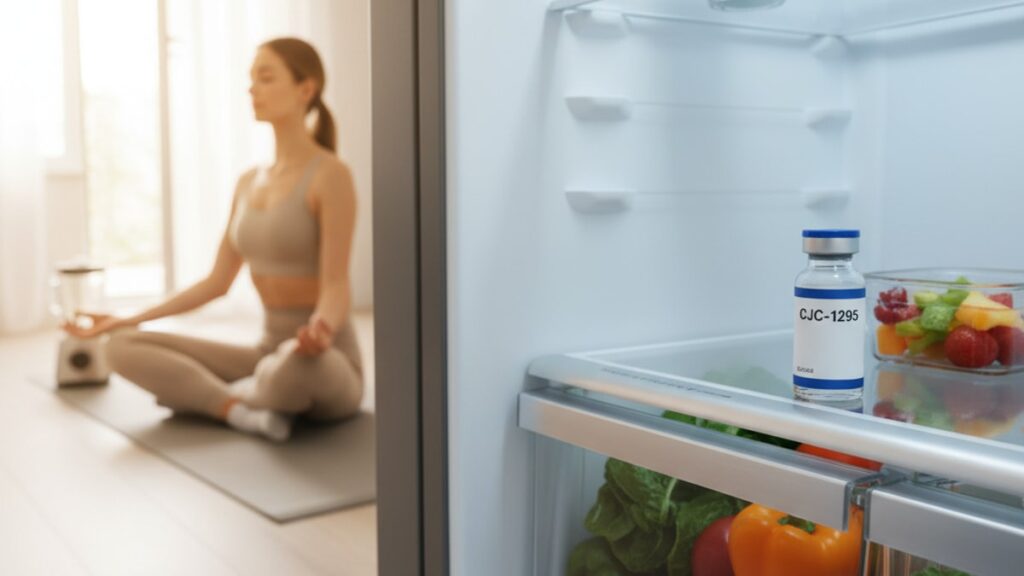
It’s a question our team gets all the time, and honestly, it’s one of the most critical questions a researcher can ask. You’ve invested in a high-purity peptide like CJC-1295 for your study, meticulously planned your protocols, and now the success of your experiment hinges on something that seems deceptively simple: storage. How long does CJC-1295 really last in the fridge? The answer isn't a simple number. It's a science.
Here at Real Peptides, we don’t just focus on crafting peptides with impeccable, verifiable purity through our small-batch synthesis process; we see ourselves as partners in your research journey. And that partnership means ensuring you have the knowledge to maintain that purity from the moment you receive your vial to its final application. Wasting a peptide due to improper storage is a catastrophic, completely avoidable setback. So, let's break down the nuances and give you the definitive answer you need to protect your work.
It’s More Than Just a Date on a Vial
First things first, we need to get one thing straight. When we talk about the shelf life of CJC-1295, we’re actually talking about two completely different states of the compound, and they have wildly different stability profiles. We can't stress this enough—treating them the same is the fastest way to compromise your results.
One is the lyophilized state. The other is the reconstituted state.
Thinking they have the same storage requirements is like assuming a bag of flour and a loaf of fresh bread have the same expiration date. One is a stable, preserved raw material, while the other is an active, perishable product. The moment you add liquid, you start a clock, and understanding that clock is everything.
The Two States of CJC-1295: Lyophilized vs. Reconstituted
Let’s dig into the fundamental difference, because this is the foundation of proper peptide handling.
Lyophilized CJC-1295 (The Powder)
This is the form you receive from us. Lyophilization, or freeze-drying, is a sophisticated process where the peptide is frozen and then the surrounding pressure is reduced to allow the frozen water to sublimate directly from a solid to a gas. It’s a delicate process, but it’s the gold standard for preserving fragile biological molecules. By removing virtually all the water, we halt the chemical reactions—like hydrolysis and oxidation—that would otherwise degrade the complex amino acid chains. Our experience shows that the quality of the lyophilization process itself has a significant impact on the initial stability of the product.
In this dry, powdered state, CJC-1295 is remarkably stable. It's a resilient little puck of potential. But even in this state, it's not invincible. It’s still sensitive to its environment, particularly heat and light, which can slowly chip away at its structural integrity over long periods.
Reconstituted CJC-1295 (The Liquid)
This is the peptide after you’ve added a diluent, typically bacteriostatic water. You've rehydrated it, bringing it back to life for use in your research. And—let's be honest—this is where the trouble can start. The reintroduction of water makes the peptide biologically active and ready for use, but it also makes it vulnerable. The very medium that makes it usable also exposes it to a host of degradation pathways.
The peptide chains are now floating in a solution where they can fold improperly, clump together (aggregation), or be attacked by microbes. The clock is now ticking, and its speed is determined by temperature, the type of water you used, and how you handle it. This is where the question of “how long does CJC-1295 last in the fridge” truly comes into play.
So, How Long Does Lyophilized CJC-1295 Last?
Before we get to the fridge life of the liquid, let's cover the powder. It’s simple, really. When stored correctly, lyophilized CJC-1295 is stable for a very long time. Our team recommends storing the lyophilized powder in a freezer at approximately -20°C (-4°F) for maximum long-term stability—we're talking upwards of several years.
Can you store it in a standard refrigerator? Yes, for shorter periods. If you plan on reconstituting it within a few months, a fridge (around 2-8°C or 36-46°F) is perfectly acceptable. The key is keeping it in a stable, cold, dark environment. Light can be just as damaging as heat over time, so keeping the vial in its original box is a simple but effective protective measure. The main takeaway for the powder is this: cold and dark is good; colder and dark is better for the long haul.
Top 10 Peptides RANKED for MAXIMUM Performance
This video provides valuable insights into how long does cjc-1295 last in the fridge, covering key concepts and practical tips that complement the information in this guide. The visual demonstration helps clarify complex topics and gives you a real-world perspective on implementation.
The Big Question: Reconstituted CJC-1295 Fridge Life
Alright, here's the answer you came for. Once you've reconstituted CJC-1295 with bacteriostatic water, our professional observation is that it remains potent and stable for approximately 4 to 6 weeks when stored consistently in a refrigerator at 2-8°C (36-46°F).
But that timeframe isn't a guarantee. It's a best-case scenario that depends on several critical, non-negotiable factors. Think of it less as a hard rule and more as a performance ceiling. Hitting that 6-week mark requires impeccable technique and the right materials. Dropping the ball on any of these can slash that lifespan dramatically, sometimes to just a matter of days.
Here’s what influences that ticking clock:
- The Quality of the Reconstitution Liquid: This is paramount. Using bacteriostatic (BAC) water versus sterile water makes a world of difference. We’ll dive deeper into this in a moment.
- Temperature Stability: Your fridge isn't a perfect environment. The temperature in the door fluctuates wildly every time you open it. The best spot is in the back of the main compartment, where the temperature is most stable.
- Light Exposure: Peptides are photolabile, meaning light energy can break their chemical bonds. Storing the vial in an opaque container or wrapping it in foil provides crucial protection.
- Handling and Agitation: Never, ever shake a vial of reconstituted peptide. Shaking introduces kinetic energy that can shear the delicate peptide chains, rendering them useless. Gentle swirling or rolling is the only acceptable method for mixing.
- Initial Peptide Purity: This one is huge. You can’t maintain the stability of an impure product. If you start with a peptide that's already full of synthesis-related impurities or has been poorly lyophilized, its degradation clock is already halfway to midnight. That’s why at Real Peptides, we obsess over our synthesis and purification processes—to give you the best possible starting point.
The Reconstitution Liquid: Your First Line of Defense
Let’s talk about water. It seems basic, but the choice of water is one of the most significant factors in determining how long your CJC-1295 will last in the fridge. You have two main options, and they are not created equal.
Sterile Water: This is simply water that has been sterilized to remove all microorganisms. It contains no preservatives. Once you open it and introduce a needle, it's no longer sterile. Microbial growth can begin almost immediately, and these microbes will happily feast on your expensive peptide. If you use sterile water, the reconstituted peptide's lifespan plummets to just a few days, maybe a week if you're extremely careful.
Bacteriostatic (BAC) Water: This is the industry standard for a reason. BAC water is sterile water with an added 0.9% benzyl alcohol. This alcohol acts as a bacteriostatic agent, meaning it doesn't necessarily kill all bacteria, but it prevents them from reproducing. This single ingredient is a game-changer, effectively preserving the peptide solution and preventing the growth of contaminants introduced during repeated withdrawals from the vial. It’s what allows you to safely achieve that 4-to-6-week stability window.
Here’s a simple breakdown our team uses to explain the choice:
| Feature | Bacteriostatic (BAC) Water | Sterile Water for Injection |
|---|---|---|
| Preservative | Contains 0.9% Benzyl Alcohol | None |
| Primary Use | Multi-dose vials | Single-dose applications |
| Fridge Stability | Excellent (prevents microbial growth) | Poor (vulnerable to contamination) |
| Recommended For CJC-1295 | Yes (The Gold Standard) | Not Recommended for multi-use |
| Expected Peptide Lifespan | 4-6 Weeks | < 7 Days |
Honestly, though. There's really no debate here. For any research involving multi-use vials, BAC water is the only professionally responsible choice.
Our Team's Step-by-Step Guide to Proper Storage
Knowledge is great, but execution is what matters. Here’s the exact protocol we recommend for maximizing the life of your reconstituted CJC-1295.
-
Prepare Your Space: Work on a clean, sanitized surface. Wear gloves. You're trying to minimize contamination at every step.
-
Reconstitute with Care: After cleaning the vial stoppers with an alcohol swab, use a sterile syringe to slowly inject the BAC water into the vial of lyophilized CJC-1295. Aim the stream of water against the side of the glass vial, not directly onto the peptide powder. This gentle introduction is crucial.
-
Do Not Shake: We can't say this enough. Once the water is in, don't shake it like a protein shake. That's catastrophic. Gently roll the vial between your hands or give it a few slow, careful swirls until the powder is fully dissolved. It should become a completely clear solution. If it remains cloudy, that's a red flag.
-
Label Everything: Immediately label the vial with the date of reconstitution. Your memory is not a reliable storage tool. This simple step prevents guesswork and potential waste.
-
Choose the Right Spot in the Fridge: Place the vial in its box or another light-blocking container. Store it in the back of the middle shelf of your refrigerator. Avoid the door or drawers where temperatures fluctuate the most.
-
A Note on Freezing: Some researchers ask about freezing reconstituted CJC-1295 to extend its life even further. Our team's official stance is to avoid this if possible. While it can preserve the peptide for longer, the freeze-thaw cycle is incredibly harsh on peptide structures. Ice crystals can form and physically damage the amino acid chains. If you absolutely must store it for longer than 6 weeks, a potential method involves pre-loading syringes with individual doses and freezing those. This avoids repeated freeze-thaw cycles on the main vial. However, this is an advanced technique and still carries risks. For most research protocols, reconstituting an amount you can use within the 4-6 week refrigerated window is the safest and most reliable approach.
Signs Your CJC-1295 May Have Degraded
How can you tell if something has gone wrong? While chemical degradation is often invisible, there are a few visual cues that should immediately raise concerns.
- Cloudiness or Murkiness: A properly reconstituted peptide solution should be perfectly clear. Any cloudiness indicates that the peptide may be aggregating (clumping together) or that there's significant bacterial contamination.
- Color Change: The solution should be colorless. Any yellowing or other discoloration is a sign of chemical breakdown.
- Particulates: If you see any floating specks or sediment after the peptide has been fully dissolved, do not use it. This is a clear sign of contamination or aggregation.
If you see any of these signs, the integrity of your research is at risk. It’s always better to discard a questionable vial and start fresh than to collect data based on a degraded compound. It's a difficult choice, but it's the right one for scientific validity.
Visualizing the Process: Expert Walkthroughs
We get it—sometimes reading about a process isn't enough. For those who are visual learners, seeing the proper technique for reconstitution and handling can make all the difference. While we focus on providing the highest-purity products, we also believe in empowering researchers with knowledge from trusted sources. We collaborate with experts in the field who break down these complex topics visually. For instance, for detailed video guides on reconstitution, handling, and lab techniques, you can often find excellent resources on platforms like YouTube from channels like MorelliFit, which provide clear, step-by-step demonstrations. Seeing it done correctly can help eliminate common mistakes before they happen.
Protect Your Research from the Start
The most advanced storage protocol in the world can't save a low-quality peptide. The battle for stability is won or lost long before the vial ever reaches your lab. It starts with the synthesis. When you source your peptides from a provider that prioritizes purity and precision, you're giving yourself a massive head start. At Real Peptides, our commitment to small-batch synthesis with exact amino-acid sequencing means you’re getting a product with minimal impurities from the outset. Fewer impurities mean fewer starting points for degradation.
This is a critical, often overlooked point. A peptide that is 95% pure is not just slightly worse than one that is >99% pure—it contains 5 times the amount of unknown variables that can interfere with your research and accelerate degradation. When your data depends on consistency, starting with the highest possible purity isn't a luxury; it's a necessity. If you're ready to see the difference that verifiable quality makes, we invite you to explore our offerings and Get Started Today.
So, how long does CJC-1295 last in the fridge? As long as your diligence allows. With the right materials, the right technique, and a commitment to starting with a high-purity product, you can confidently rely on that 4-to-6-week window. It's not just about storing a chemical; it's about safeguarding the integrity of your work and the potential of your discovery.
Protect your investment. Protect your data. It all starts in the fridge. For more insights and updates from our team on peptide handling and the latest in research, be sure to follow the Real Peptides page on Facebook. We're constantly sharing information to help our community of researchers succeed.
Frequently Asked Questions
Can I pre-load syringes with reconstituted CJC-1295 and store them in the fridge?
▼
Yes, you can. Storing pre-loaded syringes in the fridge is a common practice to ensure consistent dosing and minimize handling of the main vial. They should be stored in a light-proof container and are subject to the same 4-6 week stability window as the vial.
What is the absolute ideal temperature for my refrigerator?
▼
The ideal temperature is between 2°C and 8°C (36°F to 46°F). Our team suggests aiming for the lower end of this range, around 4°C (40°F), and ensuring the temperature is stable by avoiding storage in the fridge door.
Does the type of storage container matter for the vial?
▼
Absolutely. The vial itself is made of medical-grade glass, but protecting it from light is crucial. Storing the vial in its original box or a sealed, opaque container provides an essential barrier against light degradation, helping to preserve the peptide’s potency.
What should I do if my reconstituted CJC-1295 was accidentally left out overnight?
▼
This is unfortunate, as room temperature exposure significantly accelerates degradation. While it may not be completely inert, its potency will be compromised. For the sake of data integrity, our team strongly recommends discarding the vial and starting with a fresh one.
Why is shaking the vial so bad for the peptide?
▼
Shaking introduces harsh mechanical stress (shearing forces) that can physically break the long, delicate amino acid chains of the peptide. This process, known as denaturation, is irreversible and renders the peptide inactive. Always gently swirl or roll the vial to mix.
Is it ever okay to freeze reconstituted CJC-1295?
▼
We generally advise against it due to the damage caused by the freeze-thaw cycle. However, if long-term storage is absolutely necessary, the only viable method is to freeze individual doses in separate syringes to avoid thawing the entire batch multiple times. This is an advanced technique with inherent risks.
How can I tell if my Bacteriostatic (BAC) water is still good?
▼
BAC water is very stable, but it’s not invincible. Inspect the vial before each use for any signs of cloudiness or particulates. If the solution is not perfectly clear, it should be discarded immediately. A multi-use vial of BAC water is typically recommended for use within 28 days of being opened.
Does CJC-1295 with DAC have a different shelf life?
▼
The storage and stability principles are fundamentally the same. The addition of Drug Affinity Complex (DAC) makes the peptide more stable in vivo, but its storage requirements in vitro (in the vial) are nearly identical. It should be reconstituted with BAC water and refrigerated, with a similar 4-6 week lifespan.
What’s the main difference between sterile water and bacteriostatic water again?
▼
The key difference is a preservative. Bacteriostatic water contains 0.9% benzyl alcohol, which prevents bacteria from growing in the vial after it’s been opened. Sterile water has no preservative, making it suitable only for single-use applications as it can become contaminated quickly.
Can light from my refrigerator really damage the peptide?
▼
Yes. Peptides are photolabile, meaning they can be damaged by exposure to light, especially UV light, but even the visible light from a refrigerator bulb can contribute to degradation over time. This is why storing the vial in a dark container is a critical and easy step to take.
How should I store the lyophilized (powder) form before I use it?
▼
For long-term storage (many months to years), the lyophilized powder should be kept in a freezer at -20°C (-4°F). For shorter-term storage (a few months), a standard refrigerator at 2-8°C (36-46°F) is sufficient. Always keep it in the dark.
Is it normal for the reconstituted solution to have a slight smell?
▼
No, a properly reconstituted peptide solution should be odorless. The only exception might be a very faint chemical smell from the benzyl alcohol in the BAC water. Any strong, foul, or unusual odor is a major red flag for contamination and the vial should be discarded.











