





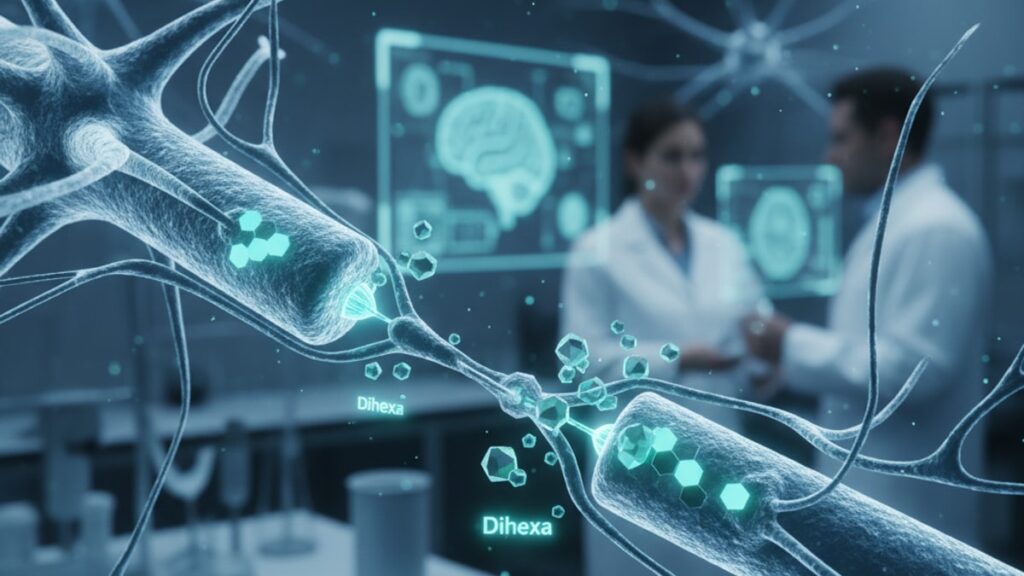
The world of cognitive enhancement and neurological research is, to put it mildly, sprawling. It's a landscape filled with compounds that promise much but often deliver little, leaving researchers and bio-enthusiasts wading through a sea of conflicting information. Then, every so often, a molecule emerges that genuinely captures the scientific community's attention. Dihexa is one of those molecules.
But the buzz is one thing; understanding the intricate biochemical dance it performs is another entirely. The question we hear constantly is, "How does Dihexa actually work?" It's not about hype. It’s about mechanism. It's about the precise, repeatable actions a compound takes at a cellular level. And—let's be honest—that's where the real story is. Our team at Real Peptides believes that a deep understanding of a peptide's function is the critical, non-negotiable first step for any serious researcher. So, let’s pull back the curtain and look at the engine.
What Exactly Is Dihexa?
Before we dive into the deep end of molecular biology, let's start simple. What is this stuff?
Dihexa, also known by its development name N-hexanoic-Tyr-Ile-(6) aminohexanoic amide, is a potent, synthetically derived peptide variant. It was engineered from a part of Angiotensin IV, a hormone that plays a role in regulating blood pressure but was also discovered to have surprising cognitive-enhancing effects. Researchers wanted to isolate and amplify those cognitive benefits without the cardiovascular side effects. They tinkered, they modified, and they stabilized the molecule, resulting in Dihexa—a compound reported to be orders of magnitude more potent than its predecessor, Brain-Derived Neurotrophic Factor (BDNF), in promoting neural connectivity.
It’s a small peptide. Just a short chain of amino acids. But its power lies in its stability and its incredible affinity for a very specific cellular target. Think of it less as a blunt instrument and more as a master key, designed to unlock one of the most powerful regenerative systems in the human body.
The Core Mechanism: How Does Dihexa Work on a Molecular Level?
Here’s where we get to the heart of the matter. Dihexa’s primary mechanism of action is surprisingly elegant for a compound with such profound effects.
It works by binding to and activating a crucial receptor system known as the c-Met receptor. This receptor's natural partner is a protein called Hepatocyte Growth Factor, or HGF. Normally, HGF binds to the c-Met receptor to initiate a cascade of cellular activities related to growth, repair, and cell survival. It’s a fundamental process for tissue regeneration throughout the body, from the liver (where HGF was first discovered, hence the name) to the brain.
Dihexa essentially mimics the action of HGF. But it does it with an almost unbelievable efficiency. Our team has reviewed the foundational research extensively, and the data suggests Dihexa forms a unique bond with the c-Met receptor. It doesn't just activate it; it creates a functional dimer—forcing two c-Met receptors together—which triggers a much stronger and more sustained downstream signal than HGF alone might produce. This is the crucial point. It’s not just an agonist; it’s a super-agonist, amplifying a natural regenerative pathway. That’s the key.
This amplified signal is what sets off a chain reaction of pro-survival, anti-apoptotic (preventing cell death), and, most importantly for our discussion, neurogenic effects. It tells the cell: grow, connect, and thrive.
HGF and c-Met: The Dynamic Duo Dihexa Activates
To really grasp how Dihexa works, you have to appreciate the HGF/c-Met pathway. It’s one of the body’s master regulators of cellular health. When you suffer an injury, this system kicks into high gear to manage the repair process. In the brain, it’s absolutely vital for maintaining neuronal plasticity—the ability of brain cells to form new connections and adapt.
But there's a problem. As we age, or in the presence of neurodegenerative conditions, the efficiency of the HGF/c-Met system can decline. HGF levels might drop, or the c-Met receptors might become less responsive. This leads to a gradual loss of synaptic connections, impaired cognitive function, and reduced capacity for repair following an injury like a stroke or traumatic brain injury. It's a slow, grinding process of disconnection.
Enter Dihexa. By directly and powerfully activating the c-Met receptor, it effectively bypasses any potential shortage of HGF. It provides the signal that the system is craving. Our experience shows that compounds targeting these fundamental regenerative pathways often hold the most promise for researchers. Instead of trying to create an artificial effect, Dihexa is essentially turning up the volume on a symphony the body already knows how to play.
Think of it this way: if your brain's communication network is a series of roads, the HGF/c-Met system is the road crew responsible for maintenance and expansion. When the crew gets old and slow, potholes form and new roads don't get built. Dihexa is like injecting a shot of pure motivation (and a whole lot of new equipment) directly into that road crew. The result? A flurry of activity—dendrites and axons (the 'branches' of neurons) begin to sprout, new synapses form, and the overall connectivity of the network is enhanced. For a visual walkthrough of how receptor tyrosine kinases like c-Met work, our YouTube channel offers some fantastic animated explanations that really simplify these complex interactions.
Beyond the Basics: Dihexa's Impact on Neurogenesis
Activating a receptor is one thing. What happens next is what truly matters.
The downstream signaling from the activated c-Met receptor is a complex web of intracellular communication, but it ultimately leads to one of the most sought-after outcomes in neuroscience: neurogenesis.
Specifically, Dihexa has been shown in preclinical models to promote synaptogenesis—the formation of new synapses, which are the communication points between neurons. This isn't just about creating new brain cells (a process that happens at a very limited rate in the adult brain). It’s about enhancing the connections between existing cells. It makes the neural network denser, more resilient, and more efficient. We can't stress this enough: cognitive function is largely a product of synaptic density and efficiency. More connections mean faster processing, better memory recall, and enhanced learning capacity.
This process is particularly evident in the hippocampus, a region of the brain that is the undisputed hub for learning and memory formation. Studies have indicated that Dihexa can spur the growth of dendritic spines in this area. These tiny protrusions on neurons are the physical sites of synapses. More spines mean more potential connections. It's the biological hardware upgrade for learning. And—most importantly—this is where researchers are focusing their attention for potential therapeutic applications in conditions characterized by cognitive decline, such as Alzheimer's and Parkinson's disease, where synaptic loss is a catastrophic hallmark of the disease's progression.
Dihexa vs. Other Nootropics: A Comparative Look
It’s becoming increasingly challenging for researchers to navigate the crowded field of cognitive-enhancing compounds. So, how does Dihexa stack up against other popular molecules? Honestly, it’s in a class of its own. Most nootropics, like the racetams or choline precursors, work by modulating neurotransmitter levels—they increase acetylcholine, dopamine, or glutamate, essentially fine-tuning the chemical signaling between existing connections.
Dihexa doesn't do that. It works upstream. Instead of just turning up the volume on the radio, it's building more radio towers and wiring them together. This is a fundamental difference in mechanism—a structural, regenerative approach versus a purely functional, modulatory one. Our team has put together a simple table to illustrate these distinctions.
| Feature | Dihexa | Racetams (e.g., Piracetam) | Ampakines |
|---|---|---|---|
| Primary Mechanism | Potent HGF/c-Met pathway agonist | Modulator of AMPA and NMDA receptors; enhances acetylcholine release | Positive allosteric modulators of AMPA receptors |
| Main Effect | Promotes synaptogenesis and neurogenesis (structural change) | Enhances neurotransmitter efficiency and membrane fluidity (functional change) | Increases glutamatergic signaling and LTP (functional change) |
| Potency | Extremely high; active at very low (nanomolar) concentrations | Moderate; requires higher (gram-level) dosing | High; active at milligram concentrations |
| Focus of Research | Neuro-regeneration, traumatic brain injury, neurodegenerative diseases | General cognitive enhancement, memory improvement in age-related decline | Cognitive enhancement, depression, ADHD, schizophrenia |
| Approach | Building new connections | Optimizing existing connections | Strengthening specific connections |
As you can see, the objective is completely different. While racetams and ampakines are about making the current system run better, Dihexa is focused on rebuilding and expanding the system itself. This makes it a formidable tool for research into conditions where the physical structure of the brain has been compromised.
The Research Landscape: What Studies Are Telling Us
While Dihexa is still classified as a research chemical and is not approved for human consumption, the preclinical data is compelling. The foundational studies, primarily from the research group at Washington State University that developed the compound, have laid out a remarkable profile.
In animal models of Alzheimer's-like cognitive deficits, Dihexa was shown to not only halt but also reverse the cognitive decline. This wasn't just a minor improvement; it was a significant, sometimes dramatic shift. The animals demonstrated restored performance in memory tasks, like maze navigation, which correlated with observable increases in synaptic density in their brains post-mortem. That’s a powerful connection between a molecular action and a behavioral outcome.
Further studies have explored its potential in models of Parkinson's disease, where it showed promise in protecting dopaminergic neurons from cell death—a key pathological feature of the disease. There's also a growing body of research looking into its application for recovery after stroke or traumatic brain injury, where its ability to promote the formation of new neural pathways could be instrumental in restoring lost function.
It's important to approach this with scientific rigor. These are preclinical, non-human studies. Yet, the consistency of the findings across different models is what makes the scientific community so optimistic. The evidence points toward a powerful neuro-regenerative agent with a clear mechanism of action. And for any researcher, a clear mechanism is gold.
Sourcing and Purity: Why It's a Non-Negotiable
Now, this is where our team at Real Peptides gets serious. A compound like Dihexa, with its intricate structure and potent effects, is only as good as its synthesis. Honestly, though, this applies to any peptide used in research.
When you're investigating a specific molecular pathway, the last thing you need is a contaminated or improperly synthesized compound throwing a wrench in your results. Impurities can create confounding variables, produce off-target effects, or simply render the compound inert. It’s a catastrophic waste of time, resources, and effort. We've seen it happen.
This is why we've built our entire operation around small-batch synthesis and rigorous quality control. Every peptide we offer, including Dihexa, is produced with an unwavering focus on achieving the exact amino-acid sequence and the highest possible purity—typically exceeding 99% as verified by third-party lab analysis. We believe that providing researchers with impeccably pure compounds is our most important contribution to the advancement of science. When you're trying to unravel the mysteries of the brain, you need tools you can trust implicitly. There is simply no room for error.
If you're conducting research in this area, we can't stress this enough: demand to see the Certificate of Analysis (CoA) for any peptide you purchase. Ensure it's recent and from a reputable lab. It's the only way to guarantee you're working with the actual molecule you intend to study. When you're ready to ensure your research is built on a foundation of absolute purity, you can Get Started Today by exploring our catalog of research-grade peptides.
Potential Applications and Future Research Directions
So, where does this all lead? The future of Dihexa research is incredibly exciting.
-
Neurodegenerative Diseases: This is the most obvious and perhaps most impactful area. The potential to restore synaptic connections in diseases like Alzheimer's or protect neurons in Parkinson's could be transformative. Future research will likely focus on refining delivery methods to ensure the peptide can efficiently cross the blood-brain barrier and reach its target tissues in sufficient concentrations.
-
Traumatic Brain Injury (TBI) and Stroke Recovery: The brain's ability to heal after a physical insult is limited. Dihexa's ability to promote the formation of new neural pathways—a process called neuroplasticity—could be a game-changer for rehabilitation, helping the brain 'rewire' itself around damaged areas.
-
Mental Health Conditions: Some emerging research suggests that synaptic disconnection and reduced neuroplasticity play a role in conditions like severe depression and PTSD. By fostering a more resilient and connected neural network, Dihexa could, in theory, provide a novel therapeutic angle for these difficult-to-treat disorders.
-
Peripheral Nerve Damage: The HGF/c-Met pathway isn't exclusive to the central nervous system. It's also involved in the regeneration of peripheral nerves. This opens up another avenue of research for using Dihexa to aid recovery from nerve injuries in other parts of the body.
Of course, this is all speculative and rests on the shoulders of future research. But the pathway is clear. The mechanism is understood. The preclinical results are promising. Now, the slow, methodical, and essential work of further investigation begins.
Dihexa stands as a testament to intelligent peptide design. It's a powerful reminder that by understanding the body's own regenerative systems, we can create tools to amplify them, potentially unlocking new ways to repair what was once considered irreparable. It's a complex molecule, but its core function is beautifully simple: it helps the brain rebuild. And in that simple function lies a world of possibility.
For those of us dedicated to the science of peptides, this is what drives us forward. It's the potential to contribute, even in a small way, to the next great breakthrough. To keep up with our latest findings and discussions on peptides like Dihexa, make sure to follow us on our Facebook page where we share insights from the front lines of biotechnology research.
Frequently Asked Questions
What is the primary mechanism of action for Dihexa?
▼
Dihexa’s primary mechanism is acting as a potent agonist for the c-Met receptor. It mimics and enhances the function of Hepatocyte Growth Factor (HGF), triggering a powerful cascade of cellular activities related to neurogenesis and cell repair.
How does Dihexa differ from Brain-Derived Neurotrophic Factor (BDNF)?
▼
While both promote neural health, they work through different pathways. Dihexa is a small molecule peptide that targets the HGF/c-Met system, and some early research suggests it may be significantly more potent than BDNF in promoting the formation of new synaptic connections.
Is Dihexa orally bioavailable?
▼
The oral bioavailability of Dihexa is generally considered to be very low, as is common with most peptides. For research purposes, it is typically administered via subcutaneous or intramuscular injection to bypass the digestive system and ensure systemic absorption.
What is the relationship between Dihexa and Angiotensin IV?
▼
Dihexa is a synthetic derivative of Angiotensin IV. Researchers identified the cognitive-enhancing properties of Angiotensin IV and modified its structure to create Dihexa, which is more stable and potent without the associated blood pressure effects.
Can Dihexa cross the blood-brain barrier (BBB)?
▼
Yes, Dihexa was specifically designed to be a small, lipid-soluble peptide, which allows it to effectively cross the blood-brain barrier. This is a crucial feature for any compound intended to have a direct effect on the central nervous system.
What kind of research is being conducted on Dihexa?
▼
Current research is primarily preclinical (animal models) and focuses on Dihexa’s potential in neurodegenerative diseases like Alzheimer’s and Parkinson’s. Studies also explore its role in recovery from traumatic brain injury and stroke.
Why is the purity of Dihexa so important for research?
▼
Purity is critical because impurities can cause unintended side effects or render the compound inactive, invalidating research results. At Real Peptides, we guarantee a purity of over 99% to ensure researchers are working with a reliable and consistent product.
What does ‘synaptogenesis’ mean in the context of Dihexa?
▼
Synaptogenesis is the formation of new synapses, the connections between neurons. Dihexa promotes this process by activating the HGF/c-Met pathway, which leads to the growth of new dendritic spines and strengthens the brain’s communication network.
Is Dihexa approved for human consumption?
▼
No, Dihexa is not approved by the FDA or any other regulatory body for human consumption. It is strictly classified as a research chemical intended for laboratory and preclinical study purposes only.
How is Dihexa typically synthesized?
▼
Dihexa is created through solid-phase peptide synthesis (SPPS). This is a precise, step-by-step chemical process where amino acids are linked together in a specific sequence to build the final peptide chain.
What is the HGF/c-Met pathway?
▼
The Hepatocyte Growth Factor (HGF) and its receptor, c-Met, form a critical signaling pathway that regulates cell growth, mobility, and survival. It is vital for tissue regeneration and repair throughout the body, including in the brain.
Does Dihexa affect neurotransmitter levels directly?
▼
Unlike many nootropics, Dihexa does not primarily work by directly modulating neurotransmitter levels like dopamine or acetylcholine. Instead, it works upstream by promoting the physical growth and repair of neural structures, which can indirectly influence neurotransmission efficiency.











