





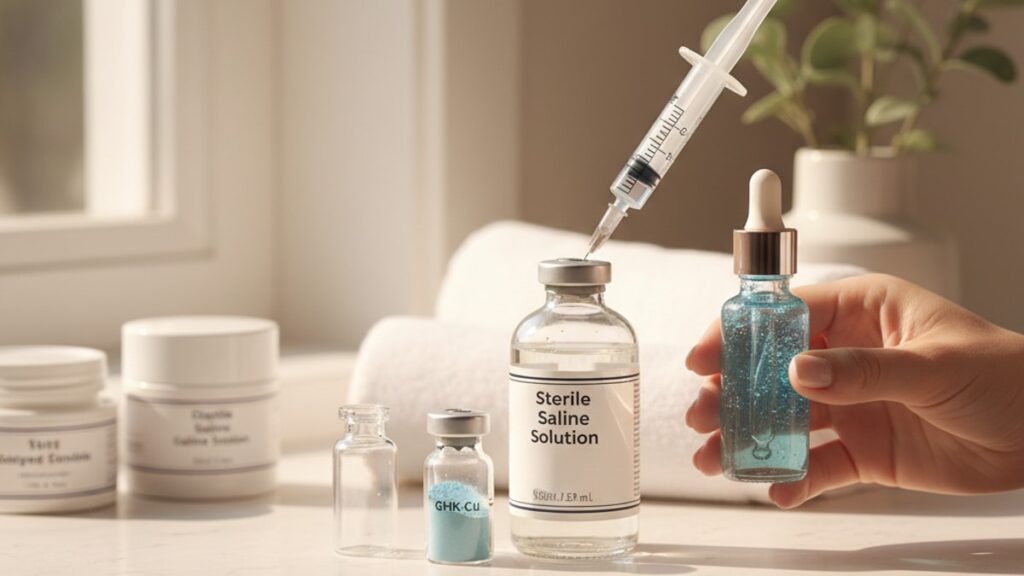
You’ve done the hard part. You've navigated the sprawling landscape of peptide suppliers, vetted their claims, and secured a vial of high-purity, lyophilized GHK-Cu. It arrives, a small vial containing a delicate, blue, chalk-like puck of powder at the bottom. This is the starting line. But—and our team can't stress this enough—the race is often won or lost in the next ten minutes. The process of reconstitution, of turning that inert powder into a viable, stable solution, is where meticulous research can either flourish or falter.
It’s a deceptively simple step that carries catastrophic consequences if done incorrectly. We've heard the stories. Researchers who, with the best intentions, compromise thousands of dollars in materials and weeks of work with a simple mistake—using the wrong diluent, shaking the vial, or storing it improperly. It’s frustrating. It’s also entirely avoidable. We're not just a supplier; we're partners in research. Our commitment to providing impeccably pure peptides at Real Peptides is only half the equation. The other half is ensuring you have the knowledge to handle them with the precision they demand. This isn't just a guide; this is our lab-tested, experience-backed protocol for how to reconstitute GHK-Cu perfectly, every single time.
Why Proper Reconstitution Isn't Just a Suggestion—It's Essential
Let’s get technical for a moment, because understanding the 'why' makes the 'how' intuitive. Lyophilization, or freeze-drying, is a remarkable process. It removes water from the peptide, placing it in a state of suspended animation. This makes it incredibly stable for shipping and long-term storage. It's inert. Safe. But the moment you introduce a liquid, you awaken it, and its fragile structure becomes vulnerable.
GHK-Cu is a tripeptide complexed with a copper ion. Its unique structure is the very source of its biological activity. When you reconstitute it, you're not just dissolving a powder; you're rehydrating a delicate, three-dimensional molecular machine. Aggressive handling, like shaking, can create shearing forces that physically break the peptide bonds. Imagine snapping a key in half—it might still look like a key, but it will never open the lock again. The same goes for a denatured peptide. It’s biochemically useless.
Furthermore, using the wrong solvent can throw the pH balance into disarray or introduce contaminants. Tap water, for instance, is a catastrophic choice, teeming with minerals, chlorine, and microbes that can degrade the peptide or introduce confounding variables into your research. The goal of reconstitution is singular: to get the peptide into a stable, sterile solution that perfectly preserves its molecular integrity. Nothing less will do.
Gathering Your Tools: The Researcher's Checklist
Before you even think about uncapping that vial, you need to assemble your toolkit. Working in a clean, organized space is non-negotiable. Our team recommends setting up on a sanitized lab bench or, at a minimum, a disinfected surface free of clutter. You wouldn't perform surgery on a dirty table, and the same principle applies here.
Here’s what you’ll need:
- Your Vial of Lyophilized GHK-Cu: The star of the show. Handle it with care.
- Reconstitution Solvent: This is your most critical choice. We'll dive deep into this next, but the most common and recommended choice is Bacteriostatic Water (BAC Water).
- Sterile Syringe: A 3ml or 5ml syringe is typically ideal for accurately measuring and transferring the solvent. Ensure it's new and in a sterile package.
- Alcohol Prep Pads: You'll need several. For sanitizing the vial stoppers and your work area.
- A Clean, Empty Sterile Vial (Optional but Recommended): If you plan on creating a more diluted solution or splitting the batch, having an extra sterile, sealed vial is invaluable.
That's it. It’s not a long list, but the quality of each item matters immensely. Using an old syringe or a questionable solvent is a gamble you can't afford to take.
Choosing Your Solvent: The Most Critical Decision You'll Make
Not all water is created equal. The liquid you use to bring your GHK-Cu back to life will dictate its stability and shelf-life. The choice seems subtle, but the implications are profound. Let’s break down the primary options our lab team works with.
| Solvent Type | Key Characteristic | Recommended Use Case | Shelf-Life Post-Reconstitution |
|---|---|---|---|
| Bacteriostatic Water | Sterile water containing 0.9% benzyl alcohol. | The Gold Standard. The benzyl alcohol prevents microbial growth, making it ideal for multi-use vials. | 3-4 weeks (refrigerated) |
| Sterile Water | Purified, sterile water with no preservatives. | Single-use applications where the entire vial will be used immediately or within 24 hours. | Less than 24 hours (refrigerated) |
| 0.6% Acetic Acid | A mild acidic solution. | Rarely needed for GHK-Cu, but used for certain peptides that have solubility issues in water. | Varies, can alter peptide stability. |
For GHK-Cu, our unflinching recommendation is Bacteriostatic Water. Why? Because it’s almost certain you won’t use the entire vial in a single experiment. Every time you puncture the rubber stopper to draw a dose, you introduce a potential contamination risk. The benzyl alcohol in BAC water acts as a bacteriostat, a tiny security guard that inhibits the growth of any contaminants that might sneak in. This is absolutely critical for maintaining the purity of your solution over several weeks of use.
Sterile water is pure, yes, but it’s a welcoming environment for bacteria. Once you’ve opened it, it offers no protection. We've seen researchers try to save a few dollars by using sterile water for a multi-use vial, only to find their solution contaminated and useless a week later. It’s a false economy. Don’t do it.
And what about acetic acid? Some peptides are stubborn and won't dissolve well in water. They require a slightly acidic environment. GHK-Cu, however, is generally very soluble in BAC water, so there's no need to complicate things with an acidic solution unless you're working with a very unusual protocol.
The Real Peptides Protocol: How to Reconstitute GHK-Cu Step-by-Step
Alright, your workspace is clean, and your tools are ready. You have your vial of Real Peptides GHK-Cu and a fresh bottle of bacteriostatic water. Let's walk through the process with the precision it deserves.
Step 1: Preparation and Sanitization
First things first, pop the plastic cap off both your GHK-Cu vial and your BAC water vial. You'll see a rubber stopper underneath. Take an alcohol prep pad and vigorously scrub both stoppers. Don't be shy. The goal is to create a sterile surface. Let them air dry for a minute. This is a simple but critical, non-negotiable element of aseptic technique.
Step 2: Calculating Your Solvent Volume
Now for some simple math. You need to decide on your final concentration. This determines how much BAC water you'll add. A common and easy-to-work-with concentration is 10mg/mL.
Let’s say your vial contains 50mg of GHK-Cu powder.
- Goal: Create a solution of 10mg per 1mL.
- Calculation: (Total mg of peptide) / (Desired mg/mL concentration) = Total mL of solvent needed.
- Example: 50mg / 10mg/mL = 5mL of BAC water.
So, you would need to draw exactly 5mL of BAC water into your syringe.
Our team recommends keeping the math simple. Concentrations like 1mg/mL, 2mg/mL, or 10mg/mL make future calculations for your experiments much, much easier. There’s no need to create a difficult, often moving-target objective with an odd number like 3.7mg/mL.
Step 3: Drawing and Introducing the Solvent
Uncap your sterile syringe. Pull the plunger back to the volume you calculated (e.g., 5mL). This fills the syringe with air. Puncture the rubber stopper of the BAC water vial and inject the air in—this equalizes the pressure and makes it much easier to draw the liquid out. Now, invert the vial and slowly pull the plunger back, drawing your exact amount of BAC water. Check for air bubbles. If you see any, flick the syringe gently to get them to the top and carefully push them out.
Now, for the most delicate part of the entire process. Take your syringe filled with BAC water and gently puncture the stopper of your GHK-Cu vial. Do not inject the water directly onto the lyophilized powder. This can cause it to foam and can physically damage the peptide. Instead, angle the needle so that the stream of water runs down the inside glass wall of the vial. Slowly, gently, depress the plunger, letting the water wash over the powder.
Step 4: The Gentle Mix
Once all the solvent is in the vial, gently remove the syringe. Now, you need to help the peptide dissolve. Your instinct might be to shake it. Do not shake it. We can’t stress this enough. Shaking is the enemy of peptide integrity.
Instead, you have two options:
- Gentle Swirling: Hold the vial between your thumb and forefinger and gently swirl it in a circular motion. Watch as the blue powder gracefully dissolves into the solution. It should only take a minute or two.
- Slow Rolling: Gently roll the vial back and forth between your palms. The warmth from your hands can slightly aid solubility, and the motion is more than enough to mix the contents without causing any damage.
Step 5: Visual Confirmation
Your work is done when the solution is perfectly clear and uniformly blue, with no visible powder, clumps, or floaters. It should look like a pristine, transparent blue liquid. If you see any cloudiness or particles that won't dissolve after a few minutes of gentle swirling, it could be an indication of a problem (though this is exceedingly rare with high-purity peptides like those from Real Peptides).
And that's it. You've successfully and safely reconstituted your GHK-Cu.
Common Mistakes We See (And How to Avoid Them)
Over the years, our team has consulted on countless research projects, and we've seen a few common, heartbreaking mistakes pop up again and again. Honestly, though, they are all easy to avoid once you know what to look for.
- The Aggressive Shake: We've mentioned it multiple times, but it bears repeating. Shaking a vial of peptides is like putting a delicate piece of machinery in a paint mixer. It creates foam and subjects the molecules to intense shear forces. The result? Denatured, useless peptides. Always swirl or roll gently.
- The Tap Water Disaster: Using tap water or even bottled drinking water is a recipe for failure. The chlorine, minerals, and potential microorganisms will compromise your peptide and your research. Stick to bacteriostatic water. It’s the professional standard for a reason.
- Incorrect Calculations: Double-check your math before you draw the solvent. An error here can lead to a solution that's twice as strong or half as weak as you intended, which will throw off all your subsequent data. Write it down, check it twice.
- Poor Storage: Reconstituting perfectly and then leaving the vial on the lab bench at room temperature is a critical error. Once hydrated, GHK-Cu needs to be refrigerated to maintain its stability.
Storage After Reconstitution: Preserving Peptide Integrity
Your reconstituted GHK-Cu is now in its active, but also most vulnerable, state. Proper storage is not optional.
The vial must be stored in a refrigerator, typically between 2°C and 8°C (36°F and 46°F). Do not store it in the refrigerator door, where the temperature fluctuates wildly. Place it in the main body of the fridge, preferably in a light-blocking box or container to protect it from degradation.
How long will it last? When reconstituted with bacteriostatic water and stored correctly, GHK-Cu is generally stable for at least 4-6 weeks. If you used sterile water, its lifespan is drastically shorter—you should aim to use it within 24 hours. Freezing is another option, but it comes with its own set of challenges. The freeze-thaw cycle can be harsh on peptides, so we generally recommend against it unless you are portioning it into single-use aliquots for very long-term storage.
What Does "Purity" Really Mean for Your Research?
In the world of peptide research, "purity" is everything. It's a term that gets thrown around a lot, but what does it actually mean? It means that when you buy a vial of GHK-Cu, the powder inside is overwhelmingly, verifiably GHK-Cu and not a cocktail of synthesis-related byproducts, failed sequences, or contaminants.
At Real Peptides, our process of small-batch synthesis and rigorous third-party testing is designed to guarantee a purity level that meets the highest research-grade standards. We provide the impeccable starting material. But the chain of purity is only as strong as its weakest link. That final link is you—the researcher. Your reconstitution and handling protocol is what preserves that purity from the vial to the experiment.
When you follow the meticulous steps we've outlined, you're not just mixing a solution; you're honoring the scientific rigor that went into creating that peptide in the first place. You're ensuring that your results are valid, repeatable, and built on a foundation of uncompromised molecular integrity. That’s the key.
Visual Learner? We've Got You Covered
Sometimes, reading about a process is one thing, but seeing it done is another. It can make all the difference. For researchers who want a visual walkthrough of lab techniques like this, our friends over at the MorelliFit YouTube channel have some truly fantastic video resources. They break down complex processes into simple, easy-to-follow steps, which can be an invaluable asset for reinforcing proper lab protocol.
Mastering how to reconstitute GHK-Cu is a fundamental skill. It's the gateway to successful research with this powerful peptide. By investing a few extra minutes in doing it right, you protect your investment, ensure the validity of your data, and set your project up for success.
This isn't just about following rules; it's about respecting the science. Precision at every step yields clarity in the results. For more lab tips and updates on our latest peptide batches, be sure to connect with us on our Facebook page. If you're ready to ensure your research starts with the highest purity materials, it's time to Get Started Today.
Frequently Asked Questions
What color should my reconstituted GHK-Cu solution be?
▼
Properly reconstituted GHK-Cu should be a distinct, vibrant, and completely transparent blue. Any cloudiness, discoloration, or visible particles could indicate a problem with either the peptide’s integrity or the reconstitution process itself.
Can I use tap water to reconstitute GHK-Cu in an emergency?
▼
Absolutely not. Our team can’t stress this enough—tap water contains minerals, chlorine, and microorganisms that will degrade the peptide and contaminate your research. Only use bacteriostatic water for multi-use applications or sterile water for immediate single use.
How long does reconstituted GHK-Cu last in the refrigerator?
▼
When reconstituted with bacteriostatic water and stored properly between 2°C and 8°C, your GHK-Cu solution should remain stable for at least 4-6 weeks. If you use sterile water, its stability drops dramatically to less than 24 hours.
What happens if I accidentally shake the vial?
▼
Vigorously shaking the vial can cause the delicate peptide chains to shear and denature, rendering them biologically inactive. If you’ve shaken it hard, the integrity of the peptide may be compromised, and we would advise against using it for critical research.
Is it normal for there to be a vacuum in the GHK-Cu vial?
▼
Yes, it’s very common. Most lyophilized peptides are sealed under a vacuum to maintain their stability and sterility. This is why we recommend injecting a corresponding volume of air into the solvent vial before drawing the liquid, as it equalizes the pressure.
Why is bacteriostatic water preferred over sterile water for GHK-Cu?
▼
Bacteriostatic (BAC) water contains 0.9% benzyl alcohol, which acts as a preservative to prevent bacterial growth. Since you’ll likely use the vial multiple times, BAC water is essential for maintaining sterility over several weeks. Sterile water has no preservative and should only be used if you plan to use the entire vial at once.
Can I pre-load syringes with GHK-Cu for later use?
▼
We strongly advise against this practice. Storing peptides in plastic syringes can lead to degradation over time as the solution interacts with the plastic and rubber plunger. It’s always best to draw your required amount from the refrigerated vial immediately before use.
My GHK-Cu powder looks like a solid puck, not a loose powder. Is this normal?
▼
Yes, this is perfectly normal and often a sign of high-quality lyophilization. The freeze-drying process often consolidates the peptide into a solid, disc-like ‘puck’ at the bottom of the vial. It will dissolve easily when you introduce the solvent correctly.
Can I freeze my reconstituted GHK-Cu solution?
▼
While freezing can extend shelf life, the freeze-thaw process can damage peptides. We generally recommend avoiding it. If you must freeze it, it’s best to portion the solution into single-use aliquots to avoid repeated thawing and refreezing of the main batch.
Does the temperature of the bacteriostatic water matter during reconstitution?
▼
Room temperature bacteriostatic water is perfectly fine for reconstitution. There is no need to chill or warm the solvent beforehand. In fact, using a solvent that is too warm could potentially risk degrading the peptide upon contact.
How do I know if my reconstituted peptide has degraded?
▼
Visual signs of degradation can include cloudiness, a change in color, or the formation of particles in the solution. If your once-clear blue solution looks milky or has floaters, it has likely degraded and should be discarded.











