





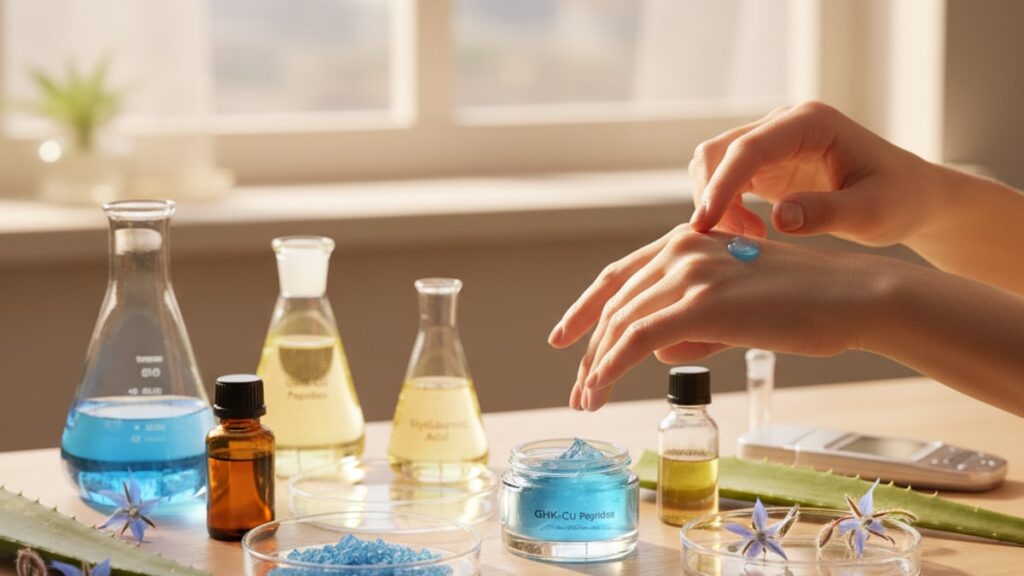
So, you're interested in how to make GHK-Cu cream. That's fantastic. It shows you're moving beyond off-the-shelf solutions and taking a proactive, scientific approach to skincare and tissue regeneration research. Our team sees this as a significant, sometimes dramatic shift in the DIY bio-hacking and cosmetic science communities. It’s a move toward precision and control.
But—let's be honest—it’s also a field filled with misinformation. We've seen the forum posts and the questionable tutorials that often lead to wasted materials and, worse, ineffective or unstable products. That's why we're putting this guide together. We're not just a supplier; our background is steeped in biotechnology and peptide synthesis. We want to give you the framework to do this correctly, safely, and effectively, drawing from the same principles of precision we apply in our own labs.
First, Let's Talk About the 'Why'
Before we dive into beakers and bases, it’s critical to understand what GHK-Cu is and why it's so revered. GHK-Cu, or Glycyl-L-Histidyl-L-Lysine, is a naturally occurring copper peptide complex. Discovered back in the 1970s by Dr. Loren Pickart, it was initially identified for its remarkable wound healing and regenerative capabilities. Think of it as a biological master switch. It has this incredible, almost uncanny ability to modulate the expression of a huge number of human genes, essentially resetting them to a younger, healthier state.
What does that mean in practical terms? It means GHK-Cu is involved in processes like stimulating collagen and elastin production (the scaffolding of your skin), promoting blood vessel growth, and exerting powerful anti-inflammatory and antioxidant effects. This isn't just marketing fluff; it's backed by decades of rigorous scientific research. The challenge isn't whether it works—it's ensuring the GHK-Cu you use is pure and that you formulate it in a way that preserves its bioactivity. If the peptide is degraded or the formulation is unstable, you're essentially just making a very expensive, blue-tinted moisturizer. And nobody wants that.
The Absolute Non-Negotiable: Sourcing Your Peptide
We can't stress this enough: your project will succeed or fail before you even open a jar of cream. It all comes down to the quality of your GHK-Cu. The market is absolutely flooded with low-purity powders, often bulk-manufactured overseas with little to no quality control. These products can be contaminated with residual solvents, have incorrect peptide sequences, or simply be of a much lower concentration than advertised.
This is the entire reason Real Peptides exists. Our team was frustrated with the lack of reliable, U.S.-based sources for research-grade peptides. We built our company around a small-batch synthesis model. Why? Because it allows for meticulous oversight at every stage, from sequencing the amino acids to the final lyophilization (that's the technical term for freeze-drying) process that ensures a stable, pure powder. Every batch we produce comes with its own purity analysis. That's the standard you should demand, regardless of where you source from.
When you're evaluating a GHK-Cu supplier, ask these questions:
- Is it synthesized in the USA? This often means stricter regulatory oversight and quality control standards.
- Do they provide third-party lab testing results? A Certificate of Analysis (COA) isn't just a nice-to-have; it's proof of purity and identity. Don't accept excuses.
- Is the purity level specified? For cosmetic and research applications, you should be looking for purity of 99% or higher.
Starting with a subpar peptide is like trying to build a skyscraper on a foundation of sand. It's a catastrophic waste of time and resources. Get this part right, and everything else becomes infinitely easier.
Choosing Your Base: The Vehicle for Delivery
Once you have your high-purity GHK-Cu, you need a carrier—a base cream, lotion, or serum to deliver it effectively. This choice is more important than you might think, as the base can affect the peptide's stability and absorption. Not all creams are created equal.
Our experience shows that simpler is often better. You want a base with a minimal ingredient list, free from potentially reactive compounds like certain acids, retinoids, or heavy fragrances that could degrade the peptide. We’ve found that GHK-Cu performs best in a pH range of roughly 5.5 to 7. A base that's too acidic can break it down.
Here's a breakdown of common base options our team has evaluated:
| Base Type | Texture & Feel | Best For (Skin Type) | GHK-Cu Stability Notes | Our Team's Recommendation |
|---|---|---|---|---|
| Hyaluronic Acid Serum | Lightweight, watery, fast-absorbing | Oily, Combination, Acne-Prone | Excellent. The simple, water-based formula is very peptide-friendly. Offers added hydration benefits. | Our top choice for facial applications. It's clean, effective, and minimizes potential interactions. |
| Simple Cream Base | Thicker, more emollient | Normal to Dry | Good, provided the pH is stable and it's free of reactive ingredients. Look for ceramides and lipids. | A solid option for body application or for those needing more moisture. Verify the ingredient list carefully. |
| Gel Base (e.g., Aloe Vera) | Cooling, lightweight, non-greasy | All skin types, especially sensitive | Generally good. Pure aloe vera gel is a fantastic, soothing carrier. Watch out for added alcohol or fragrances. | Great for post-sun or post-procedure applications where a cooling effect is desired. |
| Lightweight Lotion | Thinner than a cream, spreads easily | Normal to Oily | Variable. Lotions often have more complex formulations. Check for pH and potential irritants. | Use with caution. It can work, but a serum or simple cream is a more reliable starting point for beginners. |
Our professional observation? Start with a high-quality, pure hyaluronic acid serum. It's the cleanest and most straightforward vehicle for GHK-Cu, ensuring you get the maximum benefit from the peptide itself without interference.
The Formulation Process: A Step-by-Step Guide
This is where precision becomes paramount. You're not just cooking; you're performing a small-scale cosmetic formulation. Work in a clean, sanitized space, and use dedicated equipment. We mean it—don't use the same measuring spoons you use for baking.
What You'll Need:
- High-purity GHK-Cu powder (from a trusted source like us, of course)
- Your chosen base (cream, serum, etc.)
- A small, sterile glass or ceramic bowl
- A small amount of distilled water (NOT tap water)
- A micro-scoop or a digital scale that measures to 0.001g (a milligram scale)
- A small spatula or mixing stick
- An airtight container for your final product (dark glass is best to protect from light)
Step 1: The All-Important Calculation
You need to decide on your desired concentration. For facial applications, a concentration between 1% and 3% GHK-Cu is the standard and most researched range. Going higher isn't necessarily better and can lead to irritation. We recommend starting at 1%.
So how do you calculate that? It's a simple weight-to-weight percentage.
Let’s say you want to make 30 grams of a 1% GHK-Cu cream.
- Total Product Weight: 30g
- Desired GHK-Cu Concentration: 1% (or 0.01)
Calculation: 30g (total cream) * 0.01 (1%) = 0.3g of GHK-Cu powder.
This is why a milligram scale is critical. 0.3g is 300mg. Eyeballing this is impossible and will lead to a completely unknown concentration. Precision is not optional here.
Step 2: The Dissolution Phase
GHK-Cu is a beautiful, vibrant blue powder. It's water-soluble. Do not—we repeat, do not—just dump the powder directly into your thick cream base. It will clump, fail to distribute evenly, and you'll end up with a splotchy, ineffective product.
Our lab team recommends this method for perfect distribution:
- Measure your calculated amount of GHK-Cu powder (e.g., 0.3g) and place it in your clean, sterile bowl.
- Add a very small amount of distilled water. How much? Just enough to form a liquid slurry. For 0.3g of powder, you might only need 1-2 milliliters. The goal is simply to dissolve it completely.
- Stir gently with your spatula until the powder is fully dissolved and you have a clear, deep blue liquid. There should be no visible granules left. This is a critical checkpoint.
Why distilled water? Tap water contains minerals and chlorine that can interact with the peptide and destabilize it. It's an unnecessary variable you must eliminate.
Step 3: Incorporation and Mixing
Now you're ready to combine. This is where patience pays off.
- Measure out the amount of base you need. In our example, since you used a tiny bit of water and 0.3g of powder, you'll need slightly less than 30g of the base cream to hit your final weight. Or, to keep it simple, just add the dissolved peptide to your full 30g of cream. The final concentration will be negligibly less than 1%, which is perfectly fine.
- Add the base cream to the bowl with your dissolved GHK-Cu solution.
- Begin mixing. Slowly. Gently. The goal is to fold the base into the solution, not to whip air into it. Scrape the sides of the bowl to ensure everything is incorporated evenly.
- Continue mixing until the color is completely uniform. You should have a smooth, evenly-colored light blue cream. Any streaks or darker spots mean you need to keep mixing. This process might take a few minutes. Don't rush it.
Step 4: Storage and Stability
You've done it. You've made a high-potency GHK-Cu cream. Now you have to protect your investment.
Peptides are sensitive. They don't like heat, light, or air. Transfer your final product into an opaque, airtight container. An amber or cobalt blue glass jar with a tight-fitting lid is ideal. A pump dispenser is even better as it minimizes air exposure each time you use it.
Where do you store it? The refrigerator. Cold temperatures will significantly slow down the natural degradation process of the peptide, extending the life and potency of your cream. We've found that a well-formulated, refrigerated cream can remain potent for 3-4 months. At room temperature, that lifespan could be cut in half.
Label your container with the date it was made and the concentration. You'll thank yourself later.
Common Mistakes We See (And How to Avoid Them)
We've consulted with countless researchers and DIY formulators. Over the years, we've seen the same handful of errors derail otherwise promising projects.
- Impatience: Rushing the mixing phase is the number one culprit for a gritty or uneven final product. Take your time.
- Ingredient Overload: Trying to add too many other active ingredients. You don't know how Vitamin C or glycolic acid will interact with the copper peptide in your specific base. Start with GHK-Cu as the solo star. Let it do its job.
- Ignoring the Math: Guessing the concentration is a recipe for disappointment. You'll either create something too weak to be effective or too strong, causing potential irritation. Use a scale. Do the math.
- Improper Storage: Leaving your freshly made cream on the bathroom counter is a death sentence for the peptides inside. The warm, humid environment is the enemy. Refrigerate it. Always.
For those who are visual learners, our team is always working on new content. We break down complex processes like this in detailed videos over on our YouTube channel, so be sure to check that out for more lab-based insights and tutorials.
Making your own GHK-Cu cream is incredibly rewarding. It puts you in complete control of what you're putting on your skin and allows you to create a product that can be far more potent than many commercial offerings. It requires precision, patience, and—most importantly—an unshakeable commitment to starting with the highest quality ingredients. That's the foundation of all successful formulations. It’s the principle we’ve built our entire business on. When you're ready to take that first step, we're here to help you Get Started Today.
This process isn't just about mixing ingredients; it's about respecting the science of these incredible molecules. By following these guidelines, you're not just making a cream; you're engaging in legitimate, small-scale biotechnology. And that's something to be proud of. If you're active on social media, we'd love for you to connect with our community of researchers and bio-enthusiasts over on our Facebook page to share your results and continue the conversation.
Frequently Asked Questions About Making GHK-Cu Cream
Frequently Asked Questions
What concentration of GHK-Cu should I start with?
▼
We strongly recommend starting with a 1% concentration. This level is both effective and well-tolerated for most applications, providing a great balance of potency and safety as you begin formulating.
Why did my GHK-Cu cream turn a weird brownish or gray color?
▼
This usually indicates oxidation or a reaction with another ingredient in your base. It’s often caused by an unstable pH, exposure to reactive metals (use glass or ceramic tools!), or incompatible preservatives in the base cream.
Can I use tap water to dissolve the GHK-Cu powder?
▼
Absolutely not. Tap water contains minerals, chlorine, and other impurities that can react with the copper peptide, degrading its structure and effectiveness. Always use distilled or deionized water for formulation.
How long will my homemade GHK-Cu cream last?
▼
When stored properly in an airtight, opaque container in the refrigerator, your cream should remain potent for about 3 to 4 months. Storing it at room temperature will significantly shorten its effective lifespan.
Is it better to use GHK-Cu or plain GHK?
▼
For skin regeneration and collagen synthesis, GHK-Cu is superior. The addition of the copper molecule is what gives the peptide its distinctive regenerative properties and vibrant blue color. Plain GHK has benefits, but they are different.
Can I add other active ingredients like Vitamin C or Retinol?
▼
We advise against this, especially for beginners. Peptides can be sensitive to the pH of other actives. For example, most Vitamin C serums are highly acidic, which can destabilize and break down GHK-Cu, rendering both ingredients ineffective.
What’s the difference between the GHK-Cu I make and one I buy in a store?
▼
The primary difference is often potency and freshness. By making it yourself with high-purity powder, you can create a much higher concentration than most commercial products and ensure it’s fresh, maximizing its biological activity.
Do I need to add a preservative to my cream?
▼
If your base cream or serum already contains a robust preservative system (most commercially available bases do), you don’t need to add more. If you’re creating a base from scratch, a broad-spectrum preservative is non-negotiable to prevent microbial growth.
Why is a milligram scale so important?
▼
Accuracy is everything in formulation. A standard kitchen scale can’t measure the small amounts of peptide powder needed. A milligram scale ensures you achieve the correct, safe, and effective concentration every single time.
Can I use a blender to mix the cream?
▼
We don’t recommend it. A high-speed blender can introduce too much air and heat from friction, which can potentially degrade the peptide. Gentle, manual mixing with a spatula is the safest and most effective method.
What does GHK-Cu feel like on the skin?
▼
In a well-formulated cream, you shouldn’t feel the GHK-Cu itself. You will only feel the texture of your base cream or serum. Some users report a temporary, mild tightening sensation, which is normal.
Is a brighter blue color a sign of higher quality?
▼
Yes, generally a deep, vibrant royal blue color in the dissolved solution is a good indicator of high-purity GHK-Cu. A pale or dull color in the powder or solution might suggest lower purity or degradation.











