





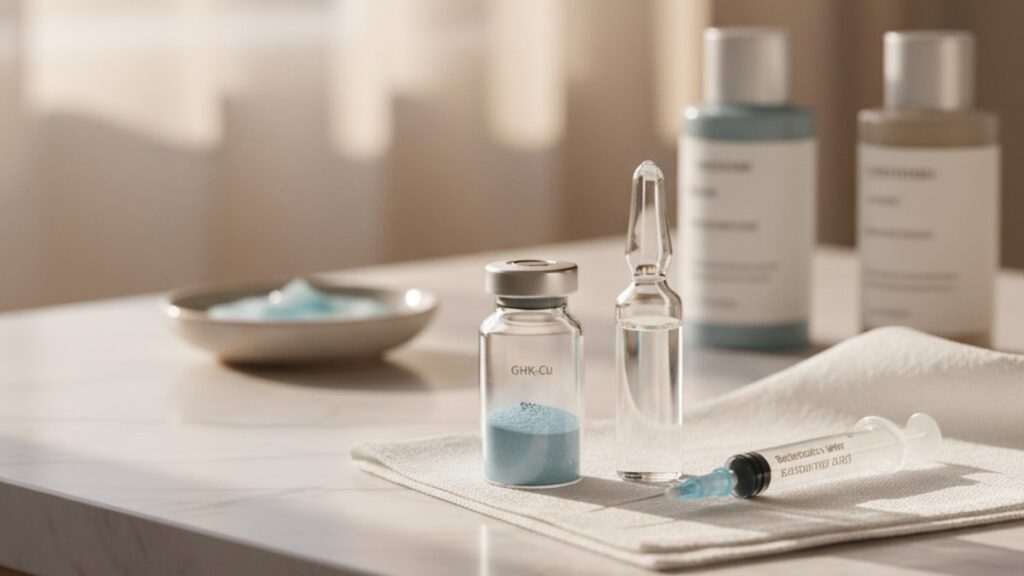
A vial of pristine, lyophilized peptide represents enormous potential. It’s the starting point for discovery, the raw material for data that could lead to a significant breakthrough. But here’s the truth our team has seen play out time and time again—all that potential can be compromised in the first five minutes on the lab bench if the reconstitution process is flawed. It’s a step that feels simple, but its importance is almost impossible to overstate. Getting it wrong doesn't just waste a vial; it can invalidate weeks or even months of work.
At Real Peptides, we're obsessed with the front end of that process. We focus on small-batch synthesis to ensure impeccable purity and precise amino-acid sequencing because we know that garbage in equals garbage out in biological research. This guide is our commitment to the other side of that equation. We want to ensure that the quality we craft in our US-based facility is the same quality you work with in your lab. So, we're pulling back the curtain on the exact, meticulous process for how to reconstitute GHK-Cu 50mg. This isn't just a set of instructions; it's our standard operating procedure, refined by our experience to ensure maximum stability, purity, and viability for your research.
Why Proper Reconstitution is Mission-Critical
Before we even touch a syringe, let's talk about the “why.” Why is the peptide a delicate, chalky puck at the bottom of the vial in the first place? The process is called lyophilization, or freeze-drying. It involves freezing the synthesized peptide and then reducing the surrounding pressure to allow the frozen water in the material to sublimate—transforming directly from a solid to a gas. This removes the water without passing through a liquid phase, which is incredibly gentle on the complex, folded structure of the peptide.
Lyophilization is the gold standard for a reason. It makes the peptide exceptionally stable for shipping and long-term storage. It's inert, safe from microbial growth, and resistant to degradation. It’s a state of suspended animation. But that delicate structure, so carefully preserved, is also incredibly vulnerable when it’s time to wake it up. Improper reconstitution—using the wrong solvent, shaking the vial, or using non-sterile techniques—can be catastrophic. It can denature the peptide, shearing the very bonds that give it its biological activity. Or it can introduce contaminants that skew your results. We can't stress this enough: the reconstitution step is an active and critical part of your experimental procedure, not just a prep-work task to rush through.
Gathering Your Essential Lab Supplies
Success in the lab is often about preparation. Walking into a process with everything you need, laid out and ready, eliminates the frantic search for a missing item mid-procedure, which is when mistakes happen. It’s about creating a controlled environment. For reconstituting GHK-Cu, your setup is straightforward, but every single item is non-negotiable.
Here’s what our team lays out every single time:
- Your Vial of GHK-Cu 50mg: Sourced from a reputable supplier (like us at Real Peptides), where you can be certain of the purity and exact quantity.
- Bacteriostatic (BAC) Water: This is your primary reconstitution solvent. It's sterile water for injection that includes 0.9% benzyl alcohol, which acts as a preservative, inhibiting microbial growth after the vial's stopper has been punctured. This is crucial for multi-use vials.
- Sterile Syringes: You’ll need at least one to draw and inject the BAC water. We recommend having a few on hand. A 3mL or 5mL syringe is typically ideal for the initial reconstitution, while smaller 1mL insulin syringes are used for accurately measuring doses from the reconstituted solution.
- Alcohol Prep Pads: For sterilizing surfaces and, most importantly, the rubber stoppers on both your GHK-Cu vial and your BAC water vial. Never skip this step.
- Sterile, Empty Vial (Optional but Recommended): Sometimes, for specific protocols, you may want to create further dilutions. Having a sterile, sealed, empty vial on hand is good practice.
- Personal Protective Equipment (PPE): At a minimum, this means disposable gloves. A lab coat is always a good idea. This protects you, but just as importantly, it protects the peptide from you—from oils, microbes, and other contaminants on your skin.
Having this checklist ready turns a potentially complex task into a simple, repeatable process. It’s about building a habit of precision.
The Reconstitution Solvent: Choosing Wisely
This is a major decision point. While there are a few options, the choice of solvent dramatically impacts the shelf-life and stability of your reconstituted peptide. Let's be perfectly clear—for GHK-Cu, the industry and scientific standard is Bacteriostatic Water.
Bacteriostatic Water (BAC Water): As we mentioned, this is sterile water with a small amount of benzyl alcohol added. That alcohol is the key. Every time you puncture the vial's rubber stopper with a syringe, you create a potential entry point for airborne bacteria. The benzyl alcohol prevents these contaminants from colonizing your solution, keeping it sterile and safe for use over several weeks (when stored properly in the refrigerator). For any research protocol that requires drawing from the same vial multiple times, BAC water is the only real choice.
Sterile Water for Injection: This is simply sterile water without any preservative. If you were to use the entire contents of the vial in a single application, immediately after reconstitution, this would be an acceptable choice. However, that’s rarely the case. Without the bacteriostatic agent, once you puncture the stopper, the clock starts ticking. The risk of contamination rises exponentially, and the reconstituted solution should ideally be discarded within 24 hours. Our experience shows this is an unnecessary risk and waste for most research applications.
Other Solvents: For some more complex, hydrophobic peptides, solvents like 10% acetic acid might be required to get them into solution. GHK-Cu is not one of them. It dissolves readily in water. Using a solvent that is too harsh can damage the peptide just as easily as shaking it can.
Here’s a simple breakdown our team uses to explain the choice:
| Feature | Bacteriostatic Water (BAC) | Sterile Water for Injection |
|---|---|---|
| Preservative | Contains 0.9% Benzyl Alcohol | None |
| Reconstituted Life | Several weeks (refrigerated) | ~24 hours (refrigerated) |
| Best For | Multi-use vials, standard research protocols | Single, immediate use protocols |
| Considerations | The gold standard for most peptides, including GHK-Cu | High risk of contamination for multi-use scenarios. |
For GHK-Cu, the choice is clear. BAC water provides the stability and safety needed for reliable, repeatable research.
The Core Protocol: How to Reconstitute GHK-Cu 50mg Step-by-Step
Alright, you’ve gathered your supplies and selected your solvent. Your workspace is clean. Now we get to the actual procedure. Follow these steps meticulously. Do not rush. Every action has a purpose.
Step 1: Preparation is Everything
First, inspect your vials. Check the GHK-Cu vial from Real Peptides to ensure the cap is secure and there are no cracks in the glass. Do the same for your BAC water. Pop the plastic caps off both vials to expose the rubber stoppers underneath. Take an alcohol prep pad and vigorously wipe both stoppers. Let them air dry for a moment. This is your sterile field. Respect it.
Step 2: Calculating Your Diluent Volume
This is where precision becomes paramount. Your goal is to create a solution with a known, easy-to-work-with concentration. You don't just dump water in; you add a precise amount to get a specific result. The most common target concentration for GHK-Cu is 10mg per mL. It makes the math for dosing simple.
Here's the formula:
(Total Peptide in Vial (mg)) / (Desired Concentration (mg/mL)) = Required Diluent Volume (mL)
Let’s apply this to your 50mg vial of GHK-Cu:
- Total Peptide: 50mg
- Desired Concentration: 10mg/mL
- Calculation: 50mg / 10mg/mL = 5mL of BAC water
Simple, right? By adding exactly 5mL of BAC water to the 50mg of powder, you will create a solution where every 1mL of liquid contains exactly 10mg of GHK-Cu. This makes calculating smaller doses incredibly easy. For a visual walkthrough of this delicate process, our team has put together detailed videos over on our YouTube channel—it can be helpful to see these calculations and measurements in action.
What if you wanted a different concentration? Say, 20mg/mL for a more concentrated solution?
- Calculation: 50mg / 20mg/mL = 2.5mL of BAC water
See how it works? You are in complete control of the final concentration. For most purposes, though, our team recommends the 10mg/mL concentration. It’s a great balance and simplifies dosing math down the line.
Step 3: The Reconstitution Process
Take your 5mL syringe and carefully draw up 5mL of air. Pierce the stopper of the BAC water vial and inject the air. This equalizes the pressure and makes drawing the liquid out much easier. Now, invert the vial and slowly pull the plunger back, drawing exactly 5mL of BAC water into the syringe. Remove the syringe.
Now, take the syringe with the 5mL of BAC water and grab your GHK-Cu vial. Pierce the rubber stopper. Here’s a critical pro-tip that separates amateurs from professionals: Do not inject the water directly onto the lyophilized powder. This can cause foaming and can physically damage the peptide. Instead, angle the needle so the stream of water runs down the inside wall of the glass vial. Depress the plunger slowly and gently. Let the water slide down and pool around the powder.
Once all the water is in, gently remove the syringe.
Step 4: Dissolving the Peptide
Your first instinct might be to shake the vial to mix it. DO NOT SHAKE THE VIAL. We will repeat this. Do not shake it. Ever. Shaking creates mechanical stress and shearing forces that can break the fragile peptide bonds, rendering it useless.
Instead, you have two options:
- Gently Roll: Hold the vial between the palms of your hands and roll it back and forth gently. The warmth from your hands and the gentle motion are usually enough to dissolve the GHK-Cu.
- Gentle Swirling: Hold the vial and swirl it in a slow, circular motion.
Be patient. GHK-Cu is highly soluble and should dissolve completely within a minute or two, resulting in a beautiful, clear, vibrant blue solution. The blue color is characteristic of the copper complex—it’s your first visual confirmation that you have GHK-Cu. If the solution is cloudy or has undissolved specks, something is wrong. Do not use it. With high-purity peptides like ours, this is almost always a result of contamination or using the wrong solvent.
Once it's fully dissolved, your GHK-Cu is reconstituted and ready for your research protocol. Now you just need to store it correctly. If you're ready to ensure your research starts with the highest quality materials, you can explore our full range and Get Started Today.
Proper Storage: Protecting Your Investment
Reconstitution is half the battle; proper storage is the other half. Peptides are sensitive, and protecting them from degradation is key to maintaining their potency throughout your experiment.
Before Reconstitution (Lyophilized Powder): The powder is very stable. It can be kept at room temperature for a few weeks without significant degradation, which is why we can ship it safely. However, for long-term storage (months or years), you should store the lyophilized vials in a freezer, ideally below -20°C.
After Reconstitution (Liquid Solution): This is when things change. The peptide is now in a less stable aqueous environment. The reconstituted vial of GHK-Cu must be stored in a refrigerator at a temperature between 2°C and 8°C (36°F and 46°F). Do not freeze the liquid solution. The freeze-thaw cycle can damage the peptide structure, similar to how shaking does. When kept in the fridge and reconstituted with BAC water, your GHK-Cu solution will remain stable and potent for at least 4-6 weeks.
Also, protect the vial from direct light. Storing it in its original box or in a dark part of the refrigerator is best practice. Our team always recommends labeling the vial with a permanent marker, noting the date of reconstitution and the final concentration (e.g., "GHK-Cu 10mg/mL, Recon on 10/26/23"). This simple habit prevents so many potential errors.
Common Pitfalls and How to Avoid Them
We've guided countless researchers through this process, and we've seen the same few mistakes pop up. Avoiding them is easy once you know what they are.
- The Vial Shake: We've said it three times already, but it's the single most common and destructive mistake. It’s an instinct, but you have to fight it. Always roll or swirl, never shake.
- Calculation Errors: Rushing the math is another classic pitfall. You end up with a concentration you didn't intend, which throws off all subsequent dosing and measurements. Double-check your calculation before you even uncap the syringe. Better yet, have a colleague check it too.
- Using the Wrong Solvent: Using sterile water when you need the vial to last for weeks, or even worse, trying to use tap water or some other non-sterile liquid. This guarantees contamination and degradation. Stick to BAC water.
- Poor Sterile Technique: Forgetting to wipe the stoppers, touching the needle, or leaving vials uncapped on the bench are all invitations for contamination. Treat the process with the seriousness of a sterile surgical procedure. It's that important for the integrity of your research.
- Improper Storage: Leaving the reconstituted vial out on the bench for hours or trying to freeze it will rapidly degrade the peptide. As soon as you're done drawing a dose, it goes directly back into the fridge. No exceptions.
Mastering how to reconstitute GHK-Cu 50mg is a foundational lab skill. It’s about more than just adding water to powder; it’s about respecting the integrity of a highly advanced research compound. By following this protocol—by being meticulous, patient, and precise—you ensure that the world-class purity we build into our peptides is the same purity that fuels your discoveries.
This commitment to excellence is what drives us. For more lab tips, deep dives into peptide science, and updates on our latest research-grade compounds, be sure to connect with us and follow our page on Facebook. We're constantly sharing insights from our team to help move research forward, together.
Frequently Asked Questions
What is the correct color of reconstituted GHK-Cu?
▼
Properly reconstituted GHK-Cu should be a distinct, clear, vibrant blue. This color comes from the copper ion complexed with the peptide. If your solution is cloudy, colorless, or has particulates, it should not be used.
Can I use tap water or bottled water to reconstitute my peptide?
▼
Absolutely not. You must use a sterile, appropriate solvent like Bacteriostatic Water. Tap or bottled water contains minerals, impurities, and microbes that will contaminate and degrade the peptide, rendering your research invalid.
How long does the lyophilized GHK-Cu powder last before mixing?
▼
The lyophilized (freeze-dried) powder is extremely stable. It can be stored in a freezer at -20°C for several years. For short periods, like during shipping or on the lab bench, it is stable at room temperature for several weeks.
How long will the mixed GHK-Cu solution last in the refrigerator?
▼
When reconstituted with Bacteriostatic Water and stored properly in the refrigerator (2°C to 8°C), the GHK-Cu solution will remain stable and potent for at least 4 to 6 weeks. If you use sterile water, it should be used within 24 hours.
What should I do if my reconstituted GHK-Cu solution is cloudy?
▼
A cloudy solution indicates a problem, most likely contamination or an issue with the solvent used. You should discard the vial immediately. High-purity GHK-Cu from a reliable source like Real Peptides should always dissolve into a clear blue solution.
Is it necessary to filter the solution after reconstitution?
▼
No, it is not necessary to filter the solution if you have used a sterile technique and high-quality, research-grade materials. The lyophilized product and the BAC water are already sterile.
Can I freeze my reconstituted GHK-Cu solution?
▼
We strongly advise against freezing the reconstituted solution. The process of freezing and thawing can create ice crystals that shear and denature the peptide bonds, reducing its potency. Refrigeration is the correct storage method.
What size syringe is best for reconstitution?
▼
For reconstituting a 50mg vial, a 3mL or 5mL syringe is typically best for accurately measuring the larger volume of BAC water. For drawing precise doses from the mixed vial, a 1mL insulin syringe with fine gradations is ideal.
Why is the peptide a powder instead of a liquid?
▼
The peptide is supplied in a lyophilized (freeze-dried) powder form because it is far more stable than in a liquid solution. This process removes water, protecting the peptide from degradation during shipping and long-term storage.
Is it normal for there to be a vacuum inside the vial?
▼
Yes, it is very common for lyophilized peptide vials to be sealed under a slight vacuum. This helps maintain sterility and is a sign of proper manufacturing. You may notice the solvent being pulled from the syringe into the vial.
Where can I purchase Bacteriostatic Water?
▼
Bacteriostatic Water is a common supply for laboratories and research institutions. It can be purchased from most major lab supply companies and various online vendors that specialize in research materials.
How can I tell if my stored peptide has degraded?
▼
Visual signs of degradation can include cloudiness or a change in color in the solution. However, the most definitive sign of degradation is a loss of expected efficacy or inconsistent results in your research application.











