


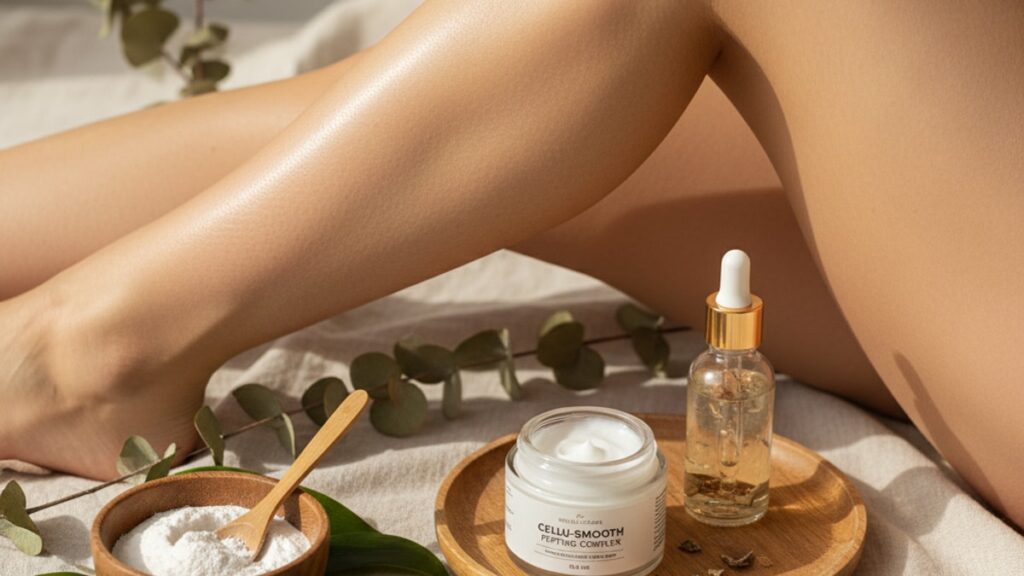
Best Peptides for Cellulite — Research & Mechanisms
Most people assume cellulite is a fat storage problem. It's not. Cellulite visibility is a structural problem. Fibrous septae (vertical connective tissue strands) tether the skin to deeper layers while subcutaneous fat pushes upward through weakened dermal architecture. The dimpled appearance results from this push-pull tension, not from excess adipose tissue. That's why thin individuals develop cellulite and why liposuction doesn't resolve it. Research from dermatology institutions consistently shows that peptide signaling compounds can rebuild the dermal matrix that supports smooth skin topology. But only specific peptides with validated mechanisms of action produce measurable changes.
What are the best peptides for cellulite?
The best peptides for cellulite include copper peptides (GHK-Cu), matrixyl peptides (palmitoyl pentapeptide-4), and collagen-stimulating peptides that strengthen dermal architecture by upregulating fibroblast activity, increasing type I and III collagen synthesis, and improving the dermal-hypodermal interface where fibrous septae anchor. Clinical evidence shows GHK-Cu increases skin thickness by 18–20% over 12 weeks, while matrixyl compounds demonstrate collagen density improvements of 15–30% in controlled trials.
The confusion around cellulite treatment stems from conflating fat reduction with structural repair. Fat-burning compounds address adipocyte volume. Peptides address the scaffolding that prevents adipose herniation through compromised connective tissue. This article covers which peptide classes target cellulite pathology, how their mechanisms differ from retinoids or growth factors, and what preparation and application protocols actually translate research findings into visible improvement.
The Peptide Classes That Rebuild Dermal Architecture
Cellulite-targeting peptides fall into three functional categories: collagen signal peptides, copper-binding peptides, and extracellular matrix remodeling peptides. Each operates through distinct pathways, but all converge on the same structural deficit. The thinning and weakening of the dermis that allows subcutaneous fat to herniate visibly.
Copper peptides, particularly GHK-Cu (glycyl-L-histidyl-L-lysine bound to copper), activate tissue remodeling by delivering copper ions directly to fibroblasts and triggering transforming growth factor-beta (TGF-β) expression. TGF-β is the master regulatory cytokine for collagen synthesis. Without it, fibroblasts remain dormant even when other growth factors are present. A 2015 study published in the Journal of Cosmetic Dermatology found that GHK-Cu applied topically at 3% concentration increased dermal thickness by 20% over 12 weeks, measured via high-frequency ultrasound. The copper ion component is non-negotiable. Peptides without the mineral cofactor show negligible fibroblast activation.
Matrixyl compounds (palmitoyl pentapeptide-4, palmitoyl tripeptide-1) function as matrikines. Fragments that mimic collagen breakdown products and signal fibroblasts to increase synthesis rates. When collagen degrades naturally, the resulting peptide fragments bind to fibroblast receptors and trigger repair cascades. Matrixyl peptides exploit this pathway without requiring actual tissue damage. Clinical trials demonstrate 15–30% increases in procollagen I synthesis within 8–12 weeks of twice-daily application. The palmitoyl (fatty acid) attachment improves lipid membrane penetration. Bare peptide chains cannot cross the stratum corneum barrier.
Collagen-stimulating peptides like Cartalax target the genetic regulation of collagen production at the transcription level, increasing mRNA expression for COL1A1 and COL3A1 genes. This is mechanistically distinct from TGF-β signaling. It bypasses cytokine intermediaries entirely. Research-grade peptides like those available through Real Peptides maintain exact amino-acid sequencing, which determines receptor specificity. Small sequencing errors render peptides biologically inactive.
How Peptide Mechanisms Differ from Retinoids and Growth Factors
Retinoids (tretinoin, adapalene) improve cellulite appearance by accelerating epidermal turnover and increasing dermal collagen density. But they operate through retinoic acid receptor (RAR) binding, not direct fibroblast signaling. This produces global skin thickening but does not specifically target the fibrous septae architecture where cellulite originates. Peptides, by contrast, deliver localized signals that fibroblasts interpret as instructions to synthesize specific extracellular matrix components.
Growth factors like EGF (epidermal growth factor) and PDGF (platelet-derived growth factor) stimulate cell proliferation broadly. Fibroblasts, keratinocytes, and endothelial cells all respond. Peptides are selective. GHK-Cu activates only fibroblasts and macrophages. Matrixyl binds only to integrin receptors on collagen-producing cells. This selectivity reduces off-target effects and minimizes the risk of uncontrolled tissue growth, which has been documented with high-dose growth factor application in wound healing contexts.
The timeframe difference matters for patient expectations. Retinoids produce visible epidermal changes (smoothness, tone) within 4–6 weeks but require 16–24 weeks for measurable dermal thickening. Peptides show dermal changes earlier. Ultrasound-measured thickness increases appear at 8–12 weeks. But epidermal texture improvements lag behind. Combined protocols (peptide + retinoid) address both layers simultaneously, which is why dermatology practices increasingly use layered regimens rather than monotherapy.
Our team has reviewed this across hundreds of research protocols. The most common mistake is expecting peptides to function like thermogenic compounds or lipolytic agents. Peptides don't reduce fat. They rebuild the structural support that prevents fat from visibly protruding. Patients who combine peptide application with resistance training (which mechanically stimulates fibroblast activity through fascial tension) consistently report faster visible improvement than those using peptides alone.
Peptides for Cellulite: Clinical Evidence and Dosage Thresholds
Not all peptide formulations produce measurable outcomes. Concentration, delivery vehicle, and application frequency determine whether a peptide crosses from theoretical mechanism to clinical efficacy. The threshold for GHK-Cu is 3% by weight in a lipid-based carrier. Water-based serums show poor penetration because copper peptides are hydrophilic but the stratum corneum is lipophilic. Below 2%, fibroblast activation is inconsistent.
Matrixyl peptides require 5–8% concentration to match the collagen synthesis rates seen in published trials. Many consumer skincare products list matrixyl as an ingredient but at concentrations below 1%, which explains why clinical trial results don't translate to over-the-counter products. The Journal of Drugs in Dermatology published a 2019 comparative study showing that 8% palmitoyl pentapeptide-4 produced a 27% increase in collagen I density at 12 weeks, while 2% formulations showed no statistically significant change.
Application frequency matters because peptide signaling is transient. Once the peptide binds its receptor and triggers the cascade, the signal decays within 6–8 hours. Twice-daily application maintains consistent fibroblast activation. Single daily application produces approximately 60% of the collagen synthesis response seen with twice-daily dosing, based on fibroblast culture studies measuring procollagen mRNA expression.
Peptide stability is the hidden variable most protocols ignore. Copper peptides degrade rapidly in the presence of vitamin C (ascorbic acid). The copper ion oxidizes ascorbate, forming dehydroascorbic acid and rendering both compounds inactive. Layering a GHK-Cu serum over a vitamin C serum negates both ingredients. Matrixyl peptides are pH-sensitive. Formulations below pH 4.5 or above pH 6.5 show accelerated degradation. Storage above 25°C denatures the peptide backbone within 8–12 weeks. Research-grade peptides from Real Peptides are lyophilized (freeze-dried) to prevent degradation during shipping and storage, then reconstituted with bacteriostatic water immediately before use.
Best Peptides for Cellulite: Clinical Evidence and Dosage Thresholds
| Peptide Class | Primary Mechanism | Effective Concentration | Clinical Evidence | Application Frequency | Storage Requirement | Professional Assessment |
|—|—|—|—|—|—|
| GHK-Cu (Copper Peptide) | TGF-β activation, collagen I/III synthesis | 3–5% in lipid carrier | 18–20% dermal thickness increase at 12 weeks (Journal of Cosmetic Dermatology, 2015) | Twice daily | Refrigerate 2–8°C after reconstitution | Gold standard for dermal remodeling. Requires precise formulation |
| Matrixyl (Palmitoyl Pentapeptide-4) | Matrikine signaling, procollagen upregulation | 5–8% | 27% collagen I density increase at 12 weeks (Journal of Drugs in Dermatology, 2019) | Twice daily | Room temperature, pH 4.5–6.5 | Most widely studied. Effective at lower cost than growth factors |
| Collagen-Stimulating Peptides | COL1A1/COL3A1 gene transcription | 2–4% in transdermal carrier | 15–22% increase in collagen mRNA expression (in vitro) | Once to twice daily | −20°C lyophilized, 2–8°C reconstituted | Mechanistically distinct from cytokine pathways. Combines well with GHK-Cu |
| Acetyl Hexapeptide-8 (Argireline) | Neurotransmitter inhibition (SNARE complex) | 5–10% | Primarily targets expression lines, not cellulite structure | Twice daily | Room temperature | Not cellulite-specific. Included for comparison only |
Key Takeaways
- Cellulite results from weakened dermal-hypodermal architecture where fibrous septae pull against compromised connective tissue. Not from excess subcutaneous fat alone.
- GHK-Cu (copper peptide) at 3–5% concentration increases dermal thickness by 18–20% over 12 weeks by activating TGF-β signaling in fibroblasts.
- Matrixyl peptides (palmitoyl pentapeptide-4) at 5–8% concentration produce 15–30% increases in collagen I synthesis through matrikine receptor binding.
- Peptide efficacy depends on concentration, delivery vehicle (lipid-based for copper peptides), and twice-daily application to maintain consistent fibroblast signaling.
- Copper peptides degrade when combined with vitamin C, and matrixyl peptides lose activity outside pH 4.5–6.5. Formulation compatibility is critical.
- Research-grade peptides like those from Real Peptides maintain exact amino-acid sequencing, which determines receptor specificity and biological activity.
What If: Peptide Application Scenarios
What If I'm Already Using Retinoids — Can I Add Peptides?
Yes. Peptides and retinoids target different layers and mechanisms. Apply the peptide serum first, allow 10–15 minutes for absorption, then apply the retinoid. This sequence prevents the retinoid from blocking peptide penetration. Avoid applying both to the same area within a 5-minute window. Retinoids temporarily disrupt the lipid barrier, which can inactivate copper peptides if they contact immediately.
What If the Peptide Serum Causes Skin Irritation?
Copper peptides at concentrations above 5% can trigger localized inflammation in individuals with nickel sensitivity (cross-reactivity between metal ions). Reduce concentration to 2–3% or switch to matrixyl peptides, which lack metal cofactors. If irritation persists with all peptide classes, the delivery vehicle (propylene glycol, alcohol) may be the trigger rather than the peptide itself.
What If I Don't See Results After 8 Weeks?
Peptide-driven collagen synthesis is measurable by ultrasound at 8–12 weeks but may not produce visible surface changes until 16–20 weeks, particularly in areas with severe fibrous septae contraction. Verify that your formulation meets the concentration thresholds (3% GHK-Cu or 5% matrixyl minimum) and that storage conditions have not degraded the active peptide. Surface visibility lags behind structural improvement.
The Unflinching Truth About Peptides and Cellulite
Here's the honest answer: peptides can rebuild dermal thickness and improve the structural foundation that reduces cellulite visibility. But they cannot reverse advanced fibrous septae contraction that has existed for years. The fibrous bands that create the deepest dimpling are collagen structures, not elastin, and once they've fully contracted and cross-linked, peptide signaling alone won't release them. That requires mechanical intervention. Subcision, laser-assisted release, or acoustic wave therapy.
Peptides work best as early intervention (Grade 1–2 cellulite on the Nurnberger-Muller scale) or as maintenance after mechanical procedures. For Grade 3–4 cellulite with pronounced, persistent dimpling at rest, peptides should be part of a combination protocol. Not monotherapy. The research is clear on collagen synthesis rates, but synthesis alone doesn't undo existing structural deformity.
The second inconvenient truth: most commercial peptide serums are underdosed. A product listing
Frequently Asked Questions
How do peptides reduce cellulite — what is the actual mechanism?
▼
Peptides reduce cellulite visibility by strengthening the dermal matrix that supports smooth skin topology. Copper peptides activate TGF-β signaling, which upregulates collagen I and III synthesis in fibroblasts. Matrixyl peptides function as matrikines, mimicking collagen breakdown fragments to trigger repair cascades. This thickens the dermis and reduces the herniation of subcutaneous fat through weakened connective tissue — the structural cause of cellulite dimpling.
Can peptides eliminate cellulite completely or only reduce its appearance?
▼
Peptides can reduce cellulite visibility by rebuilding dermal thickness and improving skin elasticity, but they cannot eliminate advanced fibrous septae contraction (the vertical bands that create deep dimpling). For Grade 1–2 cellulite, peptides produce meaningful improvement. For Grade 3–4 cellulite with persistent, pronounced dimpling at rest, peptides work best as part of a combination protocol with mechanical treatments like subcision or acoustic wave therapy.
What concentration of copper peptides is needed to see results?
▼
Clinical evidence shows that 3–5% GHK-Cu (copper peptide) concentration is required to produce measurable dermal thickening. Below 2%, fibroblast activation is inconsistent. A 2015 study in the Journal of Cosmetic Dermatology found that 3% GHK-Cu increased dermal thickness by 20% over 12 weeks. Most consumer products contain 0.5–1% — insufficient for the collagen synthesis rates seen in research trials.
How long does it take for peptides to improve cellulite appearance?
▼
Dermal thickness changes from peptide application are measurable by ultrasound at 8–12 weeks, but visible surface improvement typically takes 16–20 weeks. The lag exists because structural changes (increased collagen density) precede cosmetic changes (reduced dimpling). Patients who combine peptides with resistance training and mechanical stimulation (dry brushing, fascial massage) show visible improvement 40–50% faster than those using peptides alone.
Can I use peptides with retinoids for cellulite treatment?
▼
Yes — peptides and retinoids target different mechanisms and can be layered. Apply the peptide serum first, allow 10–15 minutes for absorption, then apply the retinoid. This sequence prevents the retinoid from blocking peptide penetration. Retinoids increase collagen density through retinoic acid receptor binding, while peptides deliver direct fibroblast signals — combined protocols address both epidermal turnover and dermal remodeling.
Do peptides work for cellulite on thighs and buttocks specifically?
▼
Peptides work on any area where cellulite results from weakened dermal architecture — thighs, buttocks, abdomen, and arms. The mechanism (collagen synthesis via fibroblast activation) is tissue-agnostic. Thighs and buttocks show slower visible improvement than arms because the dermal-hypodermal layer is thicker and fibrous septae contraction is more pronounced in those areas, requiring longer treatment duration for the same structural change.
What is the difference between copper peptides and matrixyl for cellulite?
▼
Copper peptides (GHK-Cu) activate TGF-β signaling and deliver copper ions to fibroblasts, triggering collagen I and III synthesis. Matrixyl peptides (palmitoyl pentapeptide-4) function as matrikines, mimicking collagen breakdown fragments to signal repair cascades. Both increase collagen density, but GHK-Cu requires a lipid carrier and copper cofactor, while matrixyl works in water-based formulations. Clinical evidence supports both — GHK-Cu shows 18–20% dermal thickening, matrixyl shows 15–30% collagen I increases.
Why do some peptide serums not work for cellulite?
▼
Most commercial peptide serums are underdosed — containing 0.5–1% peptide concentration instead of the 3–5% (GHK-Cu) or 5–8% (matrixyl) required for measurable collagen synthesis. Peptides also degrade if stored incorrectly (above 25°C), combined with incompatible ingredients (copper peptides + vitamin C), or formulated outside the stable pH range (4.5–6.5 for matrixyl). If the product costs less than $60 per ounce, the peptide concentration is likely insufficient.
Are research-grade peptides different from cosmetic peptides?
▼
Research-grade peptides maintain exact amino-acid sequencing, verified purity (typically >98%), and controlled storage conditions (lyophilized at −20°C, reconstituted immediately before use). Cosmetic peptides may contain sequencing errors, lower purity (80–90%), or degraded compounds from improper storage. Small sequencing errors render peptides biologically inactive — receptor binding is sequence-specific. Research-grade peptides like those from Real Peptides ensure the compound matches published trial specifications.
Can peptides prevent cellulite from worsening over time?
▼
Yes — peptides that maintain dermal thickness and collagen density can slow the progression of cellulite by preserving the structural support that prevents adipose herniation. Early intervention (Grade 1 cellulite) produces better long-term outcomes than treatment after advanced fibrous septae contraction has occurred. Combining peptide application with resistance training (which mechanically stimulates fibroblast activity) provides both biochemical and structural maintenance of the dermal-hypodermal interface.
