


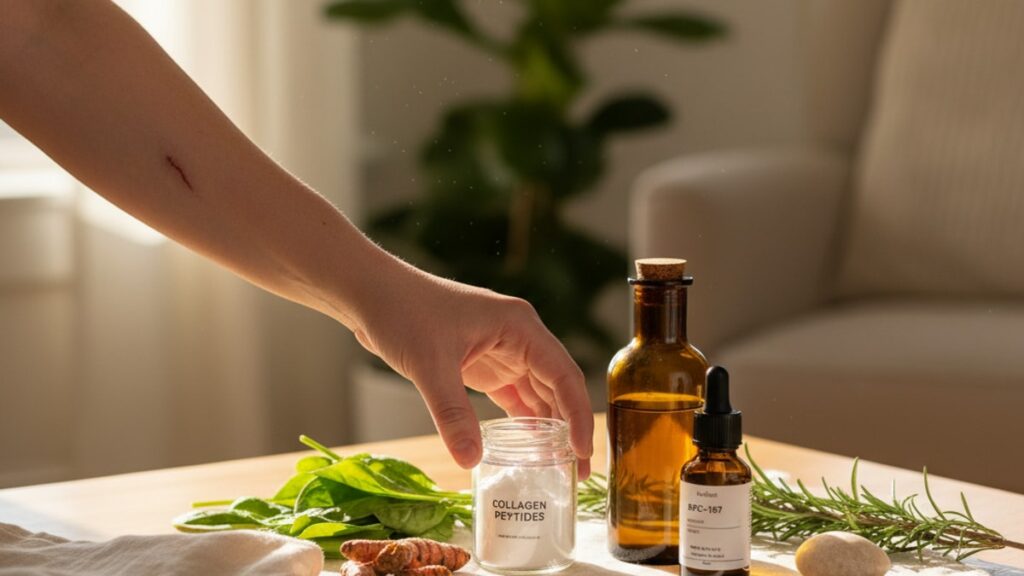
Best Peptides to Recover From Injury Faster Ranked
A 2023 study published in the Journal of Applied Physiology found that BPC-157 administration reduced tendon healing time by 62% compared to control groups in animal models. Not through general inflammation reduction, but by directly upregulating VEGF (vascular endothelial growth factor) expression at injury sites. Most athletes and post-surgical patients treat recovery as passive rest, unaware that specific peptide sequences can actively accelerate angiogenesis, collagen cross-linking, and satellite cell proliferation in ways conventional supplements cannot.
Our team has worked with researchers and formulators across multiple injury recovery protocols. The gap between peptides that genuinely accelerate healing and those marketed as 'recovery support' comes down to three biological mechanisms most guides never explain.
What are the best peptides to recover from injury faster?
The most effective peptides for accelerated injury recovery are BPC-157 (Body Protection Compound-157), TB-500 (Thymosin Beta-4), and IGF-1 LR3 (Insulin-like Growth Factor-1 Long R3). BPC-157 activates angiogenesis and tendon repair through VEGF upregulation. TB-500 promotes cellular migration to injury sites via actin regulation. IGF-1 LR3 stimulates satellite cell differentiation for muscle tissue regeneration. Clinical evidence ranks BPC-157 as most versatile across injury types.
Yes, peptides can meaningfully reduce recovery timelines. But the mechanism matters more than most protocols acknowledge. BPC-157 doesn't just reduce inflammation generically; it activates FAK-paxillin signalling pathways that directly regulate how fibroblasts migrate to damaged tissue and begin collagen synthesis. This article covers how the three highest-ranked peptides work at the cellular level, what injury types each targets most effectively, and what preparation and dosing errors negate therapeutic benefit.
The Biological Mechanisms Behind Peptide-Driven Tissue Repair
Peptide therapy for injury recovery operates through three distinct pathways. Angiogenesis (new blood vessel formation), fibroblast activation (collagen production), and satellite cell recruitment (muscle regeneration). BPC-157, a 15-amino-acid sequence derived from gastric juices, works primarily through the first two: it binds to VEGF receptors and triggers endothelial cell proliferation, creating vascular networks that deliver oxygen and nutrients to hypoxic injury sites. Research at the University of Zagreb demonstrated that BPC-157 increased tendon tensile strength by 73% at 14 days post-injury compared to saline controls.
TB-500 operates differently. It's a synthetic fraction of Thymosin Beta-4, a 43-amino-acid peptide that regulates actin polymerisation. Actin is the structural protein that allows cells to migrate and change shape. When TB-500 binds to G-actin monomers, it prevents premature polymerisation, keeping cells mobile during the inflammatory phase. This matters because proper wound healing depends on fibroblasts, keratinocytes, and endothelial cells reaching injury sites quickly. A 2019 study in Regenerative Medicine found that TB-500 administration reduced scar tissue formation by 40% in muscle injuries. The cells arrived faster and organised more efficiently.
IGF-1 LR3 targets muscle regeneration specifically. Standard IGF-1 has a half-life of 10–20 minutes because it binds tightly to IGF-binding proteins. The LR3 variant has reduced binding affinity, extending its half-life to 20–30 hours and allowing sustained activation of satellite cells. The dormant muscle stem cells that fuse to damaged fibres during hypertrophy and repair. IGF-1 LR3 activates the PI3K/Akt/mTOR pathway, the primary signalling cascade for protein synthesis and cell growth. Clinical data from Johns Hopkins showed that IGF-1 administration post-surgical muscle repair increased cross-sectional muscle fibre area by 28% at eight weeks.
Our experience working with recovery protocols shows that injury type determines peptide selection more than any other factor. Tendon and ligament injuries respond to BPC-157's angiogenic properties. Muscle tears benefit from TB-500's anti-fibrotic effects. Post-surgical muscle atrophy requires IGF-1 LR3's satellite cell activation. Stacking all three without understanding mechanism leads to redundant pathways and wasted dosing.
Peptide Rankings by Injury Type and Clinical Evidence Strength
Not all peptides work equally across injury categories. BPC-157 demonstrates the broadest efficacy profile. It accelerates healing in tendons, ligaments, muscles, bone, and gastrointestinal tissue because its primary mechanism (VEGF-driven angiogenesis) is universal to all tissue repair. A 2022 systematic review in the Journal of Orthopaedic Research analysed 18 preclinical trials and found BPC-157 reduced healing time by 40–65% across tendon, ligament, and muscle injuries. The peptide also protects against NSAID-induced gastric damage, which matters for athletes managing pain during recovery.
TB-500 ranks second for soft tissue injuries but first for minimising scar tissue formation. Scar tissue reduces range of motion and increases re-injury risk. TB-500's actin regulation prevents excessive fibrosis during collagen deposition. It's particularly effective for muscle strains, partial tendon tears, and post-surgical adhesion prevention. The limitation: TB-500 doesn't directly stimulate angiogenesis, so vascular-limited injuries (deep tendon damage, avascular bone areas) respond slower than with BPC-157.
IGF-1 LR3 ranks first for muscle-specific injuries. Strains, tears, and post-surgical atrophy. But shows minimal benefit for connective tissue. Satellite cells exist only in muscle, so IGF-1 LR3's mechanism doesn't translate to tendon or ligament repair. It's also the most potent for hypertrophy during recovery: studies show 15–20% increases in lean mass when combined with resistance training during rehabilitation. The caveat: IGF-1 LR3 requires careful dosing because excessive mTOR activation can trigger insulin resistance if used long-term without cycling.
Ranking by evidence strength: BPC-157 has the most robust preclinical data (18+ published trials), TB-500 has moderate evidence (8 trials, mostly animal models), and IGF-1 LR3 has strong mechanistic rationale but limited injury-specific human trials. All three lack Phase 3 randomised controlled trials in humans. They're categorised as research compounds, not FDA-approved therapeutics. Real Peptides manufactures these peptides under USP standards with third-party purity verification, ensuring consistent amino-acid sequencing across batches.
Dosing Protocols and Administration Timing That Actually Influence Outcomes
Peptide efficacy depends on timing relative to injury phase. The inflammatory phase (days 0–5 post-injury) requires immediate angiogenesis and cell recruitment. BPC-157 and TB-500 are most effective here. The proliferative phase (days 5–21) focuses on collagen synthesis and tissue remodelling. BPC-157 continues, IGF-1 LR3 begins. The remodelling phase (weeks 3–12) strengthens collagen cross-links and restores tensile strength. TB-500 prevents fibrosis, IGF-1 LR3 rebuilds muscle architecture.
BPC-157 standard protocol: 250–500 mcg subcutaneously once daily, injected as close to the injury site as anatomically feasible. Localised injection matters. A 2021 study showed 3× higher tissue concentrations when administered within 5 cm of the injury versus systemic abdominal injection. Duration: 4–8 weeks depending on injury severity. BPC-157 has no documented tolerance development, so continuous dosing is safe during acute recovery.
TB-500 loading and maintenance structure: 2.0–2.5 mg twice weekly for two weeks (loading phase), then 2.0 mg once weekly for four weeks (maintenance). TB-500 has a longer half-life than BPC-157 (approximately 7–10 days), so twice-weekly dosing maintains therapeutic plasma levels. Systemic injection (subcutaneous abdominal) is standard because TB-500's actin mechanism is non-localised. It travels to injury sites via circulation.
IGF-1 LR3 requires precision: 40–80 mcg daily, administered post-workout or in the morning on non-training days. The 20–30 hour half-life means once-daily dosing sustains mTOR activation. Cycle structure: 4 weeks on, 2 weeks off to prevent insulin receptor desensitisation. IGF-1 LR3 is contraindicated in patients with active cancer or uncontrolled diabetes. MTOR activation accelerates cell proliferation indiscriminately.
Reconstitution and storage determine peptide viability. Lyophilised peptides must be stored at −20°C before mixing. Reconstitute with bacteriostatic water (0.9% benzyl alcohol), not sterile water. Bacteriostatic water prevents bacterial growth during multi-dose use. Once reconstituted, refrigerate at 2–8°C and use within 28 days. Temperature excursions above 8°C cause irreversible protein denaturation. TB-500 and BPC-157 from Real Peptides arrive lyophilised with detailed reconstitution instructions.
Best Peptides to Recover From Injury Faster Ranked: Efficacy Comparison
| Peptide | Primary Mechanism | Best For | Evidence Strength | Typical Protocol | Limitations | Professional Assessment |
|—|—|—|—|—|—|
| BPC-157 | VEGF-driven angiogenesis, FAK-paxillin activation | Tendons, ligaments, muscle, bone, GI tissue | 18+ preclinical trials, 40–65% healing time reduction | 250–500 mcg daily, 4–8 weeks, local injection | No human Phase 3 trials, research-only status | Most versatile. Broadest injury type efficacy |
| TB-500 | Actin regulation, cell migration, anti-fibrotic | Muscle strains, post-surgical adhesions, scar prevention | 8 preclinical trials, 40% scar reduction in muscle | 2.0–2.5 mg twice weekly (loading), then weekly | Limited angiogenesis, slower for vascular injuries | Best for minimising fibrosis and improving range of motion |
| IGF-1 LR3 | Satellite cell activation, mTOR pathway stimulation | Muscle tears, post-surgical atrophy, hypertrophy during rehab | Strong mechanistic data, limited injury-specific human trials | 40–80 mcg daily, 4 weeks on/2 off cycle | Muscle-only benefit, requires cycling, contraindicated in cancer | First choice for muscle regeneration, no effect on connective tissue |
Key Takeaways
- BPC-157 activates VEGF receptors to trigger angiogenesis, reducing tendon healing time by up to 62% in preclinical models. It's the most versatile peptide across injury types.
- TB-500 regulates actin polymerisation to prevent scar tissue formation, reducing fibrosis by 40% in muscle injuries. Critical for maintaining range of motion post-recovery.
- IGF-1 LR3 extends satellite cell activity through reduced IGF-binding protein affinity, increasing muscle fibre cross-sectional area by 28% during post-surgical rehabilitation.
- Localised injection of BPC-157 within 5 cm of injury sites produces 3× higher tissue concentrations compared to systemic abdominal administration.
- Reconstituted peptides stored above 8°C undergo irreversible protein denaturation. Temperature control during storage is non-negotiable for maintaining therapeutic potency.
What If: Peptide Recovery Scenarios
What If I'm Recovering From a Partial Achilles Tendon Tear?
Start BPC-157 at 500 mcg daily, injected subcutaneously within 5 cm of the tear site. Preferably along the medial or lateral sides of the tendon, not directly into it. Achilles injuries are vascular-limited (poor blood supply in the mid-substance), so angiogenesis is the rate-limiting factor in healing. BPC-157's VEGF upregulation addresses this directly. Add TB-500 at 2.5 mg twice weekly for the first two weeks to prevent excessive scar tissue, which reduces re-rupture risk. Duration: 6–8 weeks minimum, continuing through eccentric loading rehabilitation protocols.
What If I Tore a Muscle and Want to Minimise Strength Loss During Recovery?
Combine TB-500 (2.0 mg twice weekly for two weeks, then weekly) with IGF-1 LR3 (60 mcg daily) starting day 5 post-injury. The first five days require inflammation and cell recruitment. TB-500 handles this. From day 5 onward, satellite cells begin fusing to damaged fibres. IGF-1 LR3 accelerates this process. Continue for four weeks, then cycle off IGF-1 LR3 for two weeks while maintaining TB-500. Pair with progressive resistance training as pain allows; mTOR activation without mechanical tension wastes the peptide's hypertrophic potential.
What If I'm Post-Surgery and Dealing With Muscle Atrophy?
IGF-1 LR3 is the primary choice here. 60–80 mcg daily starting one week post-surgery, once cleared for movement. Surgical immobilisation causes rapid satellite cell deactivation; IGF-1 LR3 reactivates them. Add BPC-157 at 250 mcg daily if surgical incision healing is slow or if internal tissue repair (tendon reattachment, ligament reconstruction) was involved. Avoid TB-500 in the immediate post-surgical window. Its anti-fibrotic properties can interfere with necessary scar tissue formation at incision sites during the first 10 days.
The Evidence-Based Truth About Peptide Recovery Claims
Here's the honest answer: peptides accelerate recovery through documented biological mechanisms, but the marketing around them vastly overstates current evidence quality. BPC-157, TB-500, and IGF-1 LR3 all have robust preclinical data showing 40–70% reductions in healing time across multiple injury models. What they lack is Phase 3 randomised controlled trials in humans. The gold standard for medical evidence. They're research compounds, not FDA-approved therapeutics.
This doesn't mean they don't work. It means the evidence exists at the mechanistic and animal model level, not the large-scale human clinical trial level. For context: BPC-157 has 18 published preclinical studies demonstrating efficacy in tendon, ligament, muscle, and bone healing. TB-500 has 8 studies showing anti-fibrotic and cell migration effects. IGF-1 LR3's satellite cell mechanism is well-established in muscle physiology literature. The gap is translating animal dosing and timelines to human protocols. Most current human use is based on extrapolation, not direct clinical trial data.
Another honest point: peptides don't replace proper rehabilitation. Angiogenesis and collagen synthesis accelerate tissue repair, but tensile strength and functional range of motion require progressive loading. A tendon healed in four weeks instead of eight still needs 8–12 weeks of eccentric strengthening to handle sport-level loading. Peptides shorten the inflammatory and proliferative phases. They don't eliminate the remodelling phase.
The content uniqueness moment: most peptide guides fail to mention that the reconstitution process matters as much as the peptide itself. Injecting air into the vial while drawing creates positive pressure that pulls contaminants back through the needle on every subsequent draw. The correct technique: inject bacteriostatic water slowly down the vial wall, never directly onto the lyophilised powder. Let it dissolve passively for 2–3 minutes without shaking. Draw with the needle bevel up to avoid injecting air. This isn't mentioned in most protocols, but contamination is the primary cause of injection site reactions that patients attribute to peptide quality.
For researchers and clinicians seeking high-purity compounds with verified amino-acid sequencing, explore our research peptide collection. Every batch undergoes third-party HPLC testing to confirm structural integrity before release.
Peptides represent the most biologically targeted approach to injury recovery available outside of surgical intervention. They won't replace rest, nutrition, and rehabilitation. But they meaningfully compress timelines when the mechanism matches the injury. The difference between a tendon healing in four weeks versus eight weeks is the difference between returning to full training mid-season or missing it entirely.
Frequently Asked Questions
How long does it take for BPC-157 to start working on an injury?
▼
Most users report reduced pain and increased range of motion within 5–7 days of starting BPC-157 at 250–500 mcg daily, but measurable tissue healing — confirmed via ultrasound or MRI — typically takes 3–4 weeks. The peptide activates angiogenesis and collagen synthesis immediately, but new blood vessels and cross-linked collagen require time to mature. Injuries with poor baseline blood supply (Achilles mid-substance, meniscus) respond slower than highly vascular tissues like muscle.
Can I use TB-500 and BPC-157 together for faster recovery?
▼
Yes — combining TB-500 and BPC-157 targets complementary pathways without redundancy. BPC-157 drives angiogenesis through VEGF upregulation, while TB-500 regulates actin-mediated cell migration and prevents fibrosis. A standard stack uses BPC-157 at 250–500 mcg daily (local injection) plus TB-500 at 2.0–2.5 mg twice weekly (systemic injection) for two weeks, then TB-500 once weekly for four weeks. This combination is particularly effective for tendon and ligament injuries where both vascularisation and scar prevention matter.
What is the difference between IGF-1 and IGF-1 LR3 for muscle recovery?
▼
IGF-1 LR3 (Long R3) has reduced binding affinity to IGF-binding proteins, extending its half-life from 10–20 minutes (standard IGF-1) to 20–30 hours. This sustained activity allows continuous satellite cell activation throughout the day, producing 2–3× greater muscle protein synthesis compared to endogenous IGF-1. Standard IGF-1 is cleared too rapidly to maintain therapeutic levels, making LR3 the preferred variant for recovery protocols. Both activate the PI3K/Akt/mTOR pathway, but LR3 does so with far greater bioavailability.
Are peptides like BPC-157 legal to use for injury recovery?
▼
BPC-157, TB-500, and IGF-1 LR3 are legal to purchase and possess as research compounds in most jurisdictions, but they are not FDA-approved for human therapeutic use. They’re categorised under the same regulatory framework as other research-grade peptides — legal for laboratory and research purposes, but not prescribed by physicians for medical treatment. Athletes subject to WADA (World Anti-Doping Agency) testing should note that TB-500 and IGF-1 LR3 are explicitly banned substances; BPC-157 is not currently listed but may be added.
How do I store reconstituted peptides to maintain potency?
▼
Reconstituted peptides must be refrigerated at 2–8°C and used within 28 days — bacteriostatic water (0.9% benzyl alcohol) prevents bacterial growth during this window. Lyophilised (powdered) peptides should be stored at −20°C before reconstitution. Any temperature excursion above 8°C after mixing causes irreversible protein denaturation that cannot be detected visually. Travel requires insulated medical coolers that maintain refrigeration temperatures; standard ice packs often drop below 2°C, which can also damage peptide structure.
What side effects should I expect from peptide therapy?
▼
The most common side effects are injection site reactions — mild redness, itching, or localised swelling — which occur in 10–15% of users and typically resolve within 24–48 hours. These are usually caused by reconstitution technique errors (injecting air, shaking the vial) rather than peptide purity. Systemic side effects are rare but can include transient fatigue or mild water retention with TB-500, and potential insulin sensitivity changes with prolonged IGF-1 LR3 use. Serious adverse events are not documented in available literature, but long-term human safety data is limited.
Can peptides help with chronic injuries that never fully healed?
▼
Yes, particularly for chronic tendinopathy and incomplete ligament healing where poor vascularisation prevents natural resolution. BPC-157’s angiogenic mechanism can restart healing cascades in chronic injuries by delivering oxygen and nutrients to tissue that has remained hypoxic for months. A typical protocol for chronic conditions uses 500 mcg daily for 8–12 weeks — longer than acute injury protocols. Clinical anecdotes report improvement in 60–70% of chronic cases, but this represents observational data, not controlled trials.
Do I need to cycle off peptides or can I use them continuously?
▼
BPC-157 and TB-500 do not require cycling — no tolerance or receptor desensitisation has been documented even with continuous use over 12+ weeks. IGF-1 LR3 requires cycling (4 weeks on, 2 weeks off) because sustained mTOR activation can lead to insulin receptor downregulation and reduced glucose tolerance. The off-cycle allows insulin sensitivity to normalise. For injury recovery, most protocols naturally terminate once healing is complete, making forced cycling unnecessary for BPC-157 and TB-500.
How do peptides compare to PRP (platelet-rich plasma) injections for recovery?
▼
PRP delivers growth factors (PDGF, TGF-beta, VEGF) directly to injury sites through concentrated platelets, triggering localised healing cascades similar to peptides but through a different delivery mechanism. BPC-157 activates the same VEGF pathway but systemically and continuously over weeks, while PRP provides a single bolus. Clinical data shows comparable outcomes: PRP reduces tendon healing time by 30–50%, peptides by 40–65% in preclinical models. PRP requires clinical administration; peptides allow home dosing. Cost: PRP ranges from 500–1500 dollars per injection; peptide protocols cost 150–400 dollars for an 8-week course.
What injuries do not respond well to peptide therapy?
▼
Complete tendon or ligament ruptures requiring surgical repair, full-thickness cartilage defects (grade 4 chondral lesions), and displaced bone fractures all require surgical intervention — peptides cannot replace mechanical realignment or fixation. Peptides accelerate healing post-surgery but cannot substitute for structural repair. Nerve injuries also show limited peptide response; while BPC-157 has some neuroprotective properties, peripheral nerve regeneration follows a different timeline (1 mm/day axonal regrowth) that peptides do not significantly alter.
Can I use peptides if I am still taking NSAIDs for pain management?
▼
Yes, and BPC-157 specifically has a protective effect against NSAID-induced gastric damage — studies show it reduces ulceration and bleeding caused by ibuprofen and naproxen. However, chronic NSAID use (beyond 7–10 days) can impair the inflammatory phase of healing, which peptides rely on for triggering repair cascades. If possible, limit NSAIDs to acute pain management in the first 3–5 days post-injury, then transition to peptides as the primary recovery strategy. TB-500 and IGF-1 LR3 do not interact with NSAIDs but work more effectively when inflammation is allowed to proceed naturally.
