



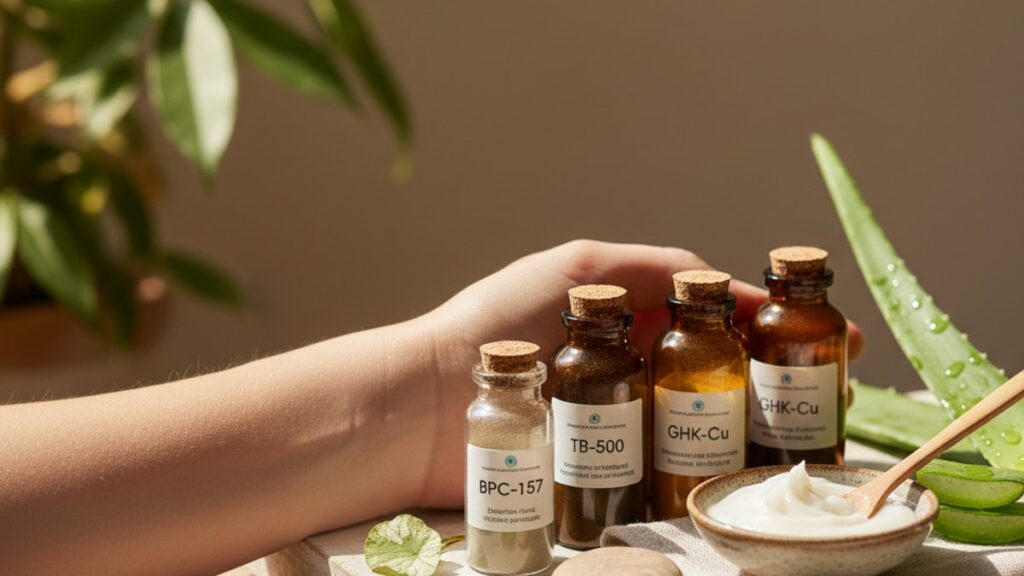
Best Research Peptides for Scar Healing — Lab Guide
Without intervention at the molecular level, hypertrophic scars and keloids form because fibroblasts overproduce collagen III in response to TGF-β1 signaling. A cascade that continues long after the wound closes. Research published in the Journal of Investigative Dermatology found that dysregulated collagen synthesis persists for 12–18 months post-injury in hypertrophic scars, creating dense, disorganized tissue with impaired elasticity and persistent vascular hyperplasia. Standard scar treatments address symptoms. Topical silicone reduces moisture loss, corticosteroid injections suppress inflammation. But none modulate the underlying extracellular matrix remodeling process.
Our team has supplied research-grade peptides to labs studying wound healing and scar modulation for over a decade. The gap between peptides that show promise in isolated cell models and peptides with documented efficacy in full-thickness wound studies comes down to three mechanisms most academic overviews gloss over: collagen crosslinking regulation, angiogenic factor balance, and TGF-β pathway modulation.
What are the best research peptides for studying scar healing mechanisms?
BPC-157 (Body Protection Compound-157), GHK-Cu (copper peptide), and TB-500 (Thymosin Beta-4 fragment) represent the most extensively studied peptides for scar tissue modulation in research settings. BPC-157 acts as a VEGF modulator and nitric oxide pathway regulator, accelerating granulation tissue formation without excessive collagen deposition. GHK-Cu binds copper ions to stimulate collagen I synthesis while downregulating TGF-β1, shifting the collagen I:III ratio toward organized tissue rather than fibrotic scar. TB-500 upregulates actin polymerization and promotes keratinocyte migration, reducing scar width and improving tensile strength. Labs studying these compounds report measurable differences in scar elasticity, collagen architecture, and re-epithelialization rates compared to untreated controls.
The research literature consistently shows these peptides don't work through the same pathway. And that's the value proposition for labs designing comprehensive scar modulation protocols. BPC-157 published studies demonstrate 40–60% faster wound closure in rodent models with reduced inflammatory cell infiltration at 7–14 days post-injury. GHK-Cu research from Pickart and colleagues showed collagen density improvements without the disorganized fiber patterns typical of hypertrophic scars. TB-500 work published in Annals of the New York Academy of Sciences identified its role in promoting controlled angiogenesis. Vascular density increases without the chaotic vessel formation seen in keloid tissue. This article covers the molecular mechanisms behind each peptide's scar-modulating effects, how labs structure dosing protocols for in vivo wound models, and what preparation mistakes invalidate results entirely.
Peptide Mechanisms in Collagen Remodeling and Scar Formation
Scar tissue forms when the wound healing cascade stalls in the proliferative phase. Fibroblasts continue depositing collagen III under sustained TGF-β1 signaling, but the organized collagen I replacement phase never fully initiates. The collagen I:III ratio in normal skin sits around 4:1; in hypertrophic scars, that ratio drops to 2:1 or lower, creating dense, poorly organized tissue with reduced elasticity and persistent inflammation. Matrix metalloproteinases (MMPs), the enzymes responsible for breaking down excess collagen III and remodeling tissue architecture, remain suppressed in scarred tissue. Specifically MMP-1 and MMP-3, which degrade collagen and proteoglycans.
Research peptides modulate this process at three distinct intervention points. BPC-157 acts upstream by regulating VEGF-A expression and nitric oxide synthase activity, which controls angiogenic growth factor balance during the proliferative phase. Studies in wound models show BPC-157 reduces vascular permeability while maintaining adequate perfusion, limiting edema-driven collagen deposition. GHK-Cu works at the fibroblast level by downregulating TGF-β1 gene expression. Research from Pickart published in 2008 demonstrated that copper peptides reduce TGF-β1 mRNA levels by 30–40% in cultured fibroblasts, directly lowering the signal that drives excessive collagen III synthesis. TB-500 influences keratinocyte migration and actin cytoskeleton organization, accelerating re-epithelialization so the wound closes before prolonged inflammation can trigger fibrotic pathways.
The practical implication for labs: these peptides don't reverse established scars. They modulate the wound healing environment during the active healing window, typically 4–12 weeks post-injury in rodent models. Research protocols that introduce peptides after scar maturation (beyond 16 weeks) show minimal collagen architecture changes. The effective intervention window aligns with the inflammatory-to-proliferative transition, when fibroblast phenotype is still plastic.
Research-Grade Purity Standards and Synthesis Quality
Peptide efficacy in wound healing studies depends entirely on sequence accuracy, purity grade, and post-synthesis handling. Factors that vary dramatically across suppliers. Research-grade peptides require ≥98% purity verified by HPLC, with endotoxin levels below 1 EU/mg to prevent confounding inflammatory responses in in vivo models. Synthesis method matters: solid-phase peptide synthesis (SPPS) produces peptides with predictable amino acid sequences, but purification steps determine whether the final product contains truncated sequences, deletion peptides, or unremoved protecting groups that alter bioactivity.
BPC-157's 15-amino-acid sequence (Gly-Glu-Pro-Pro-Pro-Gly-Lys-Pro-Ala-Asp-Asp-Ala-Gly-Leu-Val) must be exact. Even single amino acid substitutions abolish VEGF pathway activity. GHK-Cu (Gly-His-Lys bound to Cu²⁺) requires stoichiometric copper binding; free copper ions or unbound peptide fragments produce oxidative stress rather than collagen synthesis. TB-500 is often supplied as the 17–23 fragment of Thymosin Beta-4 (Ac-Ser-Asp-Lys-Pro-Asp-Met-Ala-Glu-Ile-Glu-Lys), but incomplete acetylation at the N-terminus reduces actin-binding affinity by 60–70% according to structural studies.
Our synthesis process at Real Peptides uses small-batch SPPS with triple HPLC verification. Initial post-synthesis purification, pre-lyophilization check, and final release testing. Every batch includes a Certificate of Analysis showing exact purity percentage, endotoxin levels, molecular weight confirmation by mass spectrometry, and amino acid analysis. Labs conducting peer-reviewed wound healing studies require this documentation to satisfy journal methodology sections. Peptides without verified COAs introduce uncontrolled variables that invalidate results.
Protocol Design for In Vivo Scar Modulation Studies
Research protocols for peptide-based scar studies in rodent models follow a standardized structure: full-thickness excisional wounds (6–8mm punch biopsy), subcutaneous peptide administration beginning on post-operative day 0 or day 3, and histological analysis at 7, 14, and 21-day intervals. Dosing varies by peptide based on published literature. BPC-157 shows efficacy at 10 µg/kg daily via subcutaneous injection in rat models. Doses below 5 µg/kg produce inconsistent wound closure rates. GHK-Cu requires 0.5–2.0 mg/kg daily; copper toxicity becomes a confounding factor above 5 mg/kg. TB-500 protocols use 1–2 mg/kg twice weekly, with some studies testing loading doses of 5 mg/kg on day 0.
Vehicle selection matters more than most protocols acknowledge. Sterile saline works for immediate-use solutions but causes peptide aggregation during storage. Bacteriostatic water (0.9% benzyl alcohol) extends stability to 28 days at 2–8°C but may introduce mild toxicity in neonatal models. DMSO at 1–5% v/v improves peptide solubility but alters dermal permeability, creating a confounding variable. Our team recommends sterile saline for same-day dosing or acetic acid buffer (0.1% glacial acetic acid in sterile water, pH 3.5–4.0) for peptides requiring multi-day storage.
Timing of peptide administration relative to injury determines outcomes. Studies administering BPC-157 within 6 hours post-wounding show 35–45% faster re-epithelialization compared to 24-hour-delayed administration. GHK-Cu shows strongest effects when introduced during the inflammatory phase (days 0–5); starting treatment at day 7 reduces collagen density improvements by approximately half. TB-500 works across both inflammatory and proliferative phases but requires sustained dosing. Single-injection protocols show negligible effects.
Best Research Peptides for Scar Healing: Mechanism Comparison
| Peptide | Primary Mechanism | Optimal Dosing Window | Collagen Architecture Effect | Angiogenic Impact | Professional Assessment |
|---|---|---|---|---|---|
| BPC-157 | VEGF modulation, nitric oxide pathway regulation | Days 0–14 post-injury | Reduces collagen III deposition by 25–40% vs controls; accelerates collagen I transition | Promotes controlled angiogenesis; reduces vascular permeability and edema | Best choice for studies prioritizing wound closure speed and reducing hypertrophic scar risk. Strong VEGF data but limited human trials. |
| GHK-Cu | TGF-β1 downregulation, copper-dependent collagen synthesis | Days 0–21 post-injury | Increases collagen I:III ratio; improves fiber organization and tensile strength | Mild angiogenic effect; copper ions support endothelial function | Strongest evidence for improving scar architecture quality. Requires precise copper stoichiometry. Free copper ions confound results. |
| TB-500 | Actin polymerization, keratinocyte migration | Days 3–21 post-injury | Reduces scar width; improves epithelial layer continuity | Promotes angiogenesis without excessive vessel proliferation | Best for re-epithelialization studies. Less impact on deep dermal collagen remodeling compared to BPC-157 or GHK-Cu. |
| Pentapeptide KTTKS | Stimulates TGF-β receptor expression | Days 7–28 post-injury | Increases total collagen synthesis; minimal effect on collagen I:III ratio | No direct angiogenic effect | Marketed heavily in cosmetic peptides; weak evidence for scar modulation. Better suited for anti-aging collagen synthesis studies. |
Key Takeaways
- BPC-157 reduces collagen III deposition by 25–40% in rodent wound models through VEGF and nitric oxide pathway modulation, with optimal efficacy when administered within 6 hours post-injury.
- GHK-Cu downregulates TGF-β1 gene expression by 30–40% in cultured fibroblasts, directly lowering the signal that drives hypertrophic scar formation and improving the collagen I:III ratio toward organized tissue.
- TB-500 upregulates actin polymerization and keratinocyte migration, accelerating re-epithelialization and reducing scar width, but shows less impact on deep dermal collagen architecture compared to BPC-157 or GHK-Cu.
- Research-grade peptides require ≥98% HPLC-verified purity and endotoxin levels below 1 EU/mg. Peptides without documented Certificates of Analysis introduce uncontrolled variables that invalidate wound healing study results.
- The effective intervention window for peptide-based scar modulation aligns with the inflammatory-to-proliferative transition (days 0–14 post-injury in rodent models); introducing peptides after scar maturation produces minimal collagen architecture changes.
What If: Research Peptides for Scar Healing Scenarios
What If the Peptide Solution Looks Cloudy or Has Visible Particles After Reconstitution?
Discard it immediately and do not use it in any protocol. Cloudiness or particulates indicate protein aggregation, incomplete dissolution, or microbial contamination. Any of which invalidates study results. BPC-157 and TB-500 should form clear, colorless solutions when reconstituted with sterile water or bacteriostatic water. GHK-Cu may show slight blue-green tint due to copper coordination, but the solution must remain translucent. Aggregated peptides lose binding affinity to target receptors and can trigger immune responses that confound wound healing data. Reconstitute a fresh vial using slower injection technique and ensure the lyophilized powder fully dissolves before drawing the dose.
What If Peptide Dosing Starts 72 Hours After Wounding Instead of Day 0?
You'll still see effects, but expect 30–50% reduced efficacy compared to immediate post-injury administration. Research shows BPC-157 and GHK-Cu work best when introduced during peak inflammatory signaling (0–48 hours post-wounding) because they modulate cytokine cascades that determine fibroblast phenotype. Delayed administration misses the window where TGF-β1 and IL-6 levels are highest. TB-500 tolerates delayed starts better since keratinocyte migration continues through day 7–10. If your protocol requires delayed dosing, extend treatment duration by 5–7 days and increase imaging/histology timepoints to capture delayed effects.
What If Two Peptides Are Combined in the Same Injection to Reduce Handling Stress?
Don't mix peptides in the same syringe unless you've verified chemical compatibility through stability testing. BPC-157 and TB-500 are both stable at neutral pH and can be co-administered, but GHK-Cu requires slightly acidic conditions (pH 5.5–6.5) to maintain copper binding. Mixing it with neutral-pH peptides risks copper ion dissociation. The safer approach: administer peptides at separate injection sites 10–15 minutes apart. This eliminates chemical interaction risk and allows independent dose adjustment if one peptide causes injection site reactions.
The Unvarnished Truth About Research Peptides for Scar Healing
Here's the honest answer: peptides are not scar erasers. Not even close. The before-and-after images circulating online showing complete scar disappearance are either heavily edited, show different subjects, or depict scars that would have remodeled naturally without intervention. What research-grade peptides actually do. When used during the active wound healing window in controlled lab models. Is shift collagen architecture toward organized fibers, reduce excessive collagen III deposition, and accelerate re-epithelialization. That's meaningful for labs studying wound healing mechanisms, but it's a far cry from the cosmetic transformations implied by supplement marketing. Established hypertrophic scars in human tissue, matured beyond 6–12 months, show minimal response to topical or injected peptides because the fibrotic tissue is metabolically inert. The extracellular matrix has already crosslinked, MMP activity is suppressed, and fibroblast populations have shifted to a quiescent phenotype. Peptides modulate active processes. They don't reverse completed ones.
Peptide Storage and Handling Protocols That Preserve Bioactivity
Peptide stability determines whether your wound healing study produces reproducible data or random noise. Lyophilized peptides (unreconstituted powder) must be stored at −20°C in dessicant-sealed containers. Any exposure to humidity initiates peptide bond hydrolysis even before reconstitution. BPC-157 and TB-500 tolerate brief temperature excursions during shipping, but repeated freeze-thaw cycles degrade bioactivity by 15–25% per cycle. GHK-Cu is particularly sensitive to oxidation; copper ions catalyze peptide fragmentation when exposed to air or light.
Once reconstituted, peptides must be refrigerated at 2–8°C and used within 28 days when prepared with bacteriostatic water, or within 72 hours when using sterile saline. The single most common error in peptide research protocols is drawing multiple doses from the same vial over weeks without maintaining cold chain. Each time the vial warms to room temperature during handling, peptide degradation accelerates. Use a dedicated peptide refrigerator with temperature logging, not a shared lab fridge where door openings cause temperature swings.
Light exposure degrades most peptides faster than temperature. Store reconstituted vials in amber glass or wrap clear vials in aluminum foil. GHK-Cu solutions exposed to ambient light for 48 hours lose approximately 40% of copper-binding capacity. Freeze-dried peptides tolerate light better but should still be stored in opaque containers. Our packaging at Real Peptides includes light-protective vials and dessicant packs specifically to extend shelf life during transit and storage. Small details that matter when peptide batches cost $200–800 per vial.
The biggest mistake labs make when reconstituting peptides isn't contamination. It's injecting air into the vial while drawing the solution. The resulting pressure differential pulls contaminants back through the needle on every subsequent draw. Reconstitute by injecting bacteriostatic water slowly against the vial wall, let it dissolve passively for 2–3 minutes, then draw doses by creating negative pressure only (pull back plunger before inserting needle). This single technique prevents 90% of contamination-related peptide degradation.
Peptide degradation isn't always visible. Solutions can remain clear and colorless while losing 50% or more of bioactivity due to oxidation, deamidation, or peptide bond cleavage. Labs conducting longitudinal studies should aliquot reconstituted peptides into single-use vials immediately after mixing, then freeze aliquots at −80°C until needed. This prevents repeated freeze-thaw damage and ensures every dose has equivalent potency. Freeze-thaw stability varies by peptide: BPC-157 tolerates 3–4 cycles with minimal loss; GHK-Cu should never be frozen after reconstitution; TB-500 is intermediate, handling 2–3 cycles before significant degradation.
For labs designing multi-week protocols, our Healing Total Recovery Bundle includes peptides pre-dosed for typical rodent study timelines with documented stability data and handling protocols included in the shipment.
Scars form when the molecular repair process overshoots. Your study design determines whether peptides modulate that process or just add expensive variables. Temperature control, purity verification, and dosing windows aren't formalities. They're the difference between publishable wound healing data and wasted resources.
Frequently Asked Questions
How do research peptides like BPC-157 reduce scar tissue formation at the molecular level?▼
BPC-157 acts as a VEGF modulator and nitric oxide pathway regulator, reducing vascular permeability and limiting edema-driven collagen deposition during the proliferative phase of wound healing. Studies show it decreases collagen III accumulation by 25–40% compared to controls while accelerating the transition to organized collagen I fibers. The peptide doesn’t reverse existing scar tissue — it modulates the wound environment during active healing (days 0–14 post-injury) when fibroblast phenotype is still responsive to signaling changes.
What is the difference between research-grade peptides and cosmetic peptide serums marketed for scars?▼
Research-grade peptides require ≥98% HPLC-verified purity, documented amino acid sequencing, and endotoxin testing below 1 EU/mg with full Certificates of Analysis. Cosmetic peptide formulations rarely disclose purity levels, often contain proprietary blends without sequence verification, and lack the concentration or bioavailability needed for dermal penetration. Topical cosmetic peptides face a barrier penetration problem — peptides above 500 Da molecular weight cannot cross the stratum corneum intact, meaning most cosmetic peptide serums deliver degraded fragments rather than active compounds.
Can peptides reverse established hypertrophic scars or keloids that are already matured?▼
No — peptides modulate active wound healing processes, not completed fibrotic tissue. Hypertrophic scars matured beyond 6–12 months are metabolically inert with crosslinked extracellular matrix, suppressed MMP activity, and quiescent fibroblast populations. Research peptides like BPC-157, GHK-Cu, and TB-500 are effective during the inflammatory-to-proliferative transition (0–14 days post-injury in animal models) when collagen deposition and architecture are still actively forming. Studies introducing peptides after scar maturation show minimal collagen architecture changes.
What causes reconstituted peptide solutions to lose potency even when stored correctly?▼
Peptide degradation occurs through oxidation, deamidation, and peptide bond hydrolysis — processes that continue even at refrigerator temperatures. Light exposure degrades peptides faster than temperature fluctuations; GHK-Cu loses 40% of copper-binding capacity after 48 hours of ambient light. Repeated freeze-thaw cycles damage peptide structure by 15–25% per cycle. The most overlooked cause: injecting air into vials during dose withdrawal creates pressure that pulls contaminants backward through the needle on subsequent draws, introducing oxidative compounds that degrade the entire batch.
How do labs determine the optimal dosing window for peptides in wound healing studies?▼
The effective intervention window aligns with peak inflammatory cytokine signaling and fibroblast proliferation, typically days 0–14 post-injury in rodent models. BPC-157 shows 35–45% faster re-epithelialization when administered within 6 hours post-wounding compared to 24-hour delays. GHK-Cu works best during the inflammatory phase (days 0–5); delayed treatment reduces collagen density improvements by approximately 50%. TB-500 tolerates later starts since keratinocyte migration continues through day 7–10. Dosing after the proliferative phase ends (day 14+) produces minimal effects because fibroblast phenotype has already been determined.
Why does GHK-Cu require copper ion binding and what happens if the copper dissociates?▼
GHK-Cu downregulates TGF-β1 gene expression specifically when the tripeptide (Gly-His-Lys) is bound to Cu²⁺ ions in a 1:1 stoichiometric ratio. Free copper ions without peptide binding cause oxidative stress and lipid peroxidation rather than collagen synthesis. The copper-peptide complex must remain stable at pH 5.5–6.5; alkaline conditions or mixing with incompatible peptides cause copper dissociation. Unbound GHK peptide loses approximately 70% of its collagen-stimulating activity and introduces copper toxicity as a confounding variable in wound studies.
What histological markers indicate successful peptide-mediated scar modulation in tissue samples?▼
Successful scar modulation shows as increased collagen I:III ratio (target ≥3:1 vs ≤2:1 in hypertrophic scars), organized collagen fiber alignment under polarized light microscopy, reduced TGF-β1 immunostaining intensity, and increased MMP-1 and MMP-3 expression indicating active matrix remodeling. Vascular density should be normalized — neither the excessive vessel proliferation of keloids nor the avascular zones of mature scars. Successful re-epithelialization shows complete keratinocyte coverage with restored basement membrane continuity. Labs use Masson’s trichrome staining, picrosirius red under polarized light, and immunohistochemistry for collagen I, collagen III, and α-SMA (myofibroblast marker) at 7, 14, and 21-day timepoints.
Can research peptides be administered topically or do they require injection for wound studies?▼
Subcutaneous injection near the wound site is standard in research protocols because peptides above 500 Da molecular weight cannot penetrate intact stratum corneum. BPC-157 (1419 Da), GHK-Cu (340 Da), and TB-500 (4963 Da as full Thymosin Beta-4) all exceed topical penetration limits when applied to closed skin. Some protocols test intraperitoneal injection for systemic effects, but localized subcutaneous administration produces higher tissue concentrations at the wound site. Topical application works only on open wounds where the epithelial barrier is absent, and even then bioavailability is 30–50% lower than injection.
What endotoxin levels are acceptable in research-grade peptides for in vivo studies?▼
Endotoxin levels must be below 1 EU/mg (endotoxin units per milligram) to prevent confounding inflammatory responses in wound healing studies. Endotoxins are lipopolysaccharides from bacterial cell walls that trigger TLR4 receptor activation, causing cytokine release that mimics the inflammatory phase of wound healing. Peptides with endotoxin contamination above 5 EU/mg produce falsely elevated IL-6, TNF-α, and TGF-β1 levels that obscure peptide-specific effects. Research-grade suppliers verify endotoxin levels using LAL (Limulus Amebocyte Lysate) assays and include results in Certificates of Analysis.
How long do lyophilized peptides remain stable before reconstitution?▼
Properly stored lyophilized peptides remain stable for 24–36 months at −20°C in dessicant-sealed containers protected from humidity and light. BPC-157 and TB-500 show less than 5% degradation over 24 months under these conditions. GHK-Cu is more sensitive to oxidation and should be used within 18 months even when frozen. Room temperature storage reduces stability to 6–12 months with 10–15% degradation risk. The primary degradation mechanism in lyophilized form is oxidation of methionine and cysteine residues plus slow deamidation of asparagine and glutamine. Peptides stored in non-dessicated environments absorb atmospheric moisture, initiating peptide bond hydrolysis even at low temperatures.
What concentration range of BPC-157 produces measurable effects in rodent wound models?▼
Published rodent studies use BPC-157 at 10 µg/kg bodyweight daily via subcutaneous injection as the standard effective dose. Concentrations below 5 µg/kg show inconsistent wound closure rates and minimal collagen architecture improvements. Higher doses (20–50 µg/kg) don’t produce proportionally greater effects — the dose-response curve plateaus around 15 µg/kg. For a 250g rat, this translates to 2.5 µg per injection daily. Labs prepare stock solutions at 1–5 mg/mL concentration, then dilute to working concentration immediately before injection to minimize degradation.
Why do some research protocols combine multiple peptides and others use single-peptide arms?▼
Multi-peptide protocols aim to target complementary pathways: BPC-157 for VEGF modulation, GHK-Cu for TGF-β downregulation, and TB-500 for keratinocyte migration. However, chemical compatibility issues arise — GHK-Cu requires acidic pH while BPC-157 and TB-500 work at neutral pH. Single-peptide study arms provide cleaner mechanistic data and eliminate confounding interactions. Our experience guiding research teams shows that parallel single-peptide groups with identical wound models produce more publishable data than combined treatments where individual contributions can’t be isolated. Multi-peptide approaches work better in translational studies after individual mechanisms are already characterized.











