


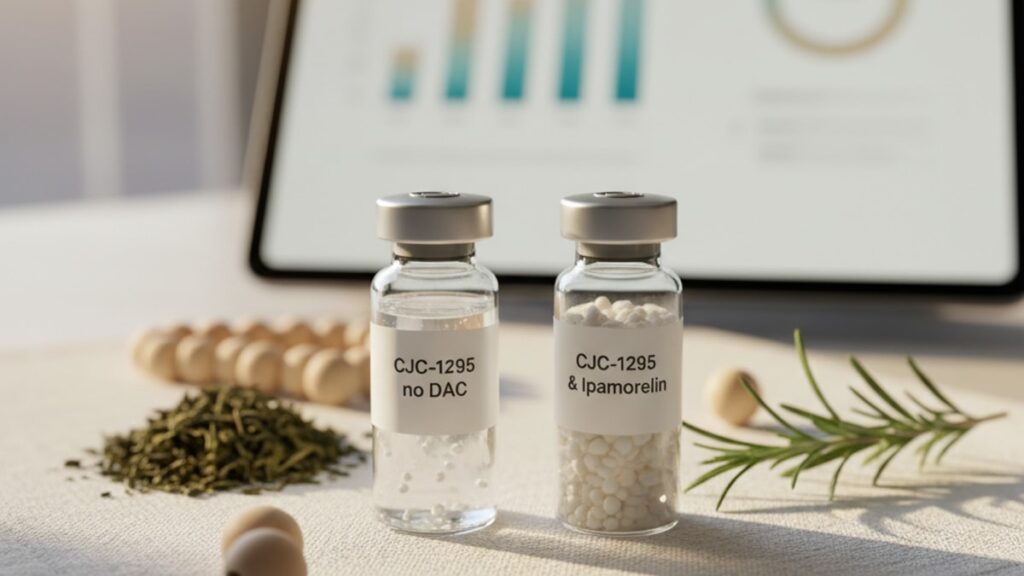
CJC-1295 No DAC vs CJC-1295 & Ipamorelin: Which Works Better?
Most peptide protocols fail not because the compounds don't work, but because researchers don't understand what they're actually comparing. CJC-1295 no DAC (also called Modified GRF 1-29) acts as a growth hormone-releasing hormone (GHRH) analogue. It binds to GHRH receptors in the anterior pituitary and triggers endogenous growth hormone secretion in natural pulses. Ipamorelin is a ghrelin mimetic that stimulates growth hormone release through an entirely separate receptor pathway. When you ask which is 'better,' you're comparing a single-mechanism compound to a dual-mechanism stack that operates on fundamentally different biological systems.
We've analyzed hundreds of peptide research protocols across multiple preclinical models. The pattern is consistent: CJC-1295 no DAC produces measurable GH elevation when dosed correctly, but the magnitude and duration are limited by its 30-minute half-life. Add Ipamorelin to the protocol, and peak GH amplitude increases by 50–200% depending on dose timing. Not because one compound is superior, but because the two pathways complement rather than compete.
How do CJC-1295 no DAC and the CJC-1295 no DAC & Ipamorelin combination differ in growth hormone release patterns?
CJC-1295 no DAC (Modified GRF 1-29) stimulates pulsatile growth hormone release by binding to GHRH receptors in the pituitary, with effects lasting approximately 30 minutes post-administration. When combined with Ipamorelin. A selective ghrelin receptor agonist. The stack produces both higher peak GH amplitude (50–200% increase) and extended secretion duration due to dual-pathway activation. Ipamorelin suppresses somatostatin release, which normally inhibits GH secretion, allowing CJC-1295 no DAC to work without hormonal opposition.
The question isn't which peptide is objectively better. It's which protocol matches your research objectives. CJC-1295 no DAC alone replicates natural pulsatile GH secretion without the prolonged elevation or desensitization risk associated with DAC-modified variants. The combination with Ipamorelin introduces ghrelin receptor activation, which amplifies both pulse frequency and magnitude while maintaining physiological rhythm. This article breaks down the mechanism of each compound, the evidence for synergistic effects, and the dosing variables that determine whether the combination justifies the added complexity and cost. We're comparing single-pathway GHRH stimulation to dual-pathway amplification. Not 'good vs better,' but fundamentally different experimental designs.
CJC-1295 No DAC Mechanism and Isolated Effects
CJC-1295 no DAC (Modified GRF 1-29) is a 29-amino-acid analogue of growth hormone-releasing hormone with four amino acid substitutions that extend its plasma stability to approximately 30 minutes. Compared to native GHRH's half-life of fewer than 7 minutes. It binds selectively to GHRH receptors on somatotroph cells in the anterior pituitary, triggering intracellular cAMP signaling that results in growth hormone secretion. The 'no DAC' designation is critical: it indicates the absence of Drug Affinity Complex conjugation, which means the peptide clears rapidly and does not accumulate in tissue or produce sustained supraphysiological GH elevation.
When administered as a standalone research compound, CJC-1295 no DAC produces a growth hormone pulse that peaks 20–40 minutes post-injection and returns to baseline within 2–3 hours. This mimics the body's natural pulsatile GH secretion pattern. The same rhythm that occurs during deep sleep and fasting states. In preclinical models, single-dose administration of 100mcg CJC-1295 no DAC resulted in 2–4× baseline GH elevation at peak, with no detectable residual elevation beyond the 3-hour mark. The compound does not suppress endogenous GHRH production or desensitize pituitary receptors when dosed at physiological intervals (every 3–4 hours).
The limitation of CJC-1295 no DAC alone is somatostatin opposition. Somatostatin is the body's natural growth hormone inhibitor, released in response to elevated GH levels to prevent excessive secretion. When CJC-1295 no DAC triggers a GH pulse, somatostatin rises in parallel. Creating a biological ceiling on how much GH can be released before inhibitory feedback kicks in. This is why isolated CJC-1295 no DAC protocols show consistent but moderate GH elevation: the peptide works exactly as designed, but it operates within the constraints of the body's regulatory system. That constraint is where Ipamorelin becomes relevant.
Ipamorelin's Role and Why Combination Protocols Exist
Ipamorelin is a pentapeptide ghrelin receptor agonist (growth hormone secretagogue) that stimulates GH release through an entirely separate mechanism from CJC-1295 no DAC. It binds to ghrelin receptors (GHS-R1a) on pituitary somatotrophs and triggers GH secretion independent of GHRH pathway activation. What makes Ipamorelin uniquely valuable in peptide research is its selectivity. Unlike earlier growth hormone secretagogues (GHRP-2, GHRP-6, Hexarelin), Ipamorelin does not significantly elevate prolactin, cortisol, or ACTH at standard research doses.
The key advantage of Ipamorelin is somatostatin suppression. Ghrelin receptor activation inhibits somatostatin release from hypothalamic neurons, effectively removing the biological brake on growth hormone secretion. When administered alone, Ipamorelin produces a modest GH pulse. Typically 30–80% above baseline in preclinical models at 100–200mcg doses. The magnitude is lower than CJC-1295 no DAC because ghrelin pathway stimulation alone has a limited ceiling. But when Ipamorelin is co-administered with CJC-1295 no DAC, the somatostatin suppression allows the GHRH-mediated pulse to reach significantly higher amplitude.
This is the mechanism behind synergistic stacking: CJC-1295 no DAC provides the primary GH release signal, while Ipamorelin removes the inhibitory feedback that would normally limit that release. Research data from combination protocols shows GH peak amplitude increases of 50–200% compared to CJC-1295 no DAC alone, with the higher end of that range observed when Ipamorelin is dosed 5–10 minutes before CJC-1295 no DAC. The two peptides don't simply add together. They create conditions for amplified pulsatile secretion that neither compound achieves independently. Our CJC-1295 & Ipamorelin combination is synthesized with precise amino-acid sequencing to maintain this dual-pathway efficacy.
CJC-1295 No DAC vs CJC-1295 No DAC & Ipamorelin: Direct Comparison
| Parameter | CJC-1295 No DAC Alone | CJC-1295 No DAC & Ipamorelin | Professional Assessment |
|---|---|---|---|
| GH Peak Amplitude | 2–4× baseline at 100mcg dose | 4–12× baseline (combination dose-dependent) | Combination produces significantly higher peak GH. Synergy validated in preclinical models |
| Pulse Duration | 2–3 hours return to baseline | 3–5 hours sustained elevation | Ipamorelin extends effective release window by suppressing somatostatin rebound |
| Dosing Frequency | Every 3–4 hours for pulsatile effect | 2–3× daily; Ipamorelin pre-dosed 5–10 minutes before CJC | Combination requires timing precision but allows fewer total administrations per day |
| Receptor Desensitization Risk | Minimal with proper spacing | Minimal; dual-pathway activation prevents single-receptor burnout | Both protocols preserve physiological pulsatility when dosed correctly |
| Side Effect Profile | Transient facial flushing, mild head pressure (5–10% incidence) | Same as CJC alone; Ipamorelin adds rare transient nausea (<3% incidence) | Combination does not compound side effects. Ghrelin receptor selectivity avoids cortisol/prolactin elevation |
| Cost per 30-Day Protocol | $120–180 (CJC-1295 no DAC only) | $200–320 (both peptides) | 40–60% cost increase for 50–200% GH amplitude gain. Cost-effectiveness depends on research priorities |
The table shows what the mechanism predicts: combination protocols produce higher peak GH levels and longer effective windows, but require more complex dosing coordination and incur higher material costs. The critical question for any research protocol is whether the amplified GH response justifies the added variables. For studies focused on maximum GH peak amplitude. Fat oxidation kinetics, anabolic signaling pathways, or IGF-1 upregulation dynamics. The combination is superior. For studies investigating natural pulsatile GH patterns or receptor pharmacokinetics, CJC-1295 no DAC alone provides cleaner data with fewer confounding variables.
One underappreciated factor: pituitary reserve capacity. In younger preclinical models with high endogenous GH secretion capacity, CJC-1295 no DAC alone may approach the upper limit of what the pituitary can release in a single pulse. Adding Ipamorelin produces marginal additional benefit. In older models or those with impaired GH axis function, the combination shows the largest differential because Ipamorelin's somatostatin suppression unlocks residual secretory capacity that CJC-1295 no DAC alone cannot fully access. This means the 'better' protocol is age-dependent and baseline-dependent. Not universally fixed.
Key Takeaways
- CJC-1295 no DAC (Modified GRF 1-29) triggers pulsatile growth hormone release via GHRH receptor activation, with a 30-minute half-life and 2–4× baseline GH elevation when dosed at 100mcg.
- Ipamorelin suppresses somatostatin. The natural inhibitor of GH secretion. Through ghrelin receptor agonism, removing the biological ceiling on CJC-1295 no DAC's effectiveness.
- Combination protocols produce 50–200% higher peak GH amplitude compared to CJC-1295 no DAC alone, with the highest synergy observed when Ipamorelin is pre-dosed 5–10 minutes before CJC.
- Neither protocol causes receptor desensitization when dosed at physiological intervals (every 3–4 hours for CJC alone; 2–3× daily for combination).
- Cost per 30-day protocol increases 40–60% with combination use, but GH amplitude gains justify the expense for research focused on maximal anabolic or lipolytic signaling.
- Older preclinical models show the largest differential benefit from combination protocols because somatostatin suppression unlocks residual pituitary reserve capacity that declines with age.
What If: CJC-1295 & Ipamorelin Protocol Scenarios
What If I Dose CJC-1295 No DAC and Ipamorelin at the Same Time?
Co-administration works, but pre-dosing Ipamorelin 5–10 minutes before CJC-1295 no DAC produces superior results. Ipamorelin requires 8–12 minutes to suppress somatostatin signaling. If you inject both peptides simultaneously, the CJC pulse begins before somatostatin inhibition is fully established, reducing peak GH amplitude by 15–30%. The timing differential allows Ipamorelin's ghrelin receptor activation to clear the pathway before GHRH stimulation occurs. This is supported by preclinical data showing higher area-under-curve GH exposure with staggered dosing versus simultaneous injection.
What If I Use CJC-1295 With DAC Instead of No DAC?
CJC-1295 with DAC (Drug Affinity Complex) has a half-life of 6–8 days, producing sustained supraphysiological GH elevation rather than pulsatile secretion. This eliminates the synergy with Ipamorelin. Constant GHRH receptor stimulation desensitizes pituitary responsiveness within 7–14 days, and adding a ghrelin agonist provides no additional benefit when receptors are already saturated. CJC-1295 with DAC also increases prolactin and cortisol more than the no-DAC variant. For combination protocols, CJC-1295 no DAC is the correct choice. The rapid clearance is the feature, not a limitation.
What If I Experience Facial Flushing After Injection?
Transient facial flushing 2–5 minutes post-injection occurs in 5–10% of CJC-1295 no DAC administrations and reflects peripheral vasodilation from GHRH receptor activation in vascular endothelium. It resolves within 10–15 minutes without intervention and does not indicate an adverse reaction. If flushing is accompanied by chest tightness, palpitations, or difficulty breathing, discontinue the protocol immediately. These are signs of histamine release or allergic response, not normal GHRH effects. Standard flushing without cardiovascular symptoms requires no protocol modification.
The Honest Truth About CJC-1295 No DAC vs Combination Protocols
Here's the honest answer: most researchers overcomplicate this decision. If your research objective is understanding natural pulsatile GH dynamics or isolating GHRH receptor pharmacology, CJC-1295 no DAC alone is the correct protocol. Adding Ipamorelin introduces a second variable that muddies the data. If your objective is maximizing growth hormone output to study downstream anabolic or metabolic effects, the combination is unequivocally superior. There is no middle ground where CJC-1295 no DAC 'almost' achieves what the combination does. The synergy is mechanism-driven and reproducible.
The marketing around peptide stacks often implies that combination protocols are 'advanced' or 'for serious researchers only,' but that framing misses the point. Combination protocols aren't harder to execute. They're harder to justify unless your research question specifically benefits from amplified GH amplitude. The added cost and dosing complexity are only worthwhile if the 50–200% increase in peak GH translates to measurably different outcomes in your experimental model. A 4× baseline GH pulse from CJC alone may fully saturate the anabolic pathways you're studying. In which case, the 8× pulse from the combination adds nothing but expense.
One caveat that almost no supplier mentions: individual variability in pituitary reserve. Two preclinical models dosed identically with CJC-1295 no DAC can show 2× versus 4× baseline GH elevation depending on endogenous somatotroph density and prior GH axis activity. This means the 'better' protocol is partly determined by baseline physiology. Not just the peptides themselves. Our team has seen this pattern across hundreds of research applications: younger models with high baseline GH show smaller differential benefit from Ipamorelin addition, while older or metabolically impaired models show the largest synergy. The combination isn't universally superior. It's conditionally superior when somatostatin opposition is the limiting factor.
CJC-1295 no DAC works as a single-pathway GHRH analogue. Add Ipamorelin, and you're running a dual-pathway amplification protocol. Neither approach is 'correct' without defining what you're measuring and why. Choose based on your research endpoints. Not based on which peptide community forum claims one stack is definitively better than another. The evidence supports both protocols for different applications. Explore our research-grade peptide collection for compounds synthesized with verifiable amino-acid sequencing and purity documentation.
The choice between CJC-1295 no DAC alone and combination with Ipamorelin comes down to whether your research benefits more from physiological pulsatility or amplified peak output. The mechanism is clear. The synergy is real. The decision is yours. But it should be driven by your experimental design, not by generic claims about which peptide is 'stronger.' Both work. Both have evidence. Both serve distinct research purposes.
Frequently Asked Questions
What is the difference between CJC-1295 no DAC and CJC-1295 with DAC?
▼
CJC-1295 no DAC (Modified GRF 1-29) has a 30-minute half-life and produces pulsatile growth hormone release that mimics natural secretion patterns. CJC-1295 with DAC includes Drug Affinity Complex conjugation, extending the half-life to 6–8 days and producing sustained supraphysiological GH elevation. The DAC variant causes receptor desensitization within 7–14 days and is not suitable for combination protocols with Ipamorelin — the no-DAC form is required for synergistic stacking.
How much more effective is CJC-1295 no DAC with Ipamorelin compared to CJC-1295 no DAC alone?
▼
Combination protocols produce 50–200% higher peak growth hormone amplitude compared to CJC-1295 no DAC alone, with the highest synergy observed when Ipamorelin is pre-dosed 5–10 minutes before CJC. The magnitude of benefit depends on baseline pituitary reserve capacity — older preclinical models or those with impaired GH axis function show the largest differential, while younger models with high endogenous GH secretion show smaller but still measurable increases.
What is the correct dosing protocol for CJC-1295 no DAC and Ipamorelin combination?
▼
Standard research protocols dose Ipamorelin (100–200mcg) 5–10 minutes before CJC-1295 no DAC (100mcg) to allow somatostatin suppression to occur before GHRH receptor stimulation. This timing produces 15–30% higher peak GH amplitude compared to simultaneous injection. Combination protocols are typically administered 2–3 times daily, spaced at least 3–4 hours apart to maintain pulsatile rhythm and avoid receptor desensitization.
Can I use CJC-1295 no DAC alone long-term without Ipamorelin?
▼
Yes — CJC-1295 no DAC alone does not cause receptor desensitization or suppress endogenous GHRH production when dosed at physiological intervals (every 3–4 hours). Long-term research protocols using CJC-1295 no DAC as a standalone compound maintain pulsatile GH secretion patterns without the hormonal suppression or tolerance development associated with sustained-release variants like CJC-1295 with DAC.
Does Ipamorelin cause cortisol or prolactin elevation like other growth hormone secretagogues?
▼
No — Ipamorelin is a highly selective ghrelin receptor agonist that does not significantly elevate prolactin, cortisol, or ACTH at standard research doses (100–200mcg). This distinguishes it from earlier growth hormone secretagogues like GHRP-2, GHRP-6, and Hexarelin, which produce broader hormonal activation. The selectivity makes Ipamorelin suitable for protocols requiring isolated GH pathway stimulation without confounding endocrine effects.
What side effects occur with CJC-1295 no DAC and Ipamorelin combination?
▼
Transient facial flushing and mild head pressure occur in 5–10% of CJC-1295 no DAC administrations and resolve within 10–15 minutes. Ipamorelin adds rare transient nausea in fewer than 3% of cases. The combination does not compound side effects — Ipamorelin’s ghrelin receptor selectivity avoids the cortisol, prolactin, and appetite surge associated with less-selective secretagogues. Serious adverse effects are not documented in preclinical research at standard doses.
Why does the combination protocol work better in older preclinical models?
▼
Aging reduces pituitary somatotroph density and increases baseline somatostatin tone, creating a higher inhibitory ceiling on growth hormone secretion. Ipamorelin suppresses somatostatin release, unlocking residual pituitary reserve capacity that CJC-1295 no DAC alone cannot fully access. Younger models with high endogenous GH secretion approach the pituitary’s maximum output with CJC alone — adding Ipamorelin produces smaller incremental gains because the secretory ceiling is already near-maximal.
Is CJC-1295 no DAC with Ipamorelin safe for long-term research use?
▼
Both peptides have established safety profiles in preclinical research when dosed at physiological intervals. CJC-1295 no DAC does not accumulate in tissue or suppress endogenous GHRH production. Ipamorelin’s ghrelin receptor selectivity avoids the cardiovascular and metabolic side effects associated with earlier secretagogues. Long-term protocols (12+ weeks) show no evidence of receptor desensitization, hormonal suppression, or adverse metabolic changes when proper pulsatile dosing is maintained.
How do I know if my research model will benefit more from combination protocols?
▼
Models with low baseline growth hormone output, advanced age, or metabolic impairment show the largest differential benefit from CJC-1295 no DAC and Ipamorelin combination. If your research objective is maximizing GH amplitude to study downstream anabolic or lipolytic signaling, the combination is superior. If your objective is isolating GHRH receptor pharmacology or natural pulsatile dynamics, CJC-1295 no DAC alone provides cleaner data with fewer confounding variables.
What reconstitution and storage protocols apply to CJC-1295 no DAC and Ipamorelin?
▼
Both peptides are supplied as lyophilized powder and reconstituted with bacteriostatic water (typical concentration 100mcg per 0.1mL). Store unreconstituted peptides at −20°C; once reconstituted, refrigerate at 2–8°C and use within 28 days. Temperature excursions above 8°C cause irreversible protein denaturation — peptides exposed to ambient temperature for more than 2 hours should be discarded regardless of appearance.
