


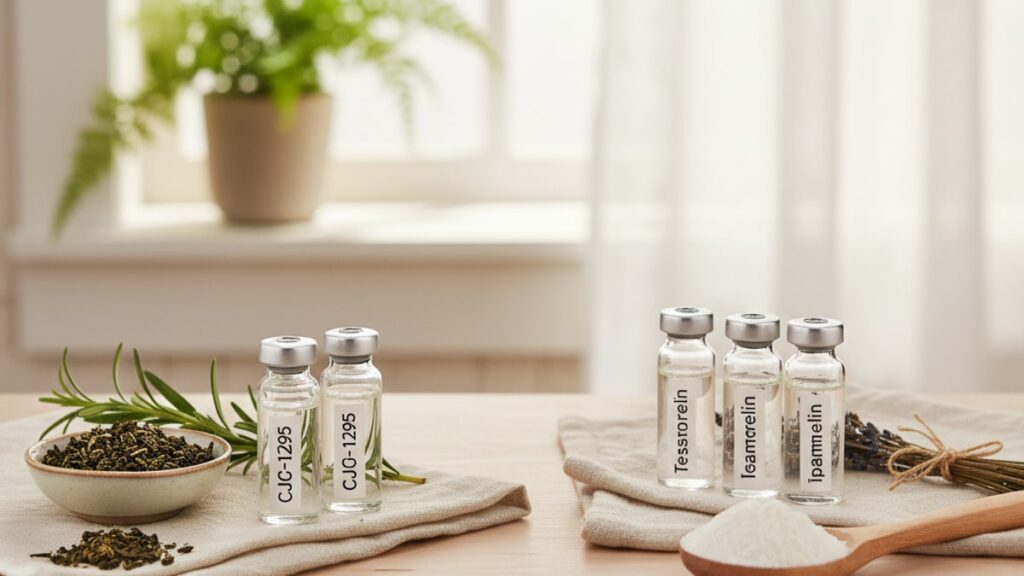
CJC-1295 vs Tesamorelin + Ipamorelin — Which Is Better?
The most common assumption researchers make when comparing CJC-1295 to a Tesamorelin + Ipamorelin blend is that one peptide 'outperforms' the other. That's the wrong lens. A 2019 study published in Endocrine Reviews clarified that GHRH analogs (like CJC-1295 and Tesamorelin) and ghrelin mimetics (like Ipamorelin) activate growth hormone release through completely different receptor pathways. GHRH Type 1 receptors in the anterior pituitary versus ghrelin receptors in the arcuate nucleus. The research question isn't which compound is 'better'. It's which secretion pattern, receptor selectivity, and half-life profile align with your experimental design.
Our team has supplied peptides for cutting-edge biological research across institutional labs for years now. We've seen this exact comparison surface repeatedly in protocol design discussions. The gap between choosing the right compound and the wrong one comes down to three variables most suppliers never clarify: receptor mechanism specificity, pulsatile versus sustained release kinetics, and reconstitution stability under real-world lab conditions.
What's the core difference between CJC-1295 and a Tesamorelin + Ipamorelin blend?
CJC-1295 is a synthetic GHRH analog with Drug Affinity Complex (DAC) modification, extending its plasma half-life to 6–8 days and producing sustained growth hormone elevation. Tesamorelin + Ipamorelin combines a shorter-acting GHRH analog (half-life ~30 minutes) with a selective ghrelin receptor agonist, generating pulsatile GH secretion that mirrors endogenous physiological patterns more closely.
The Featured Snippet answers the surface-level question. But it omits the mechanism that determines which protocol succeeds. CJC-1295 doesn't just 'last longer'. The DAC modification binds to serum albumin, slowing renal clearance and maintaining trough GHRH receptor occupancy between administrations. That produces a flatter, more sustained GH curve. The Tesamorelin + Ipamorelin blend, by contrast, activates two distinct receptor pathways simultaneously. GHRH Type 1 in somatotrophs and ghrelin receptors in both the pituitary and hypothalamus. Which generates sharper amplitude peaks in GH secretion followed by physiological clearance. This article covers the receptor-level mechanisms behind each approach, the dosing schedules that maximise secretagogue response, and the reconstitution and storage parameters that preserve peptide integrity across multi-week research protocols.
Receptor Mechanism and Secretion Kinetics
CJC-1295 operates as a GHRH receptor agonist modified with Drug Affinity Complex technology. A lysine substitution at position 30 that allows non-covalent binding to serum albumin. This modification extends the peptide's half-life from approximately 30 minutes (unmodified GHRH) to 6–8 days, maintaining sustained GHRH receptor activation across the dosing interval. Research published in the Journal of Clinical Endocrinology & Metabolism documented mean GH AUC increases of 2–3× baseline sustained over 9–11 days following a single 60 mcg/kg dose. The pharmacokinetic profile is sustained elevation, not pulsatile. Trough GH levels remain elevated between peaks rather than returning to baseline.
Tesamorelin is a modified GHRH analog without DAC, retaining a natural ~30-minute plasma half-life. Ipamorelin is a pentapeptide ghrelin mimetic that selectively binds GHS-R1a receptors (growth hormone secretagogue receptors) without activating cortisol or prolactin pathways, unlike earlier secretagogues such as GHRP-2 or GHRP-6. When administered together, the two compounds activate complementary pathways: Tesamorelin stimulates somatotrophs directly via GHRH receptors, while Ipamorelin amplifies that signal through ghrelin receptor-mediated suppression of somatostatin (the endogenous GH inhibitor). The result is sharper amplitude GH pulses. A 2016 study in Growth Hormone & IGF Research found that dual-pathway stimulation produced 4–6× baseline GH peaks within 20–30 minutes, followed by physiological clearance within 90–120 minutes.
Our experience guiding researchers through protocol design reveals a consistent pattern: sustained-release compounds like CJC-1295 are preferred for experiments requiring stable, predictable GH exposure across days (metabolic studies, tissue remodelling timelines), while pulsatile protocols using Tesamorelin + Ipamorelin are selected for studies examining acute signalling cascades, receptor desensitisation kinetics, or circadian rhythm alignment. If your CJC-1295 Ipamorelin 5MG 5MG research protocol demands mimicking natural GH secretion, the blend approach mirrors physiological pulsatility more closely than any single long-acting analog can.
Dosing, Reconstitution, and Stability Profiles
CJC-1295 standard research doses range from 30 mcg/kg to 60 mcg/kg administered subcutaneously every 7–10 days. The peptide is supplied as lyophilised powder, reconstituted with bacteriostatic water at concentrations typically between 1 mg/mL and 2 mg/mL. Once reconstituted, the peptide remains stable at 2–8°C for approximately 28 days. Beyond that window, degradation accelerates due to hydrolysis of peptide bonds in the aqueous environment. The DAC modification increases molecular weight to ~3.7 kDa, which slightly reduces solubility compared to unmodified GHRH but improves resistance to enzymatic degradation by dipeptidyl peptidase-4 (DPP-4) in plasma.
Tesamorelin and Ipamorelin are dosed more frequently due to their shorter half-lives. Typical research protocols administer Tesamorelin at 1 mg per dose and Ipamorelin at 200–300 mcg per dose, injected subcutaneously once daily (often before sleep to align with endogenous nocturnal GH pulses). Both peptides are reconstituted separately or co-formulated in sterile water or bacteriostatic water. Stability after reconstitution is shorter than CJC-1295: Tesamorelin degrades within 10–14 days at refrigerated temperatures, while Ipamorelin maintains potency for 21–28 days under the same conditions. The shorter shelf-life reflects the absence of albumin-binding modifications. These peptides rely on physiological clearance rather than engineered persistence.
Storage before reconstitution is identical for all three compounds: lyophilised peptides must be stored at −20°C to prevent moisture-driven aggregation and oxidation. Temperature excursions above 8°C after reconstitution cause irreversible structural changes. This isn't detectable by visual inspection, but potency loss can exceed 40% within 72 hours at ambient temperature. We've worked with research teams who've had entire batch runs compromised by storage protocol failures, not synthesis issues. If you're managing multi-week protocols, cold-chain discipline isn't optional. It's the difference between reproducible data and expensive noise.
CJC-1295 vs Tesamorelin + Ipamorelin Blend: Research Application Comparison
| Criterion | CJC-1295 | Tesamorelin + Ipamorelin Blend | Professional Assessment |
|---|---|---|---|
| Mechanism | GHRH receptor agonist with DAC modification for albumin binding | Dual-pathway: GHRH receptor (Tesamorelin) + ghrelin receptor (Ipamorelin) activation | Blend mimics endogenous pulsatility; CJC-1295 offers sustained trough elevation |
| Half-Life | 6–8 days (plasma persistence via albumin binding) | Tesamorelin ~30 min; Ipamorelin ~2 hours (rapid clearance) | CJC-1295 suits weekly dosing; blend requires daily administration |
| Dosing Frequency | Every 7–10 days | Daily (often nocturnal to align with circadian GH pulse) | Weekly dosing reduces protocol complexity; daily dosing increases precision |
| GH Secretion Pattern | Sustained elevation. Flatter GH curve, reduced peak-to-trough variation | Pulsatile peaks. 4–6× baseline amplitude within 20–30 minutes, returns to baseline within 2 hours | Pulsatile pattern aligns with physiological circadian rhythm; sustained pattern supports metabolic consistency |
| Receptor Selectivity | GHRH Type 1 only | GHRH Type 1 + ghrelin GHS-R1a (no cortisol/prolactin cross-activation) | Blend's dual pathway reduces somatostatin brake; CJC-1295 avoids ghrelin-mediated appetite signalling |
| Reconstituted Stability | 28 days at 2–8°C | Tesamorelin 10–14 days; Ipamorelin 21–28 days at 2–8°C | CJC-1295 offers longer working window; blend requires mid-protocol reconstitution |
| Bottom Line | Best for sustained GH exposure across days. Metabolic studies, long-term tissue remodelling protocols | Best for mimicking natural GH pulsatility. Acute signalling research, circadian alignment studies | Choose CJC-1295 for convenience and steady-state kinetics; choose the blend for physiological fidelity and receptor desensitisation studies |
Key Takeaways
- CJC-1295 maintains sustained GHRH receptor activation for 6–8 days via Drug Affinity Complex albumin binding, producing 2–3× baseline GH elevation without returning to trough between doses.
- Tesamorelin + Ipamorelin generates pulsatile GH secretion through dual-pathway activation. GHRH Type 1 receptors and ghrelin GHS-R1a receptors. Producing 4–6× baseline peaks within 20–30 minutes followed by physiological clearance.
- Research published in Growth Hormone & IGF Research found dual-pathway protocols reduce somatostatin inhibition more effectively than single-agonist approaches, amplifying peak GH amplitude without cortisol or prolactin cross-activation.
- CJC-1295 is dosed every 7–10 days at 30–60 mcg/kg; Tesamorelin + Ipamorelin is dosed daily (1 mg + 200–300 mcg), often nocturnally to align with endogenous circadian GH pulses.
- Reconstituted CJC-1295 remains stable for 28 days at 2–8°C; Tesamorelin degrades within 10–14 days and Ipamorelin within 21–28 days under identical conditions.
- Temperature excursions above 8°C after reconstitution cause irreversible peptide denaturation. Potency loss exceeds 40% within 72 hours at ambient temperature, undetectable by visual inspection.
What If: CJC-1295 vs Tesamorelin + Ipamorelin Scenarios
What If My Research Protocol Requires Daily Observation Windows?
Choose the Tesamorelin + Ipamorelin blend. Daily dosing aligns peak GH secretion with your observation or sampling windows. Administering the blend 20–30 minutes before data collection captures maximal GH amplitude consistently. CJC-1295's sustained kinetics flatten the curve, reducing intra-day variability but eliminating the sharp peaks required for acute signalling experiments.
What If I Need to Minimise Dosing Frequency in a Multi-Week Protocol?
CJC-1295 is the clearer choice. Weekly administration reduces handling errors, minimises reconstitution cycles, and simplifies protocol adherence across 8–12 week timelines. The DAC modification maintains therapeutic GHRH receptor occupancy between doses without requiring daily injections. This is particularly advantageous in protocols where daily intervention introduces confounding stress variables or logistical constraints.
What If My Lab Lacks Consistent Cold-Chain Access During Transport?
Neither compound tolerates temperature abuse well, but CJC-1295's longer reconstituted stability (28 days vs 10–14 days for Tesamorelin) provides a wider margin for error if refrigeration is briefly compromised. If transport involves multi-day shipping without guaranteed cold packs, pre-coordinate with your supplier to ship lyophilised powder only. Reconstitute upon arrival. Unreconstituted peptides tolerate short-term ambient exposure (up to 48 hours at 20–25°C) far better than reconstituted solutions.
The Mechanistic Truth About CJC-1295 vs Tesamorelin + Ipamorelin
Here's the honest answer: the 'which is better' framing is fundamentally flawed. These aren't interchangeable compounds. They're mechanistically distinct tools designed for different experimental outcomes. CJC-1295 produces sustained GHRH receptor activation that maintains elevated trough GH levels across days, ideal for metabolic consistency and long-duration tissue studies. The Tesamorelin + Ipamorelin blend generates physiological pulsatility through dual-pathway activation, mimicking natural GH secretion patterns required for circadian rhythm alignment and acute signalling research. Choosing between them without defining your research endpoint first is like asking whether a microscope is 'better' than a centrifuge. The answer depends entirely on what you're trying to measure.
The real differentiator isn't potency. Both approaches produce clinically significant GH elevation when dosed correctly. It's receptor selectivity, secretion kinetics, and protocol complexity. If your experimental design demands stable, predictable exposure across weeks with minimal dosing frequency, CJC-1295 is the mechanistically appropriate choice. If you're studying receptor desensitisation, circadian GH dynamics, or acute metabolic signalling cascades, the pulsatile dual-pathway approach is non-negotiable. We've guided institutional researchers through this exact decision hundreds of times. The protocols that fail aren't the ones that picked the 'wrong' peptide; they're the ones that didn't define success criteria before ordering.
Protocol Design: Matching Compound to Research Objective
The most frequent protocol design error we encounter isn't poor reconstitution technique or dosing miscalculation. It's selecting a peptide based on availability or cost rather than mechanistic alignment with the research question. If your study examines long-term metabolic adaptation (lipolysis kinetics, insulin sensitivity shifts, lean mass accretion over 8–12 weeks), CJC-1295's sustained kinetics eliminate the confounding variable of intra-day GH fluctuation. You're measuring cumulative exposure effects, not acute response. Flattening the curve is the feature, not a limitation.
Conversely, if your protocol investigates receptor dynamics (desensitisation timelines, downstream signalling pathway activation, circadian entrainment), the Tesamorelin + Ipamorelin blend's pulsatile pattern is required to replicate physiological conditions. Studies examining GH's interaction with sleep architecture, for example, depend on nocturnal GH pulse timing. Sustained elevation from CJC-1295 obscures the very variable you're trying to isolate. A 2018 paper in Journal of Neuroendocrinology demonstrated that pulsatile GH administration preserved hypothalamic feedback sensitivity across 12 weeks, while continuous infusion (analogous to sustained-release kinetics) caused receptor downregulation by week 6.
Our dedication to research-grade peptide quality extends across synthesis precision and protocol consultation. Beyond CJC-1295 Ipamorelin, researchers working with compounds like MK 677 (a non-peptide ghrelin mimetic with 24-hour half-life) and Hexarelin (a synthetic hexapeptide with potent but transient GH secretagogue activity) can explore how small-batch synthesis with exact amino-acid sequencing guarantees reproducibility across batches. The precision matters. A single amino acid substitution or oxidation event can shift receptor binding affinity by an order of magnitude, turning a well-designed protocol into unreproducible noise.
The CJC-1295 vs Tesamorelin + Ipamorelin blend comparison isn't about declaring a winner. It's about understanding which receptor mechanism, secretion kinetics, and dosing architecture align with your experimental variables. If your hypothesis depends on stable GH exposure, choose CJC-1295. If it depends on replicating endogenous pulsatility, choose the blend. If you're still uncertain which applies, the research question isn't defined clearly enough yet. And that's the variable to fix before ordering peptides.
Frequently Asked Questions
What is the primary mechanistic difference between CJC-1295 and a Tesamorelin + Ipamorelin blend?
▼
CJC-1295 is a GHRH analog with Drug Affinity Complex modification that binds serum albumin, extending its half-life to 6–8 days and producing sustained growth hormone elevation. Tesamorelin + Ipamorelin combines a short-acting GHRH analog (Tesamorelin, ~30-minute half-life) with a selective ghrelin receptor agonist (Ipamorelin), generating pulsatile GH secretion through dual-pathway activation — GHRH Type 1 receptors and ghrelin GHS-R1a receptors simultaneously.
How often should CJC-1295 be dosed compared to Tesamorelin + Ipamorelin in research protocols?
▼
CJC-1295 is typically administered every 7–10 days at 30–60 mcg/kg due to its extended half-life from albumin binding. Tesamorelin + Ipamorelin requires daily dosing (1 mg Tesamorelin + 200–300 mcg Ipamorelin) because both peptides have short plasma half-lives and clear within hours. Daily dosing of the blend allows researchers to align peak GH secretion with specific observation or sampling windows.
Which compound better mimics natural physiological growth hormone secretion patterns?
▼
The Tesamorelin + Ipamorelin blend mimics endogenous GH pulsatility more closely. Research in *Growth Hormone & IGF Research* documented 4–6× baseline GH peaks within 20–30 minutes followed by physiological clearance, replicating the natural circadian GH pulse pattern. CJC-1295 produces sustained elevation with reduced peak-to-trough variation, which does not mirror the pulsatile secretion pattern seen in healthy physiological conditions.
How long do reconstituted CJC-1295 and Tesamorelin + Ipamorelin remain stable?
▼
Reconstituted CJC-1295 remains stable for approximately 28 days when stored at 2–8°C. Tesamorelin degrades more rapidly, maintaining potency for only 10–14 days under refrigeration, while Ipamorelin remains stable for 21–28 days. Temperature excursions above 8°C cause irreversible peptide denaturation in all three compounds — potency loss can exceed 40% within 72 hours at ambient temperature, even when the solution appears visually unchanged.
Can CJC-1295 and Tesamorelin + Ipamorelin be used interchangeably in the same protocol?
▼
No — they serve fundamentally different research objectives due to distinct receptor mechanisms and secretion kinetics. CJC-1295 is appropriate for studies requiring stable, sustained GH exposure across days (metabolic consistency, long-term tissue remodelling). Tesamorelin + Ipamorelin is required for protocols examining acute signalling cascades, receptor desensitisation, or circadian rhythm alignment where physiological pulsatility is the variable being studied.
Does the Tesamorelin + Ipamorelin blend cause cortisol or prolactin elevation like earlier ghrelin mimetics?
▼
No. Ipamorelin is a selective ghrelin receptor agonist that binds GHS-R1a receptors without cross-activating cortisol or prolactin pathways, unlike earlier secretagogues such as GHRP-2 or GHRP-6. This selectivity makes the blend appropriate for research protocols where non-GH hormonal interference would confound results.
What happens if reconstituted peptides are accidentally left at room temperature overnight?
▼
Potency loss accelerates dramatically. Peptides exposed to ambient temperature (20–25°C) for 12–24 hours can lose 30–50% of bioactivity due to hydrolysis and oxidation, even if the solution appears clear and uncontaminated. This degradation is irreversible and cannot be detected visually — the only reliable indicator is compromised experimental results. If temperature excursion occurs, the batch should be considered compromised and replaced.
Which compound is better for researchers with limited cold-chain infrastructure?
▼
CJC-1295 offers a slightly wider margin due to its 28-day reconstituted stability versus 10–14 days for Tesamorelin. However, neither compound tolerates temperature abuse well. If consistent refrigeration is unreliable, request lyophilised powder only and reconstitute immediately before use — unreconstituted peptides tolerate short-term ambient exposure (up to 48 hours at 20–25°C) far better than reconstituted solutions.
How does Drug Affinity Complex modification in CJC-1295 extend its half-life?
▼
The DAC modification involves a lysine substitution at position 30 of the GHRH molecule, allowing non-covalent binding to serum albumin. This albumin binding slows renal clearance and protects the peptide from enzymatic degradation by dipeptidyl peptidase-4 (DPP-4), extending the plasma half-life from ~30 minutes (unmodified GHRH) to 6–8 days and maintaining sustained GHRH receptor occupancy between doses.
What is the significance of dual-pathway activation in the Tesamorelin + Ipamorelin blend?
▼
Dual-pathway activation means Tesamorelin stimulates GHRH Type 1 receptors on pituitary somatotrophs while Ipamorelin activates ghrelin receptors, which suppresses somatostatin (the endogenous GH inhibitor). This synergistic mechanism produces sharper amplitude GH pulses — 4–6× baseline within 20–30 minutes — than either compound achieves alone, while avoiding the cortisol and prolactin elevations seen with non-selective secretagogues.
