


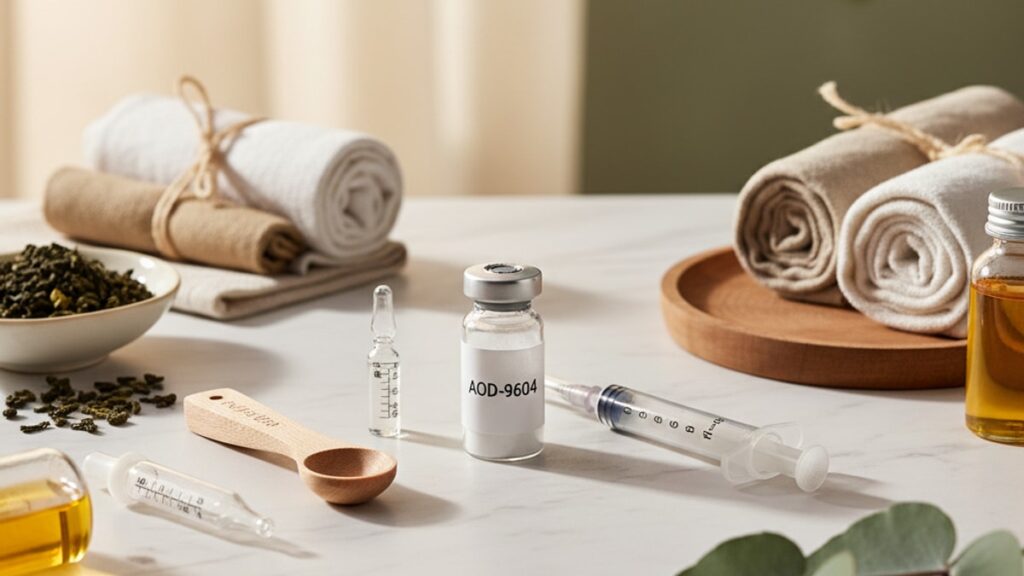
How Many Doses in AOD-9604 Vial? (Reconstitution Guide)
A single 5mg vial of AOD-9604 reconstituted with 2mL bacteriostatic water produces 10 doses at 500mcg per 0.2mL injection—but adjust the water volume to 5mL and you've just created 25 doses at 200mcg per 0.2mL. The dose count isn't fixed by the vial itself—it's determined entirely by reconstitution volume and target concentration per administration. Most protocols reference 200–500mcg per dose as the research-standard range, meaning a 5mg vial can serve anywhere from 10 applications at high concentration to 25 at lower concentration.
Our team works directly with research facilities managing peptide inventory across multi-week protocols. The most common error isn't contamination during reconstitution—it's miscalculating how many doses vial AOD-9604 provides based on dilution ratios, which either leads to premature stock depletion mid-study or excessive waste from expired reconstituted solution sitting unused past the 28-day bacteriostatic window.
How many doses does a 5mg AOD-9604 vial provide?
A 5mg lyophilised AOD-9604 vial reconstituted with 2–5mL bacteriostatic water yields 10–25 doses depending on target concentration. At 500mcg per dose (high research standard), 2mL reconstitution produces 10 doses. At 200mcg per dose (lower standard), 5mL reconstitution produces 25 doses. Dose count scales inversely with concentration—more water creates more doses at lower strength per injection.
The calculation isn't a fixed formula—it's a direct function of how much bacteriostatic water you add and what concentration per milliliter you're targeting. Researchers often assume vial size dictates dose count, but that's backwards. The vial contains a fixed peptide mass (5mg), and you control how that mass is distributed across injection volume. This article covers the reconstitution math that determines many doses vial AOD-9604 provides, the bacteriostatic water ratios that matter, and the storage constraints that set the realistic upper limit on dose count regardless of dilution.
Reconstitution Volume Determines Dose Count—Not Vial Size
Lyophilised AOD-9604 arrives as a powder measured by peptide mass (typically 5mg per vial), not by liquid volume. The moment you add bacteriostatic water, you're creating a concentration expressed in micrograms per milliliter (mcg/mL)—and that concentration dictates how many discrete doses the vial can deliver. The formula is fixed: total peptide mass ÷ target dose = number of doses.
If you reconstitute 5mg (5000mcg) with 2mL bacteriostatic water, you've created a 2500mcg/mL solution. A 500mcg dose requires 0.2mL per injection—meaning 2mL total volume yields 10 doses. Increase the water to 5mL and concentration drops to 1000mcg/mL. Now a 500mcg dose requires 0.5mL per injection. But if you target 200mcg per dose instead, 5mL reconstitution delivers 25 doses at 0.2mL each.
The constraint isn't the peptide—it's the injection volume your administration method allows. Insulin syringes typically max out at 0.5–1.0mL. If your protocol requires 0.2mL injections for procedural consistency, higher water volumes (4–5mL) let you stretch dose count at lower concentrations. Research facilities running multi-subject protocols calculate backward from daily dose requirements.
Standard Dose Ranges and Corresponding Reconstitution Ratios
Research protocols for AOD-9604 typically reference 200–500mcg per administration as the target dose range. This reflects concentrations used in published studies examining the peptide's lipolytic mechanism via selective beta-3 adrenergic receptor activation.
For 500mcg per dose (high end), reconstitute 5mg with 2mL bacteriostatic water to create 2500mcg/mL. Each 0.2mL injection delivers 500mcg—10 doses total. For 300mcg per dose (mid-range), reconstitute with 3.3mL to create 1515mcg/mL. Each 0.2mL injection delivers 303mcg—16 doses total. For 200mcg per dose (low end), reconstitute with 5mL to create 1000mcg/mL. Each 0.2mL injection delivers 200mcg—25 doses total.
The math scales predictably. Want 250mcg per dose? Reconstitute with 4mL (1250mcg/mL), inject 0.2mL per dose—20 doses total. Want 400mcg per dose? Reconstitute with 2.5mL (2000mcg/mL), inject 0.2mL per dose—12 doses.
Research facilities ordering from Real Peptides often request pre-calculated reconstitution guides for multi-vial studies. A 12-week protocol requiring daily 300mcg doses needs roughly 25 vials at 2.5mL reconstitution each. Dose count per vial directly determines inventory requirements—miscalculate and you're reordering mid-study or discarding expired solution.
28-Day Bacteriostatic Window Limits Maximum Usable Doses
Reconstituted peptides stored at 2–8°C with bacteriostatic water remain stable for 28 days maximum—after that window, bacterial growth risk and peptide degradation both increase regardless of remaining solution volume. This sets a hard ceiling on how many doses vial AOD-9604 can realistically provide.
If you reconstitute 5mg with 5mL bacteriostatic water to create 25 theoretical doses at 200mcg each, but your protocol administers doses only twice weekly, you'll use 8 doses across 28 days—the remaining 17 doses expire unused. Daily administration uses all 25 doses within 25 days. Dose count and administration schedule must align with the 28-day window or you're wasting peptide.
Lyophilised (unreconstituted) AOD-9604 stored at −20°C remains stable for 12–24 months. Reconstitution starts the clock. Researchers managing long-duration studies reconstitute one vial at a time rather than preparing multiple vials upfront.
Bacteriostatic water contains 0.9% benzyl alcohol as a preservative, which inhibits bacterial contamination during the multi-dose window but does not prevent peptide oxidation. AOD-9604's mechanism depends on intact amino-acid sequencing—temperature excursions above 8°C or extended storage beyond 28 days compromise that structure. The 28-day rule isn't conservative—it's the evidence-based stability threshold.
How Many Doses in AOD-9604 Vial: Concentration Comparison
| Reconstitution Volume | Final Concentration | Dose per 0.2mL Injection | Total Doses per 5mg Vial | Administration Frequency for 28-Day Use | Professional Assessment |
|---|---|---|---|---|---|
| 2mL bacteriostatic water | 2500mcg/mL | 500mcg | 10 doses | Daily or every-other-day | High-concentration standard—ideal for short protocols requiring maximal peptide delivery per injection; exhausts vial quickly but simplifies dosing math |
| 2.5mL bacteriostatic water | 2000mcg/mL | 400mcg | 12 doses | Thrice weekly | Mid-high range—balances dose strength with moderate vial longevity; fits well with alternate-day protocols |
| 3.3mL bacteriostatic water | 1515mcg/mL | 303mcg | 16 doses | Twice weekly minimum | Mid-range versatility—sufficient peptide per dose without excessive injection volume; realistic for bi-weekly administration within storage window |
| 4mL bacteriostatic water | 1250mcg/mL | 250mcg | 20 doses | Daily or 5x weekly | Lower mid-range—extends vial usage while maintaining clinically relevant dose strength; requires disciplined daily administration to avoid expiration waste |
| 5mL bacteriostatic water | 1000mcg/mL | 200mcg | 25 doses | Daily minimum | Maximum dilution standard—stretches vial furthest but only practical for daily protocols; any less frequent and doses expire unused past 28 days |
Key Takeaways
- A 5mg AOD-9604 vial reconstituted with 2mL bacteriostatic water yields 10 doses at 500mcg per 0.2mL injection; reconstituted with 5mL yields 25 doses at 200mcg per 0.2mL injection.
- Dose count scales inversely with concentration—more water creates more doses at lower peptide strength per administration, not a larger total peptide mass.
- Reconstituted AOD-9604 stored at 2–8°C remains stable for 28 days maximum; administration frequency must align with this window or doses expire unused regardless of dilution ratio.
- Research-standard dose ranges (200–500mcg per administration) correspond to reconstitution volumes of 5mL (low) to 2mL (high), with injection volumes held constant at 0.2–0.5mL per protocol.
- Lyophilised AOD-9604 stored at −20°C before reconstitution remains stable for 12–24 months; reconstitution starts the 28-day stability countdown immediately.
- Injection volume tolerance (0.1–0.5mL per administration) determines practical reconstitution volume—larger syringes allow higher water volumes and lower concentrations per dose.
What If: AOD-9604 Dosing Scenarios
What If I Reconstitute with 10mL Instead of 5mL—Does That Double My Dose Count?
Yes mathematically, but no practically. Reconstituting 5mg AOD-9604 with 10mL bacteriostatic water creates a 500mcg/mL solution where each 0.2mL injection delivers 100mcg—yielding 50 theoretical doses per vial. The constraint is injection volume: to deliver 200mcg per dose, you'd need 0.4mL per injection; to deliver 500mcg, you'd need 1.0mL per injection. Most insulin syringes max out at 1.0mL total capacity. Beyond volume, the 28-day bacteriostatic window means 50 doses requires daily administration for 50 days—which exceeds the stability period by 22 days.
What If I Miss the 28-Day Window by a Few Days—Is the Solution Still Usable?
Do not use reconstituted AOD-9604 beyond 28 days even if refrigerated continuously. Bacteriostatic water inhibits microbial growth but does not prevent peptide oxidation or amino-acid degradation—both accelerate after four weeks at 2–8°C. AOD-9604's lipolytic activity depends on intact C-terminal sequencing; oxidative damage renders the peptide inactive without visible indicators. Published stability data shows measurable potency loss beginning at 21–28 days depending on storage consistency. Discard and reconstitute fresh peptide rather than risk administering degraded compound.
What If My Protocol Requires 600mcg per Dose—How Do I Reconstitute for That?
Reconstitute 5mg AOD-9604 with approximately 1.67mL bacteriostatic water to create a 3000mcg/mL solution where each 0.2mL injection delivers 600mcg—yielding 8 doses per vial. If 0.2mL injection volume is too constrained, reconstitute with 2.5mL instead (2000mcg/mL) and inject 0.3mL per dose—still 8 doses total. For any target dose, divide 5000mcg (total peptide) by desired mcg per dose to find total dose count, then divide 5000mcg by that dose count to determine reconstitution volume.
The Unflinching Truth About AOD-9604 Dose Calculation
Here's the honest answer: most peptide suppliers list vial size by peptide mass (5mg, 10mg) without explaining that the buyer controls dose count entirely through reconstitution volume—and that creates consistent miscalculation. Researchers assume a 5mg vial equals 10 standard doses because 500mcg sounds like a tenth of 5mg. It is—but only if you reconstitute to 2500mcg/mL concentration and inject 0.2mL per dose. Change either variable and dose count changes immediately.
The peptide industry doesn't standardise reconstitution protocols because research applications vary too widely. A metabolism study may require 200mcg daily for 12 weeks. A short-term receptor binding assay may require 500mcg twice weekly for 4 weeks. Telling every researcher to reconstitute the same way would waste peptide for some and create supply shortages for others. The trade-off is calculation responsibility shifts entirely to the end user—and most users aren't trained in reconstitution math.
We've seen research labs order 20 vials for a study that needed 30 because they assumed each vial provided 10 doses at their target concentration when it actually provided 7. Conversely, we've seen labs discard half-full vials at day 29 because they over-diluted and couldn't use all doses within the storage window. Both errors stem from the same gap: dose count isn't intrinsic to the vial—it's a function of your reconstitution decision and your administration schedule. Calculate backward from protocol requirements before opening the vial.
Injection Volume Tolerance and Syringe Capacity Constraints
Research-grade administration of AOD-9604 typically uses insulin syringes (0.3–1.0mL capacity) or tuberculin syringes (1.0mL capacity) with 27–30 gauge needles for subcutaneous injection. The syringe's maximum volume sets a practical ceiling on injection size per dose—and that ceiling determines which reconstitution volumes are realistic.
If your syringe holds 0.3mL maximum, you cannot inject 0.5mL per dose regardless of how you've reconstituted the peptide. That constraint forces higher-concentration solutions: to deliver 500mcg per dose with a 0.3mL injection limit, you need at least 1667mcg/mL concentration, which requires reconstituting 5mg with no more than 3mL bacteriostatic water.
Larger syringes (1.0mL) allow more flexibility. A 1.0mL syringe lets you inject up to 1.0mL per dose, meaning even a heavily diluted solution can still deliver 500mcg. The trade-off is injection site tolerance—larger volumes cause more subcutaneous pressure and slower absorption. Most protocols target 0.2–0.5mL per injection.
Facilities using Real Peptides compounds for multi-subject research often standardise syringe type across the study to eliminate variability. Mixing syringe sizes mid-study introduces administration inconsistency that confounds results even if peptide mass per dose stays constant.
Inject past the 28-day window and you're administering degraded peptide. Miscalculate reconstitution volume and you'll run out of doses mid-protocol or waste expired solution. Both errors are preventable with disciplined inventory math before the first injection.
faqs
[
{
"question": "How many doses are in a 5mg vial of AOD-9604?",
"answer": "A 5mg vial provides 10–25 doses depending on reconstitution volume and target concentration. At 500mcg per dose, reconstitute with 2mL bacteriostatic water for 10 doses at 0.2mL per injection. At 200mcg per dose, reconstitute with 5mL for 25 doses at 0.2mL per injection. Dose count scales inversely with concentration—more water creates more doses at lower peptide strength per administration."
},
{
"question": "What is the correct reconstitution ratio for AOD-9604?",
"answer": "Reconstitution ratio depends on target dose per administration. For 500mcg per dose, use 2mL bacteriostatic water per 5mg vial (2500mcg/mL). For 300mcg per dose, use 3.3mL (1515mcg/mL). For 200mcg per dose, use 5mL (1000mcg/mL). The formula is: desired concentration (mcg/mL) = total peptide mass (5000mcg) ÷ water volume (mL). Adjust water volume to achieve the concentration that delivers your target dose within practical injection volume limits (0.2–0.5mL)."
},
{
"question": "How long does reconstituted AOD-9604 last in the refrigerator?",
"answer": "Reconstituted AOD-9604 stored at 2–8°C remains stable for 28 days maximum when mixed with bacteriostatic water. After 28 days, bacterial growth risk and peptide degradation both increase regardless of visual appearance. Bacteriostatic water (0.9% benzyl alcohol) inhibits microbial contamination but does not prevent oxidative damage to amino-acid residues critical for AOD-9604's lipolytic mechanism. Discard any unused solution after day 28 even if refrigerated continuously—potency loss begins before visible indicators like discoloration appear."
},
{
"question": "Can I reconstitute AOD-9604 with sterile water instead of bacteriostatic water?",
"answer": "Sterile water lacks preservatives and supports bacterial growth once the vial is punctured multiple times for multi-dose use. Bacteriostatic water contains 0.9% benzyl alcohol, which inhibits microbial contamination across the 28-day multi-dose window. If you reconstitute with sterile water, the solution must be used within 24 hours and stored under stricter aseptic conditions. For any protocol requiring more than one dose from a single vial, bacteriostatic water is the required reconstitution medium—sterile water is only appropriate for single-use immediate administration scenarios."
},
{
"question": "What happens if I inject more than 0.5mL of reconstituted AOD-9604 at once?",
"answer": "Subcutaneous injections above 0.5–1.0mL per site cause increased tissue pressure, slower absorption, and higher risk of injection site discomfort or localised swelling. The peptide itself tolerates larger volumes, but physiological constraints at the injection site do not. If your reconstitution creates a low-concentration solution requiring >0.5mL per dose, either increase concentration by reducing bacteriostatic water volume or split the dose across two injection sites. Most research protocols target 0.2–0.5mL per injection as the balance between peptide delivery and site tolerance."
},
{
"question": "How do I calculate how many vials I need for a 12-week study?",
"answer": "Multiply total study days by doses per day, then divide by doses per vial at your chosen reconstitution. Example: 12 weeks = 84 days. Daily 300mcg dosing = 84 total doses. Each 5mg vial reconstituted with 3.3mL yields 16 doses at 300mcg per 0.2mL injection. 84 ÷ 16 = 5.25 vials, round up to 6 vials to avoid mid-study stockouts. Always round up—running out mid-protocol introduces gaps that compromise data integrity. Order one extra vial as buffer for potential reconstitution errors or contamination events."
},
{
"question": "Does AOD-9604 need to be stored frozen before reconstitution?",
"answer": "Lyophilised AOD-9604 should be stored at −20°C before reconstitution to maximise shelf life (12–24 months). Once reconstituted with bacteriostatic water, refrigerate at 2–8°C—never freeze reconstituted solution, as freeze-thaw cycles denature the peptide structure and eliminate bioactivity. Unreconstituted vials can tolerate short-term ambient temperature (up to 25°C for 48 hours) during shipping without degradation, but long-term storage above −20°C accelerates oxidative breakdown even in sealed lyophilised form."
},
{
"question": "Can I increase dose count by using a smaller injection volume like 0.1mL?",
"answer": "Yes, halving injection volume doubles dose count at the same concentration. If you reconstitute 5mg with 2mL (2500mcg/mL) and inject 0.1mL per dose instead of 0.2mL, each dose delivers 250mcg and the vial yields 20 doses instead of 10. The constraint is syringe precision—0.1mL injections require syringes with 0.01mL gradation markings (insulin syringes) to ensure accurate dosing. Standard 1mL syringes with 0.1mL markings introduce too much measurement error at volumes below 0.2mL. Smaller injection volumes also concentrate peptide at the injection site, which may alter absorption kinetics compared to standard 0.2mL protocols."
},
{
"question": "What is the difference between AOD-9604 and other fragment peptides like HGH Frag 176-191?",
"answer": "AOD-9604 is a synthetically modified C-terminal fragment of human growth hormone (HGH amino acids 176-191) with a tyrosine residue modification at the N-terminus to enhance stability and oral bioavailability—though subcutaneous injection remains the dominant research administration route. HGH Frag 176-191 without the tyrosine modification has lower stability and shorter half-life. Both target lipolysis via beta-3 adrenergic receptor activation without affecting insulin sensitivity or glucose metabolism, unlike full-length HGH. The reconstitution and dosing math for AOD-9604 applies identically to HGH Frag 176-191 since both are supplied as lyophilised 5mg peptides with equivalent solubility in bacteriostatic water."
},
{
"question": "Is it safe to use AOD-9604 past the 28-day reconstitution window if it still looks clear?",
"answer": "No—visual clarity does not indicate peptide potency or sterility. AOD-9604 degrades through oxidation of methionine and tryptophan residues after 28 days in bacteriostatic solution at 2–8°C, and this degradation occurs without visible precipitation or discoloration. Bacteriostatic water prevents bacterial growth but not chemical breakdown. Studies on synthetic peptide stability show measurable potency loss begins at 21–28 days depending on storage consistency and temperature fluctuations. Administering peptide beyond the 28-day window risks delivering inactive compound with unknown degradation byproducts. When in doubt, discard and reconstitute fresh peptide—the cost of a replacement vial is negligible compared to compromised study results."
}
]
Frequently Asked Questions
How many doses are in a 5mg vial of AOD-9604?
▼
A 5mg vial provides 10–25 doses depending on reconstitution volume and target concentration. At 500mcg per dose, reconstitute with 2mL bacteriostatic water for 10 doses at 0.2mL per injection. At 200mcg per dose, reconstitute with 5mL for 25 doses at 0.2mL per injection. Dose count scales inversely with concentration—more water creates more doses at lower peptide strength per administration.
What is the correct reconstitution ratio for AOD-9604?
▼
Reconstitution ratio depends on target dose per administration. For 500mcg per dose, use 2mL bacteriostatic water per 5mg vial (2500mcg/mL). For 300mcg per dose, use 3.3mL (1515mcg/mL). For 200mcg per dose, use 5mL (1000mcg/mL). The formula is: desired concentration (mcg/mL) = total peptide mass (5000mcg) ÷ water volume (mL). Adjust water volume to achieve the concentration that delivers your target dose within practical injection volume limits (0.2–0.5mL).
How long does reconstituted AOD-9604 last in the refrigerator?
▼
Reconstituted AOD-9604 stored at 2–8°C remains stable for 28 days maximum when mixed with bacteriostatic water. After 28 days, bacterial growth risk and peptide degradation both increase regardless of visual appearance. Bacteriostatic water (0.9% benzyl alcohol) inhibits microbial contamination but does not prevent oxidative damage to amino-acid residues critical for AOD-9604’s lipolytic mechanism. Discard any unused solution after day 28 even if refrigerated continuously—potency loss begins before visible indicators like discoloration appear.
Can I reconstitute AOD-9604 with sterile water instead of bacteriostatic water?
▼
Sterile water lacks preservatives and supports bacterial growth once the vial is punctured multiple times for multi-dose use. Bacteriostatic water contains 0.9% benzyl alcohol, which inhibits microbial contamination across the 28-day multi-dose window. If you reconstitute with sterile water, the solution must be used within 24 hours and stored under stricter aseptic conditions. For any protocol requiring more than one dose from a single vial, bacteriostatic water is the required reconstitution medium—sterile water is only appropriate for single-use immediate administration scenarios.
What happens if I inject more than 0.5mL of reconstituted AOD-9604 at once?
▼
Subcutaneous injections above 0.5–1.0mL per site cause increased tissue pressure, slower absorption, and higher risk of injection site discomfort or localised swelling. The peptide itself tolerates larger volumes, but physiological constraints at the injection site do not. If your reconstitution creates a low-concentration solution requiring >0.5mL per dose, either increase concentration by reducing bacteriostatic water volume or split the dose across two injection sites. Most research protocols target 0.2–0.5mL per injection as the balance between peptide delivery and site tolerance.
How do I calculate how many vials I need for a 12-week study?
▼
Multiply total study days by doses per day, then divide by doses per vial at your chosen reconstitution. Example: 12 weeks = 84 days. Daily 300mcg dosing = 84 total doses. Each 5mg vial reconstituted with 3.3mL yields 16 doses at 300mcg per 0.2mL injection. 84 ÷ 16 = 5.25 vials, round up to 6 vials to avoid mid-study stockouts. Always round up—running out mid-protocol introduces gaps that compromise data integrity. Order one extra vial as buffer for potential reconstitution errors or contamination events.
